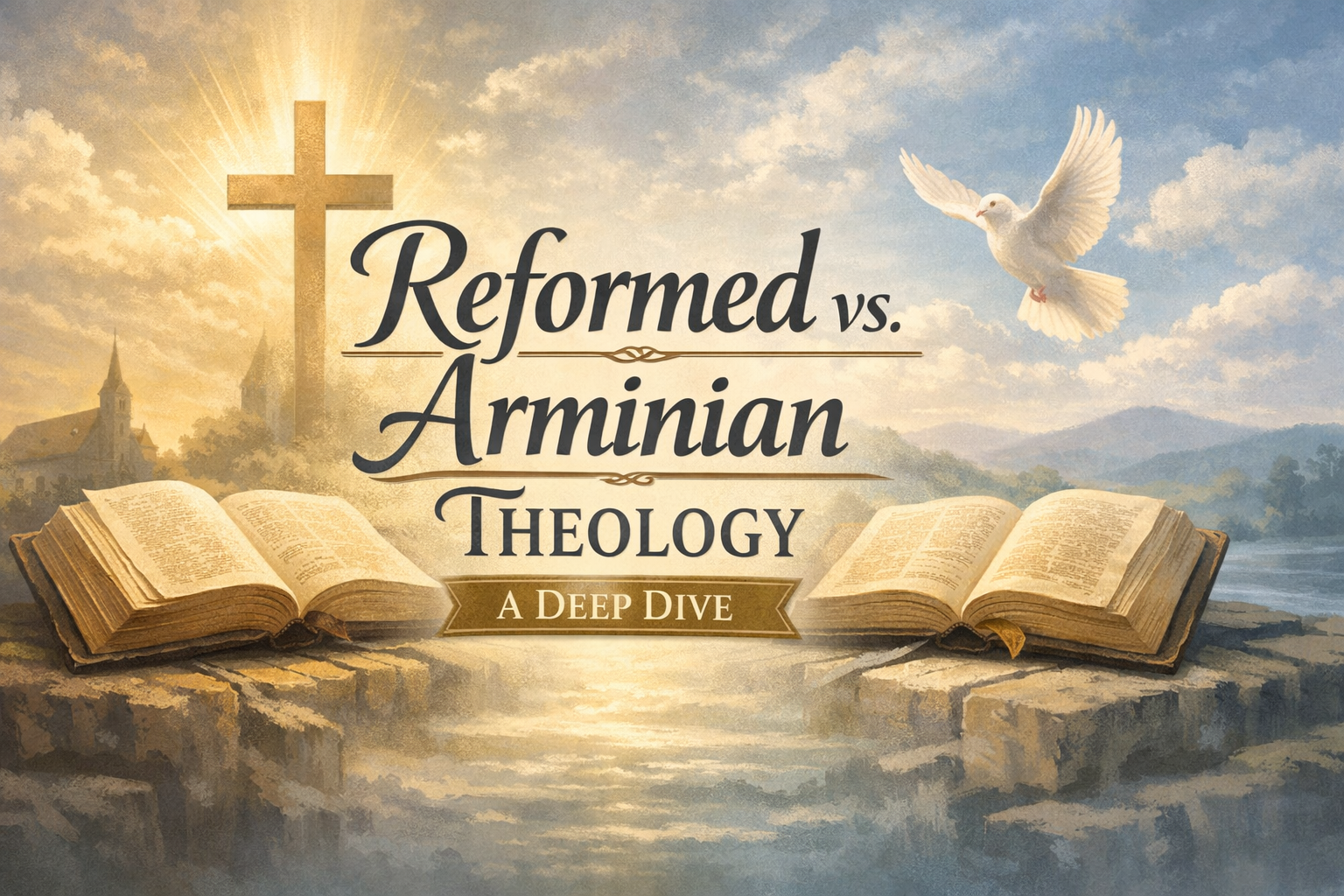
Reformed vs. Arminian Theology: A Deep Dive
Origins, Doctrines, Practical Implications, and the Common Ground That Unites Them
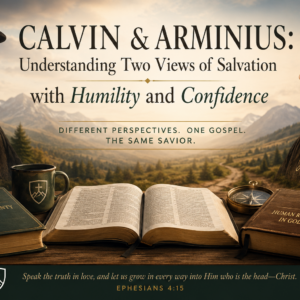
Reformed and Arminian theology represent the two major streams of Protestant thought on salvation, free will, God’s sovereignty, and human responsibility. Both affirm the Trinity, the authority of Scripture, and salvation through Jesus Christ alone. They differ — sometimes sharply — in how God saves, who He saves, and why.
This post puts both traditions in the same room and lets them speak for themselves — fairly, charitably, and clearly.
“Oh, the depth of the riches and wisdom and knowledge of God! How unsearchable are his judgments and how inscrutable his ways!” — Romans 11:33
Where Each Tradition Came From
⚓ Reformed Theology
Key figure: John Calvin (1509–1564)
Major work: Institutes of the Christian Religion
Confessions: Westminster, Belgic, Heidelberg Catechism
Historical moment: Codified at the Synod of Dort (1618–1619) in direct response to the Arminian challenge
Modern home: Presbyterian, Reformed Baptist, conservative Anglican churches
🕊️ Arminian Theology
Key figure: Jacobus Arminius (1560–1609)
Major statement: The Remonstrance (1610) — five points opposing Calvinist soteriology
Later development: John Wesley and the Methodist revival deepened and spread it
Modern home: Methodist, Wesleyan, Nazarene, Pentecostal, and many non-denominational churches
The Two Systems — TULIP and FACTS
Each tradition has a five-point summary that emerged from the same historical debate. TULIP was formulated at Dort as the Reformed response to the Arminian Remonstrance. FACTS is a modern Arminian counter-summary, showing the parallel structure of the two positions:
🌷 TULIP — Reformed
- T — Total Depravity: humanity is spiritually dead, incapable of turning to God unaided
- U — Unconditional Election: God chooses the elect based on His will alone, not foreseen faith
- L — Limited Atonement: Christ died specifically to secure salvation for the elect
- I — Irresistible Grace: God’s effectual call cannot ultimately be refused
- P — Perseverance of the Saints: the elect will endure in faith to the end
💫 FACTS — Arminian
- F — Freed by Grace: prevenient grace restores genuine freedom to respond
- A — Atonement for All: Christ died for every person without exception
- C — Conditional Election: God’s election is based on His foreknowledge of faith
- T — Total Depravity: humanity is fallen, but grace enables real response
- S — Security in Christ: salvation is real, but can be forfeited through persistent rejection
Five Key Doctrines — Side by Side
| Doctrine | Reformed View | Arminian View |
|---|---|---|
| Human Will | Bound by sin — cannot choose God without regeneration first | Freed by prevenient grace to genuinely respond |
| Election | Unconditional — based on God’s sovereign choice alone | Conditional — based on God’s foreknowledge of faith |
| Atonement | Particular — effectually secures salvation for the elect | Universal — genuinely sufficient and available for all |
| Grace | Irresistible — transforms the will; the elect come willingly | Resistible — genuinely offered, genuinely refusable |
| Perseverance | Guaranteed — those God saves He keeps | Conditional — requires continuing in faith and obedience |
What Scripture Each Side Emphasizes
⚓ Reformed Emphasis
- Romans 8:29–30 — “Those whom He predestined… He also glorified”
- John 6:37, 44 — “All that the Father gives Me will come to Me”
- Ephesians 1:4–5 — “Chosen in Him before the foundation of the world”
- Romans 9:11–16 — Election not of works but of Him who calls
🕊️ Arminian Emphasis
- 1 Timothy 2:3–4 — “God desires all people to be saved”
- 2 Peter 3:9 — “Not wishing that any should perish”
- John 3:16 — “Whoever believes” — universal scope
- Hebrews 6:4–6 — Warning against falling away after genuine faith
Three Core Tensions — Honestly Stated
⚖️ Sovereignty vs. Responsibility
Reformed theology leans hard on God’s absolute sovereignty — every event, including salvation, unfolds according to His eternal decree. Human choices are real, but they are encompassed within His sovereign plan.
Arminian theology leans equally hard on genuine human responsibility — God’s sovereignty is real, but it does not override the freedom He created. He can accomplish His purposes while allowing real resistance.
Both sides read the same Scripture. The tension is genuine, and neither tradition has fully dissolved it.
❤️ God’s Love and Justice
Reformed: God’s love is freely exercised in electing some — not owed to any — while His justice is satisfied in the condemnation of others. Election is mercy; it is never injustice.
Arminian: God’s love is universal in character — He genuinely desires all to be saved (2 Peter 3:9). A justice that gives no real opportunity is difficult to reconcile with the character of God revealed in Scripture.
🛡️ Assurance and Holiness
Reformed: The security of salvation produces grateful, obedient living. Knowing God’s grip is unbreakable frees the believer from performance anxiety.
Arminian: The call to abide and persevere motivates seriousness about holy living. Assurance is real — but it rests on continuing in Christ, not on a past decision alone.
Two Illustrations Worth Keeping
🪑 Reformed — The Chair
God builds the chair and seats you in it. You did not choose to sit — He placed you there by grace, and the chair holds you by His power. Your comfort and security rest entirely in what He has done, not in anything you maintain.
🚪 Arminian — The Door
Jesus opens the door wide and extends a genuine invitation to everyone. The grace that opens the door is entirely His. But you must choose to walk through — and having entered, you must abide inside rather than walking back out. The invitation is real. The response is real. Both matter.
How Each View Shapes Christian Living
| Area | Reformed Emphasis | Arminian Emphasis |
|---|---|---|
| Worship | Awe at God’s sovereign, unconditional grace — I was chosen; I did nothing to deserve it | Gratitude for God’s universal, pursuing love — He reached out to all, and I responded |
| Evangelism | God’s means of reaching His elect — preach boldly; trust God to call His own | Urgently necessary — every person has a real choice; every presentation matters |
| Sanctification | Trust in God’s preserving power — He finishes what He starts (Philippians 1:6) | Daily reliance on grace to persevere — abide in Christ, walk in obedience |
| Suffering | Nothing is outside God’s sovereign plan — He is working all things for good | God is present and working — our response in suffering is a real spiritual choice |
Five Voices — Two Traditions
John Calvin
Reformed
“God’s election is not based on foreseen faith but on His good pleasure and sovereign mercy.”
Jacobus Arminius
Arminian
“God does not decree who will believe, but foresees who will — and elects accordingly.”
R.C. Sproul
Reformed
“If there is one maverick molecule in the universe, then God is not sovereign.”
John Wesley
Wesleyan Arminian
“All may be saved. All may know they are saved. All may be saved to the uttermost.”
Roger Olson
Arminian
“God’s love is the center of Arminian theology. It is universal, not selective. Grace is not opposed to effort — grace is opposed to earning.”
What Both Traditions Share
- The Trinity — Father, Son, and Holy Spirit; the same God, equally affirmed by both
- The authority of Scripture — God’s Word is the final standard, not tradition or experience
- Salvation through Christ alone — no other name, no other mediator, no other sacrifice
- Justification by faith — we are declared righteous before God through faith, not works
- The necessity of the new birth — regeneration is essential, not optional
- The mission of the Church — to make disciples of all nations, proclaiming the gospel
What divides these traditions is real and worth discussing carefully. What unites them — Christ crucified and risen — is far more fundamental. Churches from both traditions have produced faithful disciples, bold evangelists, and deep theologians. The debate over election and grace is a family argument between people who share the same Lord.
Whether you lean Reformed or Arminian, both views are sincere attempts to honor Scripture and the character of God. Calvinism emphasizes His ultimate control and glory. Arminianism emphasizes His universal love and our genuine responsibility. Both are working from the same book — and both, at their best, kneel before the same Christ.
Keep reading the Bible. Listen to wise teachers from both traditions. Ask the Holy Spirit for guidance. This isn’t just about choosing sides — it’s about knowing God better and making Him known.
“Oh, the depth of the riches and wisdom and knowledge of God! How unsearchable are his judgments and how inscrutable his ways!” — Romans 11:33
Key Scriptures: Romans 11:33 · Ephesians 1:4–5 · Romans 8:29–30; 9:11–16 · John 6:37, 44 · 1 Timothy 2:3–4 · 2 Peter 3:9 · John 3:16 · Hebrews 6:4–6 · Philippians 1:6 · Acts 13:48 · Matthew 23:37 · Titus 2:11
Want to Go Deeper?
This post is the comparative overview. MVM’s companion posts go deep into each tradition on its own terms:
- Reformed Doctrine — a full treatment of the Five Solas, TULIP, and the Reformed vision of the Christian life
- Arminian and Wesleyan Theology — prevenient grace, universal atonement, entire sanctification, and Wesley’s pastoral legacy
- How Salvation Works: Five Voices — Calvin, Wesley, Graham, MacArthur, and Keller each explain the gospel journey
- What Is Salvation? Ten Theologians — the broadest survey, from Augustine to N.T. Wright
- Subscribe to get new posts delivered straight to your inbox — gospel-rooted, plain-spoken truth for the week ahead.
“For from Him and through Him and to Him are all things. To Him be the glory forever. Amen.” — Romans 11:36
Mountain Veteran Ministries
Find Your Next Bearing
Every journey needs a direction. If you're wondering where to go from here, choose the path that best fits where you are today.
⚒️ I Want to Live Faithfully
Discover practical wisdom for following Christ in today's world.
→ Living as a Christian Today✝️ I Want to Understand the Gospel
Learn what salvation means and why Jesus came.
→ Understanding Salvation📖 I Want to Understand the Bible
Explore why Christians trust Scripture and how to read it well.
→ Understanding the Bible❓ I Still Have Questions
Explore thoughtful answers to some of Christianity's hardest questions.
→ Hard Questions