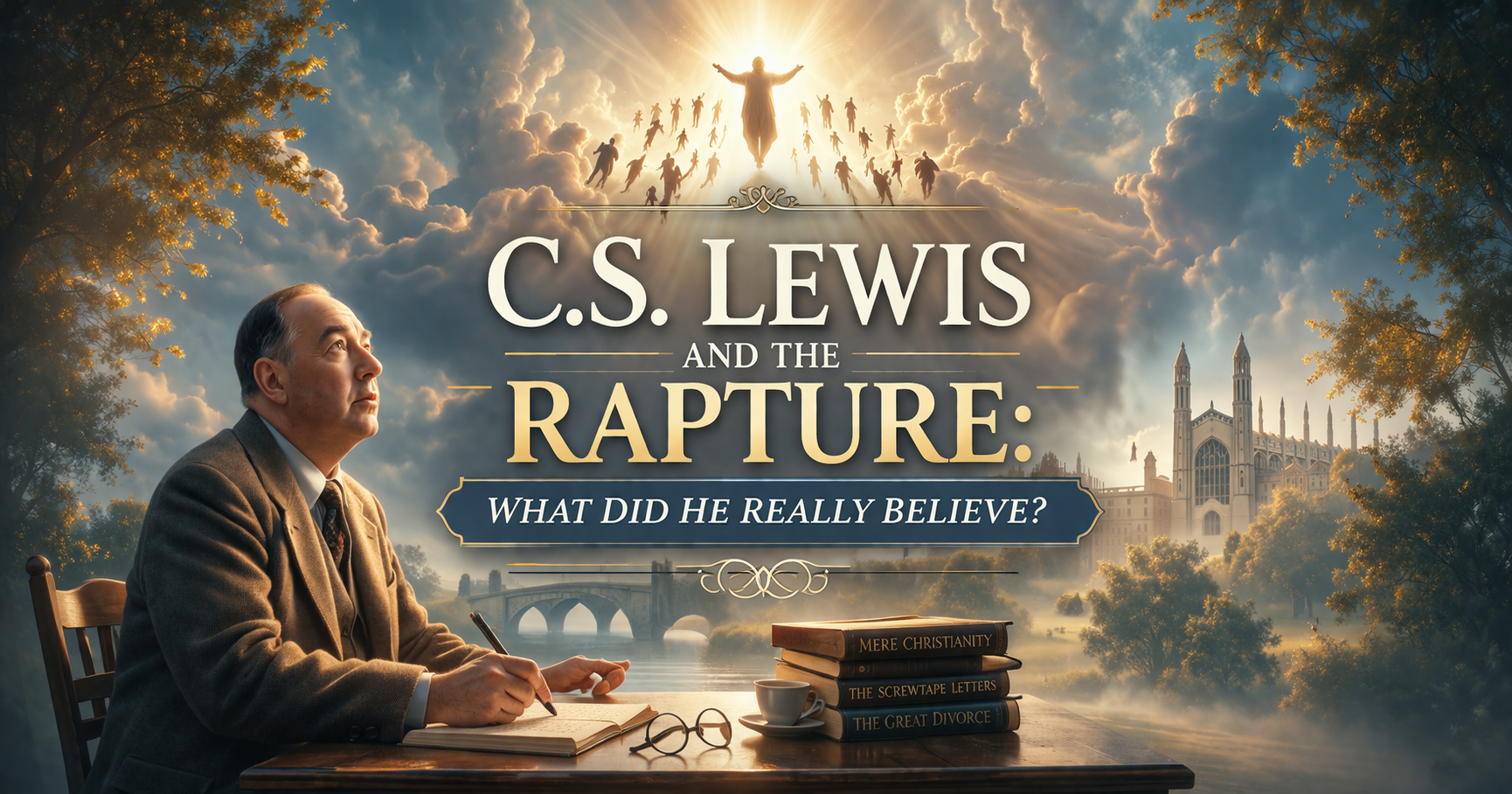
C.S. Lewis and the Rapture: What Did He Really Believe?
Did Lewis Believe in a Secret Rapture? What He Said About Christ’s Return, Judgment, and the End of All Things
C.S. Lewis is one of the most beloved Christian thinkers of the 20th century. Whether it’s Mere Christianity, The Problem of Pain, or The Chronicles of Narnia, his words continue to shape generations of believers. But in an age where end-times prophecy charts and rapture debates fill pulpits and bookshelves, many folks wonder:
What did C.S. Lewis actually believe about the Rapture and the end of the world?
The answer is more interesting — and more useful — than most people expect.
“When the Author walks onto the stage, the play is over.” — C.S. Lewis, The World’s Last Night
First — What Is the Rapture?
A Quick Definition
The Rapture — as commonly understood in evangelical and dispensational circles — refers to the sudden, secret return of Christ to remove believers from the earth before a period of Great Tribulation. This view includes a two-phase return of Christ (first secret, then visible), a seven-year Tribulation period, and a detailed prophetic timeline.
It’s important to note that this is a relatively recent development in church history. It emerged in the early 1800s with John Nelson Darby and the Plymouth Brethren, and spread widely through the Scofield Reference Bible and, much later, the Left Behind series. It was not the historic teaching of the Church — and it was not what Lewis grew up with or taught from.
What Lewis Actually Believed About Christ’s Return
Lewis never used the word “rapture” — but he absolutely, consistently affirmed the Second Coming of Jesus Christ as a central hope of the Christian faith. He just understood it very differently than the dispensational tradition.
The World’s Last Night (1960)
On Certainty and Mystery
For Lewis, the return of Christ is certain — but mysterious. Not something to graph out or schedule. Not something to decode through current events. Something to be ready for. His concern was not the when, but the who we are when it happens.
The World’s Last Night (1960)
On Judgment and Hope Together
Lewis refused to separate these two realities. The return of Christ is simultaneously the fulfillment of all hope and the moment of ultimate accountability. Any teaching that emphasizes escape without judgment — or judgment without hope — has, in his view, missed the point entirely.
The Problem of Pain (1940)
On Suffering — No Escape Hatch
This does not sound like a man expecting a supernatural evacuation plan. Lewis emphasized sanctification through trial, not escape from it. He believed tribulation is a normal — even necessary — part of the Christian life, not a problem to be solved by a pre-tribulation rapture.
Lewis vs. Dispensational Rapture Theology
| Theme | 🦁 C.S. Lewis | 📊 Dispensational Rapture View |
|---|---|---|
| Christ’s Return | Literal, glorious, unexpected — one event | Literal, split into two stages (rapture then visible return) |
| The Rapture | Not taught or supported | Central to the prophetic timeline |
| Tribulation | Christians suffer with the world — it’s normal | Christians are removed before tribulation begins |
| Timing Focus | Watchfulness and spiritual readiness | Detailed prophetic timelines and chart-reading |
| Suffering | Refines and sanctifies the believer | Something believers escape through the rapture |
| What Matters Most | Who you are when He comes | When and in what sequence events unfold |
The Scriptures Lewis Emphasized
Matthew 24:36
“No one knows the day or the hour, not even the angels in heaven, nor the Son, but only the Father.”
Lewis cited this verse consistently to warn against date-setting, timeline obsession, and prophetic sensationalism.1 Thessalonians 5:2
“The day of the Lord will come like a thief in the night.”
Lewis pointed to the unpredictability and moral urgency of the return — not its datable sequence.Revelation 21:1–5
“Then I saw a new heaven and a new earth, for the first heaven and the first earth had passed away…”
This theme of consummation — not evacuation — shows up most powerfully in The Last Battle.The Door to Narnia — Lewis’s Picture of the End
🦁 The Last Battle (1956) — Lewis’s Apocalypse
In the final Narnia story, the door to Narnia closes as stars fall from the sky — unmistakably apocalyptic imagery. The children don’t escape ahead of the trouble. They walk through the door not because they were “raptured,” but because they knew the True King.
Lewis uses Aslan to remind readers that the end of the world isn’t primarily about fear or escape — it’s about faith and recognition. When the old creation ends, a new one opens:
“Further up and further in!” — the joyful cry as the company races into the new creation.
And then the most famous line in the series:
“The term is over: the holidays have begun. The dream is ended: this is the morning.”
This is not escapism — it is consummation. Not rapture, but reunion. Not escape from the world, but the world finally becoming what it was always meant to be.
Why Lewis Avoided the Rapture Debate
Lewis lived in England in the mid-20th century. The pretribulational rapture debate was largely confined to American evangelical and fundamentalist circles and had not yet exploded into mainstream Christian culture. But beyond that context, there are deeper reasons Lewis kept his distance from this kind of prophetic speculation:
- He disliked theological fads and speculative systems
- He was committed to mere Christianity — the historic, creedal faith shared across traditions
- He emphasized ethics and spiritual transformation over prophetic decoding
- He saw date-setting and timeline obsession as spiritually dangerous distractions
“The job of the Church is to draw people into Christ, not to wrangle over what may happen at the end.” — C.S. Lewis, Mere Christianity
He didn’t ignore the end — he kept it in perspective. The Second Coming was a central Christian hope, not a puzzle to solve.
Four Lessons from Lewis on the End Times
Don’t Obsess Over Timelines
Lewis would say: Stop trying to figure out “when” and focus on “how you’re living.” The question Christ’s return should raise is not “what year?” but “am I ready?”
Be Ready Today
His call is clear: live as though Jesus could return this very hour — not in fear, but in faith. “At any moment there may break upon the world something totally unanticipated.”
Grow in Christlike Character
Suffering, hardship, and tribulation may come — but they are instruments of sanctification, not problems to escape. The Christian life was never supposed to be comfortable or safe.
Return to Historic Hope
Lewis invites us to reclaim the ancient hope of the Church — the same one confessed in every creed for two thousand years: “Christ has died. Christ is risen. Christ will come again.” That’s enough.
C.S. Lewis reminds us that the end of the world is not about escape — it’s about encounter. Not about timelines, but transformation. Not about being whisked away, but about being found faithful when the King appears.
Rather than watching the sky for signs, Lewis would have us watch our hearts for pride, indifference, and distraction. Because whether Christ comes today or a thousand years from now, what matters most is knowing Him when He does.
The play is nearly over. The Author is about to walk onto the stage. Are you living like someone who knows that?
“The term is over: the holidays have begun. The dream is ended: this is the morning.” — C.S. Lewis, The Last Battle
Key Scriptures: Matthew 24:36, 44 · 1 Thessalonians 4:16–17; 5:2 · Revelation 21:1–5; 22:20 · 2 Peter 3:9–11 · Acts 1:11 · 1 John 3:2–3
Want to Go Deeper?
This post is part of an ongoing series on eschatology and how different Christian thinkers have understood the end times. If Lewis’s approach stirred something in you, here are a few next steps:
- Read Lewis directly — The World’s Last Night and Other Essays is the most focused treatment of his eschatology; The Last Battle is the most beautiful imaginative picture of it.
- Read the companion posts — MVM’s post on David Jeremiah’s Revelation theology presents the dispensational premillennial view in detail, giving the full contrast with Lewis’s historic approach.
- Read George Eldon Ladd’s The Blessed Hope — A scholarly evangelical treatment of the Second Coming that, like Lewis, critiques the pretribulational rapture from within the orthodox tradition.
- Subscribe to get new posts delivered straight to your inbox — gospel-rooted, plain-spoken truth for the week ahead.
“Even so, come, Lord Jesus.” — Revelation 22:20
Mountain Veteran Ministries
Find Your Next Bearing
Every journey needs a direction. If you're wondering where to go from here, choose the path that best fits where you are today.
⚒️ I Want to Live Faithfully
Discover practical wisdom for following Christ in today's world.
→ Living as a Christian Today✝️ I Want to Understand the Gospel
Learn what salvation means and why Jesus came.
→ Understanding Salvation📖 I Want to Understand the Bible
Explore why Christians trust Scripture and how to read it well.
→ Understanding the Bible❓ I Still Have Questions
Explore thoughtful answers to some of Christianity's hardest questions.
→ Hard Questions