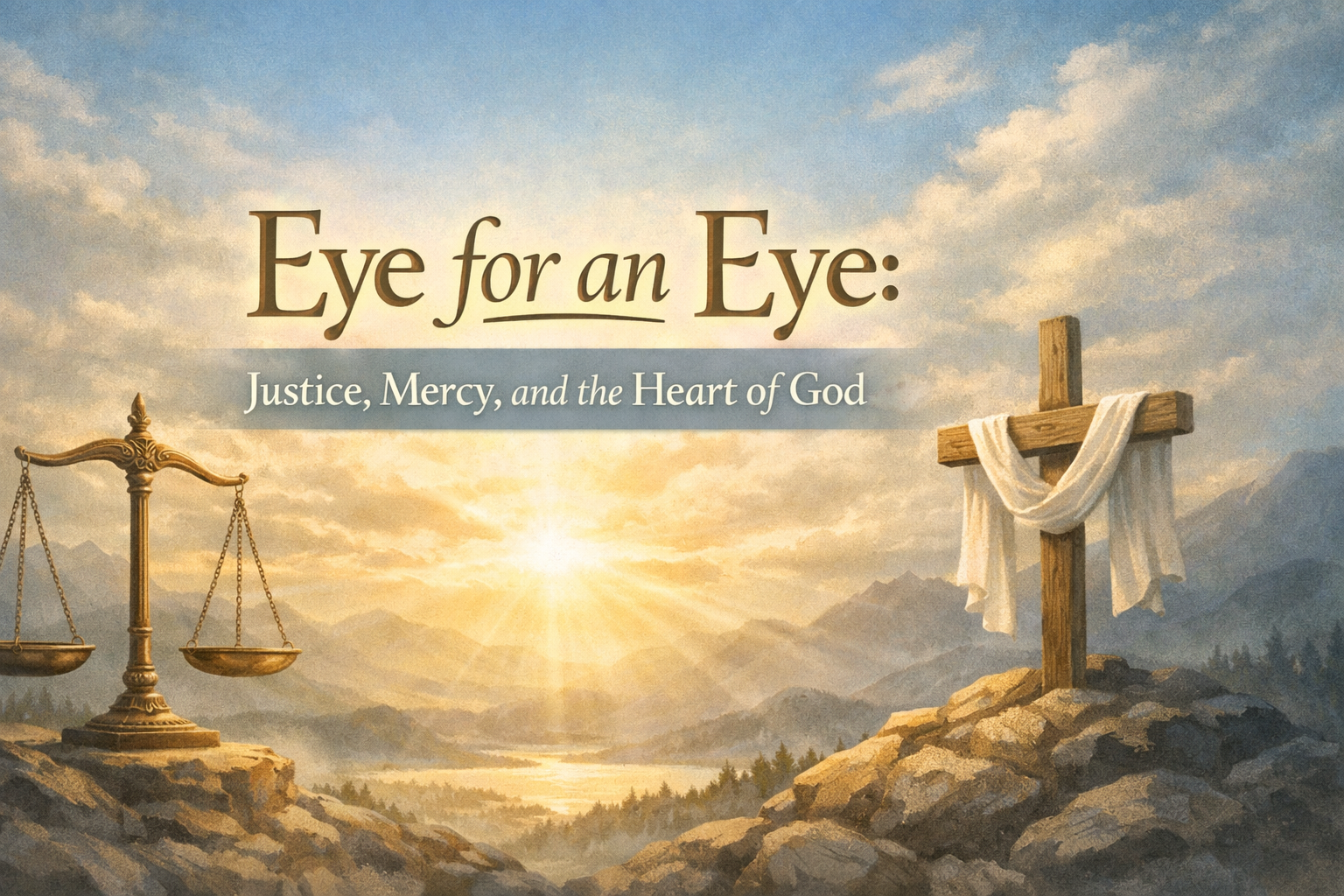
Eye for an Eye: Justice, Mercy, and the Heart of God
From Proportional Justice to Kingdom Mercy — What These Two Teachings Actually Mean
“Eye for an eye” is one of those Bible phrases that everyone seems to know — even people who have never opened a Bible. It’s tossed around in conversation to justify payback or hard justice. But is that what God meant when He gave this command? Is it really about vengeance — or is there more beneath the surface?
Let’s look at what Scripture actually teaches about this principle, how Jesus reinterpreted it, and what it means for how we live today.
“Do not be overcome by evil, but overcome evil with good.” — Romans 12:21 (ESV)
Part One — The Old Testament Foundation
The Origin and Intent of “Eye for an Eye”
The phrase appears three times in the Old Testament — each time in the context of Israel’s legal code, not personal ethics:
Exodus 21:23–25
“But if there is harm, then you shall pay life for life, eye for eye, tooth for tooth, hand for hand, foot for foot…”
Leviticus 24:19–20
“If anyone injures his neighbor, whatever he has done must be done to him: fracture for fracture, eye for eye, tooth for tooth.”
Deuteronomy 19:21
“Your eye shall not pity. It shall be life for life, eye for eye, tooth for tooth, hand for hand, foot for foot.”
These passages belong to Israel’s civil and legal code — the Mosaic Law governing how justice was to be administered among the people. The principle is called Lex Talionis, Latin for “law of retaliation.” At first glance it sounds brutal. In its original context, it was actually a law of mercy.
Key insight: In the ancient Near East, tribal vengeance was the norm. Someone broke your arm — you burned down their village. The “eye for an eye” principle was designed to limit punishment, not maximize it. One eye for one eye. No more. The law restrained the spiral of escalating violence.
Crucially, this law was directed at judges, not individuals. It was part of a structured judicial process — not a license for personal revenge. God’s intent was to enforce proportional justice, prevent blood feuds, and protect the vulnerable from over-punishment.
Part Two — Jesus Raises the Standard
Correcting the Misuse
By Jesus’s time, many teachers had twisted the law into an excuse for personal payback. People were taking matters into their own hands rather than letting judges administer proportional justice. That’s precisely what Jesus addressed in the Sermon on the Mount.
“You have heard that it was said, ‘An eye for an eye and a tooth for a tooth.’ But I tell you, do not resist an evil person. If anyone slaps you on the right cheek, turn to them the other cheek also.” — Matthew 5:38–39 (NIV)
Jesus isn’t contradicting the Old Testament. He’s clarifying its true spirit and calling His followers to a higher ethic — the ethic of the Kingdom. He does this throughout Matthew 5 with the repeated pattern: “You have heard it said… but I say to you.” In each case, He moves from the external rule to the internal condition, from law to heart.
What “Turn the Other Cheek” Actually Means
This is not a command to be passive in the face of all evil or to never confront wrongdoing. It’s a command to refuse personal revenge. Turning the other cheek is strength under control — the patience of God modeled in human behavior. Jesus is calling His people to respond with peace, humility, and trust in God’s justice rather than taking vengeance into their own hands.
📜 Old Testament Principle
Lex Talionis — proportional justice for a newly formed nation. A civil legal limit on punishment, administered by judges. A mercy law in its original context.
Purpose: Limit punishment. Prevent escalation. Protect the vulnerable.
✝️ Kingdom Standard
Jesus calls His followers beyond retribution — to a grace that absorbs wrong without seeking personal revenge. Justice remains valid; personal vengeance is surrendered to God.
Purpose: Reflect God’s character. Trust God for justice. Break the cycle.
Part Three — What It Means for Us Today
Application One
In Personal Relationships
“Eye for an eye” was never meant to govern our personal lives. In day-to-day interactions — family conflict, workplace betrayal, church disagreements, political debates — Jesus is clear: personal revenge has no place among His followers.
Application Two
In Government and Law
While Christians individually may forgive, society still needs systems of justice. Paul explicitly affirms that civil government has a legitimate role in administering punishment — and that Christians should support it.
Forgiveness and justice are not opposites — they operate in different spheres. Justice belongs to God and rightful civil authorities. Forgiveness is our personal calling.
Application Three
In the Church Community
Within the body of Christ, disputes should be handled with grace, not grudge. Paul sets a high bar for how Christians handle conflict with one another.
Rather than dragging fellow believers to court or nursing bitterness, Christians are called to model the gospel reconciliation they have received.
Three Illustrations
The Playground
A child hits another on the playground. The second child hits harder. A teacher steps in.
Justice says: “You both stop.” Revenge says: “He hit me first.” Grace says: “Let’s make peace.”
Without a limit on retaliation, a playground becomes a war zone. The law of proportional justice exists to prevent exactly that. The gospel goes further — it invites us to make peace.
The Farmer’s Fence
A farmer’s neighbor lets his cattle break through the fence and trample the corn. The farmer is furious. He considers destroying the neighbor’s well in retaliation. Instead, he talks it out calmly. The neighbor apologizes and offers compensation.
That’s the difference between “eye for an eye” justice and Kingdom mercy. One leads to a feud that poisons the land for years. The other leads to peace — and a repaired fence.
Jesus at the Cross
The clearest example of this principle in action is Jesus Himself. He had every right to call down judgment — but He didn’t.
At the cross, Jesus absorbed the world’s injustice and returned grace. He is the ultimate model of “turn the other cheek” — not as weakness, but as sovereign, purposeful love.
Misunderstandings — Clarified
❓ “Doesn’t ‘eye for an eye’ justify personal revenge?”
No — and this is the most common misreading. The law was given to judges administering a civil system. It was never a personal code of ethics. It was a mercy law, not a revenge law. Jesus confirms this by pointing the behavior of His followers in a different direction entirely.
❓ “If we always forgive, what about justice?”
Forgiveness and justice are not opposites — they’re partners operating in different spheres. You can forgive someone personally while still supporting appropriate legal consequences for their actions. Micah 6:8 holds both together: “Act justly, love mercy, and walk humbly with your God.”
❓ “Doesn’t ‘turn the other cheek’ mean accepting abuse?”
No. Turning the other cheek means refusing personal revenge — not passive acceptance of all wrongdoing. There is a time to report crime, seek help, and confront wrongdoing in love. What the command rules out is hatred, vendetta, and repaying evil with evil.
How to Respond When Wronged
- 1Pause and pray. Ask God for patience and perspective before reacting. Most regrettable responses happen in the first sixty seconds.
- 2Forgive first. Even when justice must follow. Forgiveness releases you from carrying what belongs to God.
- 3Speak truth in love. Confront wrongdoing when necessary — but with kindness as the posture, not retaliation as the motive.
- 4Leave vengeance to God. “Vengeance is mine, I will repay, says the Lord” (Romans 12:19). Trust Him to settle accounts.
Voices Worth Hearing
- John Stott: “To repay evil for evil is natural. To repay good for evil is divine.”
- Martin Luther King Jr.: “The old law of an eye for an eye leaves everybody blind.”
- C.S. Lewis: “To be a Christian means to forgive the inexcusable, because God has forgiven the inexcusable in you.”
“Eye for an eye” was meant to curb human cruelty, not encourage it. It taught ancient Israel how to build a society based on fairness and restraint — limiting the spiral of vengeance before it could consume everything.
But Jesus calls His followers to a higher road, paved with mercy, forgiveness, and humility. Not because justice doesn’t matter — it does, and God will see to it. But because His people are called to reflect His character, not the world’s reflexes.
In a world shouting for revenge, Jesus says: “Turn the other cheek.” That is not weakness. It is the power of a transformed heart that trusts God for justice and extends grace to the undeserving — exactly as we ourselves have received it.
“Do not be overcome by evil, but overcome evil with good.” — Romans 12:21 (ESV)
Key Scriptures: Exodus 21:23–25 · Leviticus 24:19–20 · Deuteronomy 19:21 · Matthew 5:38–39 · Romans 12:17–21 · Romans 13:4 · 1 Corinthians 6:7 · 1 Peter 2:23 · Micah 6:8 · John 8:7
Want to Go Deeper?
This post is part of an ongoing series on what the Bible actually teaches — in context, without the common misreadings. If it helped clarify something you’ve wondered about, here are a few next steps:
- Share it with someone who’s quoted “eye for an eye” to justify personal revenge — this post is a gentle, honest corrective for that conversation.
- Read Matthew 5–7 slowly — the Sermon on the Mount, where Jesus works through the Old Testament law and shows its true, inward meaning. It’s the clearest picture of Kingdom ethics in the New Testament.
- Subscribe to get new posts delivered straight to your inbox — gospel-rooted, plain-spoken truth for the week ahead.
“Blessed are the merciful, for they shall receive mercy.” — Matthew 5:7
Mountain Veteran Ministries
Find Your Next Bearing
Every journey needs a direction. If you're wondering where to go from here, choose the path that best fits where you are today.
⚒️ I Want to Live Faithfully
Discover practical wisdom for following Christ in today's world.
→ Living as a Christian Today✝️ I Want to Understand the Gospel
Learn what salvation means and why Jesus came.
→ Understanding Salvation📖 I Want to Understand the Bible
Explore why Christians trust Scripture and how to read it well.
→ Understanding the Bible❓ I Still Have Questions
Explore thoughtful answers to some of Christianity's hardest questions.
→ Hard Questions