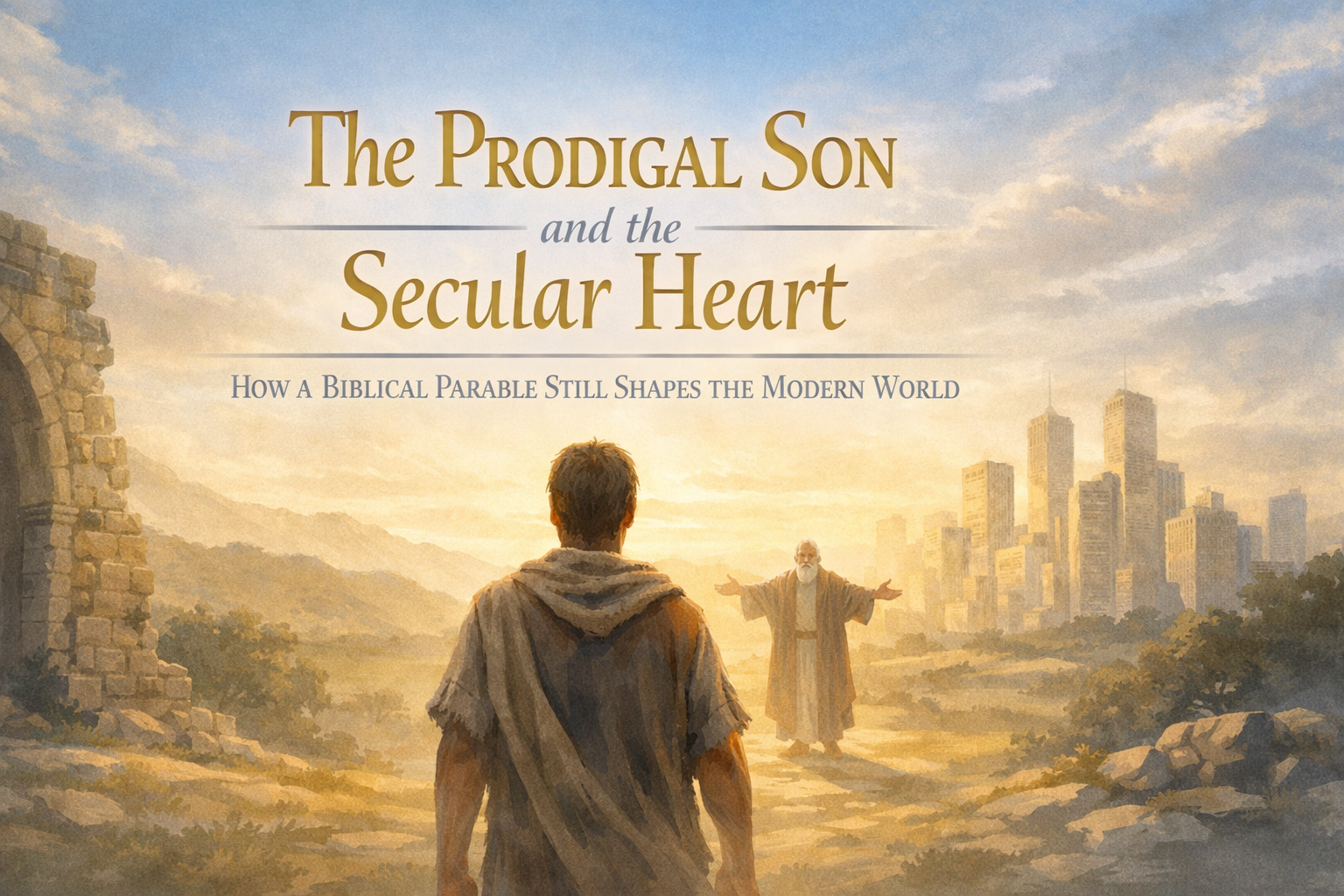
The Prodigal Son and the Secular Heart: How a Biblical Parable Still Shapes the Modern World
How a Story Told 2,000 Years Ago Still Shapes Our Films, Therapy Offices, Courtrooms, and Broken Families
Even in a world where the Bible may no longer occupy a central place in public life, some stories have such timeless power that they continue to shape the soul of society — whether people recognize their origin or not. The Parable of the Prodigal Son, told by Jesus and recorded in Luke 15:11–32, is one of those stories.
Though it was spoken two thousand years ago in a small corner of the Roman Empire, the parable continues to ripple through modern secular culture in surprising ways — from courtroom reforms to pop culture, from therapy offices to family reunions. Its themes of grace, rebellion, forgiveness, and restoration echo in hearts that have never opened a Bible.
“But while he was still a long way off, his father saw him and was filled with compassion for him; he ran to his son, threw his arms around him and kissed him.” — Luke 15:20 (NIV)
The Story in a Nutshell
Luke 15:11–32
A man has two sons. The younger asks for his inheritance early — essentially wishing his father dead — then leaves home and squanders everything in wild living. When famine strikes, he ends up feeding pigs and longing for their food. Broken and humbled, he turns home expecting rejection and instead receives open arms, a robe, a ring, and a feast.
But the story doesn’t end there. The older brother — who stayed and played by the rules — resents the celebration. “I’ve slaved for you,” he says, “and you never threw me a party!” The father responds with tender honesty: “You are always with me, and everything I have is yours. But we had to celebrate, because this brother of yours was dead and is alive again.”
With this short story, Jesus reveals the heart of God — and in doing so, reveals something about the human condition that transcends time, culture, and religious boundaries.
Ten Ways This Story Still Speaks
Theme One
🎬 Redemption in Pop Culture
You don’t have to be a Bible reader to know the Prodigal’s story. Its core arc — fall, repentance, forgiveness, restoration — has found its way into some of the most beloved stories of our time.
Good Will Hunting
A rebellious young man finally allows himself to be loved despite his brokenness — and someone is waiting for him.
Les Misérables
Jean Valjean is transformed by mercy rather than law. The bishop’s grace rewrites his entire story.
The Lion King
Simba runs from responsibility and guilt, wanders for years, and eventually returns home to take his place.
Even music without religious affiliation reflects this theme. Johnny Cash’s Hurt: “What have I become, my sweetest friend?” U2’s I Still Haven’t Found What I’m Looking For. These songs resonate because the soul’s hunger for home is real — and this parable named it first.
Theme Two
🎁 Grace Over Judgment — a Counter-Cultural Idea
Secular society, especially in the digital age, leans toward performance-based value. You’re as good as your résumé, your follower count, your past. The father in the parable throws all that out the window. The robe, the ring, and the feast weren’t earned — they were gifts.
Cancel culture, social media shaming, and political tribalism all say: “You messed up, so you’re out.” The parable says: “You messed up — and you’re still loved.”
Theme Three
🔓 The Cost of Radical Individualism
The younger son’s decision mirrors the spirit of modern Western individualism: “I want my truth, my way, my freedom.” That same spirit drives consumerism, the hookup culture, and the pursuit of personal identity detached from tradition, community, or faith. But what does it yield?
The Prodigal ends up in a pigsty. And many modern prodigals — burned out, addicted, isolated, disillusioned — find themselves in metaphorical pigsties of their own making.
The story calls out the lie that freedom without responsibility leads to joy. It shows that self-rule without wisdom leads not to life, but to hunger.
When Jesus says “He came to himself,” that moment — where pride gives way to honesty — is something many secular people experience in their own language:
- “I hit rock bottom.”
- “I lost myself.”
- “I finally woke up.”
They may not quote Luke 15. But they’re living it.
Theme Four
🏠 A Home to Come Back To
In a society where so many feel disconnected — estranged from their families, their traditions, their communities — the parable offers a powerful image: there is always a place to return to. The door is not locked. The father is not gone.
Modern therapy uses phrases like “reparenting,” “creating safe space,” and “inner child work.” These concepts often point back to the deep longing for the father’s embrace — the need to be seen, forgiven, and restored without earning it first.
Theme Five
🧠 The Psychology of the Parable
Modern psychology has affirmed what Jesus knew all along: shame isolates, but compassion heals. The younger son returns rehearsing a speech of unworthiness. The father interrupts him — not with lectures but with love. This response re-wires the son’s identity before he can finish his prepared apology.
That mirrors what happens in trauma recovery. Counselors are now trained to respond with attunement and acceptance, knowing that transformation starts with safety, not scolding. In secular therapeutic circles: “The wound is healed not by judgment but by connection.”
Jesus taught that in a field in Galilee. It took therapy another two thousand years to rediscover it.
Theme Six
🤝 Reconciliation Beyond Religion
The parable speaks to every fractured relationship — not just between people and God, but between fathers and sons, mothers and daughters, siblings, spouses, and friends. Family estrangement is rising. Divides over politics, lifestyle, and values split households and communities. The parable shows a different way.
- The father doesn’t demand an apology before running.
- He doesn’t list the son’s sins before embracing him.
- He simply sees him and goes.
Imagine if more families, neighborhoods, and nations operated like the father rather than the older brother.
Theme Seven
😤 The Older Brother Still Lives
While many modern people relate to the younger son’s wandering, secular culture is also full of older brothers — people who’ve played by the rules and resent those who “get off easy.” It shows up in politics, in moral posturing, in online discourse that cannot tolerate a comeback story.
In many ways, cancel culture is the voice of the older brother: “You broke the code. You don’t deserve forgiveness.”
Theme Eight
⚖️ Echoes in Justice and Law
Movements like restorative justice, prison reform, and re-entry programs for former inmates operate on a theology of return — even when they don’t call it that. The person who made mistakes is not beyond redemption. The goal is not mere punishment but restoration.
Even secular courts increasingly consider mental health, addiction, and trauma as mitigating factors — not to excuse wrongdoing, but to invite healing. Society is slowly rediscovering what the parable teaches plainly: mercy changes people more than shame ever could.
Theme Nine
🌅 The Quiet Witness of Grace
Even as secular society moves away from traditional Christianity, the values embedded in this parable continue to exert influence. When someone advocates for second chances, loves the unlovable, celebrates a comeback story, or chooses mercy over revenge — they are reflecting the father’s heart. Whether they’ve ever heard the Gospel or not.
The parable’s reach extends far beyond the church. That’s not an accident. Jesus told this story for everyone in the crowd — including the Pharisees who were scowling at the back.
Theme Ten
🪞 A Mirror for Every Heart
The beauty of the Prodigal Son is that it refuses to let you be a spectator. It forces introspection. Who are you in the story?
The Younger Son
Ashamed and afraid to return — certain you’ve gone too far, that the door is locked, that you’ve used up your welcome.
The Older Son
Bitter and unwilling to forgive — convinced that grace for others is an injustice to you and your faithfulness.
The Father
Watching, aching to restore someone — but afraid the embrace will be rejected, or uncertain how to make the first move.
Secular culture — despite its noise — still asks these questions. And this parable provides answers no self-help book has managed to improve on.
What the Parable Offers
In a world bent on performance, punishment, and pride, this story brings something radical:
Grace without earning
The robe and ring arrived before the apology was finished.
Forgiveness without delay
The father ran while the son was still a long way off.
Celebration without condition
The feast wasn’t a reward for reform. It was a welcome home.
The Parable of the Prodigal Son isn’t just a religious tale. It’s a mirror to the soul. It shows us what happens when we run from home — and what happens when grace runs faster.
You don’t have to believe in God to feel the power of this story. But if you do, it changes everything. It turns a tale of human longing into a revelation of divine love.
So whether you’re in the pigsty, on the road home, or standing on the porch with your arms crossed — the invitation still stands.
Come home. The Father is watching. And He’s already running.
“But while he was still a long way off, his father saw him and was filled with compassion for him; he ran to his son, threw his arms around him and kissed him.” — Luke 15:20
Key Scriptures: Luke 15:11–32 · Luke 15:20 · Romans 5:8 · 2 Corinthians 5:18–19 · Ephesians 2:4–5 · 1 John 4:19 · Matthew 18:12–14
Want to Go Deeper?
This post is part of an ongoing series on the parables of Jesus. If it stirred something in you — or brought someone to mind — here are a few next steps:
- Share it with someone who is estranged from their family, wandering from faith, or who feels like they’ve gone too far to come back. This is the post for them.
- Read Luke 15 in one sitting — the Lost Sheep, the Lost Coin, and the Prodigal Son are three movements of the same song. Together they form one of the greatest chapters in all of Scripture.
- Subscribe to get new posts delivered straight to your inbox — gospel-rooted, plain-spoken truth for the week ahead.
“But God demonstrates his own love for us in this: While we were still sinners, Christ died for us.” — Romans 5:8
Mountain Veteran Ministries
Find Your Next Bearing
Every journey needs a direction. If you're wondering where to go from here, choose the path that best fits where you are today.
⚒️ I Want to Live Faithfully
Discover practical wisdom for following Christ in today's world.
→ Living as a Christian Today✝️ I Want to Understand the Gospel
Learn what salvation means and why Jesus came.
→ Understanding Salvation📖 I Want to Understand the Bible
Explore why Christians trust Scripture and how to read it well.
→ Understanding the Bible❓ I Still Have Questions
Explore thoughtful answers to some of Christianity's hardest questions.
→ Hard Questions