
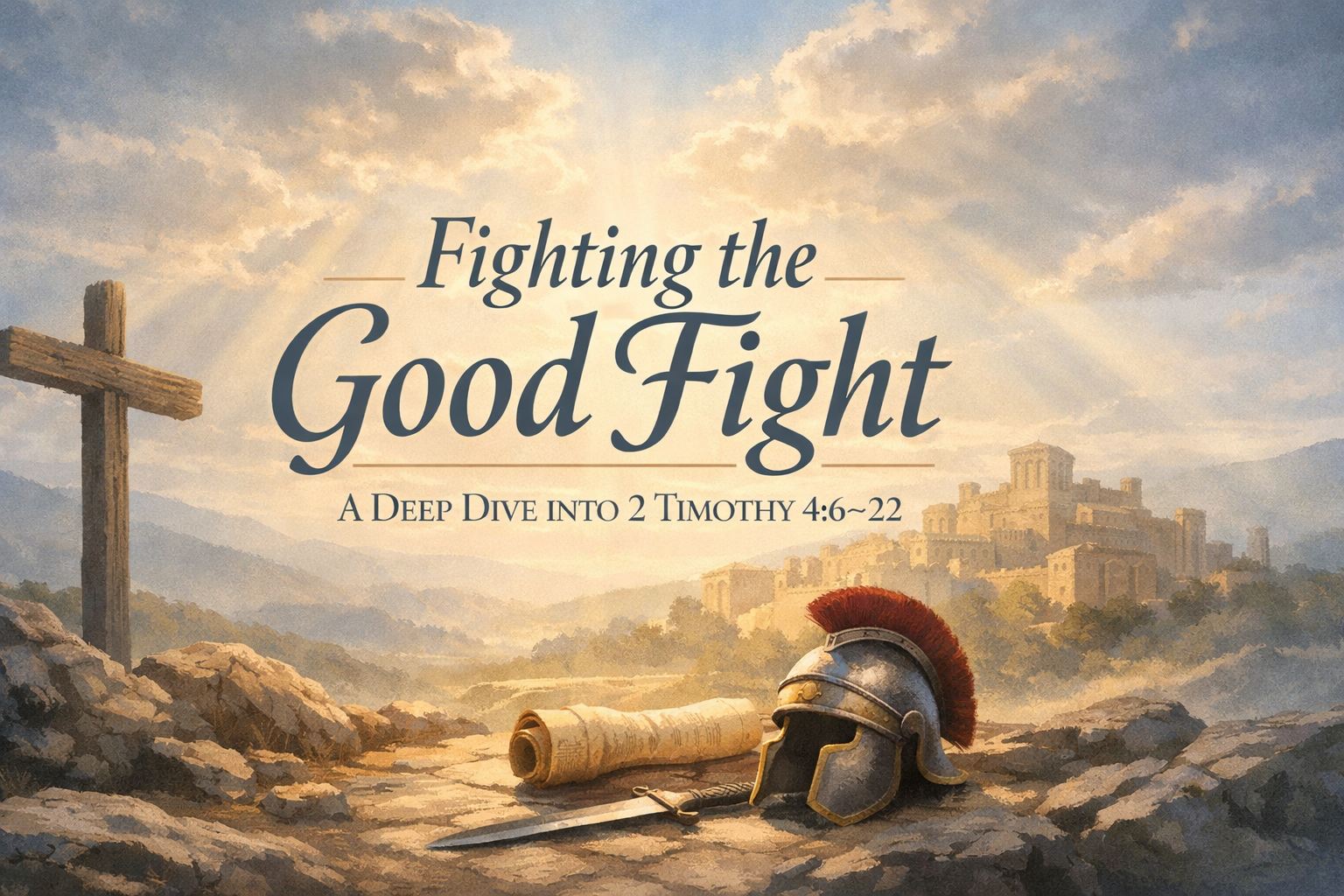
Fighting the Good Fight: A Deep Dive into 2 Timothy 4:6–22
Paul’s final letter from a Roman prison isn’t a farewell — it’s a blueprint. In 2 Timothy 4:6–22, the apostle who fought hard, finished strong, and kept the faith passes that charge on to every believer who comes after him. Here’s what it looks like to live — and finish — the Christian life well.
An Expository Study of 2 Timothy 4:6–22 — How to Live, and Finish, the Christian Life Well
When the Apostle Paul penned his final letter to Timothy, he was not sitting comfortably in a study or preaching in a vibrant church. He was in a cold Roman prison, chained and awaiting execution. Yet his words in 2 Timothy 4:6–22 are not dripping with despair — they are infused with hope, courage, and a clear sense of victory in Christ.
This passage is more than Paul’s farewell. It is a blueprint for believers on how to live — and finish — the Christian life well. Let’s walk through the text and draw out the truths that can guide us when the road is rough and the finish line feels far away.
“I have fought the good fight, I have finished the race, I have kept the faith.” — 2 Timothy 4:7 (ESV)
Part One: Paul’s Imminent Departure (2 Timothy 4:6–8)
Paul opens with two striking metaphors for his coming death. The first: a drink offering — a libation poured out as a final act of worship (Numbers 15:1–10). He sees his death as part of his spiritual service to Christ, not as a tragedy.
The second: a departure. The Greek word used here — analusis — was a nautical term for loosening a ship from its moorings so it could set sail. Paul sees death as a release, not an ending. The moorings are being cut. The voyage is beginning.
Then he looks back at his life with three short, powerful statements.
“I have fought the good fight.”
The Christian life isn’t a stroll — it’s a battle. Paul had faced beatings, shipwrecks, betrayal, and prison (2 Corinthians 11:23–28). He doesn’t regret a single scar.
“I have finished the race.”
He didn’t drop out halfway. He pressed on, like a runner determined to cross the line no matter how many miles are left.
“I have kept the faith.”
He guarded the gospel message faithfully and did not compromise — not even in a Roman courtroom facing execution.
Then Paul looks forward: “There is laid up for me the crown of righteousness.” In the ancient world, victors in athletic contests received a laurel wreath. Paul’s crown is far greater — God’s eternal approval and life in His presence. And verse 8 is careful to add: this crown is not just for Paul. It belongs to all who have loved His appearing.
The Farmer at Sunset
Picture a seasoned farmer nearing the end of his life. His hands are calloused from decades of labor. The barns are full, the fields well-tilled. As he sits on his porch at sunset, he doesn’t regret the long days or the hardships. He knows the work was worth it.
That’s Paul’s heart in these verses: a life poured out, satisfied in Christ, and confident in the reward to come.
Part Two: The Reality of Relationships and Ministry (2 Timothy 4:9–16)
Verses 9–13 · Loneliness and the Human Apostle
He Was Lonely — and He Said So
Paul’s plea to Timothy is deeply personal: “Do your best to come to me soon.” He is isolated. Many he once labored with have gone. He names Demas, who abandoned him because he “loved this present world.” This is a sobering reminder: not everyone who starts well finishes well. The pull of comfort, security, or worldly pleasure can cause people to walk away from the work.
He also asks for his cloak, his books, and his parchments. This isn’t trivial — it reminds us that even the greatest apostle felt the chill of Roman winters and still craved the nourishment of God’s Word. Holiness doesn’t exempt us from being human.
Demas
Deserted Paul, “in love with this present world.” A warning to all of us.
Luke
“Luke alone is with me.” The faithful physician and Gospel writer — the one who stayed.
Mark
Once abandoned Paul (Acts 15:37–39). Now Paul says, “He is very useful to me.” Restoration is real.
Timothy
“Do your best to come before winter.” The son in the faith, urgently summoned to the prison.
The Mark detail is worth pausing on. Paul and Barnabas had a sharp disagreement over Mark’s reliability after he left them on an earlier journey. Yet here, years later, Paul requests him specifically. Reconciliation and restoration are possible — even after public failure and painful rifts.
Part Three: Facing Opposition with Grace (2 Timothy 4:14–18)
Verses 14–18 · Alexander, the Courtroom, and the Lord Who Stood Near
When Friends Fail and Enemies Oppose
Paul mentions Alexander the coppersmith, warning Timothy of his hostility. But notice Paul’s posture: he doesn’t call for revenge. “The Lord will repay him according to his deeds.” He releases the matter to God rather than carrying it as a personal wound.
Then comes one of the most moving lines in all of Paul’s writing. At his first legal defense before Roman authorities, every single person deserted him. Not one stood beside him. And yet:
“But the Lord stood by me and strengthened me, so that through me the message might be fully proclaimed.” — 2 Timothy 4:17
Christ showed up in a Roman courtroom when every human ally had disappeared. And Paul’s confidence looking forward is not in earthly deliverance but in God’s ultimate rescue: “The Lord will rescue me from every evil deed and bring me safely into His heavenly kingdom.”
Part Four: Final Greetings and the Last Word (2 Timothy 4:19–22)
Paul closes with greetings to faithful believers — Priscilla and Aquila, longtime ministry partners; the household of Onesiphorus, who had searched Paul out in Rome and was not ashamed of his chains (2 Timothy 1:16–17). These names remind us that the Christian life is lived in community, not in isolation.
His very last words to Timothy are a blessing: “The Lord be with your spirit. Grace be with you.” For Paul, chained in a Roman prison awaiting death, the last word is always grace. Not circumstances. Not fear. Not legacy. Grace.
Five Lessons for Every Believer
Finish Well
Paul didn’t just start strong — he finished strong. In a world full of distractions and a church full of people who drift, we must keep our eyes on the eternal prize (Hebrews 12:1–2).
Are you running your race with perseverance, or have you grown weary and slowed to a walk?
Expect Opposition and Loneliness
Faithfulness to Christ will sometimes mean walking alone (John 15:18–20). Paul’s experience shows us that desertion is painful — and it’s not the end of the story. The Lord stood by him. He stands by us too.
Reconcile and Restore
Paul and Mark’s restored relationship demonstrates the power of grace across time. Failures don’t have to be permanent. Old rifts can be healed.
Who in your life needs reconciliation — and who needs you to extend the grace that was extended to you?
Depend on God’s Presence
Even if everyone else deserts us, the Lord stands by His people. Psalm 23:4: “Even though I walk through the valley of the shadow of death, I will fear no evil, for You are with me.” That promise doesn’t expire when the room empties out.
Keep an Eternal Perspective
Paul’s eyes were fixed not on the executioner’s sword but on the crown of righteousness. When life is hard and the finish line feels far, remember: God’s final reward is secure for those who love Him and persevere to the end.
The Seasoned Farmer
His hands are calloused from decades of work. His back aches from years of early mornings. The fields he planted are still being harvested by others. As the sun goes down on his last good day, he doesn’t count the hard seasons as losses. He counts them as the work.
That is Paul in a Roman prison, writing his last letter. Not bitter. Not afraid. Satisfied. Because a life poured out for Christ — even one that ends in chains — is a life that finishes well.
Paul’s story in 2 Timothy 4:6–22 is not just history — it’s an invitation. The “good fight” isn’t reserved for apostles and missionaries. It’s the daily life of every believer who seeks to be faithful in small things and large.
Run your race. Fight your fight. Keep the faith.
One day, the righteous Judge will place the victor’s crown on your head — and you will hear the words that make every hard mile worth it: “Well done, good and faithful servant.”
🙏 Closing Prayer
Father, thank You for the example of the Apostle Paul. Help us fight the good fight, finish the race, and keep the faith. Strengthen us when we feel alone, and remind us of the crown of righteousness You have promised. Teach us to forgive, to reconcile, and to rely fully on Your presence. May we finish well — by Your grace, for Your glory. In Jesus’ name, Amen.
Key Scriptures: 2 Timothy 4:6–22 · 2 Corinthians 11:23–28 · Philippians 1:6 · Hebrews 12:1–2 · Psalm 23:4 · John 15:18–20 · Matthew 25:23 · Acts 15:37–39 · 2 Timothy 1:16–17
Want to Go Deeper?
This post is part of an ongoing series working through key passages of Scripture. If Paul’s final words from prison stirred something in you, here are a few next steps:
- Share it with someone who is weary in their walk with Christ, or who feels like the fight isn’t worth finishing — this is exactly the post for that conversation.
- Read 2 Timothy straight through in one sitting — it takes about 20 minutes. Knowing Paul’s whole final letter makes chapter 4 even more powerful.
- Subscribe to get new posts delivered straight to your inbox — gospel-rooted, plain-spoken truth for the week ahead.
“He who began a good work in you will carry it on to completion until the day of Christ Jesus.” — Philippians 1:6
Mountain Veteran Ministries
Find Your Next Bearing
Every journey needs a direction. If you're wondering where to go from here, choose the path that best fits where you are today.
⚒️ I Want to Live Faithfully
Discover practical wisdom for following Christ in today's world.
→ Living as a Christian Today✝️ I Want to Understand the Gospel
Learn what salvation means and why Jesus came.
→ Understanding Salvation📖 I Want to Understand the Bible
Explore why Christians trust Scripture and how to read it well.
→ Understanding the Bible❓ I Still Have Questions
Explore thoughtful answers to some of Christianity's hardest questions.
→ Hard Questions