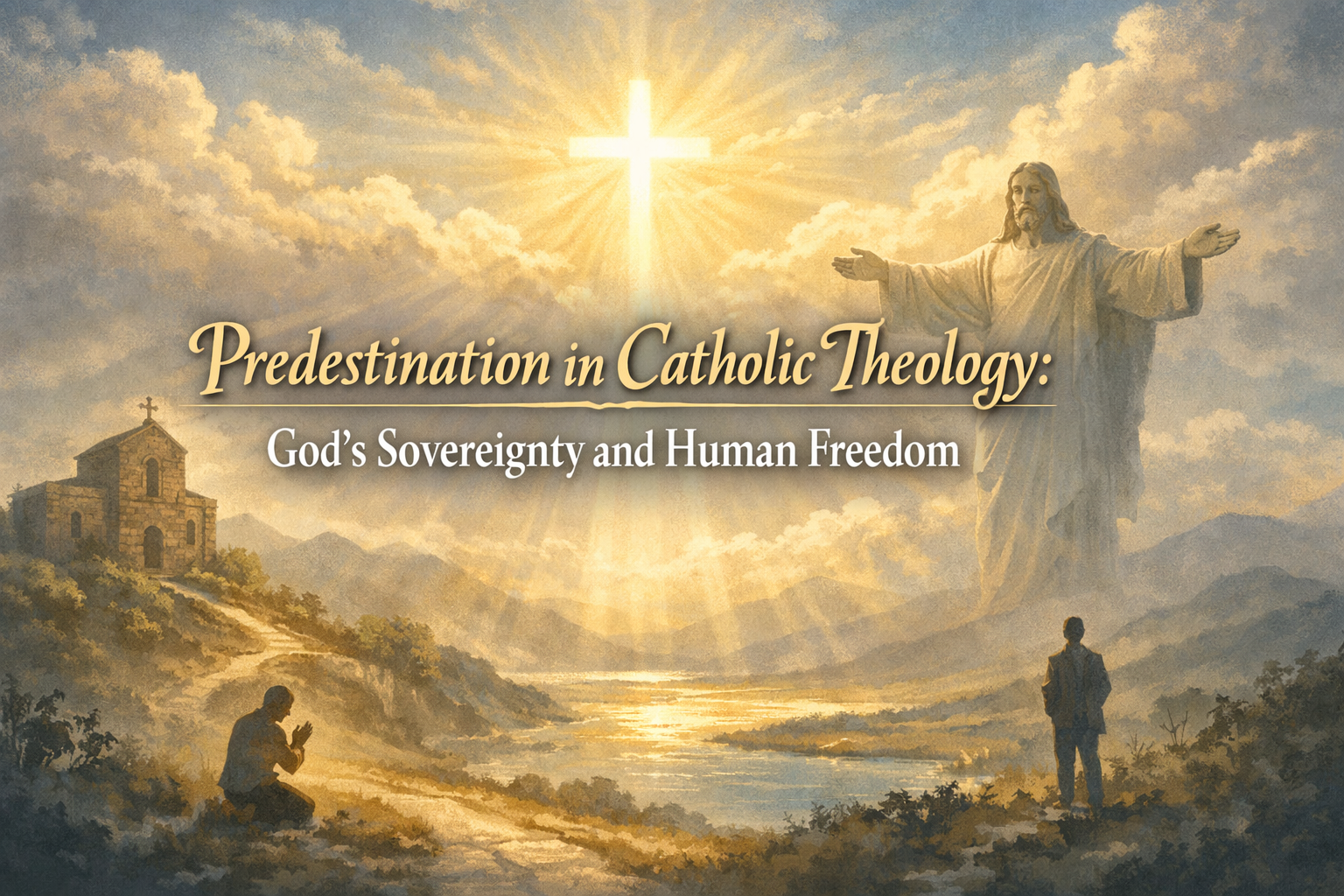
Predestination in Catholic Theology: God’s Sovereignty and Human Freedom
How the Catholic Church Holds Together God’s Sovereign Will and Human Freedom
Predestination is one of those theological terms that makes folks sit up and scratch their heads. It’s been debated for centuries across Christian traditions — and rightly so. It touches on the very heart of salvation, free will, grace, and God’s eternal plan.
Most readers of this blog are familiar with the Reformed (Calvinist) position — where God’s sovereign election is the decisive factor in salvation. This post examines a different tradition: the Catholic Church’s teaching on predestination. It’s worth understanding clearly, both because it shapes the faith of over a billion Christians worldwide and because engaging it honestly sharpens our own thinking on a genuinely difficult doctrine.
“God desires all people to be saved and to come to the knowledge of the truth.” — 1 Timothy 2:4
Catholic Teaching on Predestination: The Four Core Principles
📣 Universal Salvific Will
God genuinely desires all people to be saved and offers sufficient grace to every person. Predestination is not arbitrary selection — it operates in harmony with human free response.
✅ Single Predestination
God predestines certain individuals to eternal life. He does not predestine anyone to hell. Those condemned are so because of their own freely chosen rejection of grace.
🤝 Grace and Free Will Together
God takes the first step by offering grace — but human beings must freely cooperate. Grace is a gift that requires an open heart and a willing response. It is not forced.
🌫️ The Mystery Remains
The full mechanism of how God’s foreknowledge and human free will work together is acknowledged as a mystery beyond human comprehension. Humility is the right posture.
Catholic vs. Calvinist Predestination — Side by Side
Both traditions agree that salvation originates entirely with God and is a matter of grace. The differences are significant and real.
| 🧱 Calvinist Position | 🌿 Catholic Position |
|---|---|
| Double predestination: God actively predestines some to salvation and others to damnation, entirely apart from their choices. | Single predestination: God predestines some to glory but does not predestine anyone to hell. Damnation results from free rejection of grace. |
| God’s sovereign will is the ultimate and sole determiner of eternal destiny. Human cooperation plays no role. | God’s grace initiates and sustains the path to salvation, but human beings must freely choose to accept it. |
| Irresistible grace: When God calls the elect to salvation, they will come. The call cannot be refused. | Grace is efficacious (accomplishes salvation for those who accept) and sufficient (offered to all) — but can be resisted. |
| Election is unconditional — not based on any foreseen faith or cooperation in the individual. | Election is related to God’s foreknowledge, though the exact relationship between foreknowledge and predestination is debated within Catholic theology itself. |
Three Theologians Who Shaped the Catholic View
Augustine of Hippo
Laid the groundwork by emphasizing salvation as entirely God’s work of grace. He taught that original sin disables human will — but that grace heals and elevates it rather than replacing it. Salvation starts with God’s initiative, full stop.
Thomas Aquinas
Refined Augustine by articulating a deeper harmony between divine causality and human free choice. God as “primary cause” moves the human will infallibly toward good, yet this movement respects — rather than overrides — human freedom.
Luis de Molina
16th-century Jesuit who introduced “middle knowledge” (scientia media): God knows not only what free creatures will do but what they would do under any circumstance. This allows predestination based on foreseen free response.
What the Catechism Says
The Catechism of the Catholic Church addresses predestination directly and carefully.
- CCC 600: God’s predestination includes each person’s free response to His grace. The plan is real; the freedom is real; the relationship between them is held in mystery.
- CCC 1037: “God predestines no one to go to hell; for this, a willful turning away from God is necessary.” Damnation is never God’s doing — it is always the result of a human choice sustained to the end.
- CCC 2010: “Moved by the Holy Spirit and by charity, we can then merit for ourselves and for others the graces needed for our sanctification.” God initiates; human cooperation is real and significant.
The Ongoing Debate Within Catholic Theology: Thomism vs. Molinism
Here’s an honest note: even within Catholicism, the question of how exactly divine sovereignty and human freedom work together is unresolved. Two schools have debated this for centuries, and the Church has not dogmatically settled it.
Thomism (following Aquinas)
God’s sovereign will is the ultimate cause of salvation. His grace is intrinsically efficacious — it brings about the intended result without negating human freedom. Exactly how this works is accepted as a mystery, not a contradiction.
Molinism (following Molina)
God’s predestination is based on His “middle knowledge” — His foreknowledge of how individuals would freely respond to grace in every possible scenario. This protects human freedom while maintaining God’s providential control.
Both views are acceptable within Catholic orthodoxy. The Church’s position is that Scripture and tradition clearly establish that God is sovereign and humans are genuinely free — while leaving how those two truths fit together as an open theological question.
An Illustration: The Shepherd and the Mountain Path
The Shepherd, the Staff, and the Steep Climb
Picture a shepherd who builds a solid path leading up a steep mountain. He lovingly provides each of his sheep with a sturdy staff to aid their climb. He calls out continuously, guiding them toward the summit.
Some sheep, relying on the staff and trusting the shepherd’s voice, make the journey. Others wander into rocky ravines or get distracted by the weeds along the way. The shepherd does not push any sheep off the cliff — nor does he drag them up by force. He leads, equips, and calls. But the sheep must choose to follow.
This is the Catholic picture of predestination: God prepares the way, provides grace, and calls each soul — but does not coerce. The free response of the sheep genuinely matters.
Practical Implications for the Believer
- 1Hope, not presumption. Catholics are called to live in the hope of salvation, not in presumptive certainty. Because predestination does not eliminate free will, believers must continually cooperate with grace through faith, prayer, and the sacraments.
- 2Evangelization and mission. The universal salvific will of God mandates that the Church evangelize. Since God desires all to be saved, His grace is at work in every heart — and the mission to bring the gospel to all nations flows directly from that conviction.
- 3Assurance without arrogance. Catholics can have moral assurance of salvation through a life of grace — but the Church warns against spiritual pride. Salvation is a gift, not an entitlement. Humility and gratitude, not presumption, are the proper responses.
- 4Trust in God’s justice and mercy. Predestination ultimately reflects the balance of God’s justice and mercy. Catholics are encouraged to trust in His loving plan while faithfully responding to His grace, resting in the mystery rather than demanding a full explanation.
The Catholic doctrine of predestination is a carefully held tension: God’s sovereign grace and genuine human freedom — both affirmed, neither dissolved into the other. It refuses fatalism on one side and Pelagianism (salvation by human effort) on the other.
Whether or not one agrees with the Catholic position, understanding it honestly is worthwhile. It reflects centuries of serious engagement with the same Scriptures, wrestling with the same God, and asking the same question every serious theologian eventually faces: how does a sovereign God genuinely save people who genuinely choose?
That question doesn’t have a tidy answer in any tradition. What it has is the God who invites us — humbly — to trust Him with what we cannot fully explain.
“For those God foreknew he also predestined to be conformed to the image of his Son… And those he predestined, he also called; those he called, he also justified; those he justified, he also glorified.” — Romans 8:29–30
Key Scriptures: 1 Timothy 2:4 · Ephesians 1:4–5 · Romans 8:29–30 · John 3:16 · 2 Peter 3:9 · Acts 13:48 · John 6:37–40 · Ezekiel 18:23 · Matthew 23:37
Want to Go Deeper?
This post is part of an ongoing series examining how different Christian traditions understand major doctrines. If it helped you engage the Catholic position more clearly, here are a few next steps:
- Share it with someone who’s curious about how different traditions approach the sovereignty/freedom question — this is a good starting point for that conversation.
- Read further — compare this post with the MVM posts on Calvinism and Arminianism for a three-way view of this centuries-old debate. Then read Romans 8–11 slowly and let the text have the last word.
- Subscribe to get new posts delivered straight to your inbox — gospel-rooted, plain-spoken truth for the week ahead.
“God desires all people to be saved and to come to the knowledge of the truth.” — 1 Timothy 2:4
Mountain Veteran Ministries
Find Your Next Bearing
Every journey needs a direction. If you're wondering where to go from here, choose the path that best fits where you are today.
⚒️ I Want to Live Faithfully
Discover practical wisdom for following Christ in today's world.
→ Living as a Christian Today✝️ I Want to Understand the Gospel
Learn what salvation means and why Jesus came.
→ Understanding Salvation📖 I Want to Understand the Bible
Explore why Christians trust Scripture and how to read it well.
→ Understanding the Bible❓ I Still Have Questions
Explore thoughtful answers to some of Christianity's hardest questions.
→ Hard Questions