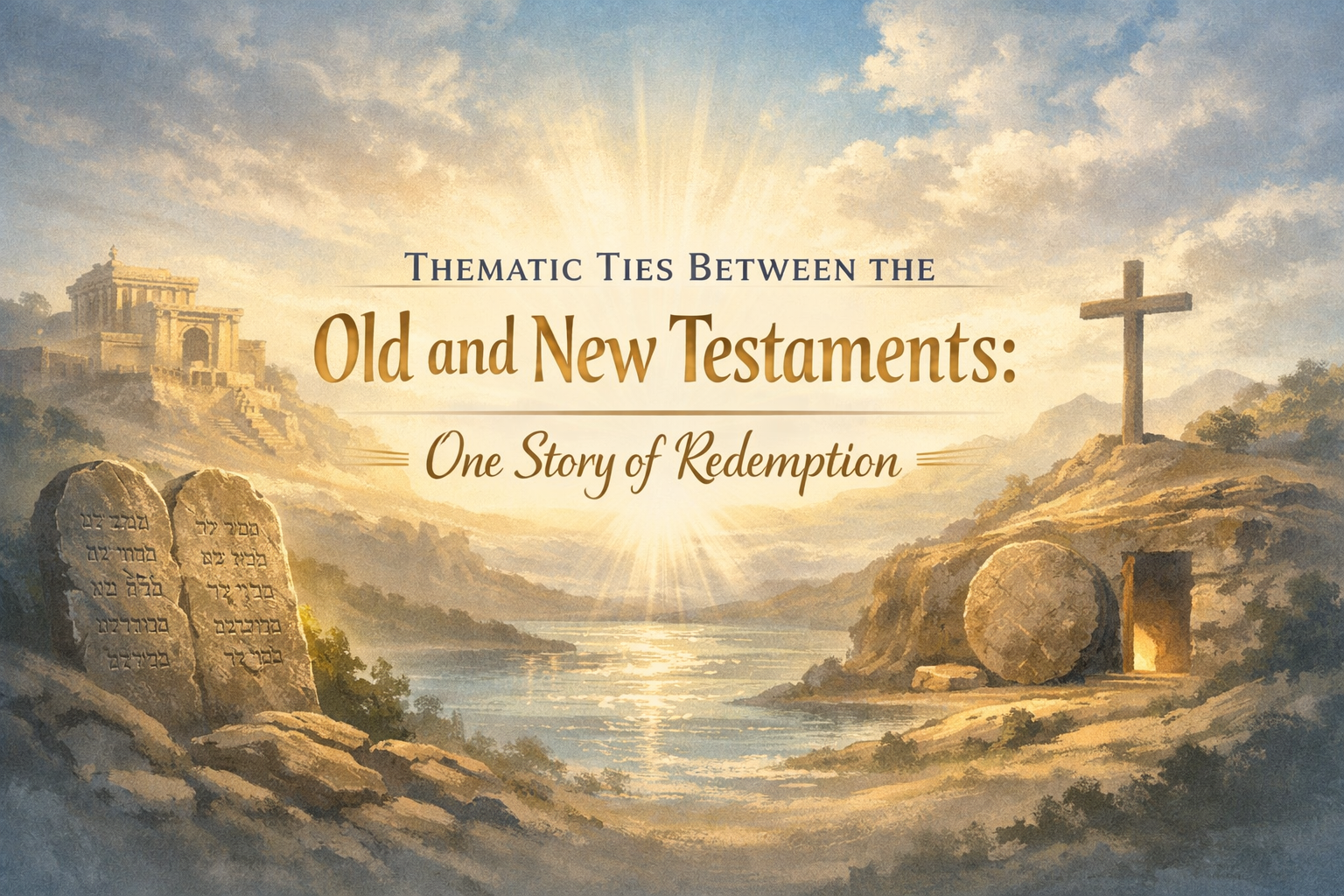
Thematic Ties Between the Old and New Testaments: One Story of Redemption
From Covenant to Consummation — the Bible Is One Story, Not Two
“The New Testament is concealed in the Old, and the Old Testament is revealed in the New.” — Augustine
Many people view the Old and New Testaments as two separate books with different messages — the Old focused on law, judgment, and Israel; the New on grace, love, and the Church. But in reality, these two halves form one continuous, unfolding story of God’s redemptive plan for humanity. The themes, promises, and patterns of the Old Testament find their fulfillment and completion in the New.
To understand the Bible fully, we need to see the thematic ties that bind them together — the same God, the same purpose, one grand narrative building toward one climax.
Eight Threads That Run Through Both Testaments
Theme One
🤝 Covenant: From Abraham to Christ
Old Testament
God’s covenant with Abraham (Genesis 12:1–3) promises a great nation through which all peoples will be blessed. This covenant is reaffirmed at Sinai, where Israel receives the Law. God’s covenant relationship with Israel runs throughout the OT — even amidst failure and exile.
New Testament
At the Last Supper, Jesus declares a New Covenant in His blood (Luke 22:20), fulfilling Jeremiah 31:31–34. This covenant is not written on stone but on hearts. It expands beyond ethnic Israel to include all who believe — forming the Church.
The thread: God always intended a covenant relationship with His people — and Christ is where that intention arrives at its destination.
Theme Two
📣 Promise and Fulfillment: Prophecy Realized
Old Testament
From the “seed of the woman” (Genesis 3:15) to the suffering servant of Isaiah 53, the OT builds sustained, centuries-long anticipation for a coming Redeemer who would save Israel and restore God’s kingdom.
New Testament
Matthew’s Gospel repeatedly uses the phrase “this was to fulfill what was spoken by the prophet.” Jesus Himself declares: “I have not come to abolish the Law or the Prophets but to fulfill them” (Matthew 5:17). The long-awaited Messiah had arrived.
The thread: Every OT promise was a promissory note. The NT is when the payment arrives — in full, in person.
Theme Three
⚖️ Law and Grace: From Command to Transformation
Old Testament
The Law given through Moses was designed to reveal God’s holiness and expose human sinfulness (Romans 3:20). It provided a moral compass and a sacrificial system to cover sins — but it could not change the human heart.
New Testament
What the Law was powerless to do, God accomplished through His Son (Romans 8:3–4). The Law showed the need for salvation; grace provided the means. Righteousness now comes through faith in Christ, not works of the Law (Galatians 2:16).
The thread: The Law was never meant to save — it was meant to show us we needed saving. Grace is the answer the Law was asking for.
Theme Four
🐑 Sacrifice and Atonement: Shadow to Substance
Old Testament
The sacrificial system was central to OT worship. Animals were offered as substitutes for human sin — but Hebrews 10:4 states plainly: “It is impossible for the blood of bulls and goats to take away sins.” These sacrifices were temporary shadows of something greater.
New Testament
Jesus is introduced as the “Lamb of God who takes away the sin of the world” (John 1:29). His death is the once-for-all atonement (Hebrews 10:10–14). The temple veil torn in two symbolizes direct access to God — no longer through repeated sacrifice, but through Christ’s finished work.
The thread: Every animal sacrifice said “something is coming.” The cross said “it has come.”
Theme Five
👑 The Kingdom of God: Earthly Shadows to Eternal Reality
Old Testament
Israel was established as a kingdom under God’s direct rule. The Davidic Covenant (2 Samuel 7) promised a future King whose reign would be everlasting. Yet Israel’s history was marked by failure and exile — showing that no earthly kingdom could fully realize God’s perfect reign.
New Testament
Jesus came proclaiming “The kingdom of God is at hand” (Mark 1:15). Through His life, death, and resurrection, the spiritual reality of God’s reign began in human hearts. The fullness of the Kingdom awaits His return — but its seeds are sown now through the Church.
The thread: Israel’s kingdom was the sketch. Christ’s kingdom is the painting — and it will never end.
Theme Six
🌍 The People of God: Israel and the Church
Old Testament
God’s covenant with Israel set them apart as His holy nation (Exodus 19:6), called to be a light to the Gentiles (Isaiah 49:6) — though they often fell short of that calling.
New Testament
Paul explains that not everyone descended from Israel belongs to Israel (Romans 9:6–8). The Church, composed of Jews and Gentiles together, becomes the covenant community. Believers are “grafted in” to the olive tree (Romans 11:17–24), forming one people under Christ.
The thread: God always intended one family. Israel was the firstborn — Christ is where all the families of the earth find their blessing (Genesis 12:3).
Theme Seven
🌐 Global Mission: From Israel to All Nations
Old Testament
Though Israel was God’s chosen nation, His plan always included the Gentiles. Isaiah 42:6 calls Israel “a light for the nations.” Jonah’s mission to Nineveh is an early hint at God’s global reach — even when His messenger resisted it.
New Testament
“Go therefore and make disciples of all nations” (Matthew 28:19). The New Testament Church carries forward the mission Israel was appointed to fulfill — bringing God’s light to the world, but now explicitly empowered by the Spirit to do so.
The thread: The Great Commission isn’t a new idea. It’s the original idea, finally unleashed.
Theme Eight
🌅 Eschatology: From Promise to Consummation
Old Testament
The prophets — Isaiah, Ezekiel, Daniel — spoke of a future restoration: a new heaven and earth where God’s glory would dwell with His people (Isaiah 65:17–25). The ending was coming. It was just not yet.
New Testament
Revelation 21–22 fulfills the prophetic vision — a new Jerusalem, a new creation, God dwelling with His people forever. The trajectory of Scripture moves from creation (Genesis 1) to new creation (Revelation 21). The story ends where it was always heading.
The thread: The Bible begins in a garden and ends in a city. The whole of Scripture is the journey between those two points.
The Arc of the Whole Story
| Theme | Old Testament | New Testament |
|---|---|---|
| Covenant | Promised to Abraham; given through Moses | Fulfilled in Christ; written on hearts |
| Prophecy | Anticipation of the Messiah | Messiah arrives in Jesus |
| Law | Exposes sin; points to the need for grace | Fulfilled by Christ; written by the Spirit |
| Sacrifice | Temporary shadows pointing forward | Once-for-all atonement at the cross |
| Kingdom | Earthly kingdom; Davidic covenant | Kingdom inaugurated; consummation coming |
| People of God | Israel — a light to the nations | Church — Jews and Gentiles grafted together |
| Mission | A light to the Gentiles | Go and make disciples of all nations |
| Eschatology | Promise of a new heaven and earth | New Jerusalem — creation renewed |
The House Illustration
Imagine the Old Testament as the foundation and framework of a house. You can see the beams, the layout, the support structures — but it feels unfinished. The New Testament is when the house is completed, furnished, and inhabited. You now see the beauty and purpose of every design decision.
The house hasn’t changed. It’s been fulfilled. And the Architect knew what He was building from the very first beam.
The Old and New Testaments are not disconnected books with opposing messages. They are two acts of the same divine drama. The Old Testament lays the foundation, sets the stage, and builds the anticipation. The New Testament reveals the fulfillment, the climax, and the resolution — in the person of Jesus Christ.
From covenant to covenant, law to grace, prophecy to fulfillment, shadow to substance — the Bible tells one story: God redeeming His people through Christ for His glory.
To truly grasp the depth of God’s plan, we must hold both Testaments in hand. The Old Testament is the promise. The New Testament is the fulfillment. Together they declare: God is faithful from beginning to end.
“And beginning with Moses and all the Prophets, he explained to them what was said in all the Scriptures concerning himself.” — Luke 24:27
Key Scriptures: Genesis 12:1–3 · Genesis 3:15 · Jeremiah 31:31–34 · Isaiah 53 · Matthew 5:17 · John 1:29 · Hebrews 10:1–14 · Romans 8:3–4 · Romans 9:6–8; 11:17–24 · Matthew 28:19 · Revelation 21:1–3 · Luke 24:27 · 2 Samuel 7 · Isaiah 65:17–25
Want to Go Deeper?
This post is part of an ongoing series on Scripture as one unified story of redemption. If it helped you see the two Testaments in a new light, here are a few next steps:
- Share it with someone who avoids the Old Testament or wonders why Christians still read it — this is a good entry point for that conversation.
- Read Hebrews straight through — it’s the NT’s most sustained treatment of the OT/NT relationship, showing how Christ fulfills every major theme of Israel’s worship and covenant life.
- Subscribe to get new posts delivered straight to your inbox — gospel-rooted, plain-spoken truth for the week ahead.
“The New Testament is concealed in the Old, and the Old Testament is revealed in the New.” — Augustine
Mountain Veteran Ministries
Find Your Next Bearing
Every journey needs a direction. If you're wondering where to go from here, choose the path that best fits where you are today.
⚒️ I Want to Live Faithfully
Discover practical wisdom for following Christ in today's world.
→ Living as a Christian Today✝️ I Want to Understand the Gospel
Learn what salvation means and why Jesus came.
→ Understanding Salvation📖 I Want to Understand the Bible
Explore why Christians trust Scripture and how to read it well.
→ Understanding the Bible❓ I Still Have Questions
Explore thoughtful answers to some of Christianity's hardest questions.
→ Hard Questions