
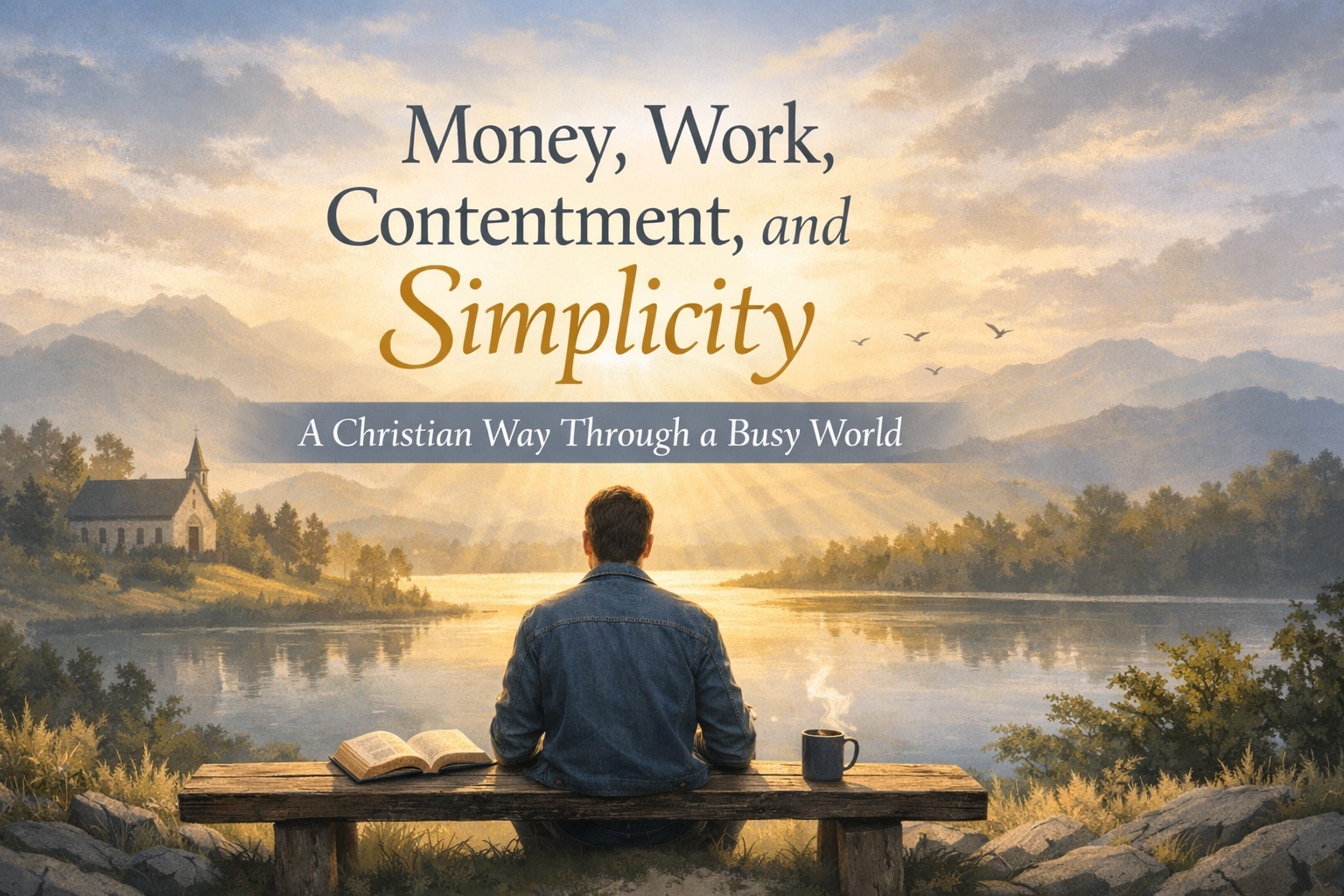
Money, Work, Contentment, and Simplicity: A Christian Way Through a Busy World
A Biblical Field Guide to Money, Work, Contentment, and Simplicity
If you’ve ever stood in a barn aisle or a breakroom and felt tugged in four directions — bills to pay, work to finish, neighbors to help, and a soul that’s running on fumes — you’re not alone. The Bible doesn’t dodge that tension. It gives us a way of life where money is a trust, work is a calling, contentment is a learned strength, and simplicity is the freedom to keep first things first.
This isn’t theory for city slickers only. It’s field-tested wisdom for families, ranch hands, teachers, retirees, and business owners across small towns and big towns alike.
Big Idea
Christians receive money and work as gifts to steward, not masters to serve. Contentment and simplicity are the posture that frees us to use both for God’s kingdom and our neighbor’s good.
Four Pillars — A Biblical Foundation
💰 Pillar One
Money: Powerful Tool, Dangerous Master
Money is like a chainsaw — you can get a lot done with it, but it’ll take your leg off if you’re careless. Scripture never says money is evil; it says the love of it is (1 Timothy 6:10). Jesus ties money directly to the heart: “Where your treasure is, there your heart will be also” (Matthew 6:21). That’s not a warning about bank accounts — it’s a diagnosis of what we worship.
Augustine said our chief problem is disordered loves. Money tends to slide into God’s spot.
Calvin framed wealth as stewardship under God’s providence — received gratefully, held loosely, spent generously.
Wesley gave us the practical triad: gain all you can, save all you can, give all you can.
Keller pointed out that greed hides. Few think they’re materialistic; habits of generosity expose and heal it.
Practically: give first so your budget bows to Christ, not cravings. Live on the rest with a plan. Keep accountability — a spouse, elder, or friend who can ask straight questions about spending drift.
🛠️ Pillar Two
Work: Creation Calling, Not Just a Paycheck
Before sin ever entered the garden, God placed Adam there “to work it and keep it” (Genesis 2:15). Work is pre-Fall — good by design, even if thorns and sweat came later. Done unto the Lord, it is a form of worship (Colossians 3:23–24).
Luther taught that God feeds and clothes the world through ordinary vocations — farmers, mechanics, mothers, and line cooks.
Dorothy Sayers said the first demand of work is to serve the work itself — do it well because God is excellent.
John Stott connected daily integrity to witness: honest weights, fair pricing, showing up on time — these things preach.
Work is not the enemy of spirituality; it’s one of its chief arenas. The goal isn’t fame or escape — it’s faithfulness. Doing the next right thing with the tools God gave you. Sabbath isn’t an interruption; it’s the rhythm that keeps work human and holy.
🌾 Pillar Three
Contentment: Learned Strength in Lean or Plenty
Paul says he learned to be content “in any and every circumstance” (Philippians 4:11–13). That’s encouraging — if it’s learned, it can be taught and practiced. Contentment isn’t resignation; it’s settled confidence that the Shepherd knows the pasture and the path (Psalm 23).
Jeremiah Burroughs called contentment “the quiet of heart” that trusts God’s wise allotments.
Elisabeth Elliot tied contentment to obedience: do the next right thing God sets in front of you, and you’ll find grace waiting there.
Contentment resists envy, fights comparison, and allows joy to land in simple gifts — warm bread, a fixed tractor, a grandchild’s laugh, a good day’s work. It isn’t passivity; it’s trust with its boots on.
🧭 Pillar Four
Simplicity: Spaciousness to Love God and Neighbor
Simplicity is not just clean countertops and a tidy sock drawer. It’s an inward freedom that produces an outward lifestyle without clutter — margin to seek the kingdom first (Matthew 6:33).
Richard Foster describes simplicity as joyful unclutteredness that flows from trusting God’s care.
Dallas Willard links simplicity to apprenticeship to Jesus — paring back hurry and needless accumulation so we can actually do what Jesus says.
Henri Nouwen urges downward mobility: choosing presence over prestige, people over possessions.
Simplicity isn’t about austerity — it’s about availability. To God in prayer, and to the folks right in front of you. It gives you the time and margin to notice needs and respond with mercy.
How the Four Fit Together
These aren’t four separate disciplines — they’re one ecosystem. Pull one thread and you affect the others.
💰 Money funds mission
Work generates income; generosity directs it toward God’s purposes; simplicity protects it from waste; contentment keeps it from ruling us.
🛠️ Work forms character
Contentment stabilizes us when work is hard; simplicity prevents ambition from becoming idolatry; money becomes a tool rather than an identity.
🌾 Contentment steadies the soul
It quiets the “more, newer, faster” churn and anchors us in Christ’s sufficiency — freeing us to give, serve, and rest without anxiety.
🧭 Simplicity creates margin
Less clutter, fewer payments, and saner schedules leave space for worship, hospitality, and service to the neighbor at the end of the driveway.
Common Ditches — and the Guardrails
-
Prosperity ditch — Equating God’s favor with financial increase. This turns God into a vending machine and discipleship into a shopping list.
Guardrail: Obey in lean and plenty. Measure blessing by Christlikeness, not cashflow.
-
Poverty-as-virtue ditch — Assuming lack is holier than stewardship. Scripture doesn’t canonize poverty; it canonizes faithful management.
Guardrail: Whether you have little or much, keep money under Christ’s lordship and in your neighbor’s service.
-
Workaholism vs. apathy — Over-identifying with your career, or shrugging your calling as unimportant.
Guardrail: Practice Sabbath and set honest goals. Let your “yes” be “yes” — and then go home.
-
“Someday generosity” — Waiting to give until you “have enough.” The widow’s mite teaches that percentage and posture matter more than amount.
Guardrail: Start small, start now. Faithful giving at any level breaks money’s grip on the heart.
Practices That Build the Muscles
💰 For Money
- Give first. Pick a percentage that stretches faith and automate it before anything else.
- Save and set aside. Emergency fund, near-term needs, long-term goals. A named dollar behaves better than a wandering one.
- Cap lifestyle creep. When income rises, pre-decide where “extra” goes — generosity, savings, debt, mission.
🛠️ For Work
- Daily dedication (60 seconds). “Lord, this day’s work is for You” (Colossians 3:23).
- Craft over clout. One tangible quality improvement each week — safer welds, clearer invoices, kinder follow-up.
- Sabbath as resistance. One day to cease and delight — reminding your heart that you are not your output.
🌾 For Contentment
- Gratitude examen at day’s end. Name three specific provisions from God today.
- Fast from comparison. Mute the apps, skip the ads for a month. Watch your peace grow.
- Pray Psalm 23 before big decisions. Let the Shepherd frame your “needs” vs. “wants.”
🧭 For Simplicity
- Purpose-based decluttering. Keep what helps you love God and neighbor. Release the rest.
- One-in/one-out rule. For gear and gadgets, something new replaces something old.
- Time budget. Block Scripture, family, church, and neighbor-love on your calendar and guard them like your wallet.
Rural and Small-Town Applications
Seasonal incomes: During harvest or peak months, build a barn reserve for lean seasons (Proverbs 6:6–8). Aim for a few months of expenses set aside before the slow season hits.
Neighbor care fund: Keep a budget line for benevolence — feed, fuel, a tire, or a repair. Bless quietly; let the right hand forget what the left did (Matthew 6:3–4).
Local work as witness: In smaller communities, your word is your mission. Show up on time, bill fairly, and make it right when you miss. Your reputation preaches.
Shared simplicity: Tool libraries, shared trailers, and neighbor-to-neighbor skills echo Acts 2 without fanfare — and save everybody money.
Questions We Actually Ask
❓ Is it wrong to want a raise or build a business?
Not at all. Scripture commends diligence and wise increase (Proverbs 10:4). The heart test is: Why? If it expands your ability to serve God and others, pursue it with prayer, integrity, and generosity.
❓ What if I’m in debt and feel stuck?
Begin with truth and hope. Make a list, build a simple plan (snowball or avalanche), and invite accountability. Small faithful steps, taken consistently, honor God and change futures.
❓ How do I know if money is mastering me?
Check the dashboard: anxiety when giving is mentioned, secrecy about spending, constant upgrading, or resentment when others succeed. The antidote is regular generosity and honest conversation with a mature believer.
❓ Isn’t simplicity just minimalism?
Minimalism often centers on self — less to manage, more personal freedom. Christian simplicity centers on love — fewer distractions so you can attend to God and the people He puts in your path.
A Framework You Can Remember
- 1Worship first. Seek the kingdom before you open the ledger or start the truck (Matthew 6:33).
- 2Work faithfully. Do good work well — your vocation is an altar (Colossians 3:23–24).
- 3Give generously. Open the fist before the heart hardens around what you hold (2 Corinthians 9:7).
- 4Live simply. Leave margin — for prayer, for people, for mercy (Matthew 6:22–24).
- 5Rest regularly. Sabbath reminds your heart that you are not the one who runs the world (Hebrews 4:9–11).
- 6Walk contentedly. Learn the strength of “enough” in Christ — in lean seasons and in full ones (Philippians 4:11–13).
Work is a calling; money is a trust; contentment is learned dependence on Christ; simplicity is wise focus. Together, they create a life that’s free from anxiety, rich in generosity, diligent in craft, and available for the people God sets in our path.
🙏 A Short Prayer
Father, everything we have is from You and for You. Teach us to work with Your strength, handle money with Your wisdom, live with the contentment of Christ, and choose the simplicity of love. Help us seek first Your kingdom — here, now, this week. Amen.
Key Scriptures: Genesis 1:26–28; 2:15 · Matthew 6:19–34 · Colossians 3:23–24 · Philippians 4:11–13 · 1 Timothy 6:6–10, 17–19 · Psalm 23 · Proverbs 3:9–10; 6:6–8 · Luke 12:13–34 · Hebrews 13:5–6 · 1 Thessalonians 4:11–12 · Romans 8:32 · 2 Corinthians 9:7
Want to Go Deeper?
This post is part of an ongoing conversation about faithful Christian living in the everyday. If it stirred something in you, here are a few next steps:
- Share it with a family, small group, or coworker wrestling with the Monday-morning grind.
- Read further — Richard Foster’s Freedom of Simplicity, Jeremiah Burroughs’ The Rare Jewel of Christian Contentment, and Tim Keller’s Counterfeit Gods are excellent starting points.
- Subscribe to get new posts delivered straight to your inbox — gospel-rooted, boots-on-the-ground truth.
“Godliness with contentment is great gain.” — 1 Timothy 6:6
Mountain Veteran Ministries
Find Your Next Bearing
Every journey needs a direction. If you're wondering where to go from here, choose the path that best fits where you are today.
⚒️ I Want to Live Faithfully
Discover practical wisdom for following Christ in today's world.
→ Living as a Christian Today✝️ I Want to Understand the Gospel
Learn what salvation means and why Jesus came.
→ Understanding Salvation📖 I Want to Understand the Bible
Explore why Christians trust Scripture and how to read it well.
→ Understanding the Bible❓ I Still Have Questions
Explore thoughtful answers to some of Christianity's hardest questions.
→ Hard Questions



Very good points, well written and understandable. Definitely thought provoking, introspection inducing. Thank you!