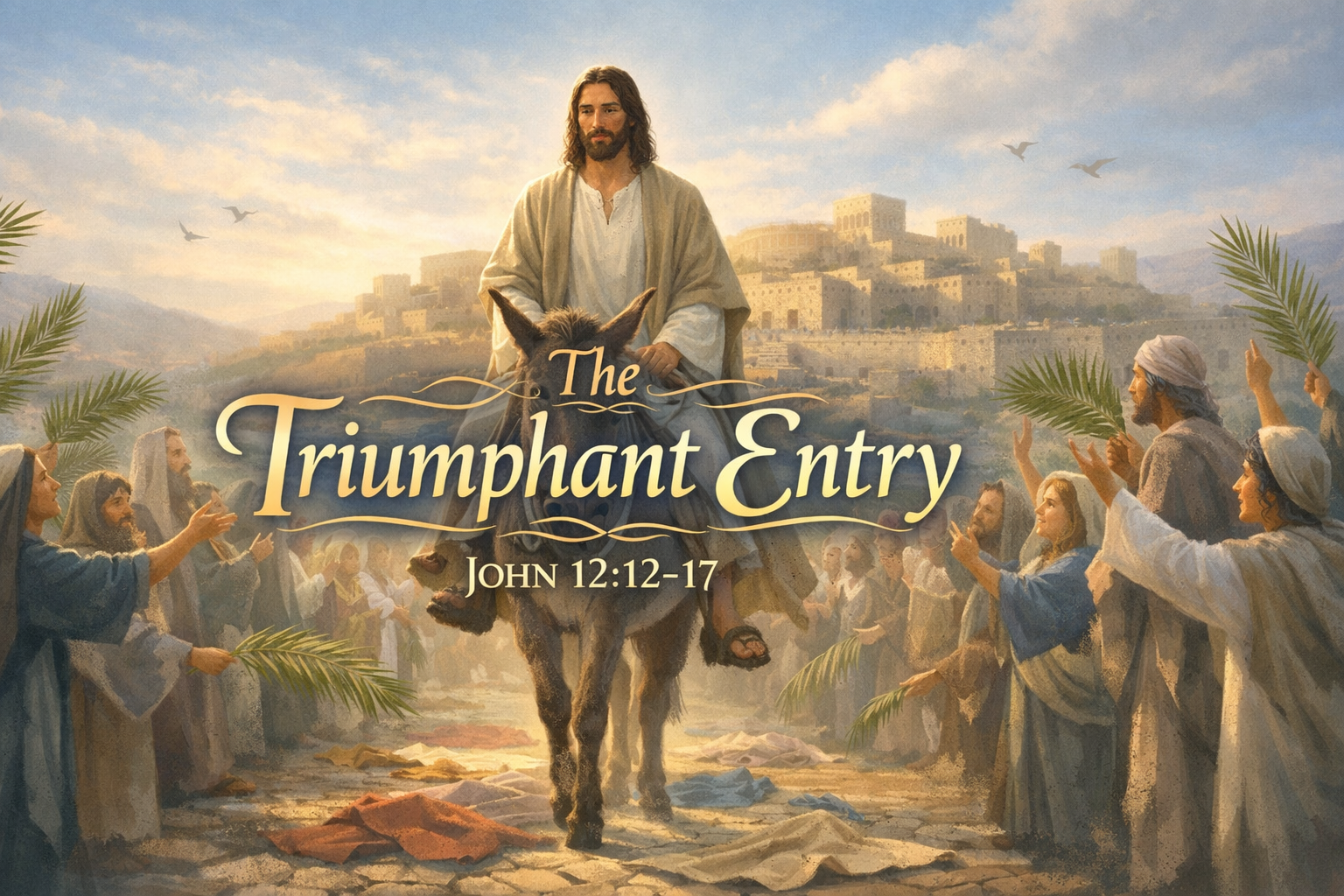
The Triumphant Entry
Based on Sermon by Pastor Doug Massingill Wy’East Community Church
When Jesus rode into Jerusalem on a donkey, the crowd cheered for a king. But they did not yet understand what kind of king had come — or what kind of throne He was riding toward. John 12:12–17 is one of the most layered and searching passages in all the Gospels.
The crowd called Him king. The disciples did not yet understand. And Jesus rode on — knowing exactly where that road led.
“The next day the large crowd that had come to the feast heard that Jesus was coming to Jerusalem. So they took branches of palm trees and went out to meet him, crying out, ‘Hosanna! Blessed is he who comes in the name of the Lord, even the King of Israel!’ And Jesus found a young donkey and sat on it, just as it is written, ‘Fear not, daughter of Zion; behold, your king is coming, sitting on a donkey’s colt!’ His disciples did not understand these things at first, but when Jesus was glorified, then they remembered that these things had been written about him and had been done to him. The crowd that had been with him when he called Lazarus out of the tomb and raised him from the dead continued to bear witness.”
John 12:12–17 (ESV)
A Scene You Think You Know
Palm Sunday is one of the most familiar scenes in the Christian calendar. We have heard the story since childhood. We picture the crowd, the palm branches, the colt, the cheering. We have sung “Hosanna” in church. We know how the week ends.
But familiarity can be the enemy of understanding. And John 12:12–17 is far more layered, far more searching, and far more unsettling than a cheerful Sunday school illustration would suggest.
Look carefully at this passage and you will find at least four things worth sitting with: a crowd that was right for the wrong reasons, a king who deliberately chose humility over spectacle, a prophecy being fulfilled in a way no one fully grasped in the moment, and a group of disciples who only understood what they had witnessed after the resurrection.
Each of those threads is worth pulling. Together they paint a portrait of Jesus that should stop us cold — and then move us to worship.
The Crowd: Right Words, Wrong Expectations
The crowd that came out to meet Jesus was enormous. John tells us it was the crowd that had come to Jerusalem for the Passover feast — pilgrims from across the Jewish world, gathered for one of the holiest weeks of the year. Word had spread fast. Lazarus had been raised from the dead just days before in nearby Bethany. The city was buzzing.
So they took palm branches. That detail matters more than it might seem. Palm branches in first-century Jewish culture were not simply decorative. They carried strong national and political symbolism, going back to the Maccabean period when palm branches were used to celebrate military victory and national liberation. When the crowd waved palms, they were making a statement. They were not just welcoming a rabbi. They were greeting what they hoped was a conquering king.
And they cried out “Hosanna” — a word drawn from Psalm 118 that means, literally, “Save now.” They quoted the rest of the psalm too: “Blessed is he who comes in the name of the Lord.” Then they added their own editorial: “even the King of Israel.”
They were not wrong. Jesus is the King of Israel. Every word they shouted was true. The problem was not their theology. The problem was their imagination. They were expecting a king like David — a military liberator who would drive out Rome, restore the nation, and sit on a visible throne.
They wanted rescue from Rome. Jesus came to rescue them from something far worse. They wanted a political revolution. Jesus was inaugurating a different kind of kingdom altogether.
This is one of the most persistent human tendencies in every generation: to come to Jesus with a real need, offer Him genuine worship, and then quietly rewrite what kind of Savior He is supposed to be. We want a Jesus who fixes the particular problem we have in mind. He comes to fix the problem we were too blind to diagnose.
The Donkey: A King Who Chose Humility on Purpose
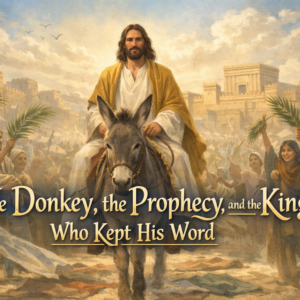
Then there is the donkey. John tells us Jesus deliberately sought out a young donkey and sat on it. This was not improvisation. It was fulfillment.
“Fear not, daughter of Zion; behold, your king is coming, sitting on a donkey’s colt!” — Zechariah 9:9 (quoted in John 12:15)
Zechariah 9:9 had been in the scrolls for centuries. The prophet saw a king coming — but not on a war horse. Not with an army at his back. Not with a sword drawn. He came on a donkey. Humble. Peaceful. Coming not to conquer by force but to bring a different kind of peace.
In the ancient world, a king rode a horse into battle. He rode a donkey in times of peace — often to signal that he came not as a warrior but as a servant of the people. Jesus chose the donkey deliberately. He was making a statement that cut directly against everything the crowd was hoping for.
This is Jesus at His most searching. The crowd wanted a war king. He gave them a peace king. They wanted a throne of political power. He was headed for a cross. They wanted liberation from Rome. He was offering liberation from sin and death.
The donkey is not a minor detail. It is the whole point. Jesus was not accidentally humble. He was not humble because He lacked the power to be otherwise. He chose this. He orchestrated it. He rode into the city knowing full well what waited at the other end of that road — and He rode in on a borrowed donkey anyway.
That kind of king is far more remarkable than anything the crowd was shouting for.
The Disciples: Understanding That Came Later
John includes a detail that the other Gospel writers do not emphasize the same way. He tells us plainly: the disciples did not understand what was happening at the time.
“His disciples did not understand these things at first, but when Jesus was glorified, then they remembered that these things had been written about him and had been done to him.”
That is a remarkable admission for an eyewitness account. John is not trying to make the disciples look bad. He is telling the truth. They were in the middle of something they could not yet fully see. They were watching it happen. They were part of it. And they did not get it — not until after the resurrection.
There is something profoundly honest and deeply pastoral about that. How often do we find ourselves in the middle of something God is doing and only understand it in retrospect? How many times has the meaning of a hard season, an unexpected turn, or a moment of apparent defeat only become clear on the other side?
The disciples were with Jesus every day. They heard every sermon, witnessed every miracle, walked every road with Him. And they still did not grasp the full meaning of what they were seeing until after He rose from the dead. The resurrection was the interpretive key that unlocked the whole story.
John is doing something important here. He is reminding his readers — then and now — that we read this story from the other side of the empty tomb. We have what the disciples lacked in that moment: the full picture. We know where the road from Jerusalem leads. We know what the cross means. We know what the third day brought.
That should change how we read every line of this passage. And it should change how we hold our own confusion in the middle of what God is doing in our lives right now.
The Witnesses: Lazarus and the Spreading Word
John closes this section by noting that a significant portion of the crowd was made up of people who had personally witnessed the raising of Lazarus — or had heard directly from those who had. They were not just fans of a popular teacher. They were eyewitnesses to the resurrection of a dead man, or they were one degree of separation from it.
This matters for two reasons. First, it tells us the Triumphal Entry was not manufactured enthusiasm. This was not a managed public relations moment. The crowd’s excitement was rooted in a specific, verifiable, recent miracle. Lazarus was a real person who had genuinely died and genuinely been raised. His testimony, and the testimony of those who saw it, was fueling the excitement that filled the streets.
Second, it sets up the contrast John develops in the verses that follow. The Pharisees look at the crowds and say to one another, “Look, the world has gone after him.” The very success of Jesus’ entry into Jerusalem is what accelerates the religious leaders’ determination to stop Him. The witness of Lazarus — the living proof of Jesus’ power over death — was the thing that made Jesus most dangerous in their eyes.
The resurrection of Lazarus pointed straight ahead to the resurrection of Jesus Himself. That is the undercurrent running through this whole passage. Death had already been publicly defeated in Bethany. What was coming in Jerusalem would be the final, definitive, world-changing defeat of death — not just for one man, but for all who belong to Christ.
What Kind of King Did You Come For?
Palm Sunday has a way of pressing a very uncomfortable question on anyone willing to hear it: What kind of king did you come for?
The crowd came for a political liberator. They got a suffering servant on a cross. They got the King who conquered death itself — but not before going through it. And because they had not been prepared for that kind of king, many of them turned. The same mouths that shouted “Hosanna” on Sunday were part of the crowd shouting “Crucify him” by Friday.
That is a sobering thing to sit with. It is easy to celebrate Jesus when we expect Him to fix the problem we have diagnosed. It is much harder to follow Him when He goes to work on the deeper problem we did not know we had.
The disciples, for all their confusion, stayed. They did not understand yet. But they did not leave. And after the resurrection, when the meaning of it all finally broke open, they gave the rest of their lives to bearing witness to this king — the one who came on a donkey, died on a cross, and walked out of a tomb.
That is the king worth following. Not a king who does what the crowd demands, but a king who does what love requires.
The King Riding Toward the Cross
Jesus did not ride into Jerusalem by accident. He rode in on purpose — fulfilling an ancient prophecy, signaling what kind of king He was, and setting His face toward the cross that would accomplish what no political revolution ever could. He came not to overthrow Rome, but to overthrow sin and death. He came not to claim a throne in a palace, but to take up a cross on a hill.
“Fear not, daughter of Zion; behold, your king is coming, sitting on a donkey’s colt!” — John 12:15, citing Zechariah 9:9
The Triumphal Entry is only triumphant when you know where the road leads. The crowd saw a beginning. We read it from the other side. We know the tomb is empty. We know the King lives. And because we know that, we can do what the disciples could not do in the moment — we can understand, and we can worship.
So this Palm Sunday, wave your branch if you like. But know who you are waving it for. Not the king the crowd wanted. The King who came anyway — humble, purposeful, unstoppable — riding toward the cross with the full weight of our salvation on His shoulders.
Hosanna. Save now. He did.
Key Scriptures: Psalm 118:25–26 • Zechariah 9:9 • John 11:43–44 • John 12:12–17 • John 12:19 • Matthew 21:1–11 • Mark 11:1–11 • Luke 19:28–44 • Philippians 2:5–11
Key Takeaways
- The crowd was right about who Jesus was, but wrong about what He came to do. They hailed Him as King of Israel — and He is. But they expected a military liberator, and He came as a suffering servant riding toward a cross.
- The donkey was a deliberate theological statement. Jesus did not stumble into humility. He chose it — fulfilling Zechariah 9:9 and signaling clearly that His kingdom operates by different rules than the kingdoms of this world.
- The disciples did not understand in the moment — and that is honest and important. Full understanding came only after the resurrection. We read this passage from the other side of the empty tomb, and that changes everything.
- The witness of Lazarus was the catalyst. The raising of Lazarus drove the crowd’s enthusiasm and accelerated the religious leaders’ opposition. It pointed directly forward to Jesus’ own resurrection.
- Palm Sunday presses a personal question on every reader. What kind of king did you come for? The answer determines whether you follow Jesus all the way — or turn away when He does not meet your expectations.
- The Triumphal Entry is only truly triumphant when read in light of Easter. The road into Jerusalem leads to a cross and an empty tomb. The triumph is not the crowd. It is the resurrection.
Mountain Veteran Ministries
Find Your Next Bearing
Every journey needs a direction. If you're wondering where to go from here, choose the path that best fits where you are today.
⚒️ I Want to Live Faithfully
Discover practical wisdom for following Christ in today's world.
→ Living as a Christian Today✝️ I Want to Understand the Gospel
Learn what salvation means and why Jesus came.
→ Understanding Salvation📖 I Want to Understand the Bible
Explore why Christians trust Scripture and how to read it well.
→ Understanding the Bible❓ I Still Have Questions
Explore thoughtful answers to some of Christianity's hardest questions.
→ Hard Questions