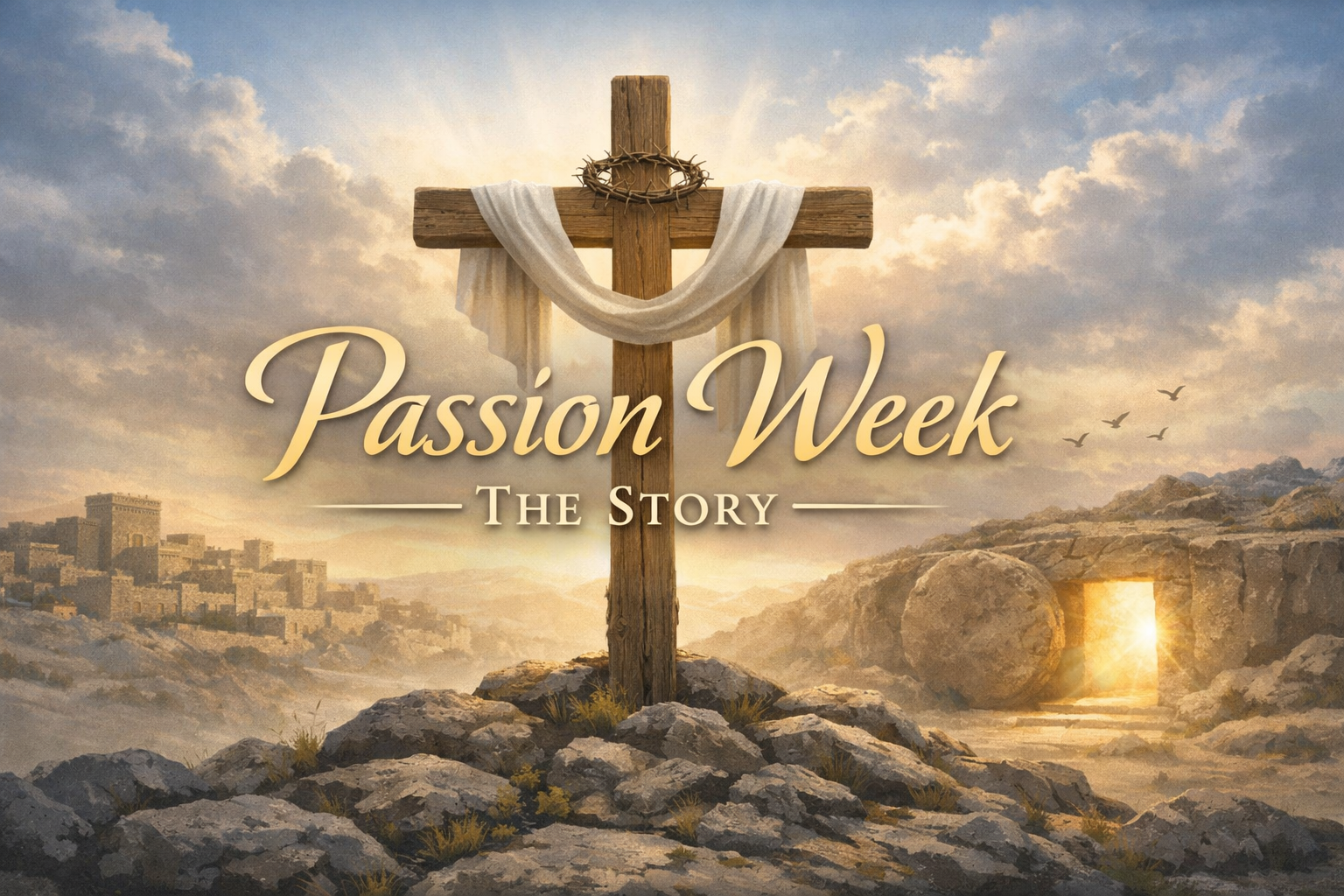
Passion Week – The Story
The last week of Jesus’ life was not a tragedy that overtook him — it was a mission he completed. From the triumphal entry to the empty tomb, every day of Passion Week moves with deliberate purpose toward the cross, the grave, and the resurrection that changes everything.
Seven days. One mission. The week that split history in half.
Every year Easter comes around and the day gets the attention it deserves — sunrise services, empty tomb, alleluias. But the week that leads up to Sunday morning is one of the most theologically loaded stretches of scripture in the entire Bible. Day by day, Jesus moves through Jerusalem with full knowledge of what is coming, and every action — every debate, every meal, every prayer — is weighted with purpose.
This is not a tragedy that overtook him. It is a mission he completed.
Let’s walk through it day by day.
What We Mean by “Passion Week”
The word “passion” doesn’t mean emotion here — it comes from the Latin passio, meaning suffering. Passion Week (also called Holy Week) refers to the final seven days of Jesus’ earthly life before the resurrection, beginning with the Triumphal Entry into Jerusalem on Sunday and culminating with the empty tomb the following Sunday morning.
The Gospels devote enormous space to this week. Matthew gives us eight full chapters. John gives us nearly half his entire Gospel. That proportion isn’t accidental. The early church understood that the cross and resurrection aren’t one piece of Jesus’ story — they are the point of it. Everything before leads here. Everything after flows from here.
For veterans especially, this week hits differently. You know what it looks like when a man walks into something he knows will cost him everything. Passion Week is that — in cosmic scope.
Day by Day Through the Week
The Triumphal Entry — A King Who Arrives Differently
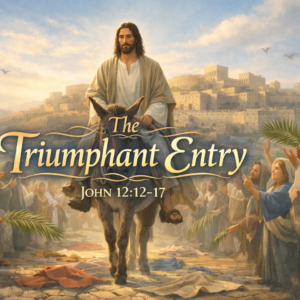
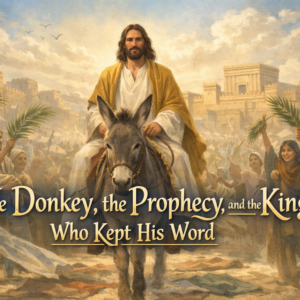
Jesus rides into Jerusalem on a donkey, fulfilling Zechariah 9:9 to the letter. The crowds spread cloaks and palm branches, crying “Hosanna!” — a Hebrew cry meaning “Save us now.” The political electricity is immediate. The city is packed with Passover pilgrims, Roman soldiers are on high alert, and the crowd wants a liberator.
Here’s what makes this entry so sharp: Roman generals and kings rode warhorses. Jesus rides a donkey — a beast of burden, an animal of peace. The crowd sees a king arriving; Jesus is showing them exactly what kind of king he is. Luke records that as the city comes into view, Jesus weeps over it (Luke 19:41–44), foreseeing its destruction. He is riding toward a crown of thorns while the crowd waves palm branches.
The Pharisees demand that he silence the crowd. Jesus tells them that if these were quiet, the stones themselves would cry out (Luke 19:40). Creation itself is at attention.
Cleansing the Temple — A Prophet Acts
Jesus enters the Temple courts and overturns the money changers’ tables, driving out those selling animals for sacrifice. He quotes Isaiah 56:7 and Jeremiah 7:11: “My house shall be called a house of prayer for all nations, but you have made it a den of robbers.”
This is not a moral tantrum about commerce. It is a prophetic act. The money changers operated in the Court of the Gentiles — the one section of the Temple where non-Jews could worship. They had turned the only place available to outsiders into a marketplace. Jesus is enacting Jeremiah’s temple judgment in real time.
Mark sandwiches this event between the cursing of the fig tree — a symbolic bookend. The fig tree looks alive but produces no fruit. The Temple looks like the house of God but has stopped functioning as one. Both get judged. The chief priests see what Jesus is doing and immediately begin plotting his arrest (Mark 11:18).
The Day of Controversy — Every Question Answered
Tuesday is the longest recorded day of the week. The religious establishment sends delegation after delegation to trap Jesus in public. The question of his authority. The question of Roman taxes. The Sadducees’ question about the resurrection. The lawyer’s question about the greatest commandment. Jesus answers each one with an authority that leaves his challengers speechless — and then turns the tables on all of them.
He asks a question they cannot answer: if the Messiah is merely David’s son, why does David himself call him “my Lord” in Psalm 110:1? Silence. From that day forward, no one dares ask him another question.
Jesus then delivers the Woes against the Pharisees in Matthew 23 — seven devastating indictments of religious leaders who turned the law into a performance and locked the kingdom to those trying to enter. It is the last time he teaches publicly.
From the Mount of Olives, overlooking the Temple, he delivers the Olivet Discourse (Matthew 24–25) — his extended teaching on the destruction of Jerusalem, the end of the age, and the call to faithful watchfulness. He tells parables about ten virgins, talents, and the final judgment. Tuesday closes with everything said that needed saying.
The Silent Day — Quiet Before the Storm
The Gospels record no public activity on Wednesday. Most scholars believe Jesus rested with his disciples in Bethany. In the background, Judas has already gone to the chief priests and negotiated a price: thirty pieces of silver — the going rate for a gored slave per Exodus 21:32, and a direct fulfillment of Zechariah 11:12–13.
The silence is part of the story. While Jesus rests, the conspiracy accelerates. While the disciples are at table with their rabbi, one of their own is finalizing the arrangements to hand him over. The contrast is stark, and the silence lets it land.
The Last Supper and Gethsemane — The New Covenant Established
Thursday is the most theologically concentrated day of the week. Jesus shares the Passover meal with his disciples in an upper room in Jerusalem. He takes the bread and the cup and reinterprets the Passover entirely: “This is my body… this is my blood of the new covenant, poured out for many for the forgiveness of sins” (Matthew 26:26–28).
He is doing what only God could authorize — replacing the Passover lamb with himself. The feast that had commemorated rescue from Egyptian slavery now points to rescue from sin and death. The new covenant of Jeremiah 31:31–34, the one with the law written on hearts rather than stone, is being inaugurated over bread and wine.
He washes his disciples’ feet — the work of the lowest household servant — and tells them this is what leadership looks like in his kingdom (John 13:12–17). He identifies Judas as the betrayer and sends him out into the night. Then, in John’s account, he delivers the Farewell Discourse and the High Priestly Prayer of John 13–17, interceding for his disciples and for every believer who would come after them.
“I do not ask for these only, but also for those who will believe in me through their word, that they may all be one, just as you, Father, are in me, and I in you.” — John 17:20–21
After the meal, they go to Gethsemane on the Mount of Olives. Jesus prays in anguish — “not my will, but yours” (Luke 22:42). Luke tells us his sweat was “like great drops of blood falling to the ground.” He asks his disciples to watch with him and finds them sleeping — three times.
Then Judas arrives with the Temple guard and identifies Jesus with a kiss. Jesus is arrested. The disciples scatter. Peter follows at a distance, and by a fire in the high priest’s courtyard, denies knowing Jesus three times before the rooster crows.
The Crucifixion — “It Is Finished”
Jesus faces six trials in the span of a few hours — three Jewish, three Roman — none of them remotely legal by the standards of the day. Before Annas. Before Caiaphas and the Sanhedrin (a nighttime trial, which Jewish law expressly prohibited). Before the full council at dawn. Before Pilate. Before Herod Antipas. Before Pilate again, who offers the crowd a choice between Jesus and a known insurrectionist named Barabbas. They choose Barabbas.
Jesus is flogged — a Roman punishment so severe it killed men before they ever reached the cross. He is dressed in a purple robe and crowned with thorns in mock coronation. He is forced to carry his cross toward Golgotha. Simon of Cyrene is conscripted from the crowd to bear it when Jesus can no longer carry the weight.
He is crucified at nine in the morning and hangs for six hours. From the cross he speaks seven recorded statements — each one worth a lifetime of reflection:
“Father, forgive them, for they know not what they do.” (Luke 23:34) — Intercession even in agony, for the very people driving the nails.
“Today you will be with me in paradise.” (Luke 23:43) — Grace for the repentant thief crucified beside him, with no credentials and no time left.
“Woman, behold your son… behold your mother.” (John 19:26–27) — Dying, and still making provision for his mother.
“My God, my God, why have you forsaken me?” (Matthew 27:46) — The cry of dereliction, quoting Psalm 22:1. A first-century Jew quoting a Psalm’s opening line invokes the whole Psalm. Psalm 22 ends in vindication and worship. Even in abandonment, Jesus is announcing what comes next.
“I thirst.” (John 19:28) — The Word through whom all things were made, fully human to the end.
“It is finished.” (John 19:30) — One Greek word: tetelestai. Merchants stamped it on paid receipts. Debt canceled. Mission complete.
“Father, into your hands I commit my spirit.” (Luke 23:46) — A quotation from Psalm 31:5. Even his last breath is scripture.
At the moment of his death, the Temple curtain tears from top to bottom — the barrier between the Holy of Holies and the rest of the Temple, the dividing wall between God and man, removed. An earthquake shakes the city. The Roman centurion overseeing the execution says, “Truly this was the Son of God” (Matthew 27:54).
Joseph of Arimathea, a member of the Sanhedrin, requests the body from Pilate and places it in his own new tomb carved from rock. Pilate authorizes a guard detachment and a wax seal on the stone at the request of the chief priests, who remember Jesus saying he would rise in three days.
The Sealed Tomb — The Longest Sabbath
The Sabbath. The disciples are shattered and in hiding. The women are preparing spices to anoint the body at the first opportunity. The tomb is sealed and guarded. From every human angle, this looks like a failed movement — one more would-be prophet executed by Rome. The stone is in the way. The guards are posted. The hope is buried with the man.
But something is happening inside the silence. The author of Hebrews calls Jesus “the founder and perfecter of our faith, who for the joy that was set before him endured the cross, despising the shame” (Hebrews 12:2). The joy was always on the other side of Saturday. The disciples just could not see it yet.
The Resurrection — Everything Changes
The women arrive at dawn and find the stone rolled away and the tomb empty. An angel declares: “He is not here, for he has risen, as he said” (Matthew 28:6). Mary Magdalene mistakes Jesus for the gardener until he speaks her name. Peter and John run to verify the empty tomb. John sees the burial cloths lying exactly as they were — with the head cloth folded separately — and believes (John 20:6–8).
Jesus appears to the disciples in the locked upper room. He appears to two followers on the road to Emmaus and opens the scriptures to them until they recognize him in the breaking of bread. He appears to Peter privately. He appears to more than five hundred people at one time — and Paul, writing to the Corinthians roughly twenty years later, notes that most of them are still alive (1 Corinthians 15:3–8). Go ask them, he is effectively saying.
The resurrection is not a consolation prize for a plan that went sideways. It is the vindication of everything Jesus claimed about himself. Death had no permanent claim on him because sin had no foothold in him. He died our death. He rose as the firstfruits of a new creation (1 Corinthians 15:20–23). What happened to him is the guarantee of what will happen to everyone who is in him.
Why This Week Holds Together as One Story
Read the week as a unit and the architecture becomes visible. Jesus enters Jerusalem at the start of Passover week — the moment when Passover lambs were traditionally selected for inspection. Four days of examination by every major religious faction in Jerusalem. Four days of questions, traps, and legal challenges — and not one charge that sticks. By Thursday night he is taken. By Friday afternoon he is dead. By Sunday morning he is risen.
The timing matches the Passover calendar to the day. This is not typology applied after the fact. It is a plan that has been running since Genesis 3:15 — the first promise of one who would crush the serpent — and it lands precisely on schedule.
The cross is where justice and mercy meet. God doesn’t look the other way on sin — that would not be just. But he does not leave us to bear it alone — that would not be love. At the cross, both things are true simultaneously. Full justice satisfied. Full mercy extended. In the same moment. At the same place.
And the resurrection is what the cross always required. A dead savior saves no one. But a risen one — a risen one changes the entire calculus of human existence. Death is no longer the final word on anything.
This Week Is an Invitation
You don’t have to understand every thread of the theology to receive what this week offers. The thief on the cross got it in one sentence: “Jesus, remember me when you come into your kingdom.” No theological training. No clean record. Just a request, and a dying savior who said yes. That was enough then. It still is.
If you are carrying something that feels final — a failure, a loss, a door that seems sealed shut — Passion Week is the story of God entering exactly that kind of darkness and walking out the other side. Not around it. Through it. And he is inviting you to follow him through.
“He himself bore our sins in his body on the tree, that we might die to sin and live to righteousness. By his wounds you have been healed.” — 1 Peter 2:24Key Takeaways
- Passion Week is a single, unified act of redemption. The entry, the teaching, the supper, the cross, and the empty tomb are not separate events strung together — they are one seamless fulfillment of the plan God announced in Genesis 3:15 and elaborated through every prophet and every Passover lamb.
- Jesus was not a victim — he was a volunteer. He set his face toward Jerusalem (Luke 9:51), chose the upper room, walked to Gethsemane knowing Judas would come, and declared “It is finished” — not “it is over.” Every step was chosen.
- The cross satisfies both God’s justice and his mercy at the same moment. This is the theological center of Christianity. Sin is not overlooked or minimized. The full penalty is paid — by God himself, in the person of his Son — so that those who trust in Christ receive mercy without God compromising his righteousness by one fraction.
- The resurrection validates everything. Paul is unambiguous: if Christ is not raised, the faith is worthless and we are still in our sins (1 Corinthians 15:17). But he is raised. And his resurrection is the firstfruits — the down payment and the guarantee — of ours.
- This week is not merely history — it is an ongoing invitation. The thief had no credentials, no time, and no clean record. He had a request and a dying savior. That was enough. It remains enough for anyone who brings the same.
Key Scriptures: Zechariah 9:9 · Isaiah 53:4–6 · Matthew 26–28 · John 13–20 · 1 Corinthians 15:1–26 · Hebrews 12:2 · 1 Peter 2:24
Mountain Veteran Ministries
Find Your Next Bearing
Every journey needs a direction. If you're wondering where to go from here, choose the path that best fits where you are today.
⚒️ I Want to Live Faithfully
Discover practical wisdom for following Christ in today's world.
→ Living as a Christian Today✝️ I Want to Understand the Gospel
Learn what salvation means and why Jesus came.
→ Understanding Salvation📖 I Want to Understand the Bible
Explore why Christians trust Scripture and how to read it well.
→ Understanding the Bible❓ I Still Have Questions
Explore thoughtful answers to some of Christianity's hardest questions.
→ Hard Questions