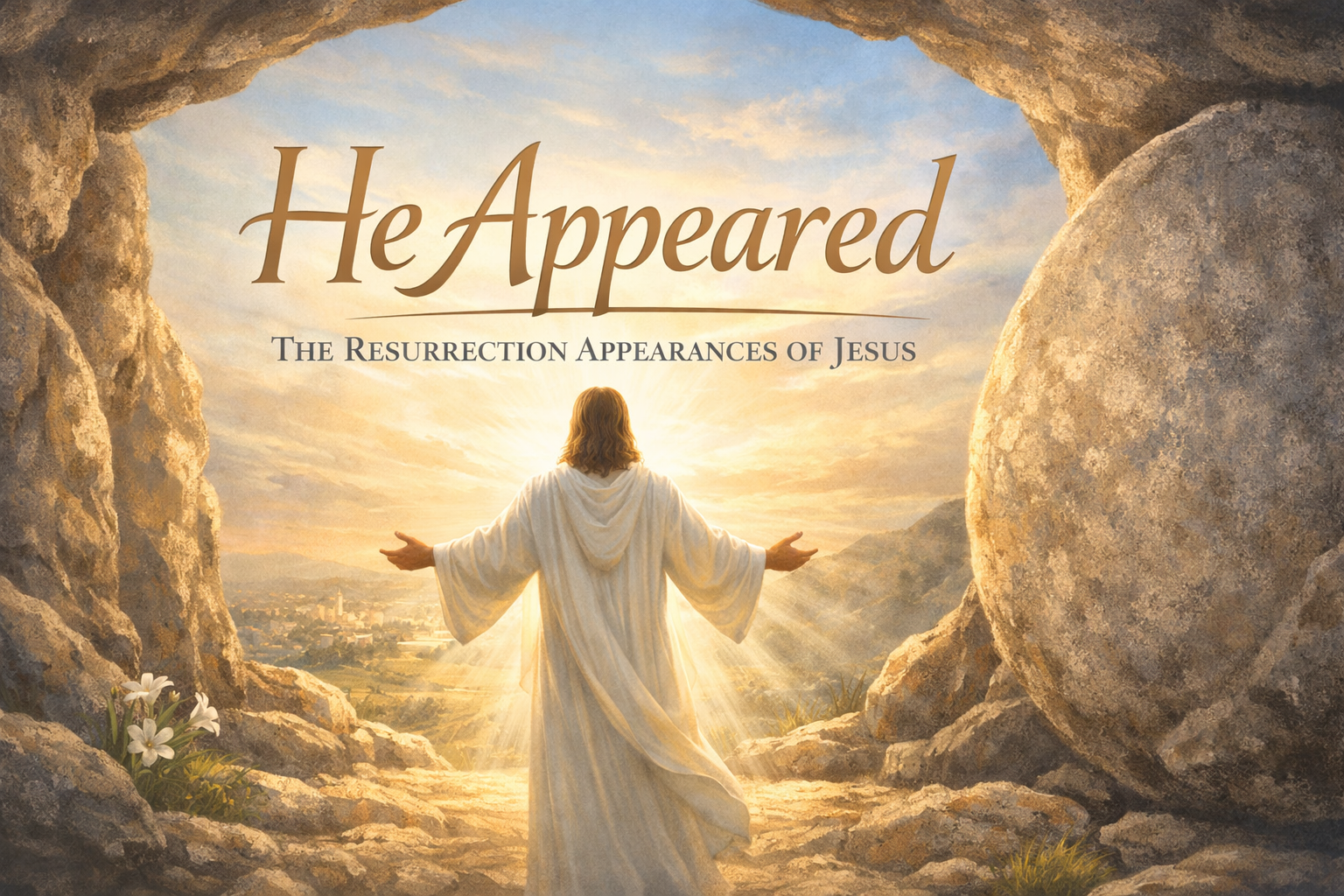
He Appeared: The Resurrection Appearances of Jesus
Easter Sunday gets all the attention. The stone rolled away. The empty tomb. The angels in white. The women running back to tell the others. It’s the hinge of human history, and rightly so.
But what happened next? What did the forty days between the Resurrection and the Ascension actually look like? Who did Jesus appear to, what did He say, and why does it matter that these appearances happened the way they did?
The post-resurrection appearances of Jesus are not a theological footnote. They are the bridge between an empty tomb and a world-changing movement. They are the reason a handful of frightened, scattered disciples became the boldest witnesses in history. And they are packed with detail that rewards careful attention.
Let’s walk through them — not as a theological checklist, but as a story. Because that’s what they are.
The First Witness: Mary Magdalene at the Tomb
The first person to see the risen Jesus wasn’t Peter. It wasn’t John. It wasn’t the inner circle of apostles who had walked with Him for three years. It was Mary Magdalene — a woman, standing alone outside the tomb, weeping.
That detail is theologically loaded and historically credible. In the first century, a woman’s testimony held no legal weight in a Jewish court. If the disciples had been manufacturing a resurrection story for public consumption, they would never have chosen women as the first witnesses. You don’t invent a story and then make it harder to believe by choice. The fact that all four Gospels name women as the first witnesses is one of the most underrated arguments for the historicity of the Resurrection.
John’s account in John 20:11–18 is the most intimate. Mary is weeping at the tomb when she turns and sees a figure she doesn’t recognize — until He says her name. “Mary.” That’s all. One word. And she knows immediately. She reaches for Him. He tells her not to cling to Him, that He has not yet ascended, and commissions her to go tell the disciples what she has seen.
“Jesus said to her, ‘Mary.’ She turned toward him and cried out in Aramaic, ‘Rabboni!’ (which means ‘Teacher’).” — John 20:16
This appearance establishes the pattern for everything that follows: the risen Jesus is real, He is recognizable, He speaks and is spoken to, and He sends people. He doesn’t appear just to be seen. He appears to commission.
The Road to Emmaus: He Opens the Scriptures
Later that same day, two disciples are walking from Jerusalem to Emmaus — a village about seven miles out. They are crushed. Their hope had died on a cross. And then a stranger falls in with them on the road.
Luke 24:13–35 gives us one of the most beautifully written narratives in all of Scripture. The stranger asks what they’re discussing, and they look at him with the exhausted disbelief of people who can’t believe anyone doesn’t already know. “Are you the only visitor to Jerusalem who does not know the things that have happened there in these days?” (Luke 24:18).
The stranger — who is Jesus, though their eyes are “kept from recognizing him” (Luke 24:16) — walks them through Moses and all the Prophets, explaining everything in the Scriptures concerning himself. Their hearts burn within them as He teaches. When they arrive at Emmaus, they urge Him to stay. He does. And at the table, when He breaks bread, their eyes are opened — and He vanishes.
This appearance tells us something critical: the risen Jesus didn’t just come back to prove He was alive. He came back to explain what His death and resurrection meant. He is a teacher to the end — and beyond it. The Scriptures had pointed to Him all along, and now He walks His followers through it personally.
There is also something deeply significant in the moment of recognition: the breaking of bread. The disciples on the road know Him not when He quotes Isaiah but when He breaks the loaf. The Eucharistic overtone is intentional. The risen Christ is still known in the breaking of bread.
Behind Locked Doors: He Brings Peace
That same evening, the disciples are gathered together in Jerusalem. The doors are locked. They are afraid — afraid of the Jewish authorities, afraid of what had happened, afraid of the reports from Mary and the women that morning that the tomb was empty and something had happened that none of them quite knew what to do with.
Then Jesus appears in the room. Not through the door. Not after someone opened it. He is simply there.
“Peace be with you.” — John 20:19
The first words He speaks to the gathered disciples in His risen body are not “Where were you?” or “Why did you run?” They are peace. He shows them His hands and His side — the wounds are still there, still real, still identifiable. They are overjoyed. Then He says it again: “Peace be with you.” And He commissions them: “As the Father has sent me, I am sending you” (John 20:21). He breathes on them and says, “Receive the Holy Spirit.”
Thomas isn’t there that night. When the others tell him what happened, he refuses to believe it. You know what Thomas says — it’s become famous for all the wrong reasons. “Unless I see the nail marks in his hands and put my finger where the nails were, and put my hand into his side, I will not believe” (John 20:25).
Thomas gets a reputation as the weak one. But his demand isn’t unusual — it’s human. And Jesus doesn’t shame him for it. A week later, He appears again in the same locked room and goes straight to Thomas. “Put your finger here; see my hands. Reach out your hand and put it into my side. Stop doubting and believe” (John 20:27).
Thomas falls apart: “My Lord and my God!” (John 20:28). That’s not the language of a man who thinks he’s seeing a ghost or a vision. That’s the confession of someone confronted with the undeniable. And Jesus doesn’t correct him. He accepts it — because it’s true.
Breakfast on the Beach: He Restores the Broken
Some time later — we don’t know exactly when — several disciples have gone back to Galilee. Peter, Thomas, Nathanael, the sons of Zebedee, and two others have gone fishing. They fish all night and catch nothing. At dawn, a figure on the shore calls out and tells them to throw the net on the right side of the boat. They do, and the net comes up so full they can barely haul it in.
John, recognizing what’s happening, says to Peter, “It is the Lord.” And Peter, because he is Peter, jumps in the water and swims to shore (John 21:7).
Jesus has a charcoal fire going. Fish cooking. Bread ready. He feeds them breakfast. The whole scene is almost unbearably tender — the risen Lord of Creation, cooking fish on a beach at dawn for tired, confused fishermen.
Then comes the most important part. Three times, Jesus asks Peter: “Simon, son of John, do you love me?” (John 21:15–17). Three times — once for each denial. Peter had failed catastrophically in the courtyard of the high priest, denying Jesus three times beside a charcoal fire. Now, beside another charcoal fire, Jesus gives him three chances to affirm his love. And three times, He commissions Peter: “Feed my lambs. Take care of my sheep. Feed my sheep.”
This appearance is the pastoral heart of the Resurrection story. The risen Jesus doesn’t just forgive — He restores. He doesn’t just take Peter back — He gives him back his purpose. The very man who had failed the most publicly is the one Jesus publicly reinstates. No one is too broken. No failure is too big. That’s the message on the beach.
Five Hundred at Once: The Undeniable Witness
The Gospels record multiple individual appearances and appearances to small groups, but Paul gives us the most astonishing data point in 1 Corinthians 15:3–8. Writing within twenty-five years of the crucifixion — in a letter to a church he had personally planted — Paul recites what scholars recognize as one of the earliest creeds of the Christian church, one he himself received probably within three to five years of the events:
“He appeared to Cephas, and then to the Twelve. After that, he appeared to more than five hundred of the brothers and sisters at the same time, most of whom are still living, though some have fallen asleep. Then he appeared to James, then to all the apostles, and last of all he appeared to me also.” — 1 Corinthians 15:5–8
Five hundred people, at the same time. And Paul adds — almost as a challenge — that most of them are still alive. He is essentially saying: go ask them. This is not the language of legend-building. You don’t invite your readers to cross-examine five hundred living witnesses if you are making things up.
The appearance to James is equally striking. James, the brother of Jesus, was not a follower during Jesus’ ministry. The Gospels tell us plainly that Jesus’ own brothers did not believe in him (John 7:5). After the resurrection, James becomes a pillar of the Jerusalem church and ultimately its leader — and he dies for his faith. Something happened to James. The most natural explanation is the one he gave: he saw his brother, risen from the dead.
The Ascension: He Leaves Them On Mission
The final appearance recorded in the Gospels and in Acts is the Ascension — forty days after the Resurrection, on the Mount of Olives outside Jerusalem. The disciples are gathered. Jesus gives them the Great Commission (Matthew 28:18–20), the promise of the Holy Spirit (Acts 1:8), and then rises until a cloud takes Him from their sight.
Two angels appear and ask the disciples why they are standing there looking up into the sky. It’s a gentle nudge — almost amused. Don’t just stand here staring. You have work to do.
The Ascension is not the end of Jesus’ story. It is the beginning of the next chapter. He sits at the right hand of the Father (Hebrews 1:3), intercedes for His people (Romans 8:34), and will return — bodily, visibly, in the same manner He left (Acts 1:11). The disciples who watched Him go would spend the rest of their lives pointing to that moment as the reason for everything they believed and everything they suffered for.
What the Appearances Tell Us
Taken together, the post-resurrection appearances of Jesus form a picture that is remarkably coherent and remarkably specific. He ate food (Luke 24:42–43). He was touched (John 20:27). He cooked (John 21:9). He taught from the Scriptures (Luke 24:27). He breathed on people (John 20:22). He was sometimes not immediately recognized — and then suddenly was.
This is not the profile of a ghost or a hallucination. Hallucinations don’t cook breakfast. Visions don’t carry the scars of real wounds. And mass psychological experiences don’t happen to five hundred people simultaneously in an era before social contagion could be spread through screens and algorithms.
The resurrection body of Jesus was real — physical, tangible, continuous with the body that had died — and yet transformed. Paul calls it a “spiritual body” in 1 Corinthians 15:44, not meaning it was immaterial, but that it was fully animated by and subject to the Spirit of God. It was what our bodies will one day be.
That last sentence is important. The appearances aren’t just evidence for a past event. They are a preview of a future one. Christ’s resurrection is the firstfruits — the first instance of what is coming for all who are in Him (1 Corinthians 15:20–23). When you read about Jesus eating fish on a beach or Thomas pressing his fingers into nail-scarred hands, you are reading about your future. A real body. A real world. A real restoration.
Why It Matters for How You Live Right Now
Paul makes the stakes uncomfortably clear: “If Christ has not been raised, your faith is futile and you are still in your sins” (1 Corinthians 15:17). Everything hangs on this. The Resurrection is not a bonus feature of Christianity — it is the engine.
But the appearances also speak to something more immediate than doctrine. They speak to how the risen Jesus deals with people. He finds Mary in her grief and speaks her name. He walks alongside two crushed disciples on a long road and explains everything they hadn’t understood. He meets a locked room full of fear with peace. He restores a man who had publicly failed him. He feeds tired fishermen breakfast before He gives them a mission.
He is the same yesterday, today, and forever (Hebrews 13:8). Which means He still does all of these things. He still speaks to the grieving. He still walks beside the confused. He still brings peace into locked rooms. He still restores the broken. He still feeds before He commissions.
The forty days aren’t ancient history. They are a window into how Jesus operates with His people — then, and now, and until He comes again.
Key Takeaways
- The appearances were physical, not visionary. Jesus ate, cooked, showed His wounds, and was touched. The resurrection body was real — transformed but bodily, a preview of the resurrection body promised to all believers.
- The witnesses were diverse, credible, and plentiful. Women, fishermen, skeptical brothers, and a former persecutor — plus five hundred at once. Paul’s public challenge to question these witnesses was not the move of a man constructing a myth.
- Jesus appears to restore, not just to prove. The beach breakfast with Peter shows us that the risen Lord’s first concern is not vindication but reconciliation. He meets failure with re-commissioning.
- Christ’s resurrection guarantees ours. 1 Corinthians 15:20–23 makes the logic explicit: He is the firstfruits. The appearances of the risen Jesus are not just historical evidence — they are a picture of the future that awaits everyone who belongs to Him.
- The Ascension is not an ending — it’s a launching. Jesus leaves His followers not abandoned but positioned: armed with the Great Commission, promised the Holy Spirit, and assured of His return. The disciples who watched Him rise were the same disciples who turned the world upside down.
Key Scriptures: John 20:1–21:25 · Luke 24:13–53 · 1 Corinthians 15:1–58 · Matthew 28:16–20 · Acts 1:1–11
Mountain Veteran Ministries
Find Your Next Bearing
Every journey needs a direction. If you're wondering where to go from here, choose the path that best fits where you are today.
⚒️ I Want to Live Faithfully
Discover practical wisdom for following Christ in today's world.
→ Living as a Christian Today✝️ I Want to Understand the Gospel
Learn what salvation means and why Jesus came.
→ Understanding Salvation📖 I Want to Understand the Bible
Explore why Christians trust Scripture and how to read it well.
→ Understanding the Bible❓ I Still Have Questions
Explore thoughtful answers to some of Christianity's hardest questions.
→ Hard Questions