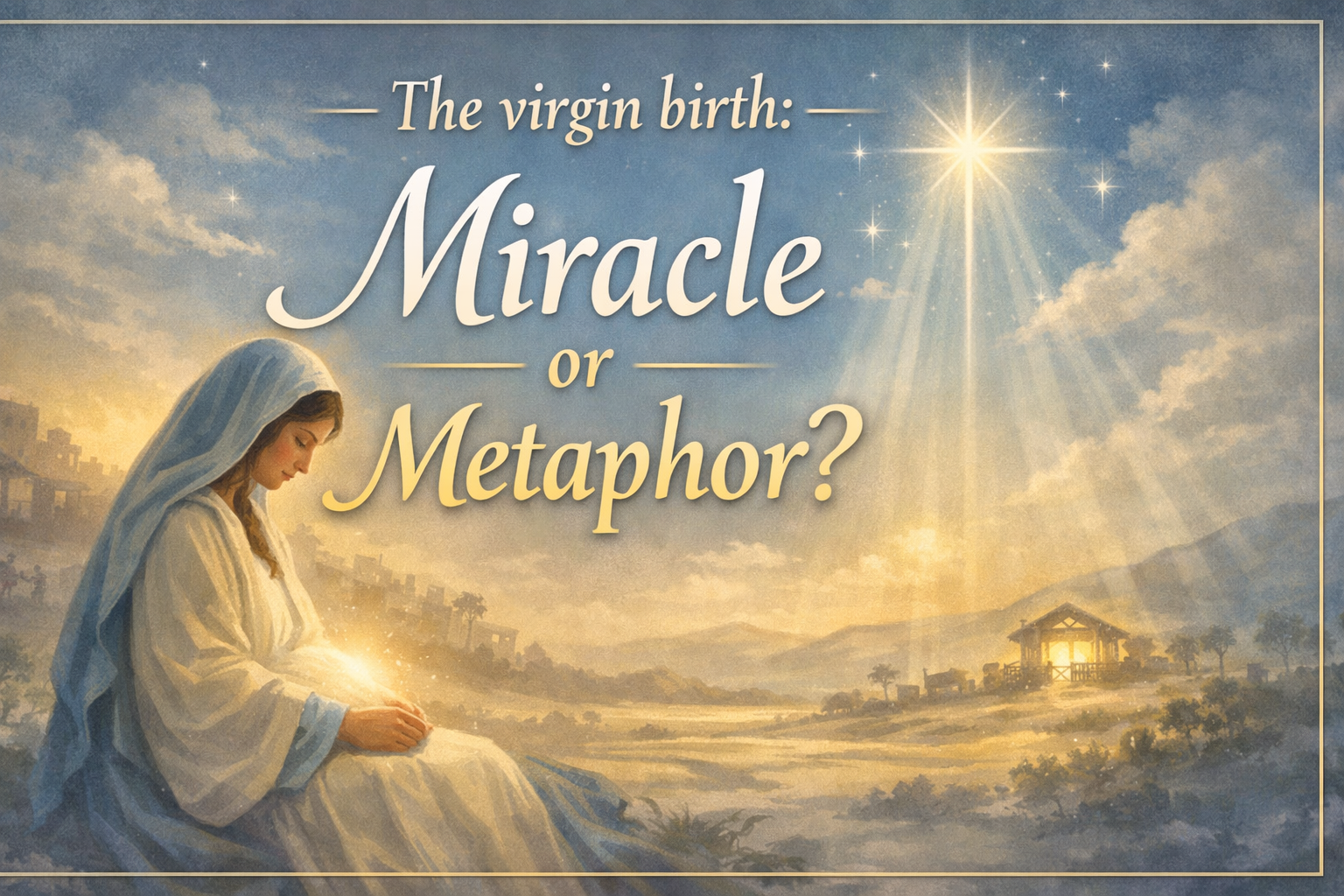
The virgin birth: miracle or metaphor?
The virgin birth is one of the doctrines that separates those who take the New Testament at face value from those who want a Christianity scrubbed clean of the supernatural. It is also one of the most historically attested and theologically loaded claims in the Christian faith. Getting it right is not a minor doctrinal housekeeping matter — it touches the nature of Christ, the reliability of Scripture, and the kind of God Christianity actually believes in.
Some theologians call it legend. The Apostles’ Creed calls it fact. The difference is not trivial — it is the difference between a Jesus who fits inside our categories and a Jesus who doesn’t.
Every Christmas the virgin birth gets a week or two of cultural attention, and every few years a theologian or journalist publishes something explaining why modern people don’t need to take it literally. The arguments tend to follow a predictable pattern: the birth narratives are late legendary additions, the word almah in Isaiah doesn’t actually mean virgin, Matthew and Luke were borrowing from pagan mythology, and sophisticated Christians have always understood these things as meaningful story rather than biological fact.
These arguments are not new. They have been answered carefully by serious scholars for more than a century. What is interesting is that they keep getting recycled as if the answers don’t exist — which suggests the motivation is less about historical investigation and more about the prior commitment to a Christianity that doesn’t require anything a naturalistic worldview can’t accommodate.
That prior commitment is the real issue. If you have already decided that miracles don’t happen — that the universe is a closed system of natural causes in which no divine intervention is possible — then the virgin birth is obviously false before you examine the evidence. But that is not a historical conclusion. It is a philosophical assumption being imposed on historical questions. The evidence deserves a fair hearing on its own terms.
What the Texts Actually Claim
Begin with what Matthew and Luke actually say, because the “metaphor” reading requires either ignoring the plain sense of the texts or arguing that the authors didn’t mean what they wrote.
Luke’s account is the more medically precise of the two. When the angel Gabriel tells Mary she will conceive and bear a son, Mary’s response is direct: “How will this be, since I am a virgin?” (Luke 1:34). The Greek word is andra ou ginōskō — literally, “I do not know a man.” It is not a statement of surprise that she is getting pregnant so soon. It is an explicit statement that she has had no sexual relationship that would make conception possible. Gabriel’s answer is equally explicit: “The Holy Spirit will come upon you, and the power of the Most High will overshadow you; therefore the child to be born will be called holy — the Son of God” (Luke 1:35). The mechanism is stated. The divine agency is identified. There is no ambiguity about what Luke is claiming.
Matthew’s account adds the legal and genealogical dimension. Joseph is described as a righteous man who, discovering Mary’s pregnancy before they had come together, was minded to divorce her quietly (Matthew 1:18–19). An angel appears to him in a dream and explains: “that which is conceived in her is from the Holy Spirit” (Matthew 1:20). Matthew then cites Isaiah 7:14 as fulfillment: “Behold, the virgin shall conceive and bear a son, and they shall call his name Immanuel” (Matthew 1:23).
Neither writer is telling a symbolic story. Both are presenting themselves as historians recording events. Luke explicitly opens his Gospel by saying he has “carefully investigated everything from the beginning” in order to write “an orderly account” so that his reader may know “the certainty of the things” he has been taught (Luke 1:1–4). A writer who announces his historical method at the outset is not inviting you to read his birth narrative as pious legend.
The Isaiah 7:14 Question
The most common scholarly objection to the virgin birth focuses on Matthew’s use of Isaiah 7:14. The argument runs like this: the Hebrew word in Isaiah is almah, which means “young woman,” not necessarily a virgin. The specific word for virgin in Hebrew is betulah. Matthew is using the Septuagint — the Greek translation of the Old Testament — which renders almah as parthenos, which does mean virgin. Matthew has been misled by the translation, or has deliberately stretched a text that was never about a miraculous birth in the first place.
This objection has a surface plausibility that dissolves under examination.
First, the word almah. It appears nine times in the Old Testament. In every case where the context allows for determination of the woman’s status, she is unmarried and presumably a virgin. There is not a single clear instance in the Hebrew Bible where almah refers to a non-virgin. The objection that almah doesn’t necessarily mean virgin is technically correct — the word focuses on youth and unmarried status rather than explicitly on virginity — but the same is true of the English word “maiden.” The connotation of virginity is embedded in the social context even when it is not the word’s primary semantic focus.
Second, the Septuagint translators — Jewish scholars working more than two centuries before Christ — chose parthenos, a word that unambiguously means virgin. They were not Christians with an agenda. They were Jewish scholars with native Hebrew competence who understood what Isaiah meant and rendered it accordingly.
Third, the passage in Isaiah 7 does have an immediate historical referent — a sign given to Ahaz in the eighth century BC — but the New Testament pattern of typological fulfillment means that a passage can have both an immediate application and a deeper, later fulfillment that the human author did not fully anticipate. Matthew is not claiming that Isaiah 7:14 had no meaning until the first century. He is claiming that the child born to Mary fulfills at a deeper level what the sign to Ahaz prefigured. That is a coherent hermeneutical move that appears throughout the New Testament’s use of the Old.
The Pagan Myth Parallel Objection
A second popular objection claims that the virgin birth is borrowed from pagan mythology — that stories of gods impregnating mortal women were common in the ancient world, and that the early Christians simply adapted the genre to give Jesus a suitably impressive origin story.
This argument collapses when you actually examine the parallel stories rather than the claim about them.
The pagan stories — Zeus and Alcmene, the divine conception of Alexander the Great, the birth of Augustus — involve gods taking physical form and engaging in sexual intercourse with women. They are stories of divine-human sexual encounter. The Gospel accounts describe nothing of the kind. The Spirit “overshadows” Mary — the same verb used in Exodus for the cloud of God’s glory over the tabernacle (Exodus 40:35). It is divine creative agency, not divine-human intercourse. The difference is not a minor detail. It is the entire point.
Furthermore, the pagan stories were well known in the first century. The Jewish audience for whom Matthew was primarily writing would have been acutely sensitive to any whiff of pagan mythological contamination. The virgin birth as Matthew presents it — conceived by the Holy Spirit, fulfilling the covenant promises of the Hebrew scriptures, born to a young Jewish woman betrothed to a descendant of David — carries none of the characteristics of the pagan genre. It reads as a sober historical account rooted in the Old Testament’s categories, not as an adaptation of Hellenistic mythology.
Why the Virgin Birth Theologically Necessary?
Even if you grant the historical arguments, a further question presses: Why does it matter? What is at stake theologically if Jesus was born the ordinary way?
Several things.
The incarnation required a unique entry point. The pre-existent Son of God taking on human nature is the most extraordinary event in the history of the cosmos. That the mode of His entry into human existence was itself extraordinary is exactly what you would expect. A virgin birth is not a strange add-on to the incarnation — it is the fitting beginning of it. The one who would be born of a woman while remaining the eternal Son of God was not going to arrive through an ordinary biological process, because He was not an ordinary human being.
The sinlessness of Christ connects to His origin. This requires care, because the virgin birth is not presented in Scripture as the mechanism by which Christ avoided original sin — the New Testament does not make that explicit connection. But the entire human race inherits its fallen nature through the normal processes of human generation going back to Adam. If Jesus entered that process entirely through normal generation, the question of how He escaped the consequences of the Fall that affect every other human being becomes significantly harder to answer. The virgin birth does not solve that problem by itself, but it marks the entry of the Son of God into humanity as something categorically different from every other human birth.
The identity of Jesus depends on it. If Jesus had a human father, He is a remarkable human being — teacher, prophet, moral exemplar — but the claim that He is the eternal Son of God made flesh loses its grounding. The angel’s explanation to Mary is explicit: the child will be called the Son of God precisely because of the manner of His conception (Luke 1:35). Strip away the virgin birth and you have a Jesus whose sonship must be redefined as something metaphorical or adoptive — which is exactly what liberal theology has consistently done, and which produces a Jesus who is insufficiently divine to accomplish what the New Testament claims He accomplished.
The credibility of Scripture is at stake. Matthew and Luke both record the virgin birth as historical fact. If they were wrong — if the virgin birth did not happen — then two of the four Gospels begin with error, and the question of what else they got wrong becomes unavoidable. The “metaphor” reading does not rescue the Gospel accounts — it concedes their historical unreliability while claiming to preserve their spiritual meaning. But a spiritual meaning detached from historical fact is not what the Gospel writers thought they were communicating.
The Early Church’s Universal Witness
One of the strongest arguments for the virgin birth is not textual but historical: the universal witness of the early church.
The Apostles’ Creed — likely crystallizing in its essential form in the second century — confesses that Jesus was “born of the Virgin Mary.” The Nicene Creed affirms He was “incarnate of the Holy Spirit and the Virgin Mary.” These are not late legendary accretions. They are the shared confession of the church across geographic and cultural boundaries from the earliest period for which we have documentation.
The church father Ignatius of Antioch, writing around AD 110 — within living memory of the apostles — affirmed the virgin birth explicitly as a real event. Justin Martyr defended it against pagan critics in the mid-second century. There is no early Christian tradition that treats the virgin birth as symbolic or legendary. The “metaphor” reading is a modern innovation with no ancient precedent in the Christian community.
The silence of opponents is also instructive. The Jewish and pagan critics of early Christianity attacked the birth narratives — but not by claiming they were legends invented by the church. They attacked them by proposing alternative explanations for a birth everyone acknowledged was unusual. The second-century Jewish polemic, recorded in various sources, claimed that Jesus was the illegitimate son of a Roman soldier named Panthera. That is an attempt to explain away the circumstances of the birth while conceding that the birth was indeed unusual. Critics who were motivated to destroy Christianity did not argue that the virgin birth was a borrowed myth. They argued about what actually caused it.
The Deeper Issue: What Kind of God?
At bottom, the resistance to the virgin birth is rarely about the historical evidence. It is about the prior question of what kind of God — if any — exists and what He is capable of doing.
If God created the universe from nothing, sustains it moment by moment by His power, and raised Jesus bodily from the dead — as Christianity claims — then a virgin conception is not a problem. It is a lesser miracle than any of those. The person who accepts the resurrection has no principled grounds for rejecting the virgin birth on the grounds that it’s too miraculous. The resurrection is a far greater intervention in the natural order, and it stands or falls on the same kind of historical evidence.
The theologians who want to retain a Christianity without the supernatural tend to work in the other direction as well — demythologizing the resurrection, redefining the atonement, softening the exclusivity of Christ. The virgin birth is usually one early station on a longer journey. Giving it up is rarely the end of the concessions.
For nothing will be impossible with God.
— Luke 1:37
That is the angel’s word to Mary when she asks how a virgin can conceive. It is also the answer to every objection rooted in the assumption that the natural order sets the limits of what God can do. A God who cannot act within His own creation is not the God of the Bible. And a Christianity built around that smaller God is not worth the name.
A Word to Veterans
Veterans are trained to evaluate intelligence — to assess what sources are credible, what evidence is reliable, what conclusions the facts actually support, and where someone is trying to sell you a conclusion the evidence doesn’t warrant. The ghost of prior assumptions dressing itself up as historical analysis is a recognizable pattern to anyone who’s been briefed on a situation where the conclusion was already decided before the facts were assembled.
The “metaphor” reading of the virgin birth follows that pattern. The objections — almah doesn’t mean virgin, Matthew borrowed from pagan myth, the birth narratives are late — sound like historical analysis but rest on a prior commitment: miracles don’t happen. Everything is filtered through that assumption before the evidence is examined, and the evidence that doesn’t fit gets explained away.
Apply the same standard to the virgin birth that you’d apply to any intelligence assessment. What do the primary sources actually say? What does the early witness of the community who had the most to lose by fabricating the claim look like? What alternative explanation fits the facts better? When you run that assessment honestly, the historical case for the virgin birth is stronger than its cultured despisers want to admit — and the case against it rests on a philosophical assumption, not a superior reading of the evidence.
Key Takeaways
- Matthew and Luke present the virgin birth as sober historical fact, not symbolic narrative. Luke explicitly announces his historical method at the outset. Both accounts describe specific people, specific conversations, and a specific mechanism — the agency of the Holy Spirit. There is no invitation to read them as legend.
- The almah objection does not hold up under examination. The word consistently carries the connotation of a young unmarried woman in the Old Testament. The Septuagint’s Jewish translators rendered it parthenos — unambiguously “virgin” — centuries before Christianity existed. Matthew’s use follows their lead, not a Christian agenda.
- The pagan myth parallel argument fails on inspection. Pagan divine-conception stories involve sexual intercourse between gods and women. The Gospel accounts describe the Holy Spirit’s creative overshadowing — the same verb used for God’s glory over the tabernacle. The genre, the mechanism, and the theological framework are entirely different.
- The virgin birth is theologically load-bearing, not decorative. It is the fitting entry point for the incarnation of the pre-existent Son, it marks the beginning of a human life that is categorically different from every other, and it is stated in Luke 1:35 as the explicit basis for the title “Son of God.”
- The early church’s universal witness is strong historical evidence. The Apostles’ Creed, Nicene Creed, Ignatius of Antioch, and Justin Martyr all affirm the virgin birth as historical fact with no dissenting voice from within the early Christian community. The “metaphor” reading is a modern innovation with no ancient Christian precedent.
- The real issue is the prior commitment to naturalism, not the historical evidence. If God exists and raised Jesus from the dead, a virgin conception is not a problem. The person who rejects the virgin birth on grounds of incredulity must explain why the resurrection — a greater miracle — escapes the same objection.
Key Scriptures: Luke 1:34–35 · Matthew 1:18–23 · Isaiah 7:14 · Luke 1:37 · John 1:14 · Galatians 4:4 · Hebrews 2:14 · Genesis 3:15 · Isaiah 9:6
Mountain Veteran Ministries
Find Your Next Bearing
Every journey needs a direction. If you're wondering where to go from here, choose the path that best fits where you are today.
⚒️ I Want to Live Faithfully
Discover practical wisdom for following Christ in today's world.
→ Living as a Christian Today✝️ I Want to Understand the Gospel
Learn what salvation means and why Jesus came.
→ Understanding Salvation📖 I Want to Understand the Bible
Explore why Christians trust Scripture and how to read it well.
→ Understanding the Bible❓ I Still Have Questions
Explore thoughtful answers to some of Christianity's hardest questions.
→ Hard Questions