Did the resurrection really happen?
The Question That Decides Everything
You can be wrong about a lot of things and it won’t ruin your life. Wrong about the best route to town. Wrong about the weather. Wrong about who won the game last Saturday. But there are questions where being wrong costs you everything. The resurrection is one of them.
The apostle Paul didn’t sugarcoat it: 1 Corinthians 15:17 — “if Christ has not been raised, your faith is futile and you are still in your sins.” Christianity doesn’t offer a comforting philosophy that works whether or not Jesus actually walked out of a tomb. It rises or falls on a historical event.
So did it happen? Not “is it meaningful to you?” Not “does it resonate spiritually?” Did a dead man actually rise from the grave in first-century Jerusalem? That’s the question. And it’s worth looking at honestly.
Start With What Almost Everyone Agrees On
Here’s something most people don’t know: historians — including skeptical ones who don’t believe Jesus rose — generally accept a core set of facts about what happened after the crucifixion. These aren’t “the Bible says so” claims. They’re conclusions drawn from multiple early sources, including non-Christian ones.
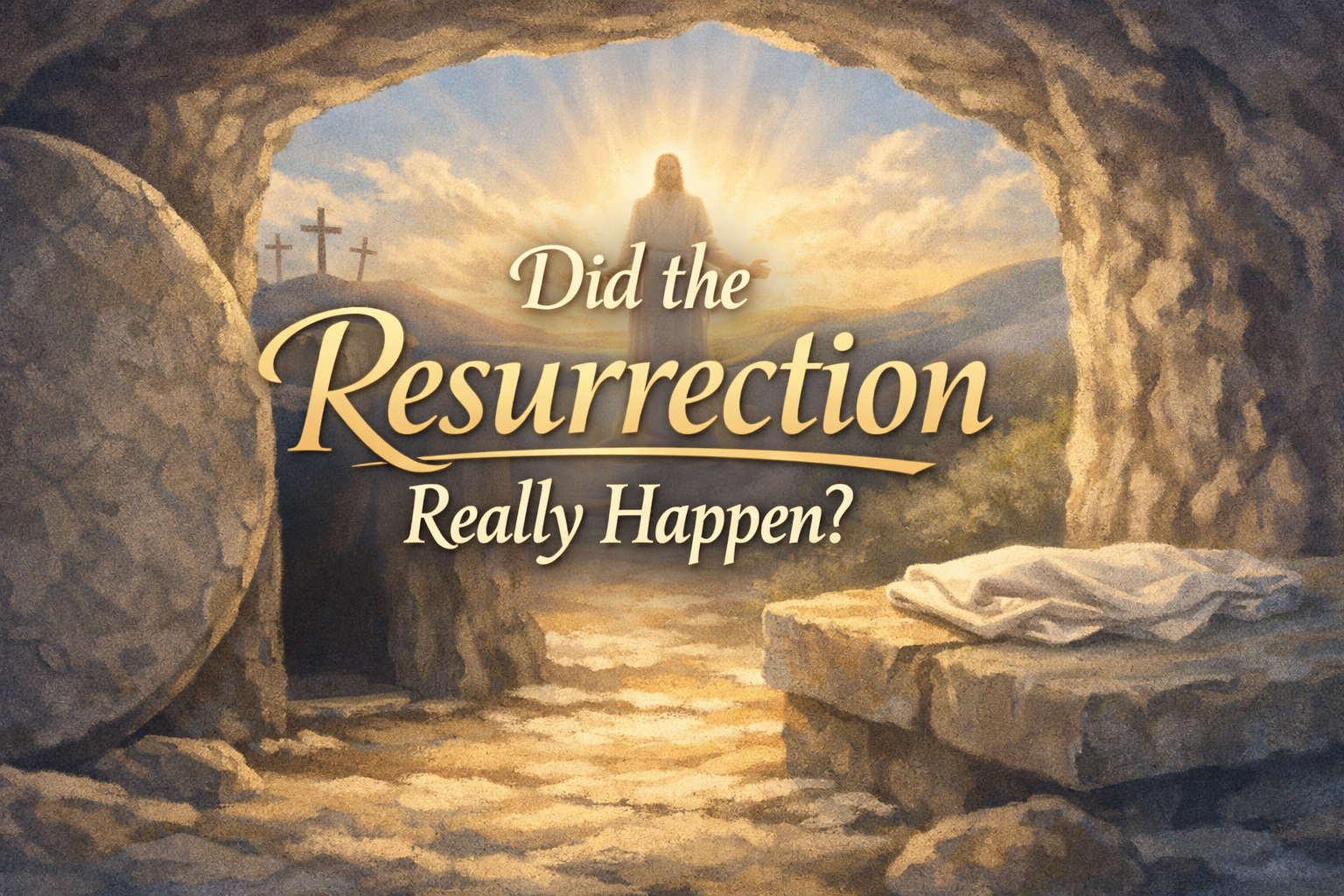
The tomb was empty. Three days after the crucifixion, the tomb where Jesus was buried was vacant. His body was gone. Even the Jewish religious leaders who had every reason to squash the resurrection story didn’t dispute the empty tomb — they just claimed the disciples stole the body (Matthew 28:11–15). You don’t invent a theft story if there’s still a body in the tomb.
The disciples claimed to see Jesus alive. Peter, James, John, Mary Magdalene, and dozens of others insisted they encountered a risen Jesus — not a vision, not a dream, but a physical person who ate food, showed his wounds, and talked with them. Paul, writing within 25 years of the crucifixion, mentions an appearance to more than 500 people at once (1 Corinthians 15:6).
The disciples were transformed. These were men who fled when Jesus was arrested. Peter denied him three times before a servant girl. Within weeks, they were preaching in the streets of Jerusalem — the same city where the execution happened — willing to die for what they claimed to have seen. They weren’t recanting under pressure. They were dying with the story still on their lips.
The church exploded in Jerusalem. Not in some remote city where the claims couldn’t be checked. Right there, in the same town, weeks after the crucifixion. Thousands were converting. If the resurrection was a lie, the evidence to refute it was a short walk away.
The Theories That Don’t Hold Up
If you’re going to reject the resurrection, you need an explanation that accounts for all of those facts — not just one of them. That’s where the alternative theories run into trouble.
The Disciples Stole the Body
This is the oldest alternative — first century old (Matthew 28:13). The problem is obvious: it requires the disciples to have knowingly fabricated the resurrection, then spent the rest of their lives suffering, being imprisoned, and dying for something they knew was a lie. People do sometimes die for beliefs that turn out to be false. They don’t die for things they personally invented and know to be false. The motivation evaporates completely.
“The disciples could have preached a risen Jesus from a safe distance, in a different country, among strangers. Instead they did it in Jerusalem, in front of eyewitnesses, in front of enemies — and they didn’t stop when it cost them everything.”
Jesus Didn’t Actually Die — The Swoon Theory
Maybe Jesus didn’t die on the cross. Maybe he just passed out, was mistakenly declared dead, and revived in the cool of the tomb. This theory was more popular in the 1800s than it is today, and for good reason — it doesn’t survive scrutiny.
Roman crucifixion was a professionally administered execution. The soldiers who performed it knew what a dead body looked like. John’s Gospel records that when the soldiers checked Jesus, they saw he was already dead and pierced his side with a spear to confirm it — producing blood and water, which is consistent with what happens to postmortem fluid separation (John 19:33–34). Beyond that: a man who had been flogged, crucified, and stabbed — and then “revived” in a cold stone tomb without medical care — would not emerge looking like a conqueror over death. He would emerge looking like he desperately needed a physician. That isn’t what the disciples reported.
The Disciples Were Hallucinating
Grief does strange things to people. Maybe the disciples wanted so badly to see Jesus alive that they experienced mass hallucinations. The problem is that hallucinations are private, individual experiences. They don’t appear to groups of five hundred people simultaneously. They don’t involve conversations, shared meals, or people touching wounds. And critically — hallucinations don’t produce an empty tomb. The body would still be there. No one produced it.
Paul’s account in 1 Corinthians 15:3–8 is especially significant here because he wrote it within a generation of the events, named specific living witnesses, and essentially said: go ask them. That’s not how you write mythology. That’s how you write history you’re confident will hold up.
The Wrong Tomb Theory
The women went to the wrong tomb in the dark, found it empty, and assumed resurrection. This one barely gets off the ground. Joseph of Arimathea, a member of the Sanhedrin, had personally donated his tomb and supervised the burial (Mark 15:43–46). The women watched where the body was laid (Luke 23:55). The tomb was known. The religious authorities who wanted to suppress the resurrection movement could have walked to the right tomb and produced the body. They didn’t. Because they couldn’t.
The Witnesses Who Had Every Reason to Lie the Other Way
When evaluating testimony, credibility increases when witnesses have nothing to gain — and decreases when they do. The resurrection witnesses are interesting because their testimony cost them, not benefited them.
James, the brother of Jesus, was a skeptic during Jesus’ ministry (John 7:5). He became one of the leaders of the Jerusalem church and was eventually killed for his faith. What changed him? Paul says James saw the risen Jesus (1 Corinthians 15:7). Skeptics don’t usually die for a story they invented about their own brother.
Paul himself is another striking case. He wasn’t a disciple. He was an active persecutor of the early church — educated, zealous, and vested in stopping the Jesus movement. Then something happened to him on the road to Damascus that he described as an encounter with the risen Christ (Acts 9:1–19). He went from persecutor to prisoner — imprisoned and eventually executed for the faith he once tried to destroy. No conversion like that makes sense without a real encounter with something.
And then there’s the women. In first-century Jewish culture, women were not considered reliable legal witnesses. If you were fabricating a resurrection story to be persuasive, you would not make women the first witnesses. You would invent male disciples as the primary eyewitnesses from the start. The fact that all four Gospels record women as the first at the empty tomb is exactly the kind of embarrassing detail that gets included when you’re reporting what actually happened, not what you wished had happened.
The Minimal Facts Argument
Scholars like Gary Habermas and Michael Licona have developed what’s called the “minimal facts” approach. Rather than starting with the assumption that Scripture is reliable, they ask: what facts about early Christianity are so well-attested — even by critical and skeptical historians — that virtually all scholars accept them? Then they ask: what explanation best accounts for those facts?
The facts are: Jesus died by crucifixion. His tomb was found empty. His followers claimed post-resurrection appearances. Those followers were transformed — willing to die for the claim. And hostile witnesses like James and Paul had dramatic conversions.
When you lay those facts out and ask what best explains all of them together, the bodily resurrection of Jesus is not a desperate last resort. It’s the most historically coherent explanation on the table.
“The resurrection is not accepted on blind faith against the evidence. It is accepted because the evidence, taken seriously, points there.”
What’s at Stake
If Jesus rose from the dead, then he is who he claimed to be. And that means his words carry authority over every other voice you’ve ever listened to — including your own. It means death is not the end. It means forgiveness for the worst things you’ve done is actually available. It means the Gospel is not a helpful story but a true one.
If he didn’t rise, then Paul was right — your faith is empty, you’re still in your sins, and Christians are, as he put it, “of all people most to be pitied” (1 Corinthians 15:19).
The stakes don’t get higher than that. Which is exactly why this question deserves more than a dismissive shrug. It deserves an honest look at the evidence.
Every major alternative theory fails to account for the full picture. The empty tomb, the eyewitness testimonies, the transformed disciples, the hostile witnesses who converted — none of the naturalistic explanations handle all of it. The resurrection does.
A man walked out of a tomb. The world hasn’t been the same since. And neither will you be, if you’re willing to take that seriously.
Key Takeaways
- The resurrection is a historical claim, not just a spiritual one. Christianity rises or falls on whether Jesus actually rose bodily from the dead — not on whether the idea is meaningful or comforting.
- The core facts are widely accepted even by skeptical historians. The empty tomb, post-resurrection appearances, the disciples’ transformation, and the rapid growth of the Jerusalem church are acknowledged across the scholarly spectrum.
- Every major alternative theory collapses under scrutiny. The theft theory, swoon theory, hallucination theory, and wrong tomb theory each fail to account for the full body of evidence.
- The witnesses had every reason not to lie. People die for beliefs they hold sincerely — not for stories they invented. The disciples, James, and Paul all suffered or died for their resurrection testimony.
- The minimal facts approach makes the case without assuming Scripture’s reliability. Starting from what even critical scholars accept, the resurrection remains the most historically coherent explanation of the data.
- The implications are total. If Jesus rose, his authority is absolute — over death, over sin, over every competing claim for your life. This is not a question you can stay neutral on forever.
Key Scriptures: 1 Corinthians 15:1–8, 17–19 · Matthew 28:1–15 · John 20:1–31 · Luke 24:36–43 · Acts 2:14–36 · Acts 9:1–22 · Mark 15:42–16:8
Mountain Veteran Ministries
Find Your Next Bearing
Every journey needs a direction. If you're wondering where to go from here, choose the path that best fits where you are today.
⚒️ I Want to Live Faithfully
Discover practical wisdom for following Christ in today's world.
→ Living as a Christian Today✝️ I Want to Understand the Gospel
Learn what salvation means and why Jesus came.
→ Understanding Salvation📖 I Want to Understand the Bible
Explore why Christians trust Scripture and how to read it well.
→ Understanding the Bible❓ I Still Have Questions
Explore thoughtful answers to some of Christianity's hardest questions.
→ Hard Questions