A Guide to Roman Catholicism, Orthodoxy, and Protestantism
Two billion people call themselves Christian. They worship on different days, pray in different postures, read from different canons, and disagree sharply about what saves a person and who speaks for God. Understanding the major divisions in Christianity isn’t a detour from faith — it’s essential to knowing what you actually believe and why.
A Plain-Spoken Guide to the Three Major Branches of Christianity
If you’ve spent any time around Christians, you’ve noticed they don’t all look the same. One group lights candles and venerates icons. Another thinks that’s dangerously close to idolatry. One traces its authority to the Pope in Rome. Another says the Pope has no more authority than any other man. One says Scripture alone is the rule of faith. Another says Scripture needs the Church to interpret it correctly. One prays to Mary. Another doesn’t.
These aren’t trivial aesthetic differences. They reflect deep, centuries-old disagreements about authority, salvation, sacraments, and the nature of the Church itself. If you’re going to understand Christianity — your own tradition or someone else’s — you need a working map of the major branches. This post gives you one.
A word up front: this is descriptive, not a verdict. Each tradition will be represented as its own members would recognize it. Where this post has a viewpoint — and it does — it will say so clearly rather than hide it in the framing.
How We Got Three Branches: The Short Version
Christianity began as a unified movement, but geographic, cultural, and theological pressures created fractures early. The first major split came in 1054 — the Great Schism — when the Western church centered in Rome and the Eastern churches centered in Constantinople formally broke communion over a set of disputes that had been building for centuries. Rome became Roman Catholicism. Constantinople and its network became Eastern Orthodoxy.
The second major split came in the 16th century. Martin Luther’s protests against Rome in 1517 ignited a reform movement that could not be contained. Within decades, Calvin in Geneva, Zwingli in Zürich, Cranmer in England, and Knox in Scotland were each leading distinct reform movements. What they shared — rejection of papal authority, insistence on Scripture as the supreme norm, and justification by faith alone — became the markers of Protestantism. The branches that grew from that movement now number in the thousands of denominations.
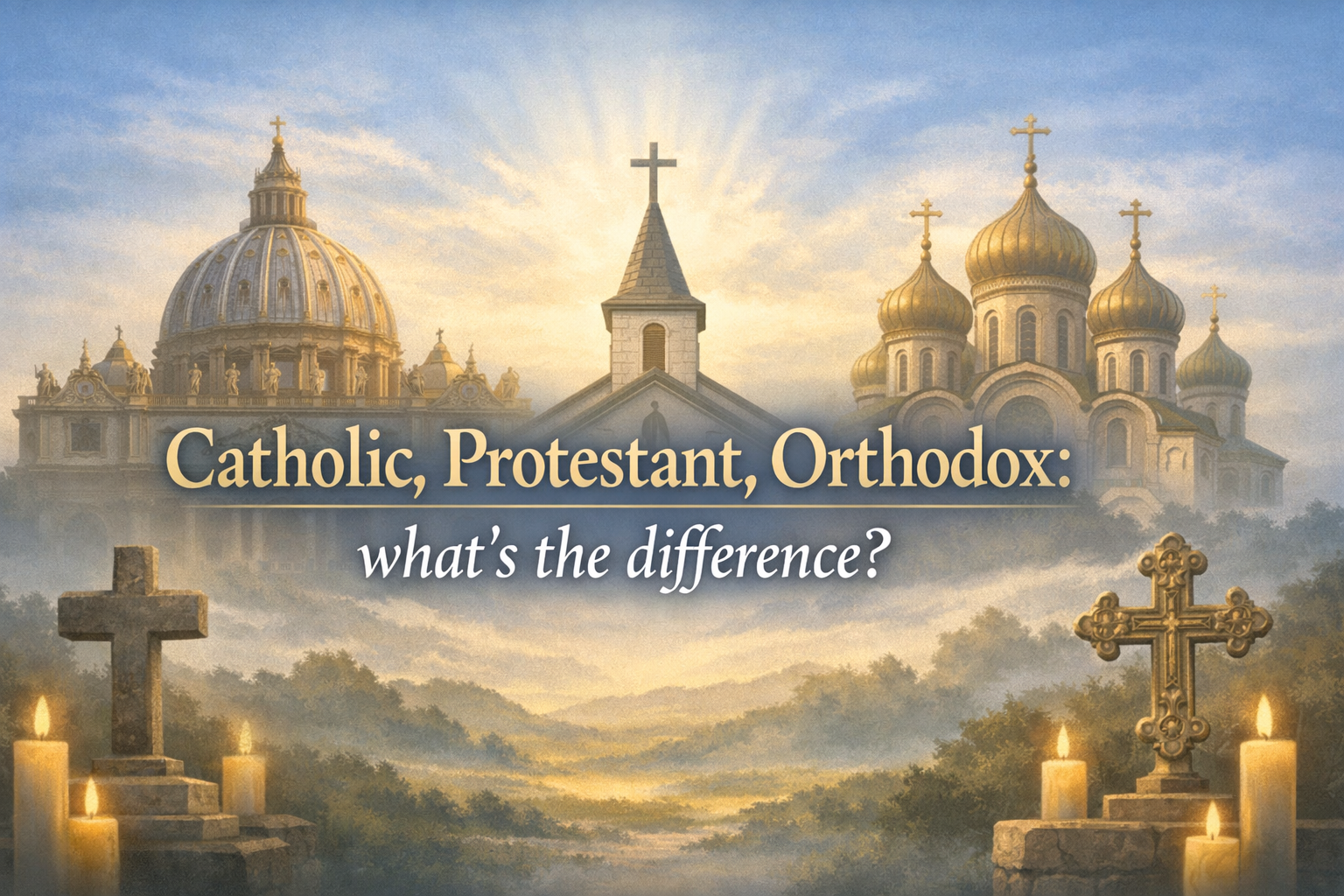
So the three major branches are Roman Catholicism, Eastern Orthodoxy, and Protestantism — each representing a distinct answer to the same core questions: Who speaks for God? What saves a person? What is the Church? What is Scripture?
Roman Catholicism
Authority
The Catholic Church’s central claim is continuity. It traces its authority through an unbroken line of bishops back to the apostles — and specifically traces the papacy to Peter, citing Matthew 16:18 as the founding charter: “You are Peter, and on this rock I will build my church.” The Pope, as Bishop of Rome and successor to Peter, holds the highest teaching authority in the Church. Under specific conditions — speaking officially on matters of faith and morals — that authority is considered infallible.
This means that for Catholics, authority has three legs: Scripture, Tradition, and the Magisterium (the Church’s teaching office). Scripture alone is not sufficient — it requires the Church’s authoritative interpretation. Tradition carries genuine doctrinal weight alongside Scripture. And the Magisterium, under the Pope, resolves disputes and defines doctrine.
Salvation
Catholic theology holds that salvation is a process, not a one-time event. Justification — being made right with God — begins at baptism, is sustained through the sacraments, and requires ongoing cooperation with grace. Faith is essential, but so are works formed by charity. The Council of Trent (1547), responding to the Protestant Reformation, formally anathematized the doctrine of justification by faith alone.
Catholics distinguish between mortal sin (which breaks the state of grace entirely and requires the sacrament of confession for restoration) and venial sin (which weakens but does not sever the relationship with God). Purgatory — a state of purification after death for those who die in God’s grace but not yet fully purified — is also a defined doctrine. Prayer for the dead and indulgences connect to this framework.
Sacraments and Worship
The Catholic Church recognizes seven sacraments: Baptism, Confirmation, Eucharist, Penance (Confession), Anointing of the Sick, Holy Orders, and Matrimony. The Eucharist is the center of Catholic worship. The doctrine of transubstantiation holds that the bread and wine at Mass become — in substance, not just symbolically — the actual body and blood of Christ. This is not metaphor. The Mass is understood as a re-presentation of the sacrifice of Calvary.
Mary holds a uniquely elevated place in Catholic devotion. Doctrines of the Immaculate Conception (Mary was conceived without original sin) and the Assumption (Mary was taken bodily into heaven) are defined dogmas. Prayers to Mary and the saints as intercessors are standard Catholic practice.
Eastern Orthodoxy
Authority
Orthodoxy shares with Catholicism the claim of apostolic succession and the weight given to Holy Tradition — the accumulated teaching, worship, and practice of the Church across centuries. Where it differs sharply is on papal authority. Orthodoxy has no Pope. Authority is held collegially by the bishops, with the Ecumenical Patriarch of Constantinople holding a primacy of honor (not jurisdiction) among equal patriarchs. Doctrinal decisions require an Ecumenical Council with reception by the whole Church.
Orthodox theology speaks much of theosis — deification — the ongoing process by which believers are transformed into the likeness of God. This shapes everything from their understanding of salvation to their approach to worship. The goal of the Christian life is not simply forgiveness but participation in the divine nature (2 Peter 1:4).
Salvation
Orthodox theology tends to frame salvation more in terms of healing and transformation than legal transaction. Where Western theology (both Catholic and Protestant) has often focused on guilt, payment, and justification, Orthodox theology emphasizes the corruption death brought to human nature and Christ’s work as the restoration of that nature. The Incarnation itself is salvific — God taking on human flesh began the healing of humanity.
This doesn’t mean Orthodoxy ignores forgiveness — it doesn’t. But the center of gravity is different. Salvation is theosis: becoming, by grace, what God is by nature. The sacraments, prayer, fasting, and the liturgical life of the Church are all understood as means by which that transformation occurs.
Sacraments and Worship
Orthodox worship is among the most ancient and formally structured in Christianity. The Divine Liturgy — still largely based on forms developed by John Chrysostom in the 4th century — is saturated with Scripture, chant, incense, and iconography. Icons are not decorations. They are understood as windows into the heavenly realm — the presence of the saint depicted made tangible. The Seventh Ecumenical Council (787 AD) defined the veneration of icons as orthodox and their rejection as heresy.
Orthodoxy also recognizes seven sacraments (called mysteries), with the Eucharist at the center. Like Catholicism, it holds a high view of the real presence of Christ in the Eucharist, though it deliberately avoids the philosophical language of transubstantiation in favor of mystery. Baptism, typically by full immersion, is immediately followed by Chrismation (equivalent to Confirmation) and first Communion — even for infants.
“Eastern Orthodoxy is the tradition most Western Christians know least. Its theology is ancient, its worship is otherworldly, and its answers to the central questions of faith are often startlingly different from what both Catholics and Protestants assume.”
Protestantism
Authority: Scripture Alone
The Reformation was fundamentally a dispute about authority. Luther’s stand at Worms — “my conscience is captive to the Word of God… here I stand, I can do no other” — was a declaration that no pope, no council, no tradition could override what Scripture plainly taught. Sola Scriptura — Scripture alone as the supreme norm and final authority for faith and practice — became the first of the five Solas of the Reformation.
This does not mean Protestants ignore tradition or that every believer interprets Scripture in isolation. The great Reformed confessions — the Westminster Confession, the Heidelberg Catechism, the Belgic Confession — show enormous respect for the early church fathers and the ecumenical councils. But tradition is always subject to correction by Scripture, not the other way around.
Salvation: By Grace Alone, Through Faith Alone
The theological heart of the Reformation was the recovery of justification by faith alone (Sola Fide). Luther called it “the article by which the church stands or falls.” The argument, drawn from Romans 3:21–26, Romans 4, and Galatians 2–3, is that sinners are declared righteous before God not by their works, not by the sacraments, not by a process of moral improvement, but by faith in Christ alone — whose righteousness is imputed (credited) to the believer.
This is not the same as saying works don’t matter. James 2 is in every Protestant Bible. The Reformers distinguished carefully: we are justified by faith alone, but the faith that justifies is never alone — it always produces genuine transformation and good works. Works are the fruit of salvation, not its root.
Grace alone (Sola Gratia) means that even the faith by which we are saved is itself a gift of God — not something we produce from within ourselves. Ephesians 2:8–9 is the Protestant proof text: “For by grace you have been saved through faith. And this is not your own doing; it is the gift of God, not a result of works, so that no one may boast.”
The Church and Sacraments
Protestantism is not monolithic. On the sacraments alone, the tradition fractures significantly. Luther held to a real (though not transubstantiation) presence of Christ in the Lord’s Supper — what he called sacramental union. Calvin held that Christ is spiritually and truly present through the Supper, received by faith. Zwingli held that the Supper is a memorial — a proclamation and remembrance, not a means of grace in itself. These three positions persist in different Protestant streams today.
Most Protestant traditions recognize two sacraments — Baptism and the Lord’s Supper — rather than seven, arguing the others lack a clear dominical institution (explicit command from Christ). Many baptize infants (Lutherans, Presbyterians, Anglicans, Methodists); many do not (Baptists, most evangelicals), holding that baptism properly follows a personal profession of faith.
The church, in Protestant theology, is defined by two marks in most Reformed confessions: the Word of God rightly preached, and the sacraments rightly administered. Authority is generally shared among elders or a congregation rather than concentrated in a hierarchy, though Anglican and Lutheran traditions retain episcopacy (government by bishops).
Where They Agree — and Why It Matters
The differences are real and significant. But so is the common ground, and in an age of skepticism it’s worth naming clearly.
All three traditions affirm the Nicene Creed — the triune God, the full deity and full humanity of Christ, the bodily resurrection, the coming judgment, and the life of the world to come. All three hold the Bible as the inspired Word of God (with different canons — Catholics and Orthodox include the deuterocanonical books that Protestants call the Apocrypha). All three practice baptism and some form of the Lord’s Supper. All three affirm that salvation is from God, not self-generated. All three hold that Jesus Christ is the only Savior.
These are not small agreements. They represent the core of historic Christian confession — the substance that all three streams received from the apostles, however differently they have developed it since.
Where This Post Stands
A plain-spoken note: this post comes from a Protestant, Reformed-leaning perspective. That means a few things are worth stating directly rather than hiding in neutral language.
The Protestant doctrine of justification by faith alone is not simply one option among equal others — it is the recovery of what Paul taught in Romans and Galatians, and what was obscured for centuries under layers of tradition and ecclesiastical authority. The Reformation was not a rupture with true Christianity. It was a return to it.
That said, the Catholic and Orthodox traditions are not dismissed here as false religions. They carry the creeds, the canon, the sacraments, and real saints who loved Jesus and died for him. The disputes are over matters that are genuinely serious — authority, the nature of justification, the role of tradition — and those disputes deserve honest engagement rather than cheap dismissal in either direction.
If you’re in one of these traditions and this post represents yours accurately but argues against it in places, that’s intentional and respectful. The goal is honest comparison, not polite fog.
“The most important question is not which branch of Christianity you’re in. It is whether you are trusting Christ alone for your standing before God — or trusting Christ plus something else. That question cuts across all three traditions.”
How to Use This Map
If you’re exploring Christianity from outside, this map tells you the terrain. The three major branches ask the same questions and give different answers. The best way to evaluate those answers is to go to the sources — read the New Testament, read the Reformation confessions, read the early church fathers — and test the claims against Scripture.
If you’re a Protestant wondering about your own tradition’s roots, the Reformation is worth understanding on its own terms — not as a rebellion but as a retrieval. The men and women who died for Sola Fide weren’t starting something new. They were recovering something old.
If you’re Catholic or Orthodox and this post has misrepresented your tradition somewhere, push back. These conversations are worth having with precision. The differences matter too much to be papered over with vague ecumenical goodwill — and too much to be settled by caricature.
Whatever tradition you’re examining, the standard remains: Acts 17:11 — the Bereans “received the word with all eagerness, examining the Scriptures daily to see if these things were so.” That posture serves every tradition well.
Key Takeaways
- The three branches trace to two historical splits. The Great Schism (1054) divided East from West; the Reformation (16th century) divided Protestantism from Rome. Each split turned on real and serious theological disagreements, not merely politics or personalities.
- The deepest disagreement is about authority. Catholicism grounds authority in Scripture, Tradition, and the Magisterium. Orthodoxy grounds it in Scripture and Holy Tradition interpreted by councils. Protestantism grounds it in Scripture alone as the supreme norm — with tradition valued but always subject to correction.
- Salvation looks different in each tradition. Catholicism frames it as a process through faith, sacraments, and works. Orthodoxy centers it on theosis — transformation into the divine likeness. Protestantism insists on justification by grace alone through faith alone in Christ alone — a forensic declaration, not a process.
- All three affirm the Nicene Creed and the core of historic Christian confession. The triune God, the full deity and humanity of Christ, the bodily resurrection, and the final judgment are common ground. This is not nothing — it is the heart of the faith.
- The sacraments divide as much as anything else. How many, what they do, whether Christ is present in the Eucharist and in what sense, and who may receive them — these questions generate sharp disagreements within and between all three traditions.
- The most important question transcends the branches. Are you trusting Christ alone for your righteousness before God — or Christ plus your cooperation, your sacramental participation, your moral progress? That question is the one the Reformation forced, and it is still the right one to ask.
Key Scriptures: Matthew 16:18 · Romans 3:21–26 · Galatians 2:16 · Ephesians 2:8–9 · 2 Peter 1:4 · Acts 17:11 · 2 Timothy 3:16–17 · 1 Corinthians 11:23–26
Mountain Veteran Ministries
Find Your Next Bearing
Every journey needs a direction. If you're wondering where to go from here, choose the path that best fits where you are today.
⚒️ I Want to Live Faithfully
Discover practical wisdom for following Christ in today's world.
→ Living as a Christian Today✝️ I Want to Understand the Gospel
Learn what salvation means and why Jesus came.
→ Understanding Salvation📖 I Want to Understand the Bible
Explore why Christians trust Scripture and how to read it well.
→ Understanding the Bible❓ I Still Have Questions
Explore thoughtful answers to some of Christianity's hardest questions.
→ Hard Questions