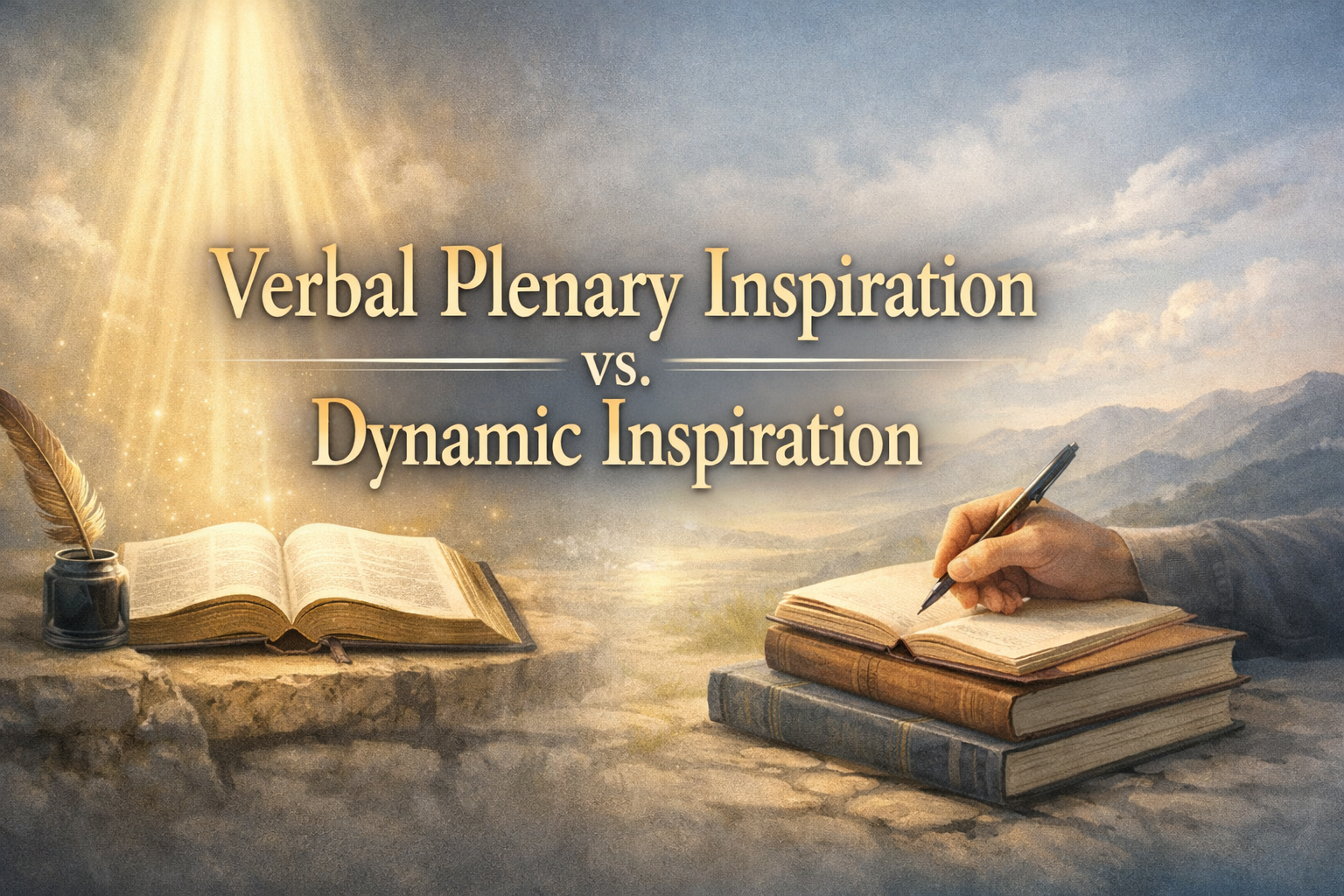
Verbal plenary inspiration vs. dynamic inspiration
When you open your Bible, what exactly are you holding? Most Christians would say “the Word of God” — and mean it sincerely. But push a little deeper and the answers diverge sharply. Did God inspire the actual words of Scripture, down to the vocabulary and grammar? Or did He inspire the writers — their thoughts, their message, their encounter with divine reality — while leaving the words themselves as human products? That’s not an ivory-tower debate. It determines how you read, how you preach, how you handle a difficult text, and ultimately what kind of authority Scripture actually holds over your life.
The doctrine of inspiration is foundational. Everything else you believe about Scripture — its authority, its reliability, its usefulness for doctrine and correction and training in righteousness — rests on what you think inspiration actually means. And within the broad evangelical tradition, two positions have dominated the conversation: verbal plenary inspiration and dynamic inspiration. They are not the same. They are not close to the same. And the distance between them has real consequences.
This post lays out both views, takes their strongest arguments seriously, and then explains why verbal plenary inspiration — the historic position of the church — is both more faithful to Scripture’s own testimony about itself and more coherent as a theological account of how an infinite God could give finite human beings His word.
Verbal Plenary Inspiration: The Historic Position
Verbal plenary inspiration holds that God so superintended the process by which the biblical authors wrote that the resulting text — the actual words of Scripture in the original languages — is the product of both divine and human authorship. Every word is genuinely the word of the human author. And every word is genuinely the word of God.
Two adjectives carry the weight of the doctrine. Verbal means the inspiration extends to the words themselves, not merely to the ideas behind them. Plenary means the inspiration extends to the whole of Scripture — not just the theologically significant portions, not just the parts that feel elevated or prophetic, but all of it.
This is the position affirmed in the Chicago Statement on Biblical Inerrancy (1978), endorsed by a broad coalition of evangelical scholars, and reflected in the confessional standards of most Reformed, Baptist, and broadly evangelical denominations. It is not a late innovation. It is continuous with how the church has understood Scripture from its earliest centuries.
Crucially, verbal plenary inspiration does not collapse into mechanical dictation — the idea that God simply used the human authors as secretaries, overriding their personalities and producing a kind of divine telegram. The human authors wrote as themselves. Paul sounds like Paul. Luke sounds like Luke. The literary differences between the Synoptics, the Johannine style, the pastoral warmth of Philemon versus the theological density of Romans — all of these are real and are products of real human authors writing from their own personalities, vocabularies, and experiences. The doctrine holds that God’s superintendence was so sovereign that it worked through those human particularities rather than around them, producing texts that are simultaneously and fully both divine and human.
“The Bible is the Word of God in such a way that when the Bible speaks, God speaks.” — B.B. Warfield, The Inspiration and Authority of the Bible
The Biblical Case for Verbal Inspiration
The primary texts are well known but deserve careful attention rather than casual citation.
2 Timothy 3:16–17 — “All Scripture is breathed out by God and profitable for teaching, for reproof, for correction, and for training in righteousness, that the man of God may be complete, equipped for every good work.” The Greek word translated “breathed out” is theopneustos — God-breathed. It applies to Scripture itself, the written text, not merely to the writers or the writing process. The text, as text, is the product of divine breath.
2 Peter 1:20–21 adds the human side of the equation: “no prophecy of Scripture comes from someone’s own interpretation. For no prophecy was ever produced by the will of man, but men spoke from God as they were carried along by the Holy Spirit.” The image of being “carried along” — the same word used for a ship driven by wind in Acts 27:15 — describes a controlled movement. The men were real agents. The Spirit was the sovereign mover.
Jesus himself treated the words of Scripture with a precision that assumes verbal inspiration. In Matthew 22:31–32, He builds an argument about the resurrection on the present tense of a verb in Exodus 3:6 — “I am the God of Abraham” — not “I was.” The tense of a single verb carries the whole argument. In John 10:35, He closes an argument with “the Scripture cannot be broken” — not “the main message of Scripture,” not “the theological core,” but Scripture itself, as text, as unbreakable.
Paul in Galatians 3:16 makes a theological argument hinge on the singular rather than plural of a single noun — “to your offspring” (singular), not “offsprings” (plural). You cannot do that kind of exegesis if inspiration is only a general divine influence on ideas. You can only do it if the words themselves carry divine weight.
Dynamic Inspiration: The Liberal Alternative
Dynamic inspiration — also called concept inspiration or thought inspiration — takes a different view. On this account, God inspired the biblical writers: their minds, their spiritual perception, their encounter with divine reality. But the words they used to express that inspiration are human words, produced by human beings in human contexts, carrying all the limitations, cultural assumptions, and occasional errors that human production implies.
The appeal of this position is obvious. It appears to resolve the tension between biblical inspiration and the findings of historical criticism. If the words are human words, then apparent historical discrepancies, scientific-sounding statements that seem to conflict with modern cosmology, and morally difficult passages in the Old Testament can be acknowledged frankly as human limitations in the expression of genuine divine truth. God gave the truth; the human authors packaged it imperfectly.
This position became dominant in mainline Protestant seminaries through the 19th and 20th centuries, and it continues to be the working assumption of much academic biblical scholarship. It is also the position, in softer or harder versions, of many who would still call themselves evangelical — people who affirm the inspiration of Scripture while treating its words as open to correction, revision, or cultural-historical relativizing.
“Inspiration guarantees the religious and theological purpose of Scripture but does not extend to matters of science, history, or culturally conditioned moral frameworks.” — A representative statement of dynamic inspiration, common in mainline theological education
The Problems with Dynamic Inspiration
Dynamic inspiration faces several serious, interconnected problems — and they compound rather than stand independently.
The separation of thought from word is philosophically incoherent. Language is not a transparent container that holds thoughts the way a cup holds water. Thought and language are bound together. There is no “idea” that exists in pristine, pre-linguistic form that can then be expressed in better or worse words. The words are the thought, at least in the form in which it is communicable. To say God inspired the thought but not the words is to say God inspired something that cannot be accessed apart from the words — which means the words carry the full weight of inspiration whether dynamic inspiration intends that or not.
It produces a canon with no principled boundary. If inspiration is a quality of the writers rather than the text, on what basis do we say these 66 books are Scripture and not others? Many deeply spiritual men and women have written about God across the centuries — Augustine, Calvin, Wesley, Spurgeon. Were they not also inspired in some meaningful sense? What distinguishes the biblical authors’ inspiration from theirs? The verbal plenary position has a clear answer: the text itself, as text, is God-breathed. Dynamic inspiration has no parallel answer that doesn’t collapse into subjectivity.
It gives the reader interpretive authority over the text. Once you’ve granted that the words are human and fallible, you’ve handed the reader — or the church, or the scholar — the authority to decide which parts reflect genuine divine truth and which parts are cultural limitation. That judgment cannot itself come from Scripture, since Scripture’s testimony to itself is now in question. It has to come from somewhere outside Scripture — reason, tradition, experience, historical criticism. The text is no longer the authority. The reader’s judgment about which parts of the text are authoritative is the authority. That is a fundamental inversion.
It cannot account for how Scripture treats Scripture. Jesus, Paul, and the New Testament authors treat the Old Testament as binding, precise, and verbally authoritative in ways that dynamic inspiration cannot accommodate. Paul’s argument in Galatians 3 on a singular noun. Jesus’s argument in Matthew 22 on a verb tense. These are not appeals to the general religious message of the Old Testament. They are appeals to words. If Jesus and Paul treated Old Testament words as carrying divine weight at the level of singular nouns and verb tenses, a theory of inspiration that locates divine authority only in ideas and not in words has a significant problem.
The Concursive Operation of God and Man
The hardest question for verbal plenary inspiration is genuine: how does God inspire specific words through specific human authors without either overriding the human personality (which contradicts the observable literary diversity of Scripture) or limiting God to whatever the human author happened to produce (which would make the claim of verbal inspiration merely retrospective rather than actually meaningful)?
The classical answer is what theologians call the concursive operation of divine and human authorship. God’s sovereign providence so ordered the lives, experiences, vocabularies, literary habits, and writing circumstances of the biblical authors that when they wrote as themselves — freely, genuinely, humanly — they produced precisely what God intended. No override. No robot. But also no accident and no limitation on God’s communicative intent.
This is analogous — though not identical — to the way Reformed theology understands the relationship between divine sovereignty and human freedom more broadly. God does not produce His ordained outcomes by canceling human agency. He produces them through it. The biblical authors were not less themselves for being inspired. They were, in the fullest sense, exactly themselves — and that is what God used.
“The Spirit did not work upon the authors of Scripture from outside, as a foreign force, but from within, stimulating their own thinking and guiding their own willing and speaking.” — Herman Bavinck, Reformed Dogmatics, Vol. 1
Bavinck’s point is important. The inspiration is not external compulsion. It is internal superintendence — God working through the full humanity of the authors to produce a text that is simultaneously fully theirs and fully His. The Incarnation provides an analogy: Jesus is fully divine and fully human, with no diminishment on either side. Scripture, as the written Word, shares something of that double nature — though the analogy must not be pressed too far.
What About the Human Marks in Scripture?
Verbal plenary inspiration does not require pretending that Scripture has no human marks. It has plenty. Luke explicitly researched his Gospel (Luke 1:1–4). Paul distinguishes his own judgment from a direct word of the Lord in 1 Corinthians 7:12. The Psalms are saturated with personal experience, raw emotion, and occasionally imprecatory fury. Ecclesiastes is a sustained exercise in the limits of human wisdom under the sun.
None of these human marks are problems for verbal plenary inspiration. They are features — the human texture through which God chose to communicate. The doctrine doesn’t flatten Scripture into a uniform divine telegram. It affirms that the full humanity of Scripture — its poetry, its narrative craft, its personal letters, its apocalyptic imagery, its wisdom literature conventions — is the vehicle of divine communication, not an obstacle to it.
What verbal plenary inspiration does require is that these human marks are not errors in the sense of the text asserting what is false. The doctrine of inerrancy — closely related but technically distinct from inspiration — holds that the original autographs of Scripture, in affirming what they affirm, do not err. That claim has its own set of nuances and qualifications, but it follows naturally from the claim that when Scripture speaks, God speaks. A God who speaks falsely is not the God of Scripture.
The Practical Difference in the Pulpit and the Pew
The stakes here are not merely academic. The difference between these views plays out every week in how pastors preach and how congregations read their Bibles.
A dynamic inspiration framework quietly trains readers to evaluate Scripture rather than submit to it — to ask “is this part the culturally conditioned human layer or the genuine divine truth?” That question, once introduced, cannot be easily contained. It expands. It applies to ethical commands that are uncomfortable, to doctrinal statements that seem narrow, to historical claims that seem improbable. The authority of Scripture becomes conditional on the reader’s ongoing judgment about which parts are really authoritative.
A verbal plenary framework trains readers differently. The text, as text, is God’s word. The preacher’s task is not to identify which parts of the text are truly divine and present those to the congregation. The preacher’s task is to handle the full text of Scripture with the skill and care that God’s word deserves — “rightly handling the word of truth” (2 Timothy 2:15). Every word of the text is on the table. Every word carries weight. Every word, carefully interpreted in its context, has something to say.
That doesn’t make interpretation easy or simple. It doesn’t eliminate the need for careful historical and grammatical work, for attending to genre and context, for humility about difficult passages. But it does mean the preacher and the congregation come to the text as people under its authority rather than people evaluating its authority. That difference, over years and decades, shapes souls in fundamentally different directions.
A Word About Honest Difficulty
Verbal plenary inspiration does not require pretending that every passage of Scripture is easy or that every apparent tension resolves neatly. There are genuinely hard texts. There are passages that have occupied the best biblical scholars for centuries without full resolution. The honest answer to some exegetical problems is “I don’t know yet.” But “I don’t know yet” is not the same as “this must be a human error.” Intellectual humility about difficult texts is appropriate. Preemptively attributing difficulty to human fallibility rather than to our own limits as interpreters is not.
Key Takeaways
- Verbal plenary inspiration means God inspired the words, not just the ideas. Verbal = the words themselves. Plenary = all of them, across all of Scripture. This is the historic position of the church and the natural reading of Scripture’s own testimony about itself.
- Dynamic inspiration locates inspiration in the writers, not the text. The resulting words are human products — genuine but fallible, which means the reader must evaluate which parts carry divine authority. That evaluation cannot itself come from Scripture.
- 2 Timothy 3:16 applies theopneustos to the text, not the writers. “All Scripture is God-breathed” — the written text itself is the product of divine breath. This is the cornerstone biblical text, and it doesn’t allow the inspiration/words distinction dynamic theory requires.
- Jesus and Paul exegete Old Testament words with verbal precision. Arguments hinging on a singular noun (Galatians 3:16) and a verb tense (Matthew 22:31–32) are only meaningful if the words themselves carry divine authority. Dynamic inspiration cannot account for this kind of exegesis.
- The concursive operation of divine and human authorship resolves the apparent tension. God’s sovereign providence worked through the full humanity of the biblical authors — their personalities, vocabularies, and experiences — to produce texts that are simultaneously fully human and fully divine.
- Dynamic inspiration’s separation of thought from word is philosophically incoherent. There are no pure ideas that exist independently of the words in which they are expressed. Inspiring the thought without inspiring the words is inspiring something inaccessible.
- The practical difference is massive. Verbal plenary inspiration places the reader under the authority of the text. Dynamic inspiration places the reader above it, as the judge of which parts are genuinely authoritative. Over time, those two postures produce very different kinds of Christians.
Key Scriptures: 2 Timothy 3:16–17 · 2 Peter 1:20–21 · Matthew 5:17–18 · Matthew 22:31–32 · John 10:35 · Galatians 3:16 · Luke 1:1–4 · Psalm 19:7 · Psalm 119:89 · Isaiah 40:8 · Hebrews 4:12
Mountain Veteran Ministries
Find Your Next Bearing
Every journey needs a direction. If you're wondering where to go from here, choose the path that best fits where you are today.
⚒️ I Want to Live Faithfully
Discover practical wisdom for following Christ in today's world.
→ Living as a Christian Today✝️ I Want to Understand the Gospel
Learn what salvation means and why Jesus came.
→ Understanding Salvation📖 I Want to Understand the Bible
Explore why Christians trust Scripture and how to read it well.
→ Understanding the Bible❓ I Still Have Questions
Explore thoughtful answers to some of Christianity's hardest questions.
→ Hard Questions