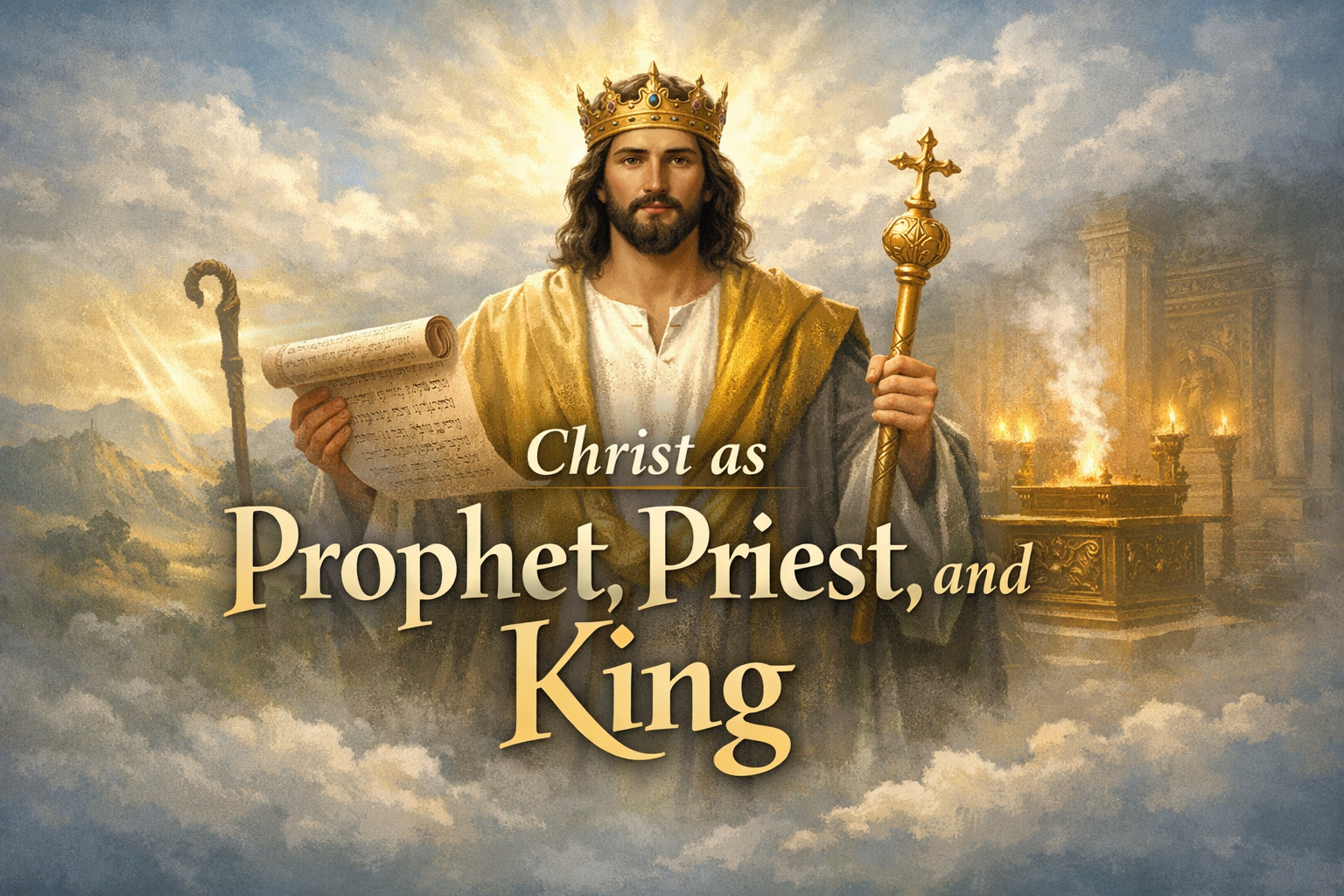
Christ as Prophet, Priest, and King
The Bible gives Jesus a lot of titles. Lamb of God. Son of Man. Word made flesh. Alpha and Omega. But one of the oldest and most structurally important frameworks the Church has used to understand who Jesus is and what He came to do organizes His entire ministry under three offices: Prophet, Priest, and King. This isn’t a theological novelty — it’s woven into the Old Testament itself. Understanding it changes how you read your Bible, how you pray, and how you relate to Christ right now.
One of Scripture’s oldest frameworks for understanding who Jesus is — and why every believer stands before God as a prophet, priest, and king in Him.
If you’ve spent any time in a Reformed catechism — the Westminster Shorter, the Heidelberg, the Belgic Confession — you’ve encountered the threefold office of Christ. The Latin term is munus triplex: three offices, one person, one redemptive mission. Christ came as Prophet, Priest, and King.
What makes this framework so durable is that it didn’t originate with Calvin or with Aquinas or with any medieval theologian. It’s embedded in the structure of the Old Testament itself. The problem Israel kept running into — age after age, king after king — was that no single person could hold all three offices faithfully at once. Prophets spoke truth but held no throne. Priests made atonement but couldn’t lead armies. Kings ruled but had no access to the Most Holy Place. Israel needed someone who could do all three — perfectly, simultaneously, and permanently.
Jesus is that someone.
The Old Testament Setup
To understand the offices Christ fulfills, you first have to understand how they worked — and failed — in Israel’s history.
Prophets were God’s mouthpiece. Their job was to speak His word to His people, calling them back to covenant faithfulness, announcing judgment and redemption, and pointing forward to what God was going to do. But the prophets were often rejected, killed, and ignored. And every prophet, even the greatest, was finite — one voice in one generation, unable to be present with every person who needed to hear God’s word.
Priests were the mediators between a holy God and a sinful people. They offered sacrifices, interceded for the nation, and maintained the system of worship that allowed Israel to dwell in proximity to God’s presence. But every sacrifice had to be repeated. Every priest eventually died. The blood of bulls and goats could never, as the writer of Hebrews puts it, take away sins (Hebrews 10:4). The whole Levitical system was a holding pattern — a sign pointing toward something it could not itself accomplish.
Kings were meant to be God’s vice-regents — ruling His people with justice, leading them in faithfulness, and extending His dominion. But Israel’s royal history is a case study in failure. Saul was rejected. David sinned catastrophically. Solomon accumulated wives and horses and foreign gods. The divided monarchy ended in exile. Even the best kings — Hezekiah, Josiah — died and their reforms died with them. The prophets kept promising a king who would be different: one from David’s line whose kingdom would have no end (Isaiah 9:6–7), who would rule in righteousness (Jeremiah 23:5–6), who would shepherd God’s people rather than exploit them (Ezekiel 34:23–24).
Into that long history of partial fulfillment and compound failure, Jesus steps.
Christ the Prophet
The Office: Speaking God’s Word
A prophet’s fundamental task is to mediate God’s word to God’s people — not opinions, not speculation, but authoritative revelation from the source. Moses was the paradigmatic prophet, and in Deuteronomy 18:15–18 he promised that God would raise up another prophet like him. That text echoes through the New Testament as a messianic expectation: the crowds at the feeding of the five thousand say, “This is indeed the Prophet who is to come into the world” (John 6:14). Peter quotes it directly in Acts 3:22 as fulfilled in Jesus.
But Jesus doesn’t fulfill the prophetic office by simply delivering God’s words, the way Moses did. He IS the Word (John 1:1, 14). His teaching carries an authority that the scribes conspicuously lacked — He says “You have heard it said… but I say to you” (Matthew 5), speaking as one who doesn’t merely transmit the law but embodies and interprets it with final authority. Hebrews opens by marking this transition: “In the past God spoke to our ancestors through the prophets at many times and in various ways, but in these last days he has spoken to us by his Son” (Hebrews 1:1–2).
Christ’s prophetic office does not end at His ascension. The Holy Spirit, whom Christ sends, continues His prophetic work in the Church — teaching, convicting, guiding into all truth (John 16:13). The preaching of the Word is, in a real sense, the ongoing exercise of Christ’s prophetic office through human instruments. When the gospel is proclaimed faithfully, Christ is speaking.
This has a direct implication for how we read Scripture. The Bible is not a record of what people thought about God. It is the Word of the Prophet who is the Word — breathed out by the Spirit of Christ (2 Peter 1:21), authoritative because its ultimate author stands behind and above every human author. To sit under Scripture is to sit under Christ’s prophetic instruction.
Christ the Priest
The Office: Mediating Between God and Man
The priest’s work has two directions: sacrifice (offered toward God on behalf of the people) and intercession (prayers and mediation on behalf of those he represents). The Levitical priesthood did both — every day, through the regular offerings; dramatically, once a year, when the high priest entered the Most Holy Place on the Day of Atonement.
Hebrews is the New Testament’s sustained argument that Jesus is the high priest the entire Levitical system was pointing to. He is a priest “after the order of Melchizedek” (Psalm 110:4, Hebrews 5–7) — not descended from Levi, but holding a priesthood that predates and supersedes the Mosaic system. His priesthood is permanent because He lives forever. His sacrifice is unrepeatable because it accomplished what every previous sacrifice could only symbolize.
The heart of the priestly office is substitution. The priest stands in the place of the people before God. Christ does this not by presenting an external animal sacrifice but by offering Himself — His own body and blood — as the once-for-all propitiation for sin (1 John 2:2, Hebrews 9:26–28). The language of Isaiah 53 is saturated with priestly imagery: “He was pierced for our transgressions, crushed for our iniquities; the punishment that brought us peace was on him, and by his wounds we are healed.” The servant bears what the people deserved. That is the priestly logic.
But Christ’s priestly work didn’t end on the cross. He ascended and sat down at the right hand of the Father — not to rest from priesthood but to exercise it in its intercessory dimension. Romans 8:34 says He “is at the right hand of God and is also interceding for us.” Hebrews 7:25 says He “always lives to make intercession” for those who come to God through Him. Right now, at this moment, Christ is before the Father as our advocate — presenting His atoning work as the basis of our standing.
This is the pastoral lifeblood of the Christian faith. When 1 John 2:1 says “if anyone sins, we have an advocate with the Father — Jesus Christ the righteous one” — that is the priestly office in action. The believer’s access to God is not earned by personal righteousness. It rests entirely on the interceding High Priest who has already presented the only sacrifice that actually counts.
Christ the King
The Office: Ruling with Justice and Power
The kingly office is the most immediately obvious of the three to anyone who reads the Gospels and the Epistles. Jesus is introduced in Matthew’s genealogy as the Son of David — the heir to the royal line (Matthew 1:1). The Magi come seeking the King of the Jews (Matthew 2:2). His triumphal entry into Jerusalem is a deliberate enactment of Zechariah 9:9, the prophecy of the humble king. The charge nailed above His cross reads: “The King of the Jews.” And His resurrection commission opens with the declaration that “all authority in heaven and on earth has been given to me” (Matthew 28:18).
There is a tension in the New Testament’s royal language, and it’s intentional. Christ’s kingdom is “not of this world” (John 18:36) in the sense that it does not operate by the power structures and coercive mechanisms of earthly kingdoms. But it is absolutely real and absolutely present. He reigns now. 1 Corinthians 15:25 says He must reign “until he has put all his enemies under his feet.” That reign is underway.
The Davidic covenant in 2 Samuel 7 promised David a son whose throne would be established forever. Every subsequent king in Israel failed that promise in some way. Psalm 2 pictures the nations raging against God’s anointed king and God laughing — because the Anointed One will ultimately inherit the nations. Psalm 110 describes a king who is also a priest, sitting at God’s right hand until his enemies are made his footstool. The New Testament quotes Psalm 110:1 more than any other Old Testament verse because it is the definitive statement of Christ’s present and coming reign.
Christ’s kingship means He rules His Church — not as an absent landlord but as an active head (Ephesians 1:22–23, Colossians 1:18). The Church does not govern herself by majority vote or cultural consensus. She is under a King whose word, delivered through Scripture, is the final authority. That is simultaneously a comfort and a challenge: comfort because the King is good and wise; challenge because it means conforming our preferences and practices to His rule rather than the other way around.
It also means that His kingship is universal, not tribal. The ascended Christ is Lord of lords and King of kings (Revelation 17:14, 19:16). Every government, every power structure, every nation operates within a cosmos that belongs to Him. The Church’s mission — making disciples of all nations — is the advance of the King’s domain into every corner of human life and culture.
Why the Three Offices Belong Together
It’s tempting to treat the threefold office as three separate topics to cover and then move on. But the power of the framework is precisely that the three offices are inseparable in Christ — and that the failure to hold them together distorts our understanding of the gospel.
A Christ who is only Prophet — only teacher and revealer — gives us a moral exemplar but no atonement. He can show us the way but cannot clear the path. This is the error of theological liberalism: reduce Jesus to a great teacher, strip out the blood, and you have an inspiring figure with no power to save.
A Christ who is only Priest — only the one who makes sacrifice — gives us a transaction without a message or a throne. We need to hear His word as well as receive His blood. And we need a living King who reigns over the community He redeemed, not just a one-time payment with no ongoing authority.
A Christ who is only King — only the triumphant ruler — can become a distant sovereign whose conquest we celebrate but whose cross we minimize. The kingdom without the cross produces triumphalism without grace. The glory of the King is inseparable from the wounds of the Priest.
Jesus is all three, always, simultaneously. He reveals. He redeems. He reigns.
You Share These Offices in Christ
Here’s something that often gets missed in this discussion: the threefold office doesn’t just describe what Christ does for us. It describes what we are called to be in Him.
Prophets: Peter calls the Church “a royal priesthood, a holy nation” (1 Peter 2:9) — a people who “proclaim the excellencies of him who called you out of darkness into his marvelous light.” Every believer is called to speak the truth of God’s Word into the world — not as an ordained office, but as a fundamental identity. You carry the prophetic word into every room you enter.
Priests: The same verse calls you “a royal priesthood.” You have direct access to God through Christ — no human mediator required. And you are called to intercede: to bring the needs of others before God, to stand in the gap for your family, your church, your community. Prayer is priestly work.
Kings: Revelation 5:10 says Christ “has made us a kingdom and priests to our God, and they shall reign on the earth.” The calling to steward creation, to pursue justice, to build and cultivate and work — all of this participates in the kingly dignity Christ shares with His people. We are not waiting to matter. We matter now, in the ordinary exercise of faithful dominion under our King.
Living Under the Threefold Lord
What does it look like, practically, to live under a Christ who is Prophet, Priest, and King?
It means treating Scripture as more than a devotional aid. It is the ongoing instruction of the Prophet who speaks with final authority. When you open your Bible, you are not merely reading ancient texts — you are sitting under the teaching of the one who said “Heaven and earth will pass away, but my words will not pass away” (Matthew 24:35).
It means going to God in prayer with boldness rather than apology. You have a High Priest who has already cleared your way into the throne room. Hebrews 4:16 is an invitation, not an aspiration: “Let us therefore come boldly to the throne of grace, that we may obtain mercy and find grace to help in time of need.” You are not an uninvited guest. You come through the Priest who is always there before you.
It means living as a citizen of a kingdom that is already established — not working to earn one, not waiting for one to begin, but living faithfully within one that has a King on the throne right now. The decisions you make about your work, your money, your family, your community are not theologically neutral. They are acts of either faithfulness or unfaithfulness to the King whose domain includes all of it.
Prophet. Priest. King. Learn these categories well. They are one of the best maps the Church has ever drawn for navigating who Jesus is and why it matters that He is all three.
Key Takeaways
- The threefold office is rooted in the Old Testament. Israel’s prophets, priests, and kings each partially fulfilled roles that only Christ could hold completely and permanently — the munus triplex is a biblical framework, not a theological invention.
- Christ the Prophet is the Word who speaks the word. He doesn’t merely deliver God’s message — He is God’s ultimate self-communication. Scripture is His ongoing prophetic instruction to His Church.
- Christ the Priest accomplishes what the entire Levitical system only symbolized. His once-for-all sacrifice removes sin; His ongoing intercession at the Father’s right hand maintains our standing before God right now.
- Christ the King reigns presently, not merely eschatologically. All authority has already been given to Him. The Church lives under an active King whose word governs her life and whose mission advances into every domain of human existence.
- The three offices must be held together. A Prophet without a Priest produces moralism; a Priest without a King produces mere transaction; a King without a Prophet produces authoritarianism without revelation. Jesus is irreducibly all three.
- Believers share in Christ’s threefold office. We are a royal priesthood — called to proclaim (prophetic), intercede (priestly), and exercise faithful stewardship of creation (kingly) as those united to Christ by faith.
- This framework changes how we read the Bible, pray, and live. Scripture is prophetic instruction. Prayer is priestly access. Daily faithfulness is kingly service. The threefold office is not academic theology — it is a map for everyday Christian life.
Mountain Veteran Ministries
Find Your Next Bearing
Every journey needs a direction. If you're wondering where to go from here, choose the path that best fits where you are today.
⚒️ I Want to Live Faithfully
Discover practical wisdom for following Christ in today's world.
→ Living as a Christian Today✝️ I Want to Understand the Gospel
Learn what salvation means and why Jesus came.
→ Understanding Salvation📖 I Want to Understand the Bible
Explore why Christians trust Scripture and how to read it well.
→ Understanding the Bible❓ I Still Have Questions
Explore thoughtful answers to some of Christianity's hardest questions.
→ Hard Questions