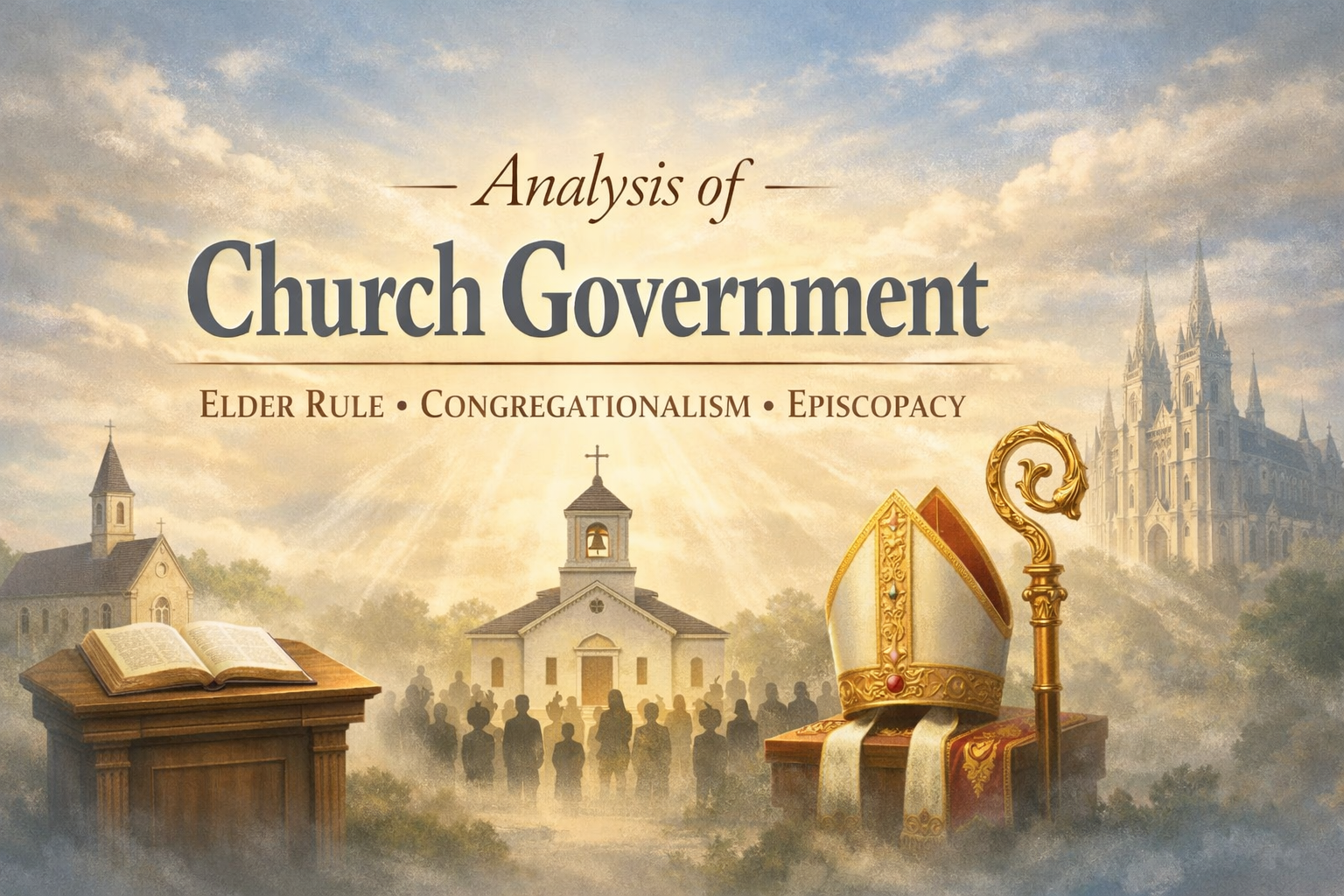
Analysis of Church Government — Elder Rule, Congregationalism, Episcopacy
Church government sounds like a dry subject — until you realize it reaches right into the life of the church. It determines who leads, who makes decisions, how accountability works, and how the congregation holds together when things get hard. Three broad models have shaped Christian thinking on this for centuries: elder rule, congregationalism, and episcopacy. Each one is asking the same question: How has Christ ordered His church to be led?
It reaches right down into the life of the congregation. It affects who leads, who makes decisions, how accountability works, how doctrine is protected, and how peace is kept when things get rough. In plain terms, church government answers this question: How has Christ ordered His church to be led?
Good people can love the same Lord, believe the same gospel, and still land in different places on this question. That is worth acknowledging up front. But the question is not one we can wave off, because the church is not ours to arrange any old way we please. If Jesus is the Head of the church, then the way His church is governed ought to reflect His wisdom and His Word.
Historically, three broad patterns have shaped most Christian thinking on this:
- Elder rule — the church is led by a plurality of qualified elders
- Congregationalism — final authority rests with the gathered congregation
- Episcopacy — oversight extends through bishops beyond the local church
Each one is trying, in its own way, to answer the same question: who holds responsibility under Christ for the oversight of the church? Let’s walk through them one by one.
Elder Rule
The Church Led by a Plurality of Qualified Shepherds
Elder rule is the view that Christ governs His church through a body of spiritually qualified elders who are responsible for teaching, shepherding, guarding doctrine, and overseeing the life of the congregation.
In the New Testament, many understand the offices of elder, pastor, and overseer to refer to the same basic shepherding role, with each word stressing a different angle on the work — “elder” pointing to maturity, “overseer” pointing to supervision, “pastor” pointing to the shepherd’s care for the flock. Passages like Acts 14:23, Acts 20:17–28, Titus 1:5–9, and 1 Peter 5:1–3 show elders being appointed in churches and charged with caring for those congregations.
The heart of elder rule is this: the church should be shepherded by a plurality of qualified men, rather than centered on one-man control on one end, or direct democracy alone on the other. This model is common in Presbyterian churches, many Reformed Baptist congregations, and other elder-led traditions.
Strengths: One major strength is shared oversight. A church is less likely to become the personal kingdom of one strong-willed leader if several qualified elders are involved — that helps guard against pride, impulsive decisions, and isolation. Elder rule also takes seriously the New Testament’s emphasis on mature, doctrinally grounded leadership that can protect the flock from error. And it tends to provide stability; decisions are not supposed to swing with every mood in the room.
In plain country terms, elder rule says the church ought not be driven by the loudest voice in the barn, nor by whichever way the wind blows that Sunday afternoon. It ought to be shepherded by tested men who know the Word and care for souls.
Dangers: Elder rule can turn into elder domination if it is not handled biblically. Elders are shepherds, not little kings. If leadership becomes closed, unapproachable, or overly controlling, the model becomes heavy-handed. Some churches may speak of plurality but in practice still revolve around one man while the others nod along. And if elders are not careful to cultivate trust and transparency, ordinary members may feel too far removed from meaningful responsibility. Elder rule works best when elders truly act like shepherds under Christ — not owners of the flock.
Congregationalism
The Church Carrying Responsibility Together
Congregationalism is the view that final earthly authority in a local church rests with the gathered congregation. Leaders still matter greatly — but the whole body has a real role in major decisions, such as receiving members, exercising discipline, and in many cases choosing leaders.
This model is common among Baptists and many free churches. Congregationalists point to passages like Matthew 18:15–17, where the church as a body is involved in discipline, and 1 Corinthians 5, where the congregation is expected to act together. They also note that letters in the New Testament are often addressed to whole churches, not merely to their leaders.
The heart of congregationalism is this: Christ entrusts meaningful responsibility to the whole local body, not just to a ruling class above it. It does not mean every person has equal wisdom or equal gifting — but it does mean the congregation bears accountability before Christ for the doctrine and life of the church.
Strengths: Congregationalism reminds the church that it is not made up of spectators. Members are not merely there to fund the ministry and watch the leaders work — they are part of the body and share in its responsibility. It also provides structural protection against unchecked pastoral authority. And it fits naturally with the New Testament’s emphasis on the priesthood of all believers — every Christian, indwelt by the Spirit, belongs to Christ and has a share in the life of the church.
In plain talk, congregationalism says the sheep are not brainless and the family of God is not supposed to hand all responsibility to a handful of men while everybody else stays half asleep.
Dangers: The danger of congregationalism is that it can slide into pure democracy, where truth starts to function like something to be voted on rather than received from God. A congregation can become driven by popularity, personal grievances, family alliances, or emotional reactions — where decisions are governed by numbers and pressure rather than Scripture and maturity. And if every serious matter becomes a floor fight, the church can wear itself out. Congregationalism works best when the congregation is well taught, spiritually serious, and glad to follow faithful leadership while still taking genuine responsibility for the life of the church. At its best it is not mob rule — it is a spiritually responsible church led by faithful shepherds.
Episcopacy
The Church Connected by Wider Oversight
Episcopacy is the view that the church is governed by bishops who hold oversight over ministers and often over multiple congregations within a region. The term comes from the Greek word episkopos, commonly translated “overseer.”
This model appears in Anglican, Methodist (in modified forms), Eastern Orthodox, Roman Catholic, and some Lutheran traditions, though these traditions do not all understand episcopacy in the same way.
The heart of episcopacy is this: Christ governs His church through an ordered ministry in which bishops provide broader oversight, unity, and continuity beyond the local congregation. Authority is not located only in the local church — it is shared within a wider structure.
Strengths: One strength is connectional unity. Episcopacy emphasizes that local churches are not islands unto themselves. That can help with doctrinal continuity, cooperative mission, and correction of isolated local errors. Many who hold this view also point to historical continuity — the belief that it reflects the church’s ancient ordering and provides visible connection across generations. And broader episcopal oversight can provide a check on local ministers or congregations that go off course.
In plain terms, episcopacy says a church should not always be left to figure everything out alone, like a farmhouse five miles from the nearest road. There is real value in wider oversight and connected order.
Dangers: The danger of episcopacy is that it can become top-heavy. Authority may feel far removed from the actual flock. Bishops and broader structures can become bureaucratic, politically entangled, or disconnected from the real life of ordinary church members. Local shepherding can weaken when too much depends on higher structures, and a congregation may end up more concerned with pleasing the chain of command than caring for the actual sheep in front of them. History shows that episcopal systems, like every other model, can be corrupted when office is prized more than holiness or faithfulness.
How They Compare
Here is the simplest way to see the difference between the three:
| Model | Authority Located In | Primary Strength | Primary Danger |
|---|---|---|---|
| Elder Rule | Local body of qualified elders | Stability, doctrinal care, shared shepherding | Can become controlling or a one-man show in practice |
| Congregationalism | Gathered local congregation | Shared responsibility, protection against clerical abuse | Can drift into factionalism or democratic drift on doctrine |
| Episcopacy | Bishops + broader church structure | Connectional unity, historical continuity | Can become bureaucratic and distant from local life |
Real life is often messier than the labels suggest. Some churches practice elder-led congregationalism, where elders lead strongly but the congregation retains final authority on major matters. Some episcopal traditions give substantial local freedom even while maintaining bishop oversight. And some churches that carry a congregational or elder-rule label are, in practice, pastor-dominated. Labels help orient us, but the actual life of the church is what matters.
The Deeper Question Underneath All Three
Beneath all three models is a more fundamental concern: How is the authority of Christ made visible in the church?
That is the real issue. No model can replace Christ. No office is infallible. No structure can guarantee faithfulness by itself. A church can have the right structure on paper and still be spiritually sick. But church government still matters, because it shapes how leadership, accountability, and correction actually happen day to day. A bad structure can encourage sin. A wise structure can restrain it.
The New Testament gives us real principles, without always spelling out a modern handbook for every situation. That is why faithful Christians have disagreed on this for a long time. What Scripture clearly teaches is this:
- Churches have leaders, and those leaders must be qualified (1 Timothy 3:1–7; Titus 1:5–9)
- Congregations carry real responsibility before God (Matthew 18:15–17; 1 Corinthians 5)
- Churches are not meant to live in total isolation from one another (Acts 15)
- Christ alone is the ultimate Head (Colossians 1:18; Ephesians 1:22–23)
Elder rule strongly emphasizes qualified leadership. Congregationalism strongly emphasizes the responsibility of the gathered body. Episcopacy strongly emphasizes wider unity and ordered oversight. The best versions of each model try to hold all of these biblical truths together. The worst versions overcorrect and end up imbalanced.
Common Failures in All Three
This is worth saying plainly: the biggest danger in church government is not only choosing the wrong label. The biggest danger is sin.
An elder-ruled church can become authoritarian. A congregational church can become chaotic. An episcopal church can become bureaucratic. So the real question is not only, “What system do we have?” It is also, “Are humility, truth, godliness, and biblical accountability actually present?”
Without those, even a good structure goes crooked.
Think of church government like the frame of a house. Most folks do not stand around admiring the studs and rafters. But if the frame is crooked, sooner or later the doors stick, the floor sags, and the roof starts leaking. Structure matters because life happens inside it — and the quality of the structure shows up eventually, one way or another.
A faithful church government, whatever its model, should do at least four things well: honor Christ as the true Head, protect sound doctrine, shepherd people wisely, and provide real accountability. Any model that does those things faithfully is aiming in the right direction. Any model that hides sin, shields leaders from correction, silences the congregation, or turns the church into a power machine is drifting away from the spirit of the New Testament.
Key Takeaways
- Church government is a practical question, not just a theoretical one. It shapes who leads, how decisions are made, how accountability works, and how the church holds together under pressure.
- Elder rule emphasizes shepherding by a plurality of qualified men. Its strength is stability and doctrinal care; its danger is becoming controlling or revolving around one man in practice despite the language of plurality.
- Congregationalism emphasizes that the whole gathered body carries real responsibility before Christ. Its strength is shared ownership and protection against clerical abuse; its danger is drifting into factionalism or treating doctrine as something to be voted on.
- Episcopacy emphasizes wider oversight and connectional unity through bishops. Its strength is continuity and broader accountability; its danger is becoming distant, bureaucratic, and disconnected from local shepherding.
- The real question underneath all three is whether Christ’s authority is being genuinely honored. No structure is self-correcting. Humility, truth, godliness, and real accountability have to be present — or even a sound model goes crooked.
Key Scriptures: Acts 14:23 · Acts 15:1–29 · Acts 20:17–32 · Matthew 18:15–17 · 1 Corinthians 5 · Colossians 1:18 · Ephesians 1:22–23 · 1 Timothy 3:1–13 · Titus 1:5–9 · 1 Peter 5:1–5
Mountain Veteran Ministries
Find Your Next Bearing
Every journey needs a direction. If you're wondering where to go from here, choose the path that best fits where you are today.
⚒️ I Want to Live Faithfully
Discover practical wisdom for following Christ in today's world.
→ Living as a Christian Today✝️ I Want to Understand the Gospel
Learn what salvation means and why Jesus came.
→ Understanding Salvation📖 I Want to Understand the Bible
Explore why Christians trust Scripture and how to read it well.
→ Understanding the Bible❓ I Still Have Questions
Explore thoughtful answers to some of Christianity's hardest questions.
→ Hard Questions