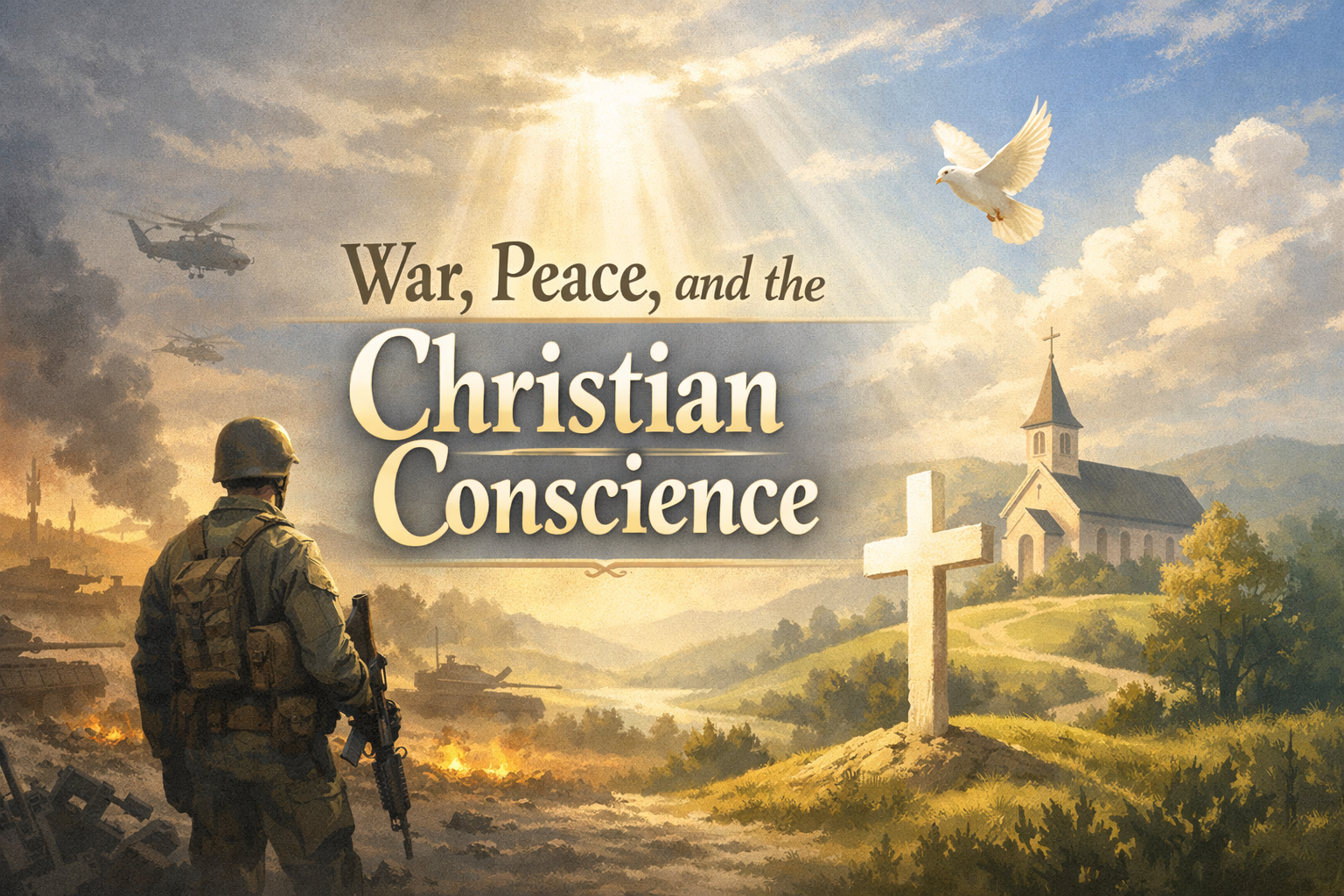
War, Peace, and the Christian Conscience
War is not abstract. It means sons and daughters deployed far from home, grieving families at gravesides, nations trying to stop evil — and sometimes causing it. And right alongside that hard subject stands another word: peace. Every Christian loves the sound of that word. But the real question is what peace actually means in a fallen world. Is it always wrong to fight? Can a Christian support war? Can a nation use force and still be right before God? Five of the most respected Christian voices of our day can help us think through it.
In this post we listen to five respected Christian teachers — John MacArthur, Tim Keller, John Piper, David Jeremiah, and N.T. Wright — and what each can contribute to how a believer thinks about war, peace, justice, and conscience. Their emphases differ, but their combined wisdom adds up to something sturdier than any one of them alone. We also take their teaching to a practical place: what should a Christian actually believe and do?
The Bible Starts Deeper Than Politics
If we start this discussion with nations and armies alone, we start too late. The Bible says the real problem begins in the human heart.
James 4:1 — “What causes fights and quarrels among you? Don’t they come from your desires that battle within you?”
Personal wars become family wars. Family wars become tribal wars. Tribal wars become national wars. Human conflict grows out of human sin — pride, greed, fear, hatred, envy, lust for power, revenge, and self-glory all help fuel the fires of violence. That is why no Christian should ever talk about war as if it were merely a matter of strategy, economics, or national interest. Beneath all of those things is the deeper disease of the soul.
Before Scripture ever tells us how to think about war between nations, it tells us what the world is really like: broken, fallen, and in need of redemption. And before we can understand peace in the world, we must understand peace with God.
Romans 5:1 — “Since we have been justified through faith, we have peace with God through our Lord Jesus Christ.”
That is the center of all Christian peace. Before nations can be healed, sinners must be reconciled. Before swords are put down outwardly, rebellion must be dealt with inwardly. The gospel is not a side note in this conversation. It is the foundation of it.
Five Christian Voices on War and Peace
MacArthur draws a firm line between the believer’s personal calling and the government’s public duty. On the personal side, Christians are called to be peacemakers — no strife-loving, no grudge-nursing, no revenge, no stirring division. “If it is possible, as far as it depends on you, live at peace with everyone” (Romans 12:18). That line is held firmly.
But MacArthur also insists the state has a different role. Romans 13:4 says rulers “do not bear the sword for no reason.” Private vengeance is forbidden; public justice is still required. Government has a God-given responsibility to restrain evil and protect the innocent — and it does not honor God by standing idle while wickedness rolls over the weak. MacArthur is not a pacifist. He believes war may be morally justified under lawful authority when truly aimed at restraining evil and defending the innocent.
His distinctive contribution: Moral seriousness about government’s God-ordained role, without romanticism about war itself. He refuses to pretend evil can always be stopped by words alone — while never forgetting that even justified force belongs to a fallen world.
Where MacArthur emphasizes truth and the duty of government, Keller emphasizes reconciliation through the gospel. He repeatedly taught that humanity’s first and greatest conflict is spiritual, not political. We were estranged from God by sin, unable to fix that breach ourselves — but Christ made peace by His blood (Colossians 1:19–20). That vertical peace, once established, begins working outward into human relationships.
Keller’s approach is therefore strongly gospel-centered and community-centered. He would say the church should be a people who model forgiveness, neighbor-love, reconciliation, and mercy in a divided world. Not as an escape from the hard questions, but as the most powerful witness to the answer. In a noisy, hot-tempered world, Christians ought to be the kind of people who can tell the truth without hatred, disagree without cruelty, and stand firm without becoming hardhearted.
His distinctive contribution: The social fruit of the gospel. Peace is not just something governments try to preserve — it is something the church is supposed to display.
Piper lands close to MacArthur on the legitimacy of civil force under Romans 13 — a Christian may, under lawful authority, participate in a just war without sinning simply by virtue of using force. He sees a real distinction between private revenge and public responsibility. But Piper adds a note that is especially important in patriotic cultures: even when a war is just, it is still tragic.
A Christian must never talk about war like it is entertainment or treat death lightly. God may ordain lawful force in a fallen world, but Psalm 11:5 says He “hates with a passion” those who love violence. Piper reminds believers that you can affirm the legitimacy of civil force and still grieve the need for it. You can believe evil must sometimes be opposed and still weep over the cost. Some Christians are tempted to become naïve. Others are tempted to become hardened. Piper helps keep us from both.
His distinctive contribution: Grief as the right posture even when force is justified. A Christian should never be cheerful about death.
Jeremiah brings a more devotional and pastoral angle — one that reminds us the visible conflicts of the world are not the only conflicts that matter. Ephesians 6:12 says our struggle is not against flesh and blood but against spiritual forces of evil. The Christian life is lived on a battlefield, but the deepest battle is not first between earthly nations. It is a spiritual battle over truth, holiness, temptation, allegiance, and the soul.
That emphasis matters because it calls us back from distraction. A man can have strong opinions about global conflict while losing the battle against bitterness in his own home. A church can debate world peace while harboring jealousy and gossip. Peace begins with Christ, grows through faith, and is lived out in a life surrendered to God. Jesus said, “Peace I leave with you; my peace I give you. I do not give to you as the world gives” (John 14:27). Without that peace, all our talk about peace in the world rings hollow.
His distinctive contribution: The inner war. He keeps the church from discussing “out there” while losing “in here.”
Wright puts more weight than most on the church’s witness as a people shaped by the cross — living as a sign of Christ’s kingdom in the middle of a violent world. When Jesus said “turn the other cheek” (Matthew 5:39), Wright does not read it as cowardice. He reads it as a kind of bold, kingdom-shaped resistance that refuses to answer the world’s violence in the world’s way. It takes more courage to absorb injustice than to retaliate.
Wright presses us to ask not only “What can government do?” but also “What kind of people is the church supposed to be?” The church does not bear the sword — it bears witness. It proclaims Christ crucified and risen. It lives now in the light of the world to come. That witness is not weak or timid. It is cross-shaped, truth-filled, and anchored in resurrection hope. There is real strength in that kind of peace.
His distinctive contribution: Kingdom ethics and the church’s witness. The question is not only what governments may do — it is what Christians are called to be.
Where All Five Agree
Those shared convictions do considerable work. They keep the discussion from drifting into either naive pacifism that ignores real evil or flag-waving triumphalism that baptizes national ambition as righteousness. And they anchor everything in Christ rather than in political systems.
What a Christian Should Actually Believe
Good theology has to come off the shelf and onto the porch. Here is the plain version of what these five voices, taken together with Scripture, point toward:
Pursue personal peace — actively, not passively. We are called to forgive, seek reconciliation, tell the truth in love, and live peaceably as far as it depends on us (Romans 12:18; Hebrews 12:14). Peace does not grow wild. It has to be cultivated and pursued. Be a peacemaker at home before anywhere else.
Recognize the role of government — soberly, not naively. Romans 13 teaches that God ordains civil authority to punish evil and uphold order. A sheriff who stops a murderer is not violating the command to love his neighbor. The moral questions become: Is it lawful? Is it just? Is it protective rather than predatory? Is it proportionate to the evil it resists? These are serious questions — and Christians ought to ask them instead of simply defaulting to tribal loyalty.
Never forget the humanity of others. Even in war, we do not stop believing that human beings are made in the image of God (Genesis 1:27). That truth puts weight on every human life. Opposition to evil does not grant permission to become monstrous in the opposition.
Keep Christ’s kingdom ultimate. Nations matter, but Christ’s kingdom matters more. No earthly flag is the banner of the New Jerusalem. Patriotism has its place. Gratitude for those who protect the innocent has its place. But the Christian’s final loyalty belongs to Jesus Christ alone.
Long for the final peace only Christ can bring. Isaiah called Him “the Prince of Peace” (Isaiah 9:6). Micah 4:3 promises a day when swords are beaten into plowshares. That day is coming. Until it is, we live in the tension — faithful, watchful, and hoping in what Christ will complete.
A Little Country Wisdom for a Hard Subject
If a rabid wolf comes into the pasture, the shepherd does not prove his love for the sheep by giving the wolf a free run. Protection is not cruelty. Sometimes protection is mercy. But no decent shepherd enjoys the blood and noise of a fight — he does what has to be done because something precious is under threat.
That is about as close as plain country terms can get to the Christian tension on this subject. We are to love peace, pray for peace, work for peace, and live peaceably. But we are not to be blind to evil, baptize cowardice and call it holiness, or wave away the role God has given lawful authority in a broken world.
The cross humbles us in this conversation. It reminds us that we were enemies of God before grace found us — that our hope is not in superior wisdom, superior nationality, or superior strength, but in a crucified and risen Savior who made peace through His blood. That ought to make Christians thoughtful, steady, grateful, and humble whenever war and peace come up for discussion.
A Prayer for Peace
Lord God, You are holy, just, and full of mercy. You are not the author of evil, yet You rule over a fallen world with wisdom greater than ours. We confess that human hearts are often restless, proud, and quick to fight — and we see that truth not only in the nations, but in ourselves.
Teach us to be peacemakers in the name of Christ. Give us grace to forgive, courage to stand for what is right, and wisdom to know the difference between weakness and mercy, between revenge and justice, between compromise and peace.
We pray for leaders in every land. Grant them restraint, humility, discernment, and a sober sense of accountability before You. Protect the innocent. Restrain the wicked. Comfort the grieving. Strengthen those who serve honorably in dangerous places. Bring home those who are far from their families.
Most of all, turn hearts to Jesus Christ, the Prince of Peace. Bring peace where there is war, repentance where there is pride, truth where there is confusion, and hope where there is despair. Make Your church a people of steady faith, deep love, and clear witness in a troubled world.
And keep our eyes fixed on that coming day when swords will be beaten into plowshares, and Christ will reign in righteousness forever. We ask it in the strong and gracious name of Jesus. Amen.
Key Takeaways
- The root of all conflict is sin, and the root of all genuine peace is the gospel. Before nations can be healed, sinners must be reconciled to God through Christ. That is not a side point — it is where the whole discussion has to begin.
- MacArthur and Piper affirm civil force under just-war conditions, but insist it must be treated with grief, not enthusiasm. Even when force is morally justified, it is still a sign that something has gone terribly wrong in a world fallen from what God intended.
- Keller emphasizes the church’s witness as a reconciling community. Peace is not only something governments try to preserve — it is something the church is supposed to display in its life together, showing the world what the gospel produces.
- Jeremiah reminds us the deepest warfare is spiritual. Christians can be so focused on conflicts out there that they neglect the battle within — against bitterness, pride, and the loss of peace with God that Christ died to restore.
- Wright emphasizes kingdom ethics — the church as a sign of Christ’s reign, not an echo of national power. The church must ask not only “what may governments do?” but “what kind of people are we called to be?”
- All five agree the church must not become captive to nationalism. No flag, party, or government carries the full authority of the kingdom of God. The Christian’s final loyalty is to Christ — and that conviction should shape everything about how believers talk about war, force, and peace.
Key Scriptures: Matthew 5:9, 38–48 · Romans 5:1 · Romans 12:14–21 · Romans 13:1–7 · Colossians 1:19–23 · Ephesians 6:10–20 · 2 Corinthians 5:18–20 · 1 Timothy 2:1–6 · Isaiah 2:4 · Isaiah 9:6 · James 4:1–4 · John 14:27
Mountain Veteran Ministries
Find Your Next Bearing
Every journey needs a direction. If you're wondering where to go from here, choose the path that best fits where you are today.
⚒️ I Want to Live Faithfully
Discover practical wisdom for following Christ in today's world.
→ Living as a Christian Today✝️ I Want to Understand the Gospel
Learn what salvation means and why Jesus came.
→ Understanding Salvation📖 I Want to Understand the Bible
Explore why Christians trust Scripture and how to read it well.
→ Understanding the Bible❓ I Still Have Questions
Explore thoughtful answers to some of Christianity's hardest questions.
→ Hard Questions