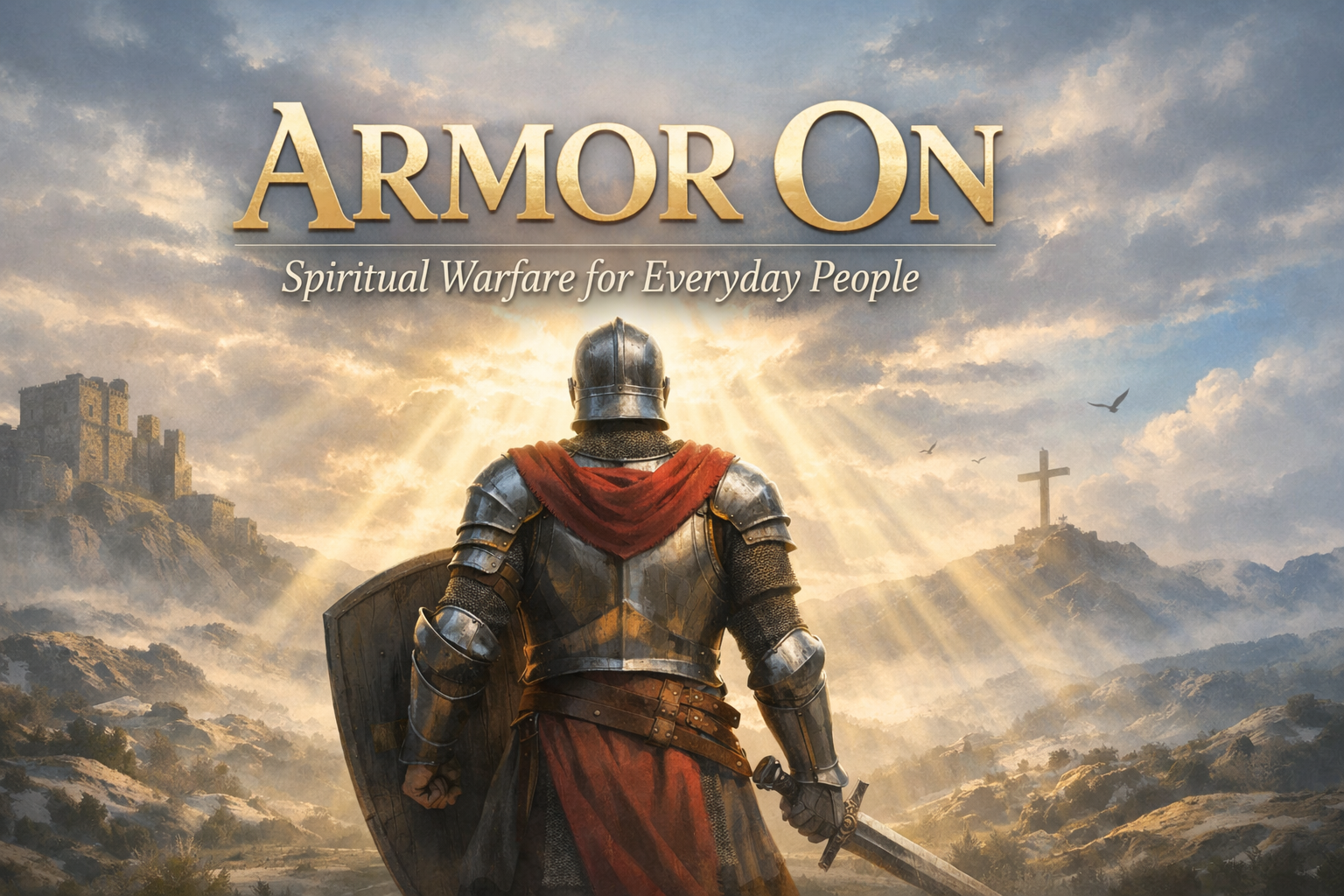
Armor On: Spiritual Warfare for Everyday People
Ephesians 6 doesn’t describe spiritual warfare as a crisis mode you enter during the hard seasons. It describes armor you put on every morning — because the battle is already happening whether you’re ready or not.
Paul’s famous armor passage isn’t written for soldiers or theologians. It’s written for regular people living ordinary lives in a world where the spiritual battle is already underway.
Most people hear “spiritual warfare” and think of something dramatic — an exorcism, a crisis of faith, a catastrophic moral collapse. The kind of thing that happens to other people, in other places, in other circumstances.
But Paul wrote Ephesians 6 to ordinary believers in Ephesus. Tradesmen, homemakers, former slaves, merchants. People with jobs and families and ordinary days that didn’t feel particularly epic. And he told them to put on armor. Not because they were about to enter some extraordinary spiritual crisis — but because the battle was already happening and they needed to be dressed for it.
That’s the thing about this passage that gets missed. It’s not emergency protocol. It’s morning routine.
The Context Paul Sets Up
Before he gets to the armor, Paul gives us a frame in Ephesians 6:10–12 that shapes everything that follows. “Finally, be strong in the Lord and in the strength of his might. Put on the whole armor of God, that you may be able to stand against the schemes of the devil. For we do not wrestle against flesh and blood, but against the rulers, against the authorities, against the cosmic powers over this present darkness, against the spiritual forces of evil in the heavenly places.”
Three things are worth slowing down for here.
First, the strength is the Lord’s, not yours. “Be strong in the Lord” — the power you’re drawing on isn’t generated internally. You don’t psych yourself up for this. You draw from a source outside yourself. That matters because the moment you start thinking your spiritual resilience is a product of your own discipline and willpower, you’ve already lost the plot.
Second, the enemy operates in schemes. Not random attacks — calculated strategy. The Greek word methodeia means a deliberate, systematic approach. He’s not improvising. He knows your patterns, your pressure points, your history. He’s been studying longer than you’ve been alive. The armor is a response to that kind of studied, patient opposition.
Third, and this is the one that reorients everything: your real enemy is not the person in front of you. “We do not wrestle against flesh and blood.” The conflict that feels like it’s between you and your coworker, you and your spouse, you and the culture — there is something behind it that Scripture names as spiritual in nature. That doesn’t make the human conflict irrelevant. It means you can stop treating people as the ultimate source of your battles. The man or woman in front of you is not your enemy, even when they’re acting like one.
The armor doesn’t make you invincible. It makes you able to stand. Paul uses that word four times in this passage — stand, withstand, stand firm, stand. The goal isn’t to advance on your own initiative. It’s to hold the ground you’ve been given.
The Belt of Truth
Ephesians 6:14a — “Stand therefore, having fastened on the belt of truth.”
In Roman armor, the belt wasn’t decorative. It was the foundation piece. Everything else attached to it or depended on it. The breastplate hung from the belt. The sword hung from the belt. Without it, the armor didn’t hold together.
That’s not a coincidence in Paul’s choice. Truth is the belt because everything else falls apart without it. If you don’t know what’s true — about God, about yourself, about your situation — the rest of the armor has nothing to anchor to.
The truth Paul has in mind here isn’t just a general commitment to honesty, though that’s part of it. It’s the truth of the gospel itself: who God is, what Christ has done, who you now are in him. That truth is the load-bearing piece. When the lies come — and they will — you need something to check them against. You need a standard, a fixed point, a ground-truth that doesn’t shift depending on how you feel on any given morning.
A lot of the spiritual warfare people experience is actually a truth problem in disguise. They’re not failing to fight hard enough; they’re fighting with bad intelligence. They’ve believed something about God or themselves that isn’t accurate, and they’re making decisions — spiritual and otherwise — on the basis of that error. The belt of truth is the correction. It says: here is what is actually real. Everything else gets measured against this.
Practically, this is why daily engagement with Scripture isn’t optional for the person who wants to hold their ground spiritually. The word is where you re-calibrate. It’s where the lies you’ve absorbed through the week get corrected. Skip that long enough and you start making decisions based on whatever the loudest voice in your head has been saying — and that voice may not be friendly.
The Breastplate of Righteousness
Ephesians 6:14b — “…and having put on the breastplate of righteousness.”
The breastplate covered the chest — the vital organs, the heart. In battle, it was the difference between a wound and a mortal wound. Paul puts righteousness in that position, and it’s worth asking: which righteousness?
There are two kinds in Paul’s theology, and they’re both in play here. The first is imputed righteousness — the righteousness of Christ credited to your account by faith, not earned, not merited, just received. That’s the theological foundation. The second is practical righteousness — the lived-out integrity of a person who is actually trying to walk in accordance with who they are in Christ.
Both protect you from the same primary threat: the accuser. If the devil’s main legal strategy is to bring charges against you — to prosecute your failures and establish your guilt before God and in your own conscience — then righteousness is what answers the charge. The imputed righteousness of Christ says: this case was already settled at the cross. There is “no condemnation for those who are in Christ Jesus” (Romans 8:1). The accusation has no legal standing.
But there’s another angle here. A man who is living with unaddressed sin — harboring something he knows is wrong but refuses to deal with — has a gap in his breastplate. Not because God has withdrawn his love or even his justification. But because the enemy has a foothold, a point of leverage, a wound that won’t close because it keeps getting reopened. Practical righteousness closes those gaps. Confession, repentance, restitution where needed — these are armor maintenance. You’re not earning your standing before God. You’re not leaving unnecessary openings for the one who is actively looking for them.
The Shoes of the Gospel of Peace
Ephesians 6:15 — “…and, as shoes for your feet, having put on the readiness given by the gospel of peace.”
This one tends to get less attention than the others, but it’s doing real work. Roman soldiers wore heavy-soled sandals with hobnails or cleats on the bottom — footwear designed to grip the ground and give stability. In a push against an opposing force, the soldier who lost his footing lost everything. Traction was survival.
Paul connects that image to the gospel of peace. The “peace” here is primarily peace with God — the reconciliation that came through Christ, the settled relationship that no longer stands under judgment. And the “readiness” is the stability that peace produces.
Here’s why that matters in warfare: a man who is not at peace with God is fighting on unstable ground. He’s uncertain of his standing. He’s not sure whether God is for him or against him. That uncertainty makes him hesitant, reactive, prone to flinching at threats. But a man who knows — really knows — that he has been reconciled to God, that the enmity is over, that the relationship is secure — that man has traction. He can absorb a blow without losing his footing because what’s underneath him doesn’t move.
The gospel of peace is also the source of your peace with other people. “As far as it depends on you, live peaceably with all” (Romans 12:18). The man who is at peace with God has something to bring into conflict that doesn’t come naturally — a genuine capacity to pursue reconciliation rather than escalation, to absorb offense without retaliating, to be a stabilizing presence rather than an accelerant. That’s not weakness. That’s the shoes doing their job.
The Shield of Faith
Ephesians 6:16 — “In all circumstances take up the shield of faith, with which you can extinguish all the flaming darts of the evil one.”
The Roman shield Paul has in mind here is the scutum — a large, full-body shield, roughly four feet tall and two and a half feet wide. Not a small buckler for deflecting individual blows. A wall-sized piece of equipment that could cover most of a soldier’s body. Soldiers could also lock shields with the man beside them, creating an interlocking barrier that a formation could advance behind.
The “flaming darts” are specific. Arrows or bolts wrapped in burning material — designed to stick and burn, to set fires and cause cascading damage rather than just puncture. The shield, in response, was often soaked in water or leather-covered so the dart would embed in the material and be extinguished before the fire could spread.
Apply that image to what faith actually stops. The flaming darts aren’t usually direct frontal assaults on your belief. They’re burning questions that, left unaddressed, spread into wider doubt: Does God really care about this? Is the Bible actually reliable? Could your faith just be wishful thinking? Are you really forgiven after what you did? Each one is designed to stick and burn. Faith doesn’t mean you never take a hit from one of those. It means you have something that absorbs the impact and extinguishes it before it spreads.
Faith here isn’t willpower or positive thinking. It’s a settled trust in the character and promises of God — a trust that has been tested enough times to know it holds. The more you’ve seen God be faithful in the past, the bigger your shield becomes in the present. This is why remembering matters. Recounting what God has done — in your life, in Scripture, in history — isn’t nostalgia. It’s shield maintenance.
And notice the communal dimension built into the image of interlocking shields. Your faith and mine together form a barrier neither of us could hold alone. This is why spiritual warfare is not a solo endeavor. The man who locks his shield in with a community of believers is significantly harder to flank than the man who is standing isolated.
The Helmet of Salvation
Ephesians 6:17a — “…and take the helmet of salvation.”
The helmet protects the head. In Paul’s metaphorical system, that means it protects the mind — your thinking, your perception, your capacity to reason and interpret what’s happening around you. Salvation is what guards that.
In 1 Thessalonians 5:8, Paul describes this same helmet as “the hope of salvation” — which adds the temporal dimension. You’re not just saved in some past-tense sense. You are being saved. You will be fully saved. The helmet is the certainty of that completed work covering your thinking in the present moment.
The mind is a primary target in spiritual warfare, and this tracks with everything we know about how the enemy operates. If he can distort your perception — make you misread a situation, interpret a challenge as abandonment, convince you that despair is realism — then your behavior follows from that distorted perception and you’ve effectively defeated yourself. The helmet stops that process at the source.
Practically, the helmet of salvation means bringing the reality of what God has secured into your thinking before the day’s interpretations get set. It’s the reason Lamentations can say “his mercies are new every morning” (Lamentations 3:23) — the writer is choosing to set his cognitive frame on the character of God rather than the weight of the circumstances. That’s not denial. That’s the helmet doing its job.
For men who’ve come back from deployment with heads full of images and experiences that distort daily life — who interpret a car backfiring as a threat, a crowd as a kill zone, a moment of stillness as the calm before contact — the concept of a covering over the mind that brings clarity and peace rather than distortion and fear is not abstract. The helmet of salvation is the cognitive reality that you are held, secured, not abandoned, not condemned, not beyond reach. That changes what you see.
The Sword of the Spirit
Ephesians 6:17b — “…and the sword of the Spirit, which is the word of God.”
Everything else in the armor list is defensive. The sword is the one offensive weapon. And Paul is specific about which sword — not the rhomphaia, the large battle sword, but the machaira, the short combat blade used in close quarters. Precise. Targeted. The weapon you use when the enemy is right in front of you.
The word of God in the believer’s hands functions as that precision instrument. Not the Bible as a general concept, but specific passages wielded in specific moments against specific lies. Jesus modeled this in the wilderness when the enemy tempted him three times. Each time, he responded with “It is written” — a specific text applied to a specific assault. He didn’t argue, didn’t explain, didn’t reason through it from first principles. He drew the sword and cut with precision.
This is why memorizing Scripture matters in a way that just reading it doesn’t fully capture. A sword in a case does you no good when the enemy is already inside your perimeter. The word needs to be accessible — in your mind and on your lips — before the moment of attack. When the thought comes that you are worthless, you need Psalm 139:14 ready. When the temptation says one more time won’t matter, you need 1 Corinthians 10:13. When the despair says there is no way out, you need Romans 8:38–39.
The sword of the Spirit is also how you fight for other people. The word you speak over someone who is drowning in condemnation, the verse you text to a brother who is about to make a decision he’ll regret, the truth you hold up against the lie someone has been living with for years — that’s the machaira working in close quarters. It’s not just defensive. It pushes the enemy back.
Prayer: The Posture That Holds It All Together
Ephesians 6:18 — “…praying at all times in the Spirit, with all prayer and supplication. To that end, keep alert with all perseverance, making supplication for all the saints.”
Paul doesn’t list prayer as a seventh piece of armor — but he doesn’t let it sit as an afterthought either. It’s the operating posture for a person who has put on everything else. The armor goes on. Then you pray. You don’t put the armor on and then go handle things yourself. You put the armor on and then maintain constant communication with the commanding officer.
“Praying at all times in the Spirit” doesn’t mean a constant stream of words. It means living in a posture of dependence and communication — oriented toward God in all circumstances. Alert. Aware. Ready to bring what you’re facing into that relationship rather than trying to manage it alone.
And then — “making supplication for all the saints.” The scope of prayer in spiritual warfare is not just self-defense. It extends to the people around you. You are praying for the armor of the person beside you as well as your own. This is the interlocking shield image in prayer form. Your intercession for a brother or sister may be the thing that holds their line when they can’t hold it themselves.
Prayer is the difference between a soldier who has gear and a soldier who is actually in communication with command. The armor matters. But armor without communication leaves you fighting with yesterday’s intelligence and no reinforcement on the way.
Putting It On Every Morning
The metaphor of armor implies something that often gets skipped: it has to be put on. Every day. It’s not installed permanently the moment you become a believer. It’s a practice, a discipline, a deliberate act that has to happen before you’re ready for the day’s engagement.
For most people, this looks like some version of a morning rhythm — time in Scripture, time in prayer, time to consciously orient toward God before the world starts making demands on your attention. Not a formula, not a performance, not a checklist you complete so God owes you a good day. A reorientation. A deliberate act of putting on what you need before you walk out into what’s already underway.
The battle doesn’t wait for you to feel ready. The schemes didn’t pause overnight. The accuser wasn’t idle while you slept. You wake up into an ongoing conflict, and the question is whether you’re going to engage it equipped or unequipped.
This is not a guilt trip for the mornings you didn’t manage it. It’s an invitation to take seriously what Paul took seriously — that the daily spiritual life of a believer is not incidental to the warfare, it is the warfare. The armor is not for crisis mode only. It’s for Tuesday. It’s for the commute to work and the difficult conversation and the moment of temptation that arrives without warning and the wave of condemnation that shows up at 2 a.m.
Put it on. Every piece. Every day.
Not because you’re strong enough to fight. Because he is — and the armor is his.
Key Takeaways
- Spiritual warfare is not emergency mode — it’s daily routine. The armor in Ephesians 6 isn’t for crisis moments. It’s for ordinary days in a battle that’s already underway whether you’re dressed for it or not.
- Your real enemy is not the person in front of you. “We do not wrestle against flesh and blood.” The conflict behind your human conflicts is spiritual — which means the people involved aren’t the ultimate source and shouldn’t be treated as the ultimate target.
- Each piece of armor answers a specific attack. Truth corrects bad intelligence. Righteousness silences the accuser. The gospel of peace gives you traction. Faith extinguishes burning doubt. Salvation covers your thinking. The word cuts precisely at the moment of contact.
- The sword is the only offensive weapon. And it works in close quarters — specific Scripture applied to specific lies in specific moments. Memorization isn’t an academic exercise; it’s combat readiness.
- Prayer is the posture that holds it all together. The armor goes on — and then you stay in communication with the One whose strength you’re drawing on. Armor without prayer is gear without coordination with command.
Gear Up Together
The armor works better when you’re not standing alone. Mountain Veteran Ministries is built for men who want to take their spiritual lives as seriously as everything else they’ve trained for. If this post stirred something, dig into more content in the Christian Life category, or reach out through our contact page. We’d be glad to hear from you.
Key Scriptures: Ephesians 6:10–18 · Romans 8:1 · John 17:17 · Matthew 4:1–11 · 1 Thessalonians 5:8 · Lamentations 3:23 · Romans 12:18 · Revelation 12:10–11 · Romans 8:38–39 · 1 Corinthians 10:13