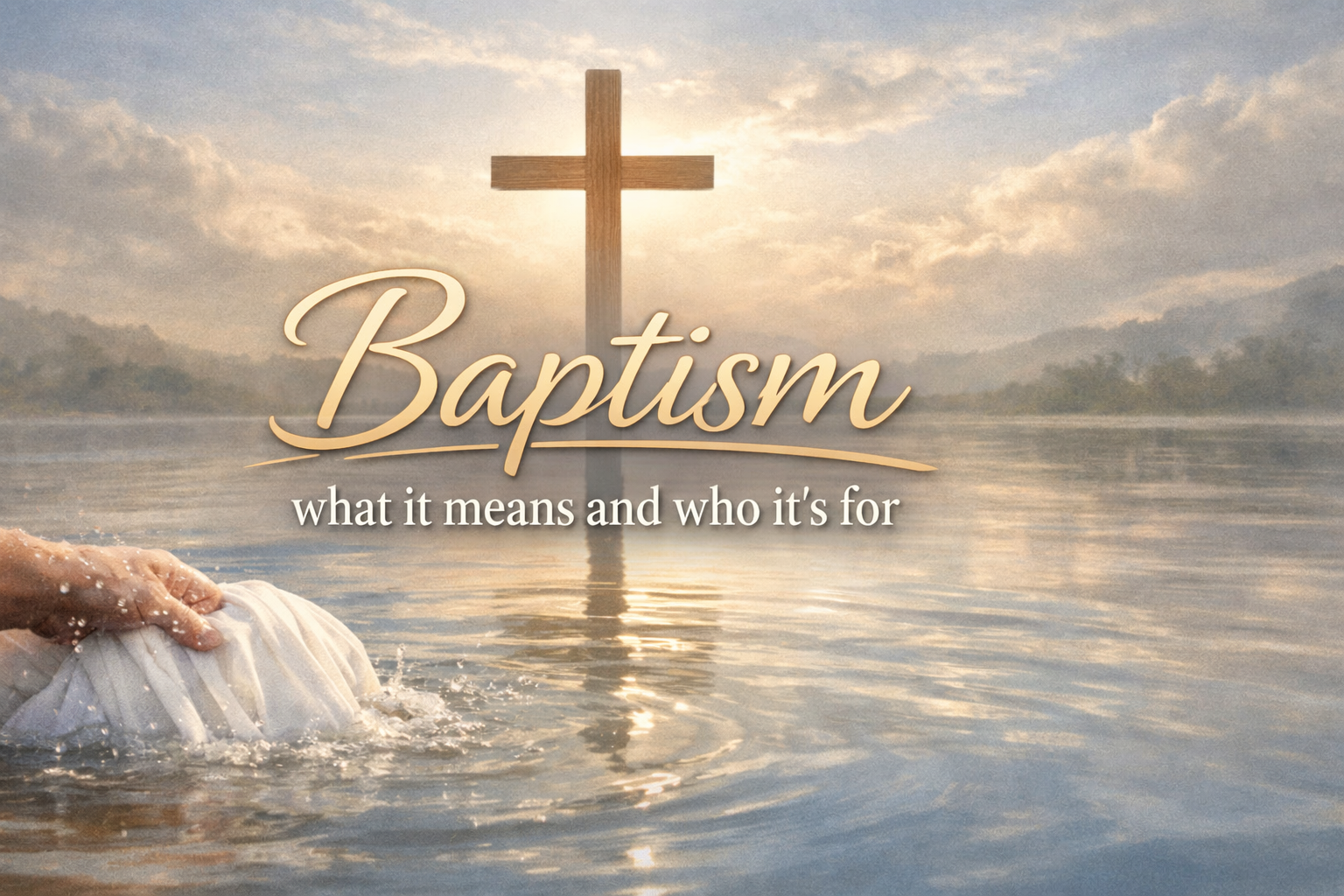
Baptism: what it means and who it’s for
Baptism is one of the two sacraments Jesus commanded His church to practice, and it is one of the most disputed topics in Christian theology. Churches divide over it. People get rebaptized over it. Whole denominations exist because of disagreements about it. Understanding what baptism actually is — what it does, what it signifies, and who it belongs to — is not a minor housekeeping question. It touches the nature of the gospel, the structure of the church, and the covenant God makes with His people.
Churches split over baptism. Families argue about it. People get rebaptized. Before picking a side, it helps to understand what the debate is actually about.
Most Christians who were baptized as infants have never seriously examined why. Most Christians who were baptized as believing adults have never seriously examined the arguments on the other side. The result is that one of the most visible and theologically rich acts in the Christian life gets treated as settled tribal identity rather than as a practice worth understanding from the ground up.
This post takes baptism seriously enough to work through the arguments carefully. It is written from a perspective sympathetic to the paedobaptist — infant baptism — tradition, which is the historic position of the Reformed, Lutheran, Anglican, and Catholic churches. The credobaptist — believer’s baptism — position held by Baptists and many evangelical free churches gets a fair hearing, because the people holding it are serious Christians reading the same Bible and deserving honest engagement rather than dismissal.
The goal is not to settle every dispute. It is to give you the tools to understand what is actually being argued, why it matters, and how to think about your own baptism — whenever and however it happened.
What Baptism Is Not
Before working through what baptism is, it is worth clearing away what it isn’t — because several popular misunderstandings distort the conversation before it starts.
Baptism is not salvation. No serious mainstream tradition teaches that the water itself regenerates the soul and that unbaptized people are automatically lost. Even traditions with a high sacramental theology — Roman Catholic, Lutheran — carefully distinguish the sign from the thing signified, and make room for the salvation of those who die without baptism but with genuine faith. The thief on the cross is the standing rebuttal to any mechanical view of baptismal regeneration (Luke 23:42–43).
Baptism is not merely a public testimony. This is the opposite error — common in low-church evangelical culture — that treats baptism as nothing more than an outward declaration of an inward decision, a kind of public announcement that carries no particular theological weight beyond the announcement itself. The New Testament language about baptism is too dense for this to hold up. Paul connects baptism to union with Christ’s death and resurrection (Romans 6:3–4), to putting on Christ (Galatians 3:27), and to the washing of regeneration (Titus 3:5). Peter says it “now saves you” — carefully explaining that he means not the removal of physical dirt but “an appeal to God for a good conscience, through the resurrection of Jesus Christ” (1 Peter 3:21). The language is richer than a public testimony framework can accommodate.
Baptism is not optional. Jesus commands it in the Great Commission (Matthew 28:19). The early church practiced it without exception for those entering the community (Acts 2:38–41). It is not a matter of personal preference or spiritual style. It is an ordinance of Christ given to His church.
What Baptism Actually Is
Baptism is a sacrament — a visible sign of an invisible grace, instituted by Christ, that seals the covenant promises of the gospel to the one who receives it. That definition is Reformed in its framing, but it captures something the New Testament consistently portrays.
The water signifies several things at once. It signifies cleansing — the washing away of sin that Christ’s blood accomplishes (Acts 22:16, Titus 3:5). It signifies death and resurrection — the believer’s union with Christ in His dying to sin and rising to new life (Romans 6:3–5). It signifies entry into covenant — incorporation into the community of God’s people, with all the promises and obligations that membership entails (Acts 2:38–39). It signifies the gift of the Spirit — the new birth and ongoing presence of God within His people (Acts 2:38).
A sign is not the same as the thing it signifies. A wedding ring is not the marriage — but it is not nothing. It marks a covenant, carries real meaning, and its removal or desecration is not trivial. Baptism functions similarly: it is the covenant sign that marks entry into the community of Christ. Whether it always accompanies the reality it signifies — genuine regeneration — is a separate question. Signs can be received without the reality, and the reality can exist without the sign. But the sign is God’s ordained way of marking His people, and treating it as optional or purely decorative misses what God is doing when He gives it.
The Covenant Framework: Why It Changes Everything
The most important interpretive question in the baptism debate is this: What is the relationship between the old covenant and the new covenant — and what does that relationship imply about who receives the covenant sign?
In the old covenant, the sign of membership in God’s covenant community was circumcision. It was applied to male members of Israel — including infants — as the mark of belonging to the people of God. It was not applied only to those who had demonstrated personal faith. It was the entry sign into the covenant community, applied on the basis of covenant membership, not on the basis of individually verified belief.
Paul makes a connection between circumcision and baptism in Colossians 2:11–12: “In him also you were circumcised with a circumcision made without hands, by putting off the body of the flesh, by the circumcision of Christ, having been buried with him in baptism.” Paul uses circumcision and baptism in parallel — not identically, but as corresponding covenant signs. The old covenant sign has been replaced by the new covenant sign.
The paedobaptist argument follows from this: If circumcision was the covenant sign applied to infants in the old covenant community, and if baptism is the corresponding covenant sign of the new covenant community, then the children of believers are in the same covenant position as the children of Israel — members of the covenant community, recipients of the covenant sign, with the expectation that they will grow into the personal faith the sign signifies.
Peter’s Pentecost sermon points in the same direction. After calling his hearers to repent and be baptized, he says: “For the promise is for you and for your children and for all who are far off, everyone whom the Lord our God calls to himself” (Acts 2:39). The promise — with its household scope — echoes the Abrahamic covenant structure. The covenant has always had a household dimension. The new covenant does not eliminate that structure; it fulfills and expands it.
The Credobaptist Case
The believer’s baptism tradition reads the same texts and reaches different conclusions — and those conclusions are not without biblical grounding. The case deserves honest engagement.
The credobaptist argument begins with the nature of the new covenant itself. Jeremiah 31:31–34 describes the new covenant as one in which all members will know the Lord — not just some, but all. “They shall all know me, from the least of them to the greatest.” If the new covenant community is defined by genuine, personal knowledge of God, then its sign should be restricted to those who demonstrate that knowledge. Applying it to infants — who cannot profess faith — includes in the visible covenant community people who may or may not belong to the invisible church, which the credobaptist tradition sees as a corruption of new covenant newness.
The credobaptist also notes that every clear instance of baptism in Acts follows proclamation and personal response. The three thousand at Pentecost heard, repented, and were baptized (Acts 2:41). The Ethiopian eunuch confessed faith and was baptized (Acts 8:36–38). The Philippian jailer believed and was baptized with his household (Acts 16:30–33). The pattern is consistent: faith, then baptism. There is no unambiguous record in the New Testament of an infant being baptized.
The household baptism passages — Cornelius, Lydia, the Philippian jailer, Stephanas — are the paedobaptist’s strongest circumstantial evidence and the credobaptist’s most contested ground. Paedobaptists argue that households in the ancient world would have included infants and children, making it probable that infants were baptized. Credobaptists note that these same passages typically include language of belief or response associated with the household (Acts 16:34 says the jailer “rejoiced along with his entire household that he had believed in God”), which could indicate that the whole household consisted of believing members.
The credobaptist is not reading the Bible carelessly. The debate is a genuine exegetical dispute, and the honest paedobaptist acknowledges that the New Testament does not contain an explicit command to baptize infants. The case rests on covenant theology and the logic of the covenant sign — not on a proof text that ends the argument.
Mode: Does It Matter How Much Water?
Alongside the question of who receives baptism is the question of how it is administered. Immersion, pouring (affusion), and sprinkling (aspersion) are all practiced in different traditions. Baptists insist on immersion as the only valid mode. Most Reformed churches practice sprinkling or pouring. Roman Catholic and Anglican churches use pouring as the standard.
The Greek word baptizō most commonly means to dip, immerse, or plunge — which is the Baptist argument for immersion as the only historically valid mode. The Reformed counterargument notes that baptizō was also used in contexts that clearly do not involve full immersion — ritual washings, the baptism of cups and vessels in Mark 7:4, the “baptism” of Israel in the cloud and sea (1 Corinthians 10:2). The word has a semantic range broader than full submersion.
The symbolism of immersion — burial and resurrection with Christ — is powerful and Paul draws on it explicitly in Romans 6. That symbolic resonance is not nothing. But the Reformed tradition argues that the meaning is carried by the water and the Word, not by the quantity of water, and that sprinkling and pouring are equally valid modes that carry the same covenantal meaning.
This is a second-order dispute — important within traditions but not church-dividing at the level of the gospel itself. Christians have held different positions on mode throughout history without concluding that the baptism of the other mode was invalid.
What Your Baptism Means for You Now
Whatever tradition you were baptized in and however you received it, your baptism is not merely a past event filed away in church records. It is a living promise that speaks to you in the present.
Martin Luther, when the devil attacked him with accusations of his sin and unworthiness, reportedly answered with two words: Baptizatus sum — I have been baptized. Not “I feel forgiven.” Not “I think I’m good enough.” I have been marked with the covenant sign of the God who saves, and that sign speaks a promise that my feelings cannot revoke.
Paul’s argument in Romans 6 makes the same pastoral move. When he wants to motivate the Roman believers against sin, he doesn’t appeal primarily to their willpower or their moral resolve. He points to their baptism: “Do you not know that all of us who have been baptized into Christ Jesus were baptized into his death?” (Romans 6:3). Your baptism is a deed to an identity. You died with Christ. You were buried with Him. You were raised with Him. Act like it.
If you were baptized as an infant and have since come to genuine faith, your baptism was not empty — it marked you as belonging to the covenant community and announced the promises of the gospel over your life before you could understand them, just as circumcision marked the infant sons of Israel before they could choose it. Your subsequent faith is the fulfillment of what the sign declared.
If you were baptized as a believing adult, your baptism was your public declaration of death to the old life and resurrection to the new, your entry into the community of God’s people, and the seal of the covenant promise spoken over you in the presence of witnesses. That event has not expired. It continues to speak.
A Word to Veterans
The military marks its people. Dog tags, rank insignia, unit patches, service ribbons — every one of these is a visible sign that carries real meaning about who you are, what you’ve done, where you belong, and what you owe and are owed. You don’t wear your rank as decoration. It identifies you. It places you in a structure. It makes claims on your behavior and creates obligations in both directions.
Baptism functions the same way in the community of Christ. It is the covenant marker that identifies you as belonging to God, places you within the body of His people, and makes visible claims on how you live. It is not a decoration applied at a pleasant ceremony and then filed away. It is a mark — permanent, meaningful, and pointing toward something larger than the moment it was received.
Veterans understand the weight of being marked by a community that makes real demands and real promises in return. The church’s marking in baptism is the same structure — but the community is the body of Christ, the demands are the commands of the risen Lord, and the promises are eternal. That is worth understanding at full weight.
Key Takeaways
- Baptism is neither automatic salvation nor a mere public testimony. The New Testament language is too rich for either extreme. Baptism is a covenant sign that seals the gospel promises to the recipient — a visible word that marks entry into the community of Christ.
- The covenant framework is the key interpretive lens. The paedobaptist case rests on the continuity between circumcision as the old covenant sign and baptism as the new covenant sign — applied to the household of faith, including children, on the basis of covenant membership rather than individually verified belief.
- The credobaptist case is exegetically serious and deserves honest engagement. The new covenant’s “all shall know me” structure, the consistent Acts pattern of faith-then-baptism, and the absence of an explicit infant baptism command are real arguments that cannot be dismissed without engagement.
- Mode is a secondary question. Immersion, pouring, and sprinkling are all practiced by serious Christian traditions. The meaning is carried by the water and the Word, not the quantity of water — though the symbolism of immersion resonates powerfully with the Romans 6 death-and-resurrection imagery.
- Your baptism continues to speak in the present tense. Luther’s Baptizatus sum is the pastoral model. When sin and accusation come, you point to the covenant mark — not to your feelings or your performance, but to the promise God announced over you in water and Word.
- Baptism is not optional — it is an ordinance of Christ. The Great Commission commands it, the early church practiced it without exception, and treating it as a personal preference misses the ecclesial and covenantal weight the New Testament gives it.
Key Scriptures: Matthew 28:19 · Acts 2:38–39 · Romans 6:3–5 · Colossians 2:11–12 · Galatians 3:27–29 · 1 Peter 3:21 · Titus 3:5 · Genesis 17:7 · Jeremiah 31:31–34