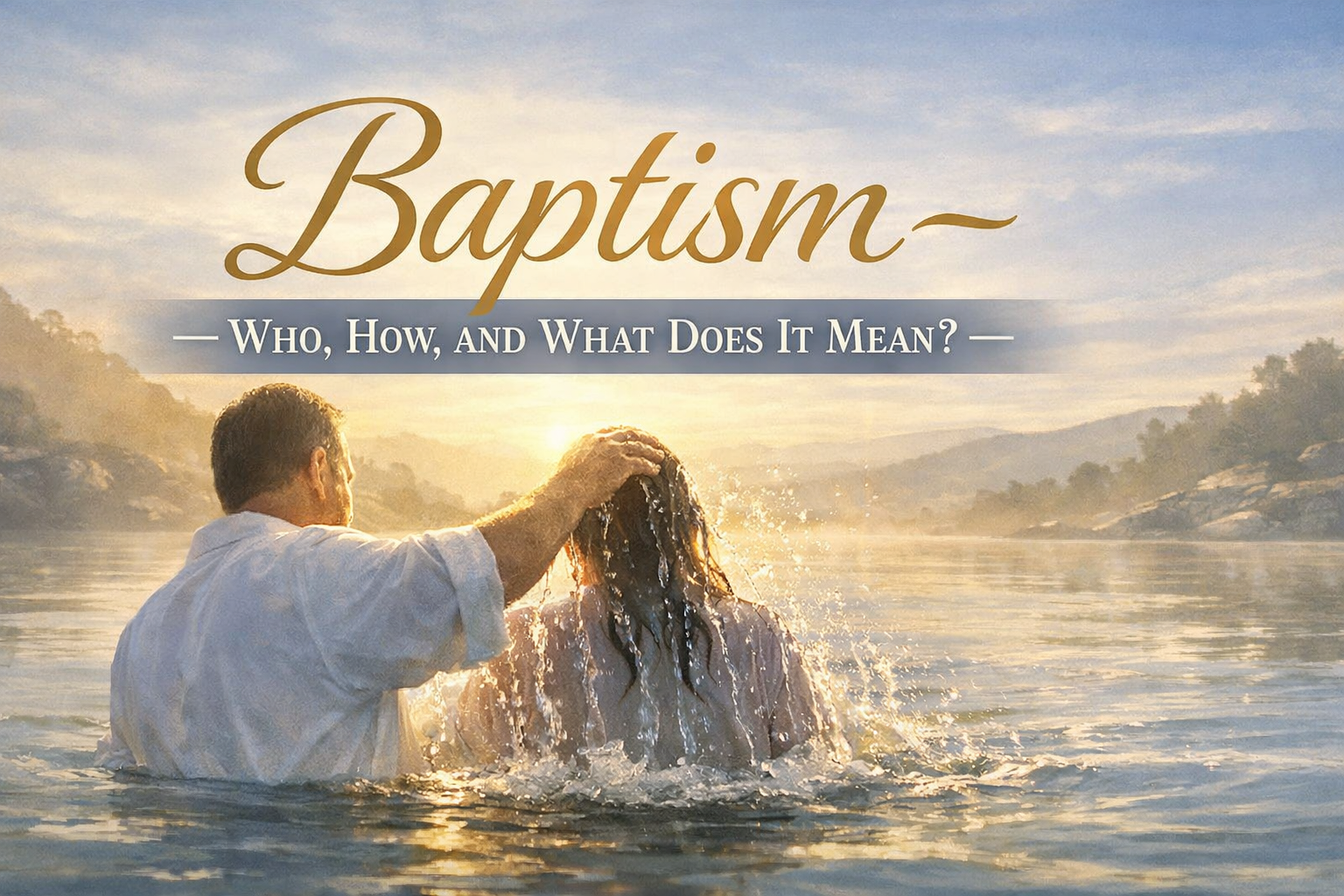
Baptism — who, how, and what does it mean?
Baptism stirs up questions in almost every church. Some folks were baptized as infants and never thought much more about it. Others came to faith later in life and were immersed as believers. Some churches sprinkle, some pour, some immerse. And the debates over who should be baptized and how it should be done have run for centuries. So it is worth slowing down and asking plainly: Who should be baptized? How should it be done? And what does baptism really mean?
That said, this is one of those topics where sincere, Bible-believing Christians do not all land in the same place. So truth, yes — but also charity. We ought to speak clearly without speaking harshly, and we ought to hold our convictions from Scripture without treating everyone who disagrees as though they are careless with the Word.
In plain talk: baptism is a Christ-given sign that marks a person’s identification with Jesus Christ and His people. It is deeply important, but it does not save by the act itself. It points beyond itself to the saving work of Christ. Let’s walk through it.
Why Baptism Matters
Before getting to the debated questions, we need to start here: baptism matters because Jesus commanded it.
Matthew 28:19 — “Go ye therefore, and teach all nations, baptizing them in the name of the Father, and of the Son, and of the Holy Ghost.”
That settles one part of the matter. Baptism is not optional in the sense of being unimportant. It belongs to Christian discipleship — not an extra feature for unusually serious believers, but one of the ordinary ways Christ marks out His people. In the book of Acts, when people believed the gospel, baptism followed. It was part of openly confessing Christ, not a side note tacked on later.
Baptism matters because it is commanded by Christ, practiced by the early church, tied to discipleship, and a public confession of belonging to Jesus. It is not the gospel itself, but it is one of the ways the church visibly bears witness to the gospel.
What Baptism Means
Four Things the Sign Is Pointing To
Before we can settle “who” and “how,” we need to understand “what.” At its heart, baptism is a sign — a visible, bodily act that points to spiritual realities.
Baptism does not literally wash away sin by the water itself, but it points to the cleansing that comes through Christ. Acts 22:16 connects baptism with washing away sins through the calling on the name of the Lord — the outward washing pointing to the inward reality.
Romans 6:3–4 — baptism into Christ is baptism into His death and resurrection. The believer is declaring: “My old life is not my hope anymore. My hope is in Jesus. I died with Him, and I rise in Him.”
Baptism has a church-shaped meaning. It marks a person as belonging to the visible community of Christ’s people. A man going into the water is declaring publicly: “I belong to Christ now, and I am not ashamed of it.”
Baptism says something has changed — not that the act itself magically changes the heart, but that the baptized person is identified with the new life found in Christ. It is a sign of repentance, faith, forgiveness, and new belonging.
In simple terms, baptism is like putting up a public signpost that says: This person belongs to Jesus Christ.
Does Baptism Save?
This question needs a careful answer. Some passages speak about baptism in very strong language, and we should not soften what Scripture says. But taken across the full teaching of the New Testament, baptism is not the thing that saves a sinner by the outward act alone.
Ephesians 2:8–9 — “For by grace are ye saved through faith… not of works, lest any man should boast.”
The thief on the cross was not baptized, yet Jesus told him, “Today shalt thou be with me in paradise” (Luke 23:43). That reminds us that the saving power is in Christ, not in water. At the same time, we should not swing the other way and treat baptism like it barely matters. The New Testament never talks that way either.
The best way to put it: baptism is not the cause of salvation, but it is a God-given sign of salvation and allegiance to Christ. It is important without being the foundation of justification. 1 Peter 3:21 calls baptism the “answer of a good conscience toward God” — the outward pledge of an inward reality.
Who Should Be Baptized?
Here is where Christians have genuinely disagreed for a long time, and it is worth understanding both main positions honestly.
Believer’s Baptism
This view holds that baptism should be given to those who personally repent and believe the gospel. Baptism follows a credible profession of faith — it is the sign of conscious faith and personal discipleship. This is the position commonly held by Baptists and many evangelical churches.
The basic argument runs close to the New Testament pattern: people hear the gospel, they believe, then they are baptized. In Acts 2:41, those who “gladly received his word were baptized.” In Acts 8, the Ethiopian eunuch hears, believes, and is baptized. In Acts 16, Lydia believes and is baptized, and the jailer believes and is baptized the same night.
If baptism signifies union with Christ, new life, and discipleship, many argue it makes best sense when the person being baptized can say for himself or herself, “Yes, that is true of me.” This view also protects the idea that baptism is tied to personal repentance and conscious faith, not merely inherited membership.
The concern raised by others is that it may overlook covenant continuity and fail to account for the place of children within the visible people of God — a pattern that runs through the whole biblical story.
Infant Baptism
This view holds that the children of believing parents may rightly receive baptism as members of the covenant community, even before they make a personal profession of faith. It is held in various forms by Presbyterian, Reformed, Lutheran, Anglican, and other traditions, though they do not all mean exactly the same thing by it.
The core argument rests on covenant theology. In the Old Testament, children of the covenant received the sign of covenant membership through circumcision. Since the New Covenant is understood as the fulfillment — not the abolition — of that covenant continuity, many argue that the children of believers should still receive the covenant sign, which is now baptism rather than circumcision. Colossians 2:11–12 draws a close relationship between circumcision and baptism. Household baptisms in Acts (Acts 16:15, 33) are also cited as evidence.
This view also underscores that grace comes before our response — God acts first, and the covenant sign marks that prior grace. The infant receives the sign not as a declaration of existing faith but as a mark of belonging to the covenant community, with the expectation of coming to personal faith.
The concern raised by others is that the New Testament nowhere explicitly shows infants being baptized, and that the repeated pattern of faith-before-baptism carries significant weight. There is also a pastoral worry that infant baptism, in some settings, can lead people to rest in the outward sign while lacking any present faith in Christ.
Believer’s baptism says the sign belongs to those who personally believe — faith is the prerequisite.
Infant baptism says the sign may also belong to the children of believers as members of the covenant community — covenant inclusion is the basis, with personal faith expected to follow.
Hold your convictions from Scripture. But do not speak as though every Christian on the other side is careless with the Bible. Many are trying earnestly to honor God’s Word.
How Should Baptism Be Done?
The three modes practiced across Christian history are immersion, pouring, and sprinkling. Each has its defenders and its theological rationale.
The Case for Immersion
Many Baptists and evangelical churches hold immersion as the only proper mode, and the case for it is real. The Greek word baptizō often carries the sense of dipping or immersing. More importantly, immersion displays the symbolism of Romans 6 with striking clarity — down into the water, up again, picturing death to sin and rising to new life in Christ. The burial-and-resurrection imagery is vivid and hard to improve on. Many New Testament baptism scenes also seem to involve substantial water, which fits immersion naturally.
The Case for Pouring and Sprinkling
Other traditions argue that while immersion may be meaningful, Scripture does not require one exclusive mode. They point out that the meaning of baptism is richer than a single image. Cleansing and purification are central to the sign, and the Old Testament background includes ritual sprinklings and washings (Ezekiel 36:25; Hebrews 9:19–22). Prophecies of God pouring out His Spirit and cleansing His people also lend weight to pouring as a fitting mode. From this view, the power of baptism lies not in the quantity of water but in what God signifies through it.
Immersion most powerfully pictures burial and resurrection with Christ.
Pouring and sprinkling more directly highlight cleansing, purification, and the outpouring of the Spirit.
The deeper issue is not water quantity — it is faithfulness to Christ and the meaning of the sign. But churches ought to practice what they believe Scripture teaches, with both seriousness and humility.
What Baptism Does Not Mean
Clearing away some common confusion is worth the time.
Baptism does not mean a person is sinless. It is not a declaration that someone has arrived spiritually. It is the public beginning of a life of discipleship, not the finish line.
Baptism does not guarantee final salvation apart from faith. Whether you come from a believer’s baptism tradition or an infant baptism tradition, the church must never let people rest in the outward sign while neglecting the inward reality. The sign is precious, but Christ Himself is the Savior.
Baptism is not a work by which we earn favor with God. No man stands right with God because he went into water. We stand right with God because of Jesus Christ alone.
Baptism is not the end of Christian growth. It belongs to the beginning of discipleship under Christ — not the completion of it.
Baptism and the Church
Baptism is not only about the individual and Jesus. It is also about the church.
A baptized Christian is publicly marked out as belonging to the visible body of Christ. The church witnesses it, recognizes it, and receives the baptized person as openly belonging to Christ’s people. That means baptism carries responsibility. It says, “I am not my own. I belong to Christ, and I belong among His people.”
In a world where everybody wants private spirituality with no accountability, baptism takes a public stand. It says, “No — I am openly with Jesus.” There is something sturdy and beautiful about that. The ordinance does not let faith stay hidden. It calls the believer out into the light, in front of witnesses, under the name of the Father, the Son, and the Holy Spirit.
Baptism is not a stand-alone religious event. It belongs to the life of following Christ — a beginning that leads somewhere, not a ceremony that completes something.
So What Should a Christian Do?
If someone has come to real faith in Christ and has never been baptized, the answer is plain: be baptized, in obedience to Christ.
If someone was baptized as an infant and later comes to different convictions about the mode or meaning, he ought to study the Scriptures carefully, seek wise counsel, and follow his conscience under the Word of God.
If someone was baptized years ago but now realizes he was never truly trusting Christ at the time, he should think honestly about whether his baptism matched biblical faith and confession — and seek counsel from his elders.
These are not always easy questions. But they should be approached honestly and prayerfully, not avoided because they are uncomfortable.
Key Takeaways
- Baptism matters because Jesus commanded it. It is not optional or unimportant — it belongs to Christian discipleship and is the ordinary, public way Christ marks out His people.
- Baptism points to four realities: cleansing, union with Christ, entrance into God’s people, and new life. It is a sign — rich, meaningful, and visible — that declares this sinner’s hope is in Jesus.
- Baptism does not save by the outward act. We are saved by grace through faith in Christ. But baptism is still a God-given sign of salvation and allegiance — important without being the ground of justification.
- Two main views exist on “who”: believer’s baptism and infant baptism. Both are held by serious Christians with serious biblical arguments. Hold your convictions clearly — but hold them with charity toward those who differ.
- Three modes exist: immersion, pouring, and sprinkling. Immersion powerfully pictures burial and resurrection; pouring and sprinkling highlight cleansing and the Spirit’s outpouring. The power lies not in the water quantity but in what God signifies through the act.
- Baptism is public and communal, not merely private. It binds a person to the visible church and to a life of accountability and discipleship under Christ’s name.
Key Scriptures: Matthew 28:19–20 · Acts 2:38–41 · Acts 8:26–39 · Romans 6:3–4 · Galatians 3:26–29 · Colossians 2:11–12 · 1 Peter 3:21 · Ephesians 2:8–9