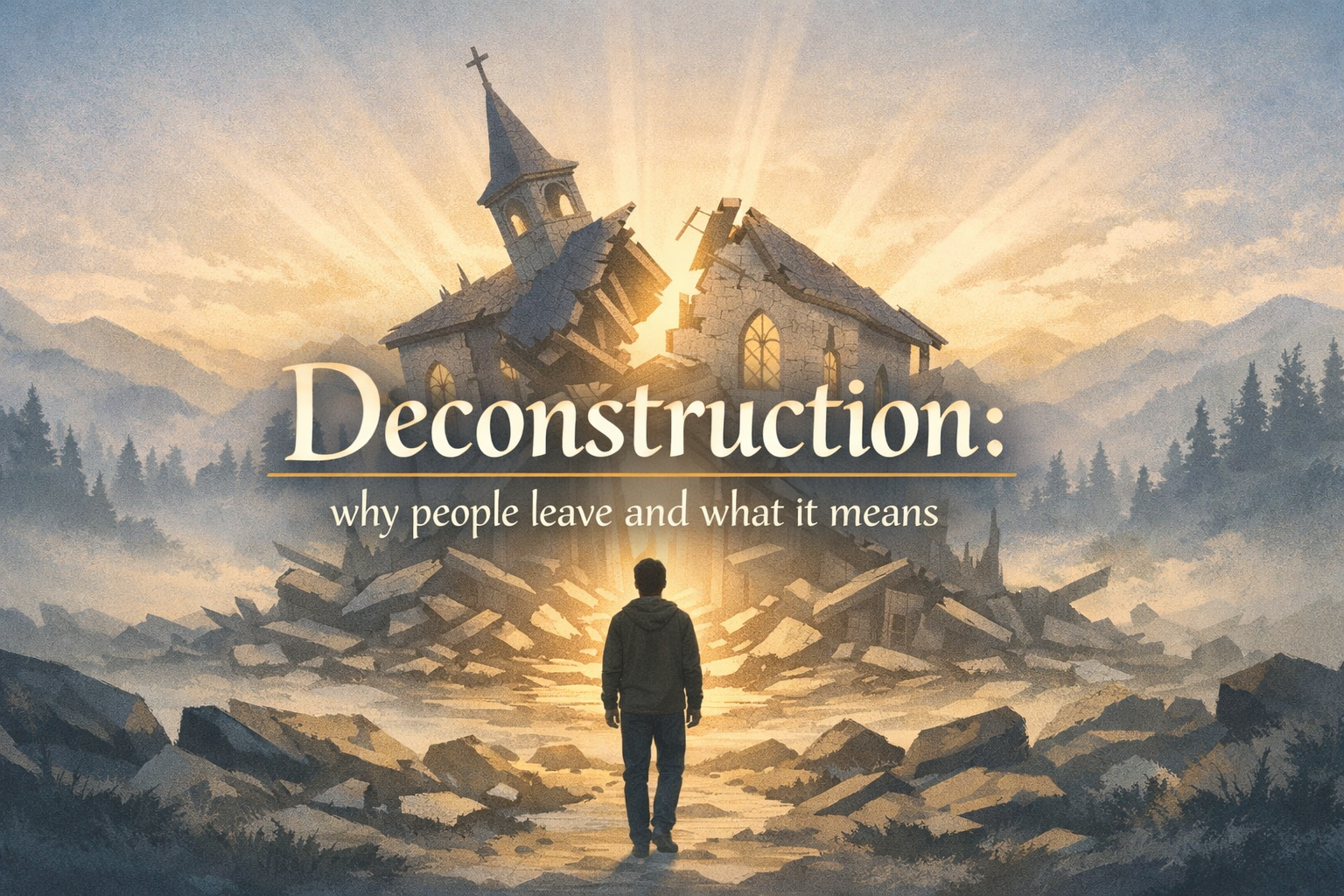
Deconstruction: why people leave and what it means
Deconstruction is not new. People have been walking away from inherited faith for as long as there has been inherited faith. What is new is the speed, the scale, the social infrastructure that makes leaving easier, and the language that makes it feel like intellectual progress rather than loss. Understanding why people leave — honestly, without dismissing them — is one of the most important things the church can do right now.
Taking Seriously the Questions — and the People Asking Them
Someone you know has deconstructed. Maybe your kid. Maybe a friend from the youth group you grew up in. Maybe someone from your congregation who was leading a small group two years ago and now posts skeptical memes on social media. Maybe it is you, quietly, wondering if the faith you inherited is actually true or just familiar.
Deconstruction is the word the current moment uses for the process of pulling apart inherited religious belief — examining the foundations, questioning what you were taught, and often ending up somewhere very different from where you started. It has its own online ecosystem, its own podcasts, its own community of people who find solidarity in the shared experience of leaving. For many people it feels like waking up. For the people who love them, it often feels like loss.
The church’s typical responses have not been great. Dismissing deconstruction as rebellion, immaturity, or moral failure misses the real reasons people leave and guarantees the church will keep losing them. Treating every question as a threat rather than an opportunity produces exactly the brittle, anxious faith that shatters when it meets real pressure. On the other end, churches that simply adjust their theology to match whatever the deconstructing person wants to believe are not helping anyone find truth — they are just offering a different brand of social belonging.
This post will take deconstruction seriously — the real reasons behind it, what is legitimate in it, what is not, and what the church needs to learn from it whether or not the person asking the questions ever comes back.
What Deconstruction Actually Is
The word itself comes from postmodern literary theory — Jacques Derrida’s analytical method for exposing the assumptions buried in texts and structures of meaning. In popular Christian usage it has been detached from that academic origin and now means something more general: the process of critically examining inherited religious belief, often resulting in significant revision or abandonment of that belief.
Not all deconstruction ends in departure. Some people go through a serious reckoning with their inherited faith and come out the other side with a more robust, examined, and durable belief than they had before. That is not deconstruction in the sense the word is usually used online — it is what theologians and careful pastors have always called mature faith. The word faith in Scripture is never presented as the absence of honest questioning. Abraham went to a land he did not know. Job argued with God from the ash heap. Thomas demanded to touch the wounds. The psalms of lament are not exercises in comfortable piety.
The deconstruction that results in departure — the kind this post is primarily engaging — typically involves a process that begins with genuine questions, passes through a period of serious doubt, and ends with the conclusion that Christianity is false, harmful, or not worth the cost of continued commitment. That process is real, it is often painful, and it deserves honest engagement rather than dismissal.
Why People Actually Leave: The Honest List
Research on religious disaffiliation and the accounts of people who have deconstructed consistently point to a cluster of reasons. They are not all the same, they are not all equally valid, and they are not all primarily intellectual — though they are often framed that way. Being honest about the actual reasons is the first step toward an honest response.
Moral Injury from the Church
This is the reason that comes up first, most often, and with the most intensity in deconstruction accounts. Not intellectual objections to the resurrection. Not philosophical problems with the existence of God. Abuse — spiritual, sexual, emotional — by leaders who wielded religious authority to harm people and faced no consequences, or were actively protected by the institution. Watched the church prioritize its reputation over the people it damaged. Experienced the particular cruelty of being told that their pain was somehow their fault, or that forgiveness required silence.
The Southern Baptist Convention’s abuse scandal, the Catholic Church’s decades-long cover-up, the consistent pattern of celebrity pastor implosions — Mars Hill, Harvest Bible, Ravi Zacharias Ministries — these are not isolated incidents. They are a pattern, and people who have lived inside that pattern have reasons for leaving that deserve something more than a theological counter-argument. You do not answer a wound with a syllogism.
The appropriate response to this reason for deconstruction is not a defense of the institution. It is grief, acknowledgment, and the willingness to say plainly: what was done to you was wrong, it was sin, and the people who did it and protected them will answer for it. That is not a concession that Christianity is false. It is a recognition that Christians — including Christian leaders — are sinners, that institutions are corruptible, and that the gospel itself indicts the abuse that was done in its name.
Intellectual Questions That Were Never Allowed
Many people who deconstruct report that the environment they grew up in treated sincere questions as threats. Doubt was something to suppress, not engage. Asking hard questions about the reliability of Scripture, the problem of evil, the exclusivity of Christ, or the church’s history produced anxiety in leaders and social pressure to return to safe answers — rather than genuine intellectual engagement.
When those people eventually encountered the questions in a context where they were welcomed — a secular university, an online community, a conversation with a thoughtful skeptic — the questions felt new and devastating, even if the answers were available. The problem was not that the questions were unanswerable. The problem was that the environment had communicated that unanswered questions were evidence of deficient faith, producing people who had learned to suppress rather than engage.
The appropriate response here is a church culture that takes intellectual honesty seriously. The Bereans examined the Scriptures daily to test what they were taught (Acts 17:11) and were commended for it. Doubt is not the enemy of faith — pretending you do not have doubts while you do is. A church that can engage the hard questions — the reliability of the Gospels, the problem of suffering, the archaeological record, the ethical difficulties of the Old Testament — with honesty and confidence will produce more resilient faith than one that treats every question as a threat to be managed.
The Church’s Moral Failures on Race, Gender, and Justice
Many people, particularly younger ones, have deconstructed in part because they encountered the church’s historical record on race and slavery, its treatment of women, its handling of LGBT people, and concluded that an institution with that record cannot be trusted as a moral authority. The two previous posts in this series address the racial and sexual ethics questions in depth. The point here is simply to name this as a genuine driver of deconstruction and note that dismissing it as capitulation to progressive culture misses the fact that many of the specific failures being named are real.
The appropriate response is the same as with moral injury: honest acknowledgment of real failures, without pretending that those failures settle the question of whether Christianity is true. The church’s failure to live up to its own ethic is evidence that the people in the church are sinners — which is exactly what the church has always claimed. It is not evidence that the ethic itself is wrong or that the Christ the church proclaims is not who he said he was.
The Deconstruction Community Itself
This reason is less comfortable to name but equally real: the online deconstruction community provides something many people are not getting from their church — a sense of being seen, understood, and not alone in their struggles. The social and emotional pull of a community that welcomes questions and celebrates leaving is genuinely powerful, especially for people who have felt unseen or judged in their congregations.
Deconstruction, for many people, is not primarily an intellectual journey. It is a social one. They are following people — online influencers, podcasters, former ministry workers turned skeptics — who are articulate, sympathetic, and culturally fluent in ways that many churches are not. The content of what those voices are saying matters less than the experience of being welcomed by them.
This does not make the deconstruction illegitimate. But it does mean that the church’s response cannot be purely intellectual. If people are leaving partly because they found community outside, the response has to include genuine community inside — the kind that can hold people through doubt without making doubt feel like betrayal.
Genuine Intellectual Conclusions
Some people leave because they have genuinely examined the evidence, engaged the arguments, and concluded that Christianity is not true. This is the reason most often given in deconstruction accounts — and the least common actual primary driver, according to research on religious disaffiliation. But it is real, and it deserves a real intellectual response rather than dismissal.
The honest answer is that the intellectual case for Christianity is strong — stronger than most people who deconstruct have encountered, because most people who deconstruct encountered a version of Christianity that did not know how to make it. The historical reliability of the Gospels, the resurrection evidence, the coherence of Christian theism, the explanatory power of the Christian account of human nature — these are not positions that collapse under scrutiny. They are positions that most deconstructing people have never seen seriously defended.
What Is Legitimate in Deconstruction
Not everything that goes by the name of deconstruction is rebellion or capitulation. Some of it is exactly what the church should want to see — people taking their faith seriously enough to examine it rather than coasting on borrowed conviction.
Examining what you actually believe and why is not a threat to genuine faith. It is a precondition of it. A faith that has never been tested does not know its own strength. The person who has wrestled with the problem of evil and come through it is not weaker for the wrestling — they are more equipped for the next encounter with suffering than someone who has only been told easy answers.
Discarding bad theology is also legitimate. Many people who deconstruct were taught a version of Christianity that was genuinely deficient — moralistic, tribal, intellectually thin, pastorally cruel. Rejecting that is not the same as rejecting Christ. The tragedy is when people cannot find their way from the bad version to the real one — when the only path they see leads out of Christianity entirely rather than deeper into it.
“The goal of faith is not the preservation of the version you started with. It is the pursuit of the truth that faith is reaching toward. Sometimes that pursuit requires tearing down what was built wrong. The question is whether you rebuild — and on what foundation.”
What Is Not Legitimate in Deconstruction
Honesty requires saying this too, even though it is the less popular part of the conversation.
Deconstruction is sometimes driven more by the desire to do what you want — sexually, relationally, professionally, socially — than by honest intellectual inquiry. When a person’s deconstruction conveniently removes all the constraints they were chafing against while leaving their sense of spiritual identity and community largely intact, that is worth examining. It does not mean the questions are not real. It means that desire and reason are not as separable as people like to think, and that honest intellectual inquiry requires asking whether you are following the evidence or rationalizing the conclusion you already wanted.
Paul’s description in 2 Timothy 4:3–4 — people who “will not endure sound teaching, but having itching ears they will accumulate for themselves teachers to suit their own passions” — is not a description of every person who deconstructs. It is a warning about a real pattern that every honest deconstructing person should hold up as a mirror.
The deconstruction community also tends to treat departure as intellectual progress and continued belief as intellectual stagnation or self-deception. That framing is not neutral — it is itself a faith claim about the relationship between reason and religion, and it is not a claim that should be accepted uncritically. Some of the most rigorous thinkers in history — Augustine, Aquinas, Pascal, Chesterton, Lewis, Plantinga, Alvin Plantinga — concluded that Christian belief is not a retreat from reason but its proper fulfillment. The assumption that smart people outgrow faith is a cultural prejudice, not an argument.
What the Church Needs to Learn
Whatever the primary driver of any given person’s deconstruction, the wave of departures the church is experiencing is not primarily a failure of apologetics. It is a failure of formation, community, and integrity. The appropriate response is not better debate tactics. It is a better church.
A better church takes intellectual questions seriously rather than treating them as threats. It produces graduates of its youth programs who have actually encountered the hard questions and seen them engaged with honesty and confidence — not suppressed with social pressure.
A better church takes abuse seriously rather than protecting institutions. It has accountability structures that function, that do not defer to celebrity and power, and that put the dignity of the abused ahead of the reputation of the leader.
A better church takes genuine community seriously — the kind that is present in suffering, that knows people deeply enough to notice when someone is struggling, that does not require people to pretend they have no doubts in order to belong.
A better church takes its own ethic seriously — living out the unity it proclaims, treating the vulnerable with the dignity it claims to believe they have, holding its leaders to the same standards it applies to everyone else.
None of that is capitulation to the deconstruction movement. It is fidelity to what the church is supposed to be. The deconstruction wave is partly a judgment on the ways the church has failed to be what it claimed. The appropriate response is not defensiveness. It is repentance — and the slow, costly work of becoming more genuinely what the gospel produces.
For Those Who Are in the Middle of It
If you are in the middle of deconstruction yourself — questioning things you were raised to believe, not sure what you actually think, wondering if you are losing your faith or finding it — a few things are worth saying directly.
Honest questions are not evidence of failing faith. They may be evidence of maturing faith. The psalms of lament, Job’s arguments, Thomas’s demand — the biblical record is full of people who brought their doubt and confusion to God rather than away from him. That is what you should do. Not perform certainty you do not have. Not suppress the questions. Bring them.
Examine the sources. The deconstruction community is not a neutral guide to Christianity — it has its own commitments, its own blind spots, and its own social pressures toward a particular conclusion. The apologists and theologians who have engaged the hard questions seriously — N.T. Wright on the Gospels and resurrection, Tim Keller on doubt and suffering, Alvin Plantinga on reason and faith, Michael Licona on historical method — deserve the same hearing as the deconstruction podcasters. Read both. Think hard. Do not mistake the social comfort of one community for the intellectual weight of its arguments.
Do not confuse the failures of the church with the truth claims of Christ. The church is full of sinners — that is not a surprise, it is the premise. The question is not whether every Christian has lived consistently with the faith. They have not. The question is whether Jesus rose from the dead and whether he is who he claimed to be. That question is answered by evidence, not by the behavior of his followers.
Jude 1:22: “Have mercy on those who doubt.” That is the instruction to the church. And it is also, addressed the other direction, a description of what God is toward those who are honestly wrestling. Mercy — not judgment, not abandonment, not impatience. The God who is there in the wrestling is the same God who was there before the questions started. He is not threatened by them.
Key Takeaways
- Deconstruction is not primarily an intellectual phenomenon — it is a relational and moral one. The most common drivers are moral injury from church abuse, questions that were never allowed, and the experience of finding more community outside the church than inside. Responding with better arguments alone misses the actual presenting problems.
- Some deconstruction is legitimate and the church should want to see it. Examining what you believe and why is a precondition of genuine faith, not a threat to it. Discarding bad theology — moralistic, tribal, intellectually thin — is not the same as discarding Christ. The tragedy is when people cannot find the path from a deficient version of Christianity to the real one.
- Some deconstruction is motivated reasoning dressed up as intellectual inquiry. When deconstruction conveniently removes every constraint while preserving every benefit of Christian identity, the 2 Timothy 4:3–4 warning deserves honest self-examination. Desire and reason are not as separable as deconstruction culture assumes.
- The church’s response cannot be primarily apologetic — it must be ecclesial. Better debate tactics are not the answer. A church that takes intellectual questions seriously, abuses seriously, genuine community seriously, and its own ethic seriously is the answer. The deconstruction wave is partly a judgment on the ways the church has not been that.
- Do not confuse the church’s failures with the truth claims of Christ. The church is full of sinners — that is the premise, not the scandal. The question is not whether Christians have lived consistently with the faith. They have not. The question is whether Jesus rose from the dead. That question is answered by evidence, not by institutional behavior.
- God is not threatened by honest questions. The psalms of lament, Job’s arguments, Thomas’s demand, the Bereans’ daily examination — the biblical record commends honest inquiry rather than performed certainty. Bringing doubt to God rather than away from him is not faithlessness. It is the only kind of faith that can be called mature.
Key Scriptures: Acts 17:11 · Psalm 22:1–2 · Job 38:1–3 · John 20:27–29 · Mark 9:24 · Jude 1:22 · 2 Timothy 4:3–4 · Hebrews 11:1 · Romans 10:17