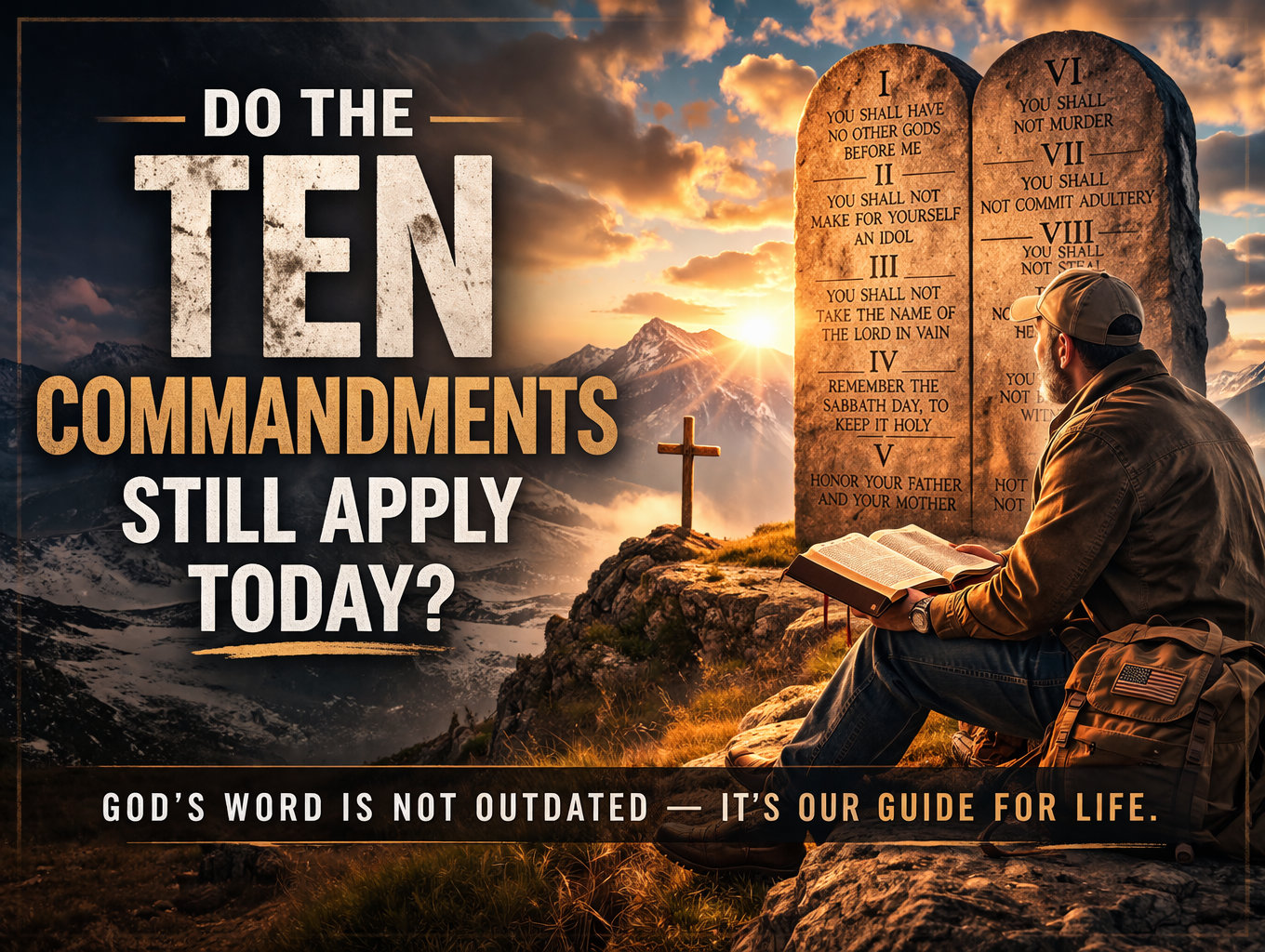
Do the Ten Commandments Still Apply Today?
Understanding God’s Moral Law in a New-Covenant World — and Why It Still Matters on the Back Roads and the Broadband
Out here in the high country, where the snow still lingers on north-facing slopes and cell reception comes and goes, you learn that some things never change. People still marry and fight, hope and hurt, cheat and forgive — just like they did when Moses trudged down Sinai with two slabs of rock.
Fast-forward a few thousand years and we’re navigating self-driving cars, quantum computers, and social networks that never sleep. So folks ask — sometimes with a grin, sometimes with a sneer — “Do those commandments still matter? Aren’t we past all that?”
Technology changes at lightning speed. But the human heart plods along at camel pace. We still need direction, correction, and protection. Here’s why the Ten Commandments remain God’s helpful fence line for the New-Covenant believer.
“If you love Me, keep My commandments.” — John 14:15
Where the Commandments Sit in the Bible Story
Before we talk application, let’s place the Commandments in the sweep of Scripture — because context is everything.
- Slavery to freedom first. Israel had just been rescued from Egyptian oppression (Exodus 1–14). The Commandments were not a pre-condition for rescue — they were a post-rescue revelation: “I set you free; here is how free people live.”
- A covenant ceremony. Mount Sinai functions like a wedding altar. Yahweh vows to be Israel’s God; Israel vows faithfulness. The Ten Commandments are the vows hung on the wall.
- Wilderness schooling. The commandments trained a nomadic nation how to treat God and neighbor before they ever plowed Canaan’s soil.
The principle that never changes: Salvation precedes obligation. We obey because we’ve been loved — not to get loved.
Jesus and the Law — Deeper, Wider, Higher
Jesus’ famous statement — “I came not to abolish but to fulfill” (Matthew 5:17) — means He filled the Law to the brim and drank it down on our behalf. But fulfillment isn’t replacement. Think of it like raising a barn: the foundation remains, but Christ raises the roof, frames the walls, and turns a bare slab into a home.
- Then: “Do not murder.” Now: Jesus forbids murderous anger (Matthew 5:21–22).
- Then: “Do not commit adultery.” Now: He addresses lustful imagination (Matthew 5:27–28).
Christ doesn’t loosen the bolts — He tightens them to the heart.
Three Kinds of Old Testament Law
| Category | Examples | Status in Christ |
|---|---|---|
| Moral | Ten Commandments; justice for the vulnerable | Timeless — reflects God’s unchanging character |
| Ceremonial | Sacrifices, priestly dress, dietary restrictions | Fulfilled in Christ’s priesthood and perfect offering |
| Civil | Property lines, leprosy quarantine, inheritance law | Context-bound to ancient Israel; principles apply, specifics don’t |
Scholar J.I. Packer calls the moral law “creation-transcending constants.” What’s righteous in one era is righteous in all eras — because it reflects who God is, not just what He told one culture to do.
Five Core Reasons We Still Need the Ten
Mirror — They Reveal Sin
Paul: “Through the law comes knowledge of sin” (Romans 3:20). The commandments show you what you actually are — not what you imagine yourself to be. They drive you to the gospel because they show you your need for it.
Map — They Direct the Redeemed
Like trail markers on a foggy ridge, they keep saved people off moral cliffs. They don’t save you — but once you’re saved, they show you where the path goes.
Moral DNA — They Display God’s Character
Truthfulness, loyalty, justice, mercy — etched in stone because they’re etched in God. The commandments don’t just tell us what to do; they tell us what God is like.
Love’s Framework
Paul ties love and law together (Romans 13:8–10). Love is the muscle; the commandments are the bones. Without bones, muscle has no shape or direction. Love needs the law to know where to go.
Community Safeguard
Societies that abandon the commandments drift toward chaos. C.S. Lewis called moral absolutes the “tao” that holds civilization together. The fence protects what lives inside it.
A Rural Spin on Each Commandment
| # | Ancient Wording | Back-Road Rendition | 2025 Application |
|---|---|---|---|
| 1 | No other gods | Don’t hitch your wagon to any other deity | Keep money, politics, patriotism, and hobbies from becoming idols |
| 2 | No idols | Don’t carve calves — physical or digital | Resist image-based culture that photoshops God into our own likeness |
| 3 | Don’t misuse God’s Name | Don’t drag the Lord’s good name through the mud | Quit “Christian” cursing online; honor God in emails and contracts |
| 4 | Remember the Sabbath | Rest when God says rest | Carve out weekly worship and unplugging — even during harvest |
| 5 | Honor father & mother | Tip your hat to Momma and Daddy | Care for aging parents; teach kids family roots and respect |
| 6 | Do not murder | Don’t end a life God began | Oppose abortion, hate, revenge; value life from womb to hospice |
| 7 | No adultery | Stay faithful under the same roof | Digital purity, faithful marriage, purity culture with grace |
| 8 | Do not steal | Keep your hands off what ain’t yours | Honest taxes, fair pricing, respect intellectual property |
| 9 | Don’t lie | Shoot straight | Truthful advertising; no gossip at the feed store or on social media |
| 10 | Don’t covet | Don’t eyeball your neighbor’s John Deere | Fight comparison culture — contentment in Christ, not consumerism |
Voices Across Church History
| Era | Leader | What They Said |
|---|---|---|
| 2nd century | Irenaeus | “The Decalogue was not abolished by advent of Christ but ventured deeper into our hearts.” |
| 16th century | Martin Luther | “We need the Law to teach, to accuse, and to direct the regenerate.” |
| 18th century | John Wesley | “Inward love produces outward obedience; thus Christians establish the Law.” |
| 20th century | Elisabeth Elliot | “God is God. Because He is God, He is to be obeyed.” |
| 21st century | Tim Keller | “Grace does not free you from obedience; it frees you to obedience.” |
Two Ditches to Avoid
⬅️ Legalism
The error: Turning commandments into a ladder to heaven — as if keeping them earns or maintains God’s favor.
Symptom: Prideful rule-keeping; judgmental spirit toward those who stumble.
Cure: Remember why Jesus had to die. No one climbs that ladder. Grace alone saves.
➡️ Antinomianism
The error: “We’re under grace, so rules don’t apply anymore.” Using grace as a permission slip for drift.
Symptom: Flippant sinning, spiritual apathy, moral ambiguity dressed as freedom.
Cure: Read Romans 6:1–4. Grace trains rather than excuses.
“He who turns the gospel into a cloak for sin shall be damned with the Pharisee who turns the Law into a cloak for self-righteousness.” — Charles Spurgeon
Law and Gospel — Two Tracks, One Locomotive
Picture two parallel railroad tracks. The locomotive needs both to run straight:
📜 Law — Track One
- Shows the problem
- Commands holiness
- Exposes sin
- Drives us to Christ in need
- Guides grateful obedience
✝️ Gospel — Track Two
- Provides the solution
- Grants holiness by grace
- Cleanses sin
- Sends us back to Law to live in gratitude
- Empowers what Law demands
A locomotive runs safest on both rails. Ditch one, and the whole thing derails.
Modern Life Through the Commandments
Digital Integrity (Commandments 8 & 9)
Plagiarism, music piracy, and AI-generated cheating count as theft. Forwarding false memes violates truthfulness. The commandments didn’t anticipate the internet — but they speak directly to what happens on it.
Consumer Culture (Commandment 10)
Covetous scrolling through retail apps breeds restlessness and debt. The antidote isn’t just willpower — it’s gratitude rooted in contentment in Christ rather than comparison with neighbors.
Politics as Idolatry (Commandments 1 & 2)
When party loyalty eclipses kingdom loyalty — when you trust princes more than the Lord — that’s idolatry. Psalm 146 is the prescription: “Do not put your trust in princes.”
Sanctity of Life (Commandment 6)
Standing for the unborn, the elderly, the refugee, and the vulnerable isn’t just a political position — it’s an application of “do not murder” in a world that devalues life at both ends. Foster care, crisis pregnancy support, and end-of-life compassion are commandment 6 in action.
Sabbath Rhythms (Commandment 4)
Farmers often feel guilty resting during haying season — but the command doesn’t take a harvest hiatus. Build Sabbath into winter rhythms, carve mini-Sabbaths weekly, and trust that the One who made the land can manage it one day without you.
🪓 Fencing the Homestead
I’ve got an old cedar-post fence around my back pasture. Its purpose isn’t to oppress my cattle — it’s to keep coyotes out and cows off the highway. That’s what God’s commandments do. They fence in human flourishing.
Tear them down and the coyotes of chaos sneak in: broken homes, addiction, violence, cynicism, and a culture that can no longer tell right from wrong. The fence isn’t a prison. It’s protection.
Common Objections — Short Answers
| Objection | Short Answer |
|---|---|
| “We’re under grace, not Law.” (Romans 6:14) | True for justification — not true for sanctification. Grace frees you to obey, not from obeying. |
| “The commandments are all negatives — just ‘don’ts.'” | Eight negatives protect two positives: love God and love neighbor. The fence protects the garden. |
| “Following rules kills relationship.” | Ask any healthy marriage. Boundaries guard intimacy — they don’t threaten it. |
| “The commandments ignore cultural progress.” | Moral truth transcends culture. Technology changes the tools; the human heart stays the same. |
Mount Sinai shook with thunder; Mount Calvary shook with redemption. Same God, same moral heartbeat. Sinai wrote the standard; Calvary paid the debt; Pentecost powered the obedience.
Do the Ten Commandments still apply? Yes — not as shackles, but as spiritual steering. Obeying them won’t make God love you. He proved His love at the cross. But living them out shouts back: “Love received. Love returned.”
Let’s plant that truth like alfalfa seed in spring, nurture it with prayerful rain, and harvest a crop of holiness that feeds hungry hearts — right here on the backroads and across the broadband cables of a wired world.
“If you love Me, keep My commandments.” — John 14:15
Key Scriptures: John 14:15 · Exodus 20 · Matthew 5:17–28 · Romans 3:20; 6:1–4; 13:8–10 · Galatians 3 · Ephesians 6:1–3 · James 2:8–11 · Jeremiah 31:33 · Philippians 2:12–13 · Galatians 5:22–23 · Colossians 3:15
Want to Go Deeper?
The Ten Commandments sit at the intersection of law and gospel, creation and covenant, freedom and faithfulness. Here are a few next steps:
- Read J.I. Packer’s Keeping the 10 Commandments — the clearest modern treatment of each commandment’s contemporary application, from the man who called them “creation-transcending constants.”
- Read Kevin DeYoung’s The 10 Commandments: What They Mean, Why They Matter, and Why We Should Obey Them — brief, accessible, and pastorally sharp.
- Read the companion MVM posts on Justification, Sanctification, and Conviction — the commandments connect all three: they expose our need (justification), guide our growth (sanctification), and the Spirit applies them to our hearts (conviction).
- Subscribe to get new posts delivered straight to your inbox — gospel-rooted, plain-spoken truth for the week ahead.
“He has told you, O man, what is good; and what does the LORD require of you but to do justice, and to love kindness, and to walk humbly with your God?” — Micah 6:8