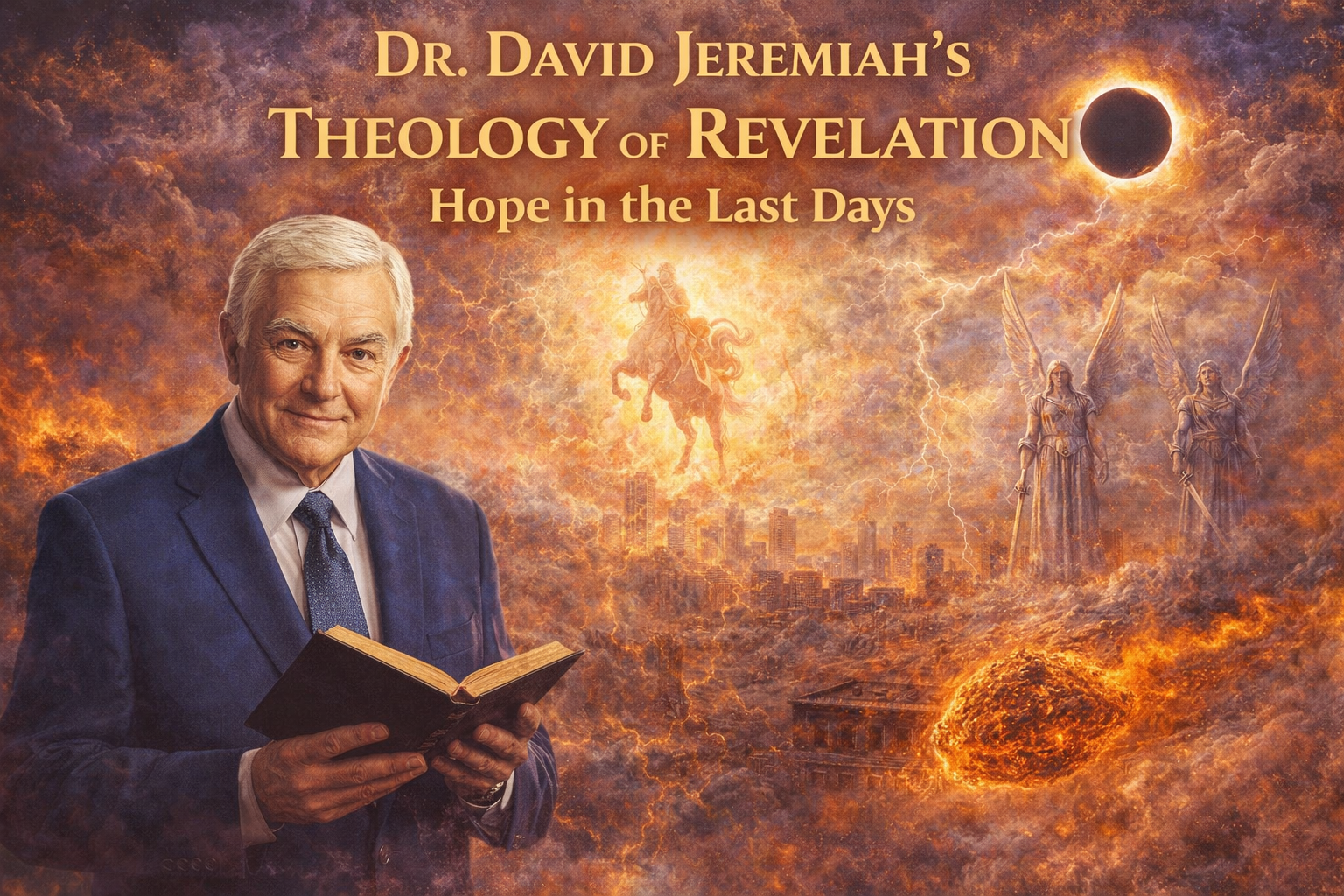
Dr. David Jeremiah’s Theology of Revelation: Hope in the Last Days
How a Dispensational Premillennialist Reads the Final Book of the Bible — and Why It Still Matters Today
In uncertain times, the final book of the Bible offers unmatched clarity, comfort, and warning. Yet many believers avoid Revelation due to its mysterious symbols and daunting imagery. Dr. David Jeremiah — longtime pastor of Shadow Mountain Community Church and founder of Turning Point Ministries — has spent decades serving as a faithful guide through these prophetic pages.
To Jeremiah, Revelation is not a foggy vision or a spiritual riddle. It’s God’s precise, literal, and ordered plan for the end of the age. His goal in teaching it is never fear — it’s faith, urgency, and holiness.
“The Revelation of Jesus Christ is not a mystery — it’s a message. And God promises a blessing to those who read it, hear it, and obey it.” — David Jeremiah, Escape the Coming Night
Jeremiah’s Theological Framework
At the core of Jeremiah’s interpretation is a futurist, literal reading of Revelation. He sees chapters 4–22 as yet to be fulfilled — not as allegory, not as metaphor, but as divine history written in advance. His framework rests on five foundational pillars:
Literal interpretation of prophecy — what it says is what it means
Pretribulational rapture of the Church before the Great Tribulation
A literal seven-year Tribulation of divine judgment on the earth
Christ’s physical return and literal 1,000-year Millennial reign on earth
Final judgment followed by a New Heaven and New Earth — a real, eternal home for God’s people
This structure follows the dispensational premillennial tradition established by scholars such as John Walvoord, Charles Ryrie, and Tim LaHaye.
Walking Through the Book
Chapters 1–3
📌 Letters to the Seven Churches
Jeremiah sees these chapters as both historical and timeless. Written to real churches in Asia Minor, they also serve as messages to every church in every age. He finds personal application in each — particularly the warnings to Ephesus (lost its first love), Smyrna (faithful under persecution), and Laodicea (lukewarm and in danger of being left behind). He urges modern congregations to examine themselves honestly through these letters.
Chapters 4–5
🏛️ The Throne Room of Heaven
Here the prophetic vision begins. John is “caught up” into heaven — an event Jeremiah links symbolically with the rapture of the Church. The worship scene that follows anchors everything: God on His throne, the Lamb as the only One worthy to open the scroll of history. This heavenly scene sets the stage for all the judgments to come.
Chapters 6–18
⚡ The Great Tribulation
Seven years of divine judgment and global upheaval — seals, trumpets, and bowl judgments pouring out in sequence. Jeremiah teaches this as a literal future period, and he doesn’t soften it. Earthquakes, plagues, war, famine, and cosmic catastrophe fill these chapters. Yet even here God’s mercy is visible:
- The 144,000 sealed Jewish evangelists preaching the gospel worldwide
- The Two Witnesses standing boldly in Jerusalem (Rev. 11:3–12)
- People coming to faith even in the worst of times
The Antichrist rises during this period — beginning as a charismatic peacemaker, making a treaty with Israel, then breaking it and demanding worship. The Mark of the Beast (Rev. 13:16–18) becomes the mechanism of economic control. Jeremiah draws parallels between this prophesied system and today’s digital infrastructure, biometric IDs, and centralized financial technology — not to set dates, but to show that the scaffolding is being built.
Chapter 19
👑 The Return of Christ
The culmination of history. Jesus Christ — the rider on the white horse — returns in power and glory to defeat the Beast and his assembled armies at Armageddon. The Antichrist and False Prophet are cast into the lake of fire. The long rebellion of the nations reaches its end. Jeremiah teaches this as a literal, physical, visible return — the same Jesus who ascended, coming back the same way (Acts 1:11).
Chapter 20
🌿 The Millennial Kingdom
A literal 1,000-year reign of Christ on earth. Satan is bound. The curse is progressively lifted. Believers reign with Christ. Peace and righteousness characterize the age. This is the fulfillment of God’s covenant promises to Israel — distinct from the eternal state that follows.
Chapters 21–22
🌈 New Heaven and New Earth
The old earth passes away and God creates a new eternal home for His redeemed. Jeremiah takes this literally — not as metaphor for a state of mind, but as a real place for real people. The New Jerusalem descends. God dwells with His people. No more death, sorrow, crying, or pain. Streets of gold, gates of pearl, and God as the light — forever.
The Rapture — Hope Before the Wrath
One of Jeremiah’s most emphasized doctrines is the pretribulational rapture: before the seven-year Tribulation begins, Christ will call His Church home. The Church then is notably absent from the Tribulation period in Revelation — which Jeremiah sees as reinforcing evidence for this sequence.
1 Thessalonians 4:16–17
“The Lord Himself will descend from heaven… and the dead in Christ will rise first. Then we who are alive will be caught up together with them in the clouds to meet the Lord in the air.”
Revelation 3:10
“Because you have kept my word about patient endurance, I will keep you from the hour of trial that is coming on the whole world.”
Revelation 4:1
“Come up here” — the voice calling John into heaven, which Jeremiah reads as a symbolic picture of the Church being taken up before the judgments begin.
“The Bible is clear: God has not appointed us to wrath.” — David Jeremiah
Strengths and Honest Critiques
✅ Strengths
- Clarity and accessibility — Jeremiah translates complex prophecy into understandable, biblical terms without losing the weight of the text
- Pastoral relevance — He preaches prophecy to prepare hearts, not to speculate. The goal is always holiness, evangelism, and courage
- High view of Scripture — Consistent literal interpretation and unwavering confidence in biblical authority
⚠️ Common Critiques
- Limited engagement with other views — Preterist, historicist, and idealist readings get little attention; his aim is pastoral, not academic
- Current events connections — Some find links to today’s technology speculative, though Jeremiah carefully avoids date-setting
- First-century context — Futurist-only focus can underemphasize Revelation’s original encouragement to persecuted early Christians
How to Apply This Today
Be Watchful
Prophecy is not an academic exercise — it’s a call to readiness. Live every day as though Christ could return before it ends.
“Live every day like Jesus could come today.” — David Jeremiah
Be Holy
Revelation calls believers to purity in a polluted world (Rev. 3:4–5). The closer we draw to the end, the more countercultural holiness becomes — and the more essential.
Be Bold
Use the urgency of prophecy to share the gospel. There is still time. People can still come to Christ. The door is not yet shut.
Be Hopeful
Despite the headlines, the King is coming. Evil has an expiration date. The last chapter has already been written — and it ends in glory.
“Revelation tells us that evil will not win. Christ will return. Heaven is real. And the best is yet to come.” — David Jeremiah
To David Jeremiah, the Book of Revelation is not dark and scary. It’s a love letter from Christ — warning of coming judgment but overflowing with eternal hope. It’s the only book in Scripture that promises a specific blessing to those who read it, hear it, and live it (Rev. 1:3).
Friend, Revelation isn’t meant to make you hide in fear. It’s meant to light a fire in your heart, fill you with urgency, and lead you to the feet of Jesus. The end is not the end — it’s the beginning of glory.
So stay ready. Keep your lamp full. Our redemption is drawing near.
“Even so, come, Lord Jesus.” — Revelation 22:20
Key Scriptures: Revelation 1:3; 3:4–5, 10; 4:1; 11:3–12; 13:16–18; 19:11–21; 20:1–6; 21:1–5; 22:20 · 1 Thessalonians 4:16–17 · Acts 1:11 · Ephesians 1:4 · Hebrews 11:10
Want to Go Deeper?
David Jeremiah has written extensively on Revelation and end-times prophecy. If this post stirred your heart, here are the best next steps:
- Escape the Coming Night — Jeremiah’s chapter-by-chapter guide through Revelation, written for everyday readers
- The Book of Signs — 31 undeniable prophecies of the last days, connecting Scripture to current events
- Agents of the Apocalypse — A character-based journey through Revelation’s key end-time figures
- Turning Point Radio and YouTube — Ongoing prophetic teaching from Jeremiah’s ministry
- Subscribe to MVM to get new posts delivered straight to your inbox — gospel-rooted, plain-spoken truth for the week ahead.
“Blessed is the one who reads aloud the words of this prophecy, and blessed are those who hear, and who keep what is written in it, for the time is near.” — Revelation 1:3