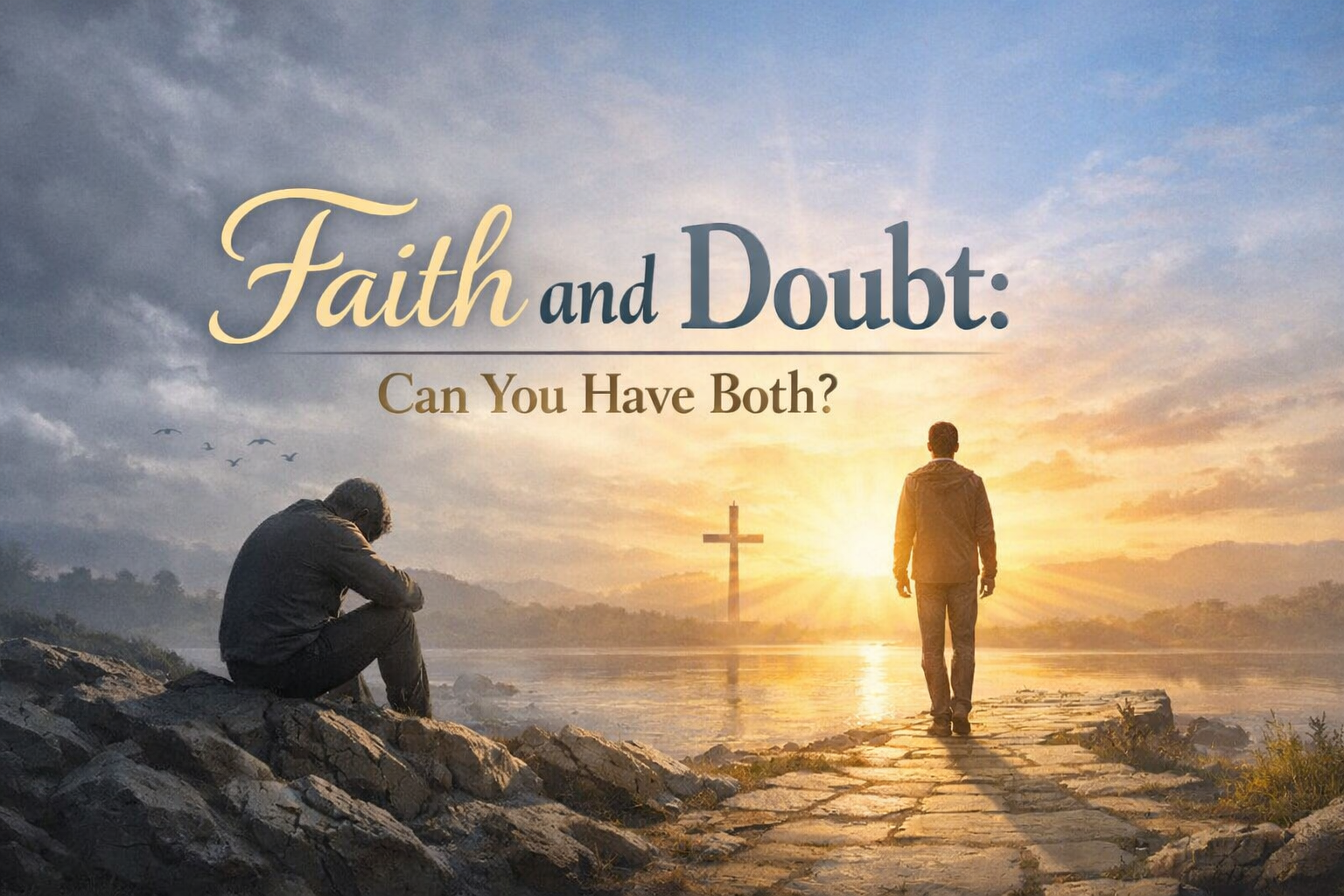
Faith and doubt: can you have both?
Most people think doubt is the enemy of faith. But the Bible tells a different story — one where doubt shows up in the middle of genuine belief, not as proof that belief has failed. If you’ve ever wrestled with hard questions about God while still trusting Him, you’re not broken. You’re in good company with some of the most faithful people who ever lived.
Wrestling with hard questions doesn’t mean your faith is failing — it may mean it’s growing.
There’s a conversation that happens in almost every church, usually in hushed tones. Someone pulls a pastor or an elder aside and says something like: “I believe in God, but I’ve got questions I can’t shake. Does that mean I don’t really have faith?”
It’s a good question. And the fact that people ask it quietly — like they’re confessing something shameful — tells you a lot about how the church has handled doubt over the years. Too often, we’ve treated it as the opposite of faith. A spiritual weakness. Something to be corrected or suppressed rather than understood.
But that’s not what the Bible teaches. And it’s not what the greatest saints in church history experienced.
The truth is more complicated — and more hopeful. Faith and doubt can coexist. In fact, for most believers, they do.
What We Mean When We Say “Doubt”
First, we need to be precise, because “doubt” gets used to cover a lot of different territory.
There’s intellectual doubt — honest questions about whether Christianity is true. Does God exist? Did the resurrection actually happen? How do I make sense of suffering? These are real questions that serious people ask, and they deserve serious answers, not dismissal.
There’s emotional doubt — the experience of God feeling distant or absent. You believe the doctrines, but prayer feels hollow. You go through the motions, but the sense of God’s presence you once had has evaporated. The Psalms are full of this.
And there’s volitional wavering — the pull toward unbelief when life gets hard, when prayers seem unanswered, when the cost of following Christ gets real. This is closer to what James addresses when he talks about the double-minded man.
These are different problems with different pastoral responses. But they share a common thread: they all feel like threats to faith. The question is whether they have to be.
What the Bible Actually Shows Us
One of the most remarkable things about Scripture is its honesty about the inner lives of believers. The Bible doesn’t present faith as a state of serene, uninterrupted certainty. It shows us something messier and more human.
Thomas is the obvious starting point. When the other disciples told him the risen Lord had appeared, Thomas said he wouldn’t believe unless he saw the nail marks himself (John 20:25). Jesus didn’t rebuke him for asking — He showed up eight days later and let Thomas see and touch. And then He said something worth noting: “Blessed are those who have not seen and yet have believed” (John 20:29). That’s not a condemnation of Thomas. It’s a statement about the nature of the faith most of us will need to exercise.
John the Baptist sent messengers from prison to ask Jesus: “Are you the one who is to come, or shall we look for another?” (Matthew 11:3). This is the man who baptized Jesus, who declared Him the Lamb of God, who leapt in the womb at Mary’s greeting. And now, in a dark cell, he’s asking if he got it right. Jesus didn’t send back a rebuke. He sent back evidence — the blind see, the lame walk, the dead are raised — and then called John the greatest man born of woman.
The father of the demon-possessed boy may be the most raw example of all. When Jesus told him everything was possible for one who believes, the man cried out: “I believe; help my unbelief!” (Mark 9:24). That’s not a confession of unbelief. It’s a confession of mixed belief. And Jesus healed his son.
The pattern is consistent. The Bible doesn’t portray doubt as disqualifying. It portrays how we bring our doubt as the significant question.
The Reformed Tradition on Faith and Assurance
The Reformed tradition has thought carefully about this, and it offers a helpful framework. The Westminster Confession of Faith distinguishes between saving faith and full assurance. Chapter 18 acknowledges that true believers may face doubts, temptations, and a sense of God’s withdrawal — and that this doesn’t mean their faith is false or their election uncertain.
“This infallible assurance doth not so belong to the essence of faith, but that a true believer may wait long, and conflict with many difficulties before he be partaker of it.”
— Westminster Confession of Faith, 18.3
John Calvin similarly argued that faith is not the absence of doubt but the conquest of it. In the Institutes, he wrote that faith is not a “quiet and tranquil” state free from conflict — it is trust that persists through conflict. The believer is always fighting against their own unbelief, and this fight itself is a sign of spiritual life, not spiritual death.
This is a pastorally important distinction. A person who has never doubted may simply have never thought deeply about what they believe. A person who doubts but keeps returning to Christ, keeps wrestling, keeps trusting despite the questions — that’s a different thing entirely.
Where Doubt Becomes Dangerous
None of this is to say that doubt is harmless or that it can be left unaddressed indefinitely. There’s a difference between doubt that drives you toward God and doubt that drives you away from Him.
James warns against the man who asks for wisdom without genuinely expecting God to answer — who is “double-minded” and “unstable in all his ways” (James 1:6–8). The problem there isn’t the act of asking hard questions. It’s a heart that has already decided it won’t accept whatever God gives. It’s doubt weaponized as an excuse for disobedience.
Hebrews 3:12 warns against “an evil, unbelieving heart that turns away from the living God.” The key phrase is turns away. The direction matters. Doubt that keeps you in the wrestling match — crying out to God, seeking answers, hanging on even when you can’t see clearly — is categorically different from doubt that becomes an exit ramp.
The practical test is this: What is your doubt doing to your behavior? Is it driving you to pray more, study more, seek counsel? Or is it being used to justify pulling back from the community, neglecting Scripture, and rationalizing sin? The first kind of doubt, handled rightly, can deepen faith. The second kind, left unchecked, corrodes it.
What to Do With Doubt
So what does faithful doubt-management look like? A few things.
Bring it to God directly. The Psalms model this. Psalms 13, 22, 88 — these are raw, unfiltered expressions of confusion, abandonment, and complaint addressed directly to God. There’s no pretending. There’s no cleaning it up before prayer. Lament is a biblical category. You are allowed to say God, I don’t understand this, and it’s hard to trust you right now. That honesty is not faithlessness — it’s the beginning of honest faith.
Feed your mind, not just your feelings. A lot of doubt is intellectual in origin, and intellectual doubt deserves intellectual engagement. Read the apologists. Study the historical evidence for the resurrection. Work through the philosophical arguments for God’s existence. Christianity is not a blind leap — it’s faith built on evidence and testimony that has withstood scrutiny for two millennia. Your questions probably have better answers than you’ve been given.
Stay connected to the body.** Don’t doubt alone. One of the enemy’s most effective tactics is isolation — getting you to carry your questions in private where they can grow unchecked and distorted. Find a pastor or elder you trust. Get into a community that can handle hard conversations. The church at its best is a place where doubt can be spoken and worked through, not hidden and shamed.
Keep acting on what you do believe. Faith is not merely intellectual assent — it’s action. Even when the emotional and intellectual dimensions of faith feel shaky, you can still show up, still serve, still give, still pray. Often it’s the continued practice of faith that brings the feeling of faith back. You don’t wait until you feel certain to act like you believe. You act like you believe and watch what God does with that.
A Word to the Veteran Community
If there’s one group that tends to carry doubt silently, it’s veterans. The culture trains you to project confidence and keep weakness private. Admitting uncertainty — about anything — can feel like a breach of discipline.
But many veterans come home with questions about God that combat generated. Where was God in that? Why did he make it and I didn’t? How does a good God let that happen? Those questions are serious, they deserve serious engagement, and they are not signs of a broken faith. They are signs of a mind that is actually grappling with reality.
The men in Scripture who doubted most openly — Thomas, John the Baptist, the Psalms writers — were not soft men. They were men under pressure, in darkness, carrying real burdens. Their honesty before God was not weakness. It was a particular kind of courage.
You don’t have to have it all figured out. You just have to keep showing up to the fight.
Key Takeaways
- Doubt and faith are not opposites. Scripture consistently shows genuine believers wrestling with uncertainty — Thomas, John the Baptist, the father in Mark 9 — without their faith being declared invalid.
- The Reformed tradition distinguishes saving faith from full assurance. Believers can have real faith while lacking a sense of certainty, and that struggle is a sign of spiritual life, not spiritual death.
- The direction of your doubt matters more than the presence of it. Doubt that drives you toward God — in prayer, in Scripture, in community — is categorically different from doubt used as an exit ramp from obedience.
- Biblical lament is a legitimate response. The Psalms model honest, even anguished conversation with God. You don’t have to clean up your questions before you bring them to Him.
- Intellectual questions deserve intellectual engagement. Christianity has withstood serious scrutiny for two thousand years. Your hard questions likely have better answers than you’ve encountered — seek them out.
- Keep acting on what you do believe. Faithful action often precedes the return of confident feeling. You don’t wait to feel certain — you keep moving and watch what God does with that obedience.
Key Scriptures: John 20:24–29 · Matthew 11:1–6 · Mark 9:24 · Psalm 13 · James 1:6–8 · Hebrews 3:12 · Romans 4:18–25 · Westminster Confession of Faith 18.3