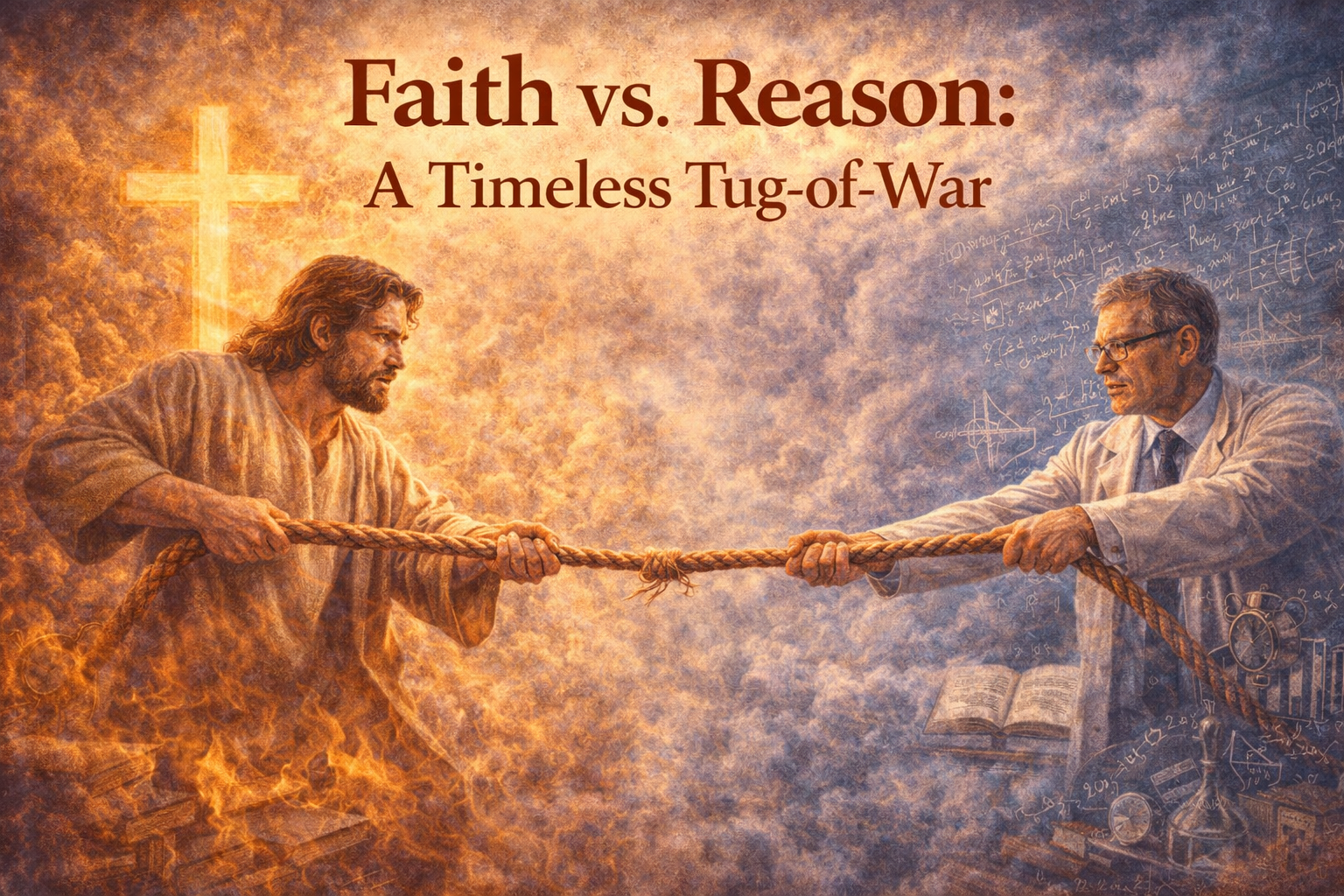
Faith vs. Reason: A Timeless Tug-of-War
A Survey from Plato to Plantinga — and Why the Christian Answer Is Neither War nor Truce, But Integration
The question of faith versus reason is one of the most enduring debates in human thought. Are they allies in our pursuit of truth, or do they stand in irreducible tension? From ancient philosophers to modern apologists, this issue continues to shape how believers and skeptics alike understand the world and their place in it.
Faith refers to trust and confidence in things not seen — especially divine truths revealed by God. Reason is the ability to think logically, analyze, and evaluate based on evidence. The tension arises when one is called to believe something that seems to stretch or challenge the boundaries of what reason can confirm on its own. Can you logically prove God’s existence? Are miracles rational? Can a crucified carpenter from Nazareth truly be the Savior of the world?
For most serious Christian thinkers across twenty centuries, the answer has not been to choose one over the other. It has been to understand how the two can work together — each doing what the other cannot, both pointing toward the same truth.
“Faith and reason are like two wings on which the human spirit rises to the contemplation of truth.” — Pope John Paul II, Fides et Ratio
A Historical Survey — From Ancient Philosophy to the Present
Ancient Foundations
Plato and Aristotle, the pillars of Western philosophy, established reason as the primary tool for understanding reality. Their reflections on metaphysics and morality laid groundwork that Christian theology would engage for centuries. Aristotle’s concept of a “Prime Mover” — an uncaused cause that sets all motion in action — would later resurface in Aquinas’s cosmological arguments for God’s existence. The seeds of the conversation were planted in Athens long before they bloomed in Jerusalem.
Early Christianity
Paul taught that salvation comes through faith (Romans 1:17) and that believers live by faith, not by sight (2 Corinthians 5:7). Tertullian, writing around AD 200, famously asked “What has Athens to do with Jerusalem?” — expressing caution about importing Greek philosophical frameworks into Christian theology. His question represents one pole of a tension that the Church has navigated ever since: how much does faithful Christianity need the tools of human reason, and how much should it hold them at arm’s length?
The Middle Ages — The Great Reconcilers
Augustine (354–430) believed reason could and should serve faith, writing: “I believe in order to understand, and I understand the better to believe.” Anselm (1033–1109) offered the ontological argument — a rational attempt to demonstrate God’s existence from the concept of a being than which nothing greater can be conceived. Thomas Aquinas (1225–1274) is perhaps the greatest reconciler of the two: his Summa Theologica argued that truths of faith and truths of reason cannot ultimately contradict one another because both originate in God. Reason can lead a person to acknowledge God’s existence; full knowledge of God comes through faith and revelation. The two are complementary, not competitive.
The Enlightenment — The Tension Sharpens
Enlightenment thinkers elevated reason above all other sources of knowledge, often diminishing faith to a private sentiment or cultural artifact. David Hume attacked the rational basis for miracles. Immanuel Kant concluded that reason cannot access God — placing Him in the domain of practical reason rather than theoretical knowledge. Deism emerged: God as a divine clockmaker who created the world and then stepped away, with no further revelation, no miracles, no personal involvement. This was not Christianity, but it borrowed Christian language. The Enlightenment sharpened the conflict and forced Christian thinkers to be more precise about what faith actually claims — and what it doesn’t.
The Modern Era — Integration Reasserted
C.S. Lewis argued in Mere Christianity that faith builds upon reason: once reason has taken you as far as it can go, faith steps in to complete the journey. Alvin Plantinga countered modern skepticism by demonstrating that belief in God is a “properly basic belief” — rational even in the absence of formal proof, in the same way that belief in the external world or other minds is rational. Richard Dawkins, representing the opposing view, insisted in The God Delusion that religious belief is irrational and unsupported by evidence. The contemporary Christian landscape includes apologists, scientists, and theologians who consistently argue that faith and reason are partners — not simply because it is convenient, but because that is what the evidence supports.
Three Positions on the Relationship
Position One — Opposed
Fideism vs. Rationalism: Two Ways of Discarding the Other
Fideists argue that human reason is fallen and unreliable — only faith leads to truth. Strict rationalists argue the opposite: empirical evidence and logic are the only valid tools for discovering truth, and faith is superstition dressed in religious language.
Both extremes fail for the same reason: they dismiss half of human experience. Fideism leaves the Christian unable to give an account of his hope (1 Peter 3:15) and treats the intellectual gifts God gave us as irrelevant. Rationalism cannot account for meaning, morality, consciousness, or the longing that runs through every human being for something that the material world cannot supply. Neither position has the intellectual range to do justice to the full scope of reality.
Position Two — Separate
Two Parallel Tracks That Never Meet
In this view, faith and reason operate in separate domains that don’t interact. Søren Kierkegaard spoke of a “leap of faith” — the idea that genuine belief requires moving beyond reason, or even against it, into pure trust. This respects both faith and reason in their own spheres but produces a fragmented worldview. The scientist goes to church on Sunday but operates his laboratory on entirely different principles the rest of the week. The two halves never speak to each other, and eventually the split becomes impossible to sustain with integrity.
Position Three — Complementary
Two Wings, One Flight — The Integrationist View
Augustine, Aquinas, Pascal, and John Paul II all arrived at the same essential conclusion: faith and reason are not rivals but partners. Reason can lead a person toward God, illuminating the rationality of belief. Faith, received, leads to deeper understanding — the kind of understanding that transforms rather than merely informs. Neither cancels the other; each does what the other cannot. Reason asks the questions; faith answers the deepest ones. Reason clears the ground; faith builds on it. This is not a comfortable middle ground that satisfies no one — it is the position best supported by both the biblical testimony and the history of Christian intellectual life.
What Scripture Says
Scripture does not treat reason and faith as enemies. It presents a God who invites honest inquiry and calls for genuine trust — sometimes in the same breath.
Key Thinkers — A Quick Reference
| Thinker | Core Position | Summary Quote |
|---|---|---|
| Augustine | Faith and reason mutually reinforce each other | “I believe in order to understand.” |
| Aquinas | Both originate in God; neither contradicts the other | “Faith and reason are two means of reaching truth.” |
| Pascal | Reason has limits; the heart has its own logic | “The heart has its reasons which reason does not know.” |
| C.S. Lewis | Reason leads to the threshold; faith crosses it | “Faith is holding on to things your reason has once accepted.” |
| Plantinga | Belief in God is properly basic — rational without proof | Faith in God is warranted even in the absence of formal argument. |
| Dawkins | Faith is irrational by definition | “Faith is belief without evidence.” (disputed by most Christian philosophers) |
Faith and Reason in Practice
Apologetics — The Discipline of Reasoned Faith
Christian apologetics blends faith and reason as a matter of vocation. It offers evidence for the truth of Christianity while acknowledging that ultimate transformation comes through the Spirit. Works like Lee Strobel’s The Case for Christ and William Lane Craig’s Reasonable Faith represent this approach — intellectually serious, evangelistically motivated, and persuaded that the two do not conflict.
Science and Christianity — Partners in Investigation
Science and Christianity are frequently presented as adversaries, but the historical record does not support that narrative. Francis Collins, director of the Human Genome Project, is a committed Christian who finds no conflict between his scientific work and his faith. Galileo observed: “I do not feel obliged to believe that the same God who has endowed us with sense, reason, and intellect has intended us to forgo their use.” Science answers the how. Faith answers the why. Both are necessary. Neither replaces the other.
Personal Faith — Reason Clears the Path, Faith Takes the Step
For many people, the journey to faith begins with intellectual honesty — wrestling with questions about suffering, meaning, morality, or origin. Reason clears obstacles, dismantles false assumptions, and leads a person to the threshold of a decision. Faith is the step across. It is not a step into irrationality — it is a step into trust, grounded in everything reason has already established about the character and reliability of God.
The Bridge and the Canyon
Imagine reason as a bridge leading toward a vast canyon. It takes you far — further than you might have expected — but not all the way. You can see the other side, shimmering with promise. Faith is what allows you to cross the gap. It does not contradict the bridge — it completes the journey the bridge began.
Reason brings us to the edge of life’s biggest questions: Why are we here? What is right and wrong? Is there a God who sees and cares? Faith provides the courage and trust to step into those answers — even when they go further than what we can see from where we are standing.
Neither the bridge nor the crossing is optional. You need both to reach the other side.
Faith and reason are at war only when misunderstood or misapplied. Properly understood and properly embraced, they are allies, not adversaries — each doing what the other cannot, both pointing toward the same truth.
The Christian is called to love God with all his heart, soul, strength, and mind. The intellect is not excluded from worship. It is included in it. We are not asked to check our reason at the door of the church — we are asked to bring it fully inside and let it be sanctified along with everything else we offer to God.
Faith and reason: not either-or, but both-and — two wings on which the human spirit rises toward truth.
“I believe in order to understand, and I understand the better to believe.” — Augustine of Hippo
Key Scriptures: Isaiah 1:18 · 1 Peter 3:15 · Hebrews 11:1 · Matthew 22:37 · Romans 1:17, 20 · 2 Corinthians 5:7 · Proverbs 3:5–6 · Acts 17:22–31
Want to Go Deeper?
This survey introduces a conversation that runs through most of MVM’s apologetics series. These companion posts and resources go deeper on specific aspects:
- Does God Exist? Ten Thinkers, Ten Arguments — the full survey of philosophical arguments for God’s existence, from Augustine through Lennox — the most sustained exercise in faith-and-reason integration on the MVM site
- How Can You Believe in Something Unprovable? — a direct answer to the Enlightenment challenge that faith requires what reason cannot supply
- How Can You Not Believe — the Wonders of Creation — the experiential dimension of the faith-reason conversation, from the base of Mt. Hood
- Mere Christianity — C.S. Lewis; the clearest popular demonstration that reason, followed honestly, leads toward Christian faith rather than away from it
- Reasonable Faith — William Lane Craig; the most rigorous academic integration of faith and reason in contemporary Christian apologetics
- Subscribe to get new posts delivered straight to your inbox — gospel-rooted, plain-spoken truth for the week ahead.
“Come, let us reason together, says the Lord.” — Isaiah 1:18