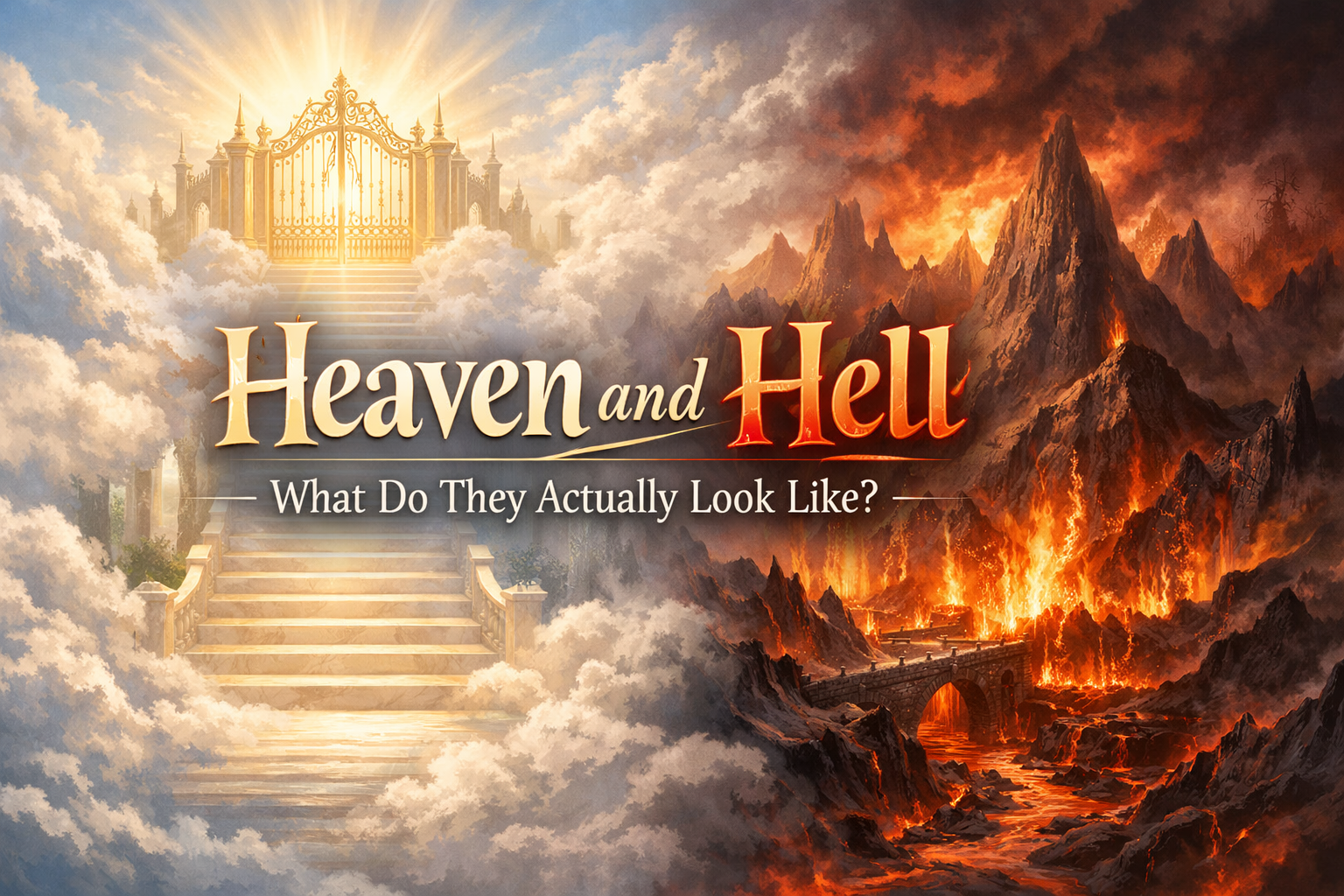
Heaven and hell — what do they actually look like?
Few questions reach deeper into the human heart than this one: What happens after we die? What do heaven and hell actually look like? Most folks have picked up their ideas from old paintings, funeral talk, movies, and half-remembered Bible verses. But if we want the truth, we need to leave the cartoons behind and listen carefully to Scripture — because the Bible speaks about both with enough clarity to sober us, comfort us, and call us to Christ.
But before we can answer “What do they look like?” we need to push past some badly rotten boards. Heaven is not disembodied drifting on clouds with nothing to do. It is not less real than this world — it is more real, more alive, more whole, more glorious. And hell is not cartoon-devil country. Satan is not the ruler of hell in the sense of running it as king. He is judged there. Hell is not his kingdom in triumph. It is part of God’s final judgment.
With those cleared away, let us listen to what Scripture actually says.
Why Both Doctrines Matter
This is not idle curiosity about the afterlife. The truth about heaven and hell matters because it tells us something about the holiness of God, the seriousness of sin, the worth of the soul, the glory of Christ, and the urgency of the gospel.
If heaven is real, then our hope is far bigger than comfort in this world. The best things we taste here are previews of something incomparably greater.
If hell is real, then sin is far more serious than modern people like to admit. Rebellion against a holy God carries consequences no polite culture can negotiate away.
If both are real, then the biggest question in any human life is not “How do I get ahead?” — it is “Am I right with God?” Everything else, in the end, is secondary.
What Heaven Actually Looks Like
The Unveiled Presence of God
When people ask what heaven looks like, they often mean: what will believers experience forever? The Bible answers in layers — speaking of the present heavenly presence of God and pointing us toward the final state, the new heavens and new earth. And that distinction matters, because the final Christian hope is not simply “going to heaven when you die.” The final hope is resurrection life in a renewed creation with God forever. That is bigger and better than most people realize.
The first and most important truth is this: heaven is heaven because God is there.
Psalm 16:11 — “In thy presence is fulness of joy; at thy right hand there are pleasures for evermore.”
The beauty of heaven is not mainly scenery, gates, jewels, or streets of gold. The beauty of heaven is the presence of the Lord. Revelation 21 says the dwelling of God is with man — that is the center of everything. Heaven is not chiefly about getting our own private dream life. It is about being brought home to God — seeing Him, enjoying Him, worshiping Him, and living in unhindered fellowship with Him forever.
Heaven is described as beautiful beyond present language. In Revelation 21–22 we read of the holy city, the New Jerusalem — brilliance like precious stones, streets of gold, gates of pearl, a river of the water of life, the tree of life, no more curse, no temple because the Lord Himself is its temple, no need of sun or moon because the glory of God gives it light.
Are these descriptions literal in every detail? Some may be. Some may be symbolic. But either way, the point is not weakened — it is strengthened. Scripture is reaching for the finest words it can find and still coming up short. The imagery says this place is pure, glorious, radiant, ordered by God’s beauty, filled with life, and free from corruption. In old country language, the Bible is giving us the best human language has and warning us that even that is not enough.
Heaven means no more death, grief, or pain. This is one of the sweetest promises in all of Scripture.
Revelation 21:4 — “And God shall wipe away all tears from their eyes; and there shall be no more death, neither sorrow, nor crying, neither shall there be any more pain.”
No hospitals. No funerals. No cancer wards. No betrayal. No graveyards. No shame that follows you out of bed in the morning. No mind wearing out, no body breaking down, no sorrow hanging on the doorknob when you wake. That does not mean people become less human there. It means they become fully restored as God intended. Heaven is not less life. It is life healed.
Heaven includes resurrection and a renewed creation. This part often gets missed. The final biblical hope is not that souls escape matter forever. The Christian hope is bodily resurrection. Jesus rose bodily. Believers will rise bodily. Creation itself will be renewed. Romans 8 speaks of creation groaning and awaiting liberation. Revelation 21 speaks not merely of heaven above, but of a new heaven and a new earth. The final state is not ghostlike — it is embodied, renewed, glorious, and whole.
In plain talk, heaven is not us leaving behind everything solid and real. It is God making all things new.
Heaven is a place of joyful worship and restful service. Worship in Scripture is not lifeless repetition — it is overflowing joy, awe, gratitude, holiness, and delight in God. Revelation shows praise around the throne and also reigning, serving, and living before God. Heaven includes worship without distraction, service without exhaustion, joy without guilt, fellowship without jealousy, and purpose without futility. If life in this world has moments that feel rich, beautiful, and deeply right, heaven is not the loss of that goodness. It is the fulfillment of it without sin.
And heaven means seeing Christ. To be in heaven is to be with Christ. Paul said it is “far better” to depart and be with Him. The One we have trusted by faith, we shall see by sight. The Christ who was pierced for sinners, risen from the grave, and exalted in glory — He will not remain distant forever to His people. That is why heaven looks like home: because He is there.
What Hell Actually Looks Like
The Justice of God Against Sin
Modern people do not like talk about hell. Many dismiss it as cruel, outdated, or impossible to reconcile with a loving God. But Jesus spoke of hell plainly, seriously, and often. If we believe Jesus, we cannot simply wave hell away.
The first thing to say is this: hell is the righteous judgment of God against sin. That is why hell cannot be understood correctly unless we first understand who God is and what sin is. If God is holy, infinitely pure, and morally perfect — and if sin is real rebellion against Him — then final judgment is not a strange doctrine. It is a morally necessary one.
In plain talk, hell is not God flying off the handle. Hell is God judging evil with perfect justice.
Hell is described as fire. Jesus spoke of “everlasting fire” and “hell fire.” Revelation 20 speaks of the lake of fire. Whether that imagery is literal in every element or partly symbolic, the point is not softened — it is sharpened. Fire in Scripture speaks of pain, destruction, holiness, exposure, and judgment. The Bible is telling us hell is terrible, consuming, and fearful beyond what we would wish on anyone. It is a place of punishment, not comfort.
Hell is also described as darkness. This is where Scripture grows especially striking — because fire and darkness seem to contradict each other, and that is precisely the point. Hell is not a place that can be mapped with floor plans. It is described through dreadful images that together convey exclusion, terror, ruin, misery, shame, and irreversible loss. Jesus speaks of “outer darkness” where there is weeping and gnashing of teeth. Darkness speaks of separation from blessing, joy, peace, and light. Fire speaks of pain and wrath. Together they warn us that hell is not something any sane soul should brush aside.
Hell means exclusion from the favorable presence of God. God is present everywhere in one sense — no creature escapes His sovereign rule. But hell is exclusion from the joy, peace, beauty, and fellowship of His gracious presence.
2 Thessalonians 1:9 — “Who shall be punished with everlasting destruction from the presence of the Lord, and from the glory of his power.”
That does not mean God ceases to be Lord there. It means the lost do not enjoy Him. They do not dwell in His favor. They are shut out from the blessedness for which they were made. In plain terms, hell is the soul finally given over to judgment, outside the joy of God.
Hell is conscious and final. There are debates among Christians about the precise nature of final punishment — whether eternal conscious punishment or annihilation better fits the biblical data. But the historic and dominant Christian position has been that hell involves conscious, ongoing judgment. Jesus spoke of weeping and gnashing of teeth. Revelation speaks of torment. The language is not casual or temporary-sounding. Hell is not a shrug from God. It is not a slap on the wrist. It is not a temporary holding room where everybody eventually gets sorted out and welcomed in. Scripture presses urgency precisely because judgment is real and fixed — and the gospel is urgent precisely because the danger is real.
Literal or Symbolic? The Right Answer
Many people ask: are heaven’s gold streets literal? Is hell’s fire literal? Are the images symbolic?
The best answer is that some imagery may be symbolic — but the realities are not less real because of that. In fact, the symbols may be pointing to realities far greater than the images can contain. If heaven’s glory is symbolized by gold and jewels, that does not make heaven less glorious. It means earthly treasure is the closest language we have for something beyond our present capacity to comprehend. If hell’s misery is symbolized by fire and darkness, that does not make hell less dreadful. It means the Bible is straining human language to the limit in order to warn us.
Do not think “symbolic” means imaginary. In Scripture, symbolic language often points to something more real and weighty, not less.
What Heaven and Hell Together Tell Us
These two doctrines stand together, and that matters. A God with only heaven and no hell might seem easier for modern people to accept, but He would not be the holy God of the Bible. A God with only hell and no heaven would not be the God who sent His Son to save sinners. The God of Scripture is both just and merciful — and both doctrines are needed to see Him clearly.
Heaven tells us God is good beyond telling — generous, life-giving, beautiful, and the reward of His people. He is preparing joy beyond death for all who are in Christ.
Hell tells us God is holy and just — He does not excuse evil, does not wink at rebellion forever, and will judge what is wicked. His justice is not a bluff.
And both truths drive us to the same place: Jesus Christ.
The cross makes no sense in a world without hell. Why would the Son of God bear wrath, shame, and death if sin carried no true danger? And the resurrection makes no sense unless heaven is real hope. Why would Christ rise if death and judgment were the end of the story?
Heaven and hell both push us straight to Christ. He is the One who saves from judgment. He is the One who opens eternal life. He bore sin so sinners might be forgiven. He will judge the living and the dead.
If you want to know how serious hell is, look at the cross. And if you want to know how glorious heaven is, look at the risen Christ.
A Plain Summary
- The presence of God without barrier
- The glory of Christ fully seen
- Beauty beyond earthly comparison
- No sin, no death, no curse, no pain
- Resurrection life in a renewed creation
- Worship, joy, fellowship, and fullness — forever
- Final judgment under God’s perfect justice
- Exclusion from the joy of His gracious presence
- Ruin, darkness, fire, sorrow, and dread
- Conscious punishment in fearful language
- Irreversible separation from all blessing
- The final due penalty of unforgiven sin
The Most Important Question
After all the imagery, all the doctrine, and all the debate, the biggest question is not whether you can sketch heaven and hell in neat colors. The biggest question is this:
Where do you stand with Jesus Christ?
The dividing line is not church background, good manners, political views, or family tradition. The dividing line is Christ. Those united to Him by faith have eternal life. Those who reject Him remain under condemnation. Nobody strolls into heaven by moral effort — sinners enter by grace through faith in Christ. And hell is not only for headline monsters. It is the just end of unforgiven sin, which includes respectable sinners, religious sinners, quiet sinners, and outwardly polished sinners who never came to Christ.
In plain country terms, this world is not the whole story. The road does not end at the grave. Every soul is headed somewhere. And the only safe shelter from judgment, and the only sure doorway to life, is Jesus Christ.
So do not merely ask what heaven and hell look like. Ask whether you know the Savior who rescues sinners and brings them home. Because in the end, the greatest glory of heaven is not the city, the river, or the light. It is this:
1 Thessalonians 4:17 — “And so shall we ever be with the Lord.”
That is the blessed hope. And it is worth everything.
Key Takeaways
- Heaven is real and it is better than our pictures of it. It is not floating on clouds — it is resurrection life, a renewed creation, the unveiled presence of God, and the face of Christ. The Bible’s imagery strains to describe something beyond what human language can fully contain.
- The center of heaven is God Himself. Heaven is heaven because God is there. The beauty, the joy, the fullness — all of it flows from His presence. Seeing Christ is the heart of eternal life, not merely the scenery around it.
- Hell is real and it is worse than our pictures of it. Fire and darkness together describe exclusion, judgment, pain, and ruin beyond ordinary language. Jesus spoke of it plainly, seriously, and repeatedly. We do not honor Him by waving it away.
- Hell is the righteous judgment of a holy God against sin. It is not God losing His temper. It is final, fixed, conscious judgment — the just end of unforgiven rebellion against the One in whom all life and blessing reside.
- Both doctrines point to the cross. The cross makes no sense without hell — why would the Son of God bear wrath if sin carried no true danger? The resurrection makes no sense without heaven — why would Christ rise if death were the end? Heaven and hell both drive us straight to Christ.
- The most important question is not what they look like — it is where you stand with Jesus. The dividing line is not morality or religion. It is Christ. Those in Him have eternal life. Those outside Him remain under condemnation. That is why the gospel is urgent.
Key Scriptures: Psalm 16:11 · Matthew 25:31–46 · Luke 16:19–31 · John 14:1–6 · Romans 8:18–25 · 1 Corinthians 15 · 2 Thessalonians 1:7–10 · Revelation 20:11–15 · Revelation 21–22