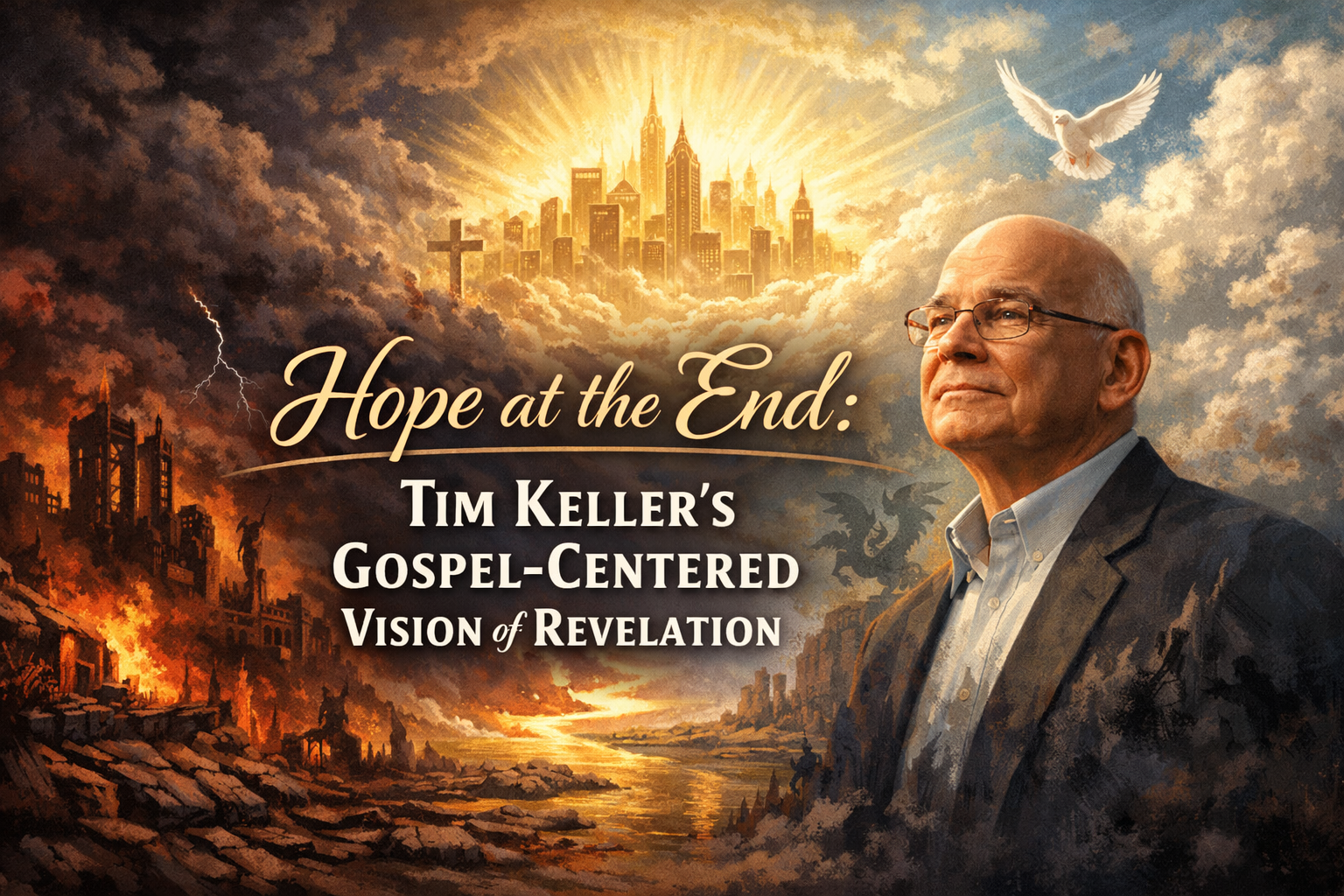
Hope at the End: Tim Keller’s Gospel-Centered Vision of Revelation
How the Founder of Redeemer Presbyterian Read the Most Misunderstood Book in the Bible
When most folks hear the word Revelation, they picture beasts, dragons, war, and fire from heaven. For some, it’s a scary mystery best left alone. For others, it’s a prophetic puzzle waiting to be decoded. But for Tim Keller — the late pastor, author, and founder of Redeemer Presbyterian Church in New York City — Revelation was a book of comfort. Not confusion. Not fear. Comfort.
“Revelation was not written to confuse Christians. It was written to comfort them.” — Tim Keller, “The World That Is To Come”
Keller believed Revelation isn’t primarily about predicting the exact sequence of end-times events. It’s about giving Christians courage, hope, and perspective in the middle of a troubled world. Through its symbolic language, the book makes one thing unmistakably clear: Jesus wins — and He will make all things new.
Seven Insights from Keller on Revelation
Insight One
📜 Revelation Is Pastoral, Not Just Prophetic
The first thing Keller established about Revelation is its audience and purpose. The book opens with letters to seven real churches — congregations in Asia Minor struggling with compromise, persecution, and spiritual apathy (Revelation 2–3). These were not abstract future organizations. They were actual communities of believers under pressure.
John wrote to help them endure, remain faithful, and trust in God’s sovereignty. For Keller, that pastoral purpose never disappears as the book unfolds — every vision of judgment, every image of the Lamb, every promise of the New Jerusalem is ultimately written for the struggling church in every age.
Insight Two
🎨 Apocalyptic Language Is Symbolic, Not Literal
Keller consistently reminded readers that Revelation belongs to a literary genre — apocalyptic literature — with its own conventions. The beasts, dragons, and harlots aren’t descriptions of literal monsters. They represent systems of evil: political corruption, economic exploitation, spiritual deception. “Babylon” is the symbol of human pride, empire, and idolatry in every age.
Taking the symbols seriously means asking what they represent — which often yields a far more powerful reading than treating them as descriptions of literal future creatures. Beneath the surface of history is a spiritual war, but the victory belongs to the Lamb.
Insight Three
🕊️ The Lamb Conquers Through Sacrifice
One of Keller’s most powerful insights came from Revelation 5. John weeps because no one can open the sealed scroll of history. He is told to look for the Lion of Judah — but when he turns, he sees a slain Lamb.
This paradox — strength through weakness, victory through sacrifice — is the core of Keller’s Revelation theology. Jesus conquers sin, death, and evil not by force, but by giving His life. And the same pattern shapes the Christian life: we overcome not with power, but with faith, humility, and love. Revelation is a call to that same kind of costly faithfulness.
Insight Four
🌍 Heaven Comes Down — Restoration, Not Escape
For Keller, the climax of Revelation is not destruction — it is restoration. In Revelation 21–22, heaven doesn’t receive evacuated believers. Heaven descends. The New Jerusalem comes down to earth. The world is made new, not abandoned.
This renewed creation is where God will dwell with His people. No more tears, death, or pain. It’s Eden restored — but in a city filled with glory, justice, and joy. The story ends not with souls floating in the clouds, but with God tabernacling with His people on a renewed earth.
“Then I saw a new heaven and a new earth… He will wipe away every tear from their eyes, and death shall be no more.” — Revelation 21:1, 4
Insight Five
🏙️ Babylon vs. the New Jerusalem
Keller often drew the contrast between Revelation’s two cities as the central drama of the human story — and a framework for understanding our own moment in history.
🔥 Babylon
- Human pride and self-sufficiency
- Materialism and economic exploitation
- Moral decay and spiritual deception
- Power through domination
- Glory that fades and falls
🌿 New Jerusalem
- God’s kingdom of peace and justice
- Beauty, righteousness, and truth
- Light without darkness or shame
- Power through the Lamb’s sacrifice
- Glory that endures forever
Rather than withdrawing from culture, Keller taught that Christians should engage it faithfully. Live in Babylon, but don’t become Babylon. Seek the good of the city while longing for the city that is to come.
Insight Six
⚔️ Overcoming — The Call to Endurance
A recurring phrase through the letters to the seven churches is: “To the one who overcomes…” Keller returned to this theme repeatedly. Revelation is not a passive book about waiting for rescue. It is an active call to persevere — to stay faithful in trials, resist compromise, and keep your eyes on the Lamb.
This was Keller’s consistent pastoral application: the gospel doesn’t just save you from judgment — it gives you strength to endure the present. The vision of the slain and risen Lamb on the throne is not primarily a prediction about the future. It’s a statement about the present reality that shapes how we live right now.
Insight Seven
🧭 No Timelines — Christ-Centered, Pastoral Interpretation
Keller didn’t obsess over prophetic timelines, dates, or decoding sequences. He was not a chart-maker. He engaged seriously with Revelation’s imagery but avoided the trap of treating it as an eschatological puzzle to be solved. Rather than staking out a firm position in the millennial debate (premillennial, postmillennial, or amillennial), he kept the focus on the core message every tradition agrees on:
- Jesus is on the throne
- Evil will be judged
- God’s people will endure
- The world will be made new
Revelation is not about escape from the world. It’s about victory through faithfulness — and mission in the meantime.
Keller’s Revelation Theology at a Glance
| Theme | Keller’s View |
|---|---|
| Genre | Apocalyptic — symbolic, not literal; like a political cartoon, to be taken seriously but not woodenly |
| Purpose | Pastoral comfort and courage for the suffering Church — not a prophetic timeline to decode |
| Jesus in Revelation | The slain and risen Lamb — conquers through sacrifice, not force |
| Judgment | God will right all wrongs; every tear will be accounted for |
| The Future | A restored, renewed creation — heaven comes down, not believers going up |
| The Church’s Task | Endure, witness, and be a preview of the New Jerusalem in the middle of Babylon |
Three Applications for Today
Courage in a Hostile Culture
Whether you’re in rural Oregon or downtown Manhattan, the pressure to conform is real. Keller urged Christians to stand firm — not with anger or fear, but with gentle, gospel-rooted courage. Babylon is loud, but it is not permanent.
Hope in Suffering
If you’re battling illness, grief, injustice, or anxiety, Revelation’s promise is not vague optimism. It is a specific, anchored hope: God sees every tear, and He has promised to wipe them all away.
“God will right all wrongs.” — Tim Keller
Mission in a Broken World
Revelation doesn’t tell us to hunker down and wait. It calls us to bear witness, live faithfully, and preview the kingdom of God with our lives — being the kind of community the New Jerusalem represents, even in the middle of Babylon.
“The church is to be a preview of the New Jerusalem.” — Tim Keller
Tim Keller didn’t see Revelation as a book of fear or fantasy. He saw it as a call to faithful living, deep hope, and unshakeable joy — rooted in the reality that the Lamb who was slain is now on the throne, and that His victory is not pending. It’s already secured.
So hold on. Keep your eyes on Jesus. The end of the world is not destruction. It is the beginning of everything that was always meant to be.
“Behold, I am making all things new.” — Revelation 21:5
Key Scriptures: Revelation 1:3; 2–3; 5:5–6; 13:1–18; 21:1–5; 22:20 · 1 Peter 5:8–9 · Hebrews 12:1–2 · Romans 8:18
Want to Go Deeper?
This post is part of an ongoing series on how different Christian thinkers have approached Revelation and the end times. Read the companion posts for the full picture:
- David Jeremiah on Revelation — MVM’s treatment of the dispensational premillennial view, which interprets Revelation literally and futuristically.
- C.S. Lewis and the Rapture — How another beloved Christian thinker viewed the Second Coming and why he avoided prophetic speculation.
- What the Early Church Fathers Believed About the Rapture — What Irenaeus, Augustine, Chrysostom, and others actually taught about the end times.
- Read Keller directly — His sermon series “The World That Is To Come” is available through Redeemer’s archive; Richard Bauckham’s The Theology of the Book of Revelation is the best scholarly companion to Keller’s approach.
- Subscribe to get new posts delivered straight to your inbox — gospel-rooted, plain-spoken truth for the week ahead.
“The end of the world is not destruction. The end is joy.” — Tim Keller