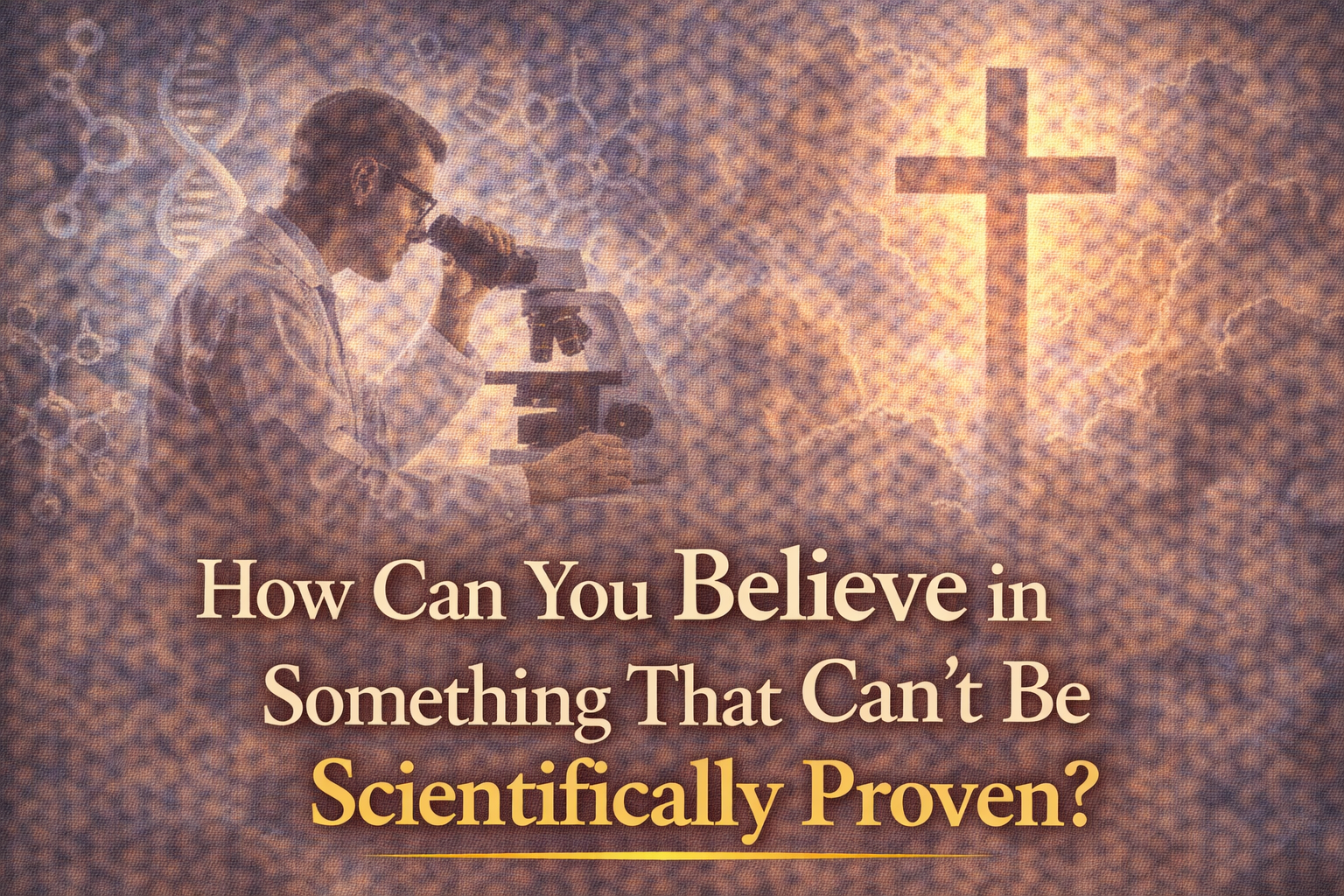
How Can You Believe in Something That Can’t Be Scientifically Proven?
A Christian Response to the Limits of Scientific Proof — and Why Faith Is Not the Opposite of Reason
In an age dominated by data and digital proofs, many people ask: “How can you believe in something that can’t be scientifically proven?” That question is honest and important — and it deserves more than a shrug or a sermon.
From a Christian perspective, this isn’t a matter of blind faith, ignorance, or wishful thinking. It’s about understanding what science actually is, what it cannot do, and the kind of truth that goes beyond the test tube.
“I believe in Christianity as I believe the sun has risen — not only because I see it, but because by it I see everything else.” — C.S. Lewis
The Limits of Scientific Proof
What Science Is — and Isn’t
Science is a powerful and trustworthy tool. It helps us build bridges, cure diseases, and understand the cosmos. But it has real, well-defined boundaries. Science is based on observation, repetition, empirical testing, and falsifiability — which means it can only study what is natural, material, and measurable.
By definition, it cannot test for things outside nature — like the supernatural, the spiritual, or the eternal. This isn’t a weakness. It’s just an honest description of what the scientific method is designed to do. A thermometer is a reliable tool; it just can’t tell you whether Beethoven’s Fifth is beautiful.
Here are some things science cannot, in principle, prove or disprove:
Faith Is Not Blind
A Common Misunderstanding
Trust Grounded in Evidence Is Not the Same as Credulity
Christian faith is not a leap into darkness. It is trust in what is reasonable but not visible — grounded in God’s character, His Word, the resurrection of Jesus, and the testimony of transformed lives across twenty centuries.
The biblical definition of faith is instructive:
“Now faith is the substance of things hoped for, the evidence of things not seen.” — Hebrews 11:1
Faith “fills the gap” where science cannot reach — not by making things up, but by drawing from experience, revelation, reason, and the internal witness of the Spirit. It is trust in a Person, not a blind assertion about unprovable facts.
Christianity Is Built on History
Not Myth — Historical Events
The Resurrection: Evidence Without a Lab
Christianity isn’t built on vague spiritualism or ancient myth. It’s built on specific historical events — most centrally the life, death, and resurrection of Jesus Christ. These events happened in a known time, in a known place, under a known Roman governor.
The resurrection, while not reproducible in a laboratory, is supported by significant historical evidence:
- Over 500 eyewitnesses, most still living when Paul wrote (1 Corinthians 15:6)
- The empty tomb — acknowledged even by Jesus’ opponents, who claimed the body was stolen
- The martyrdom of apostles who would not recant what they claimed to have seen
- The explosive growth of the early Church in the very city where the crucifixion occurred
Historian Gary Habermas summarizes the scholarly consensus: there are over a dozen historical facts that critical scholars — including skeptics — broadly agree on, chief among them that Jesus’ followers genuinely believed He rose from the dead. Whether one accepts that belief is a different question; the sincerity and historical groundedness of the claim is not seriously disputed.
Everyone Believes in Unprovable Things
Ironically, even committed skeptics hold beliefs that science cannot prove. Consider what we accept every day without laboratory verification:
The Skeptic’s Own Faith
- Love — you feel it, you act on it, you would sacrifice for it. You cannot measure it in a beaker.
- Justice — there is no scientific unit of “fairness.” Yet most people believe some things are genuinely wrong.
- Mathematics — exists abstractly and necessarily, but has no physical substance you can weigh or photograph.
- Logic itself — the rules of logic are necessary for science but are not verified by scientific testing.
- Trust — every time you board a plane, you’re betting your life on trust, not certainty.
Believing in God is not categorically different from these examples. Christians hold that God is the best and most coherent explanation for what science cannot explain — the origin of the universe, the existence of moral law, the reality of consciousness, and the persistent human longing for meaning.
God Is Not Inside the System He Made
The Category Error
You Can’t Measure the Author from Inside the Story
God, if He exists, is not a creature within the universe. He is the Creator of the universe — and therefore outside of its natural laws. To demand scientific proof of God is to demand that the measuring stick measure the one who made it.
To say “I won’t believe in God unless He can be scientifically proven” is a category error — like saying “I won’t believe in Shakespeare unless I can find him in a play.” The Author is not one of the characters. He’s outside the text.
“The heavens declare the glory of God; the skies proclaim the work of His hands.” — Psalm 19:1
Creation points to its Creator. But the Creator Himself is not captured by creation’s categories or contained by creation’s tools.
What Scripture Says About Reasoned Faith
| Scripture | Teaching |
|---|---|
| Romans 1:20 | God’s invisible qualities are clearly seen in creation — so that people are without excuse |
| 1 Peter 3:15 | Always be prepared to give a reason for the hope you have — with gentleness and respect |
| Hebrews 11:3 | By faith we understand that the universe was formed at God’s command |
| John 20:29 | “Blessed are those who have not seen and yet have believed” — faith as a virtue, not a weakness |
Three Thinkers on Faith and Reason
Tim Keller
The Reason for God
“To say you can only believe what can be proven by science is itself a belief — a faith statement about the limits of knowledge.”
John Lennox
Oxford Mathematician
“Faith is not a leap into the dark; it’s a step into the light, based on evidence. Science and God are not competitors.”
Alister McGrath
Oxford Professor of Science & Theology
“Science and religion are not competitors. They’re like two lenses focused on the same reality from different angles.”
Science Was Born in a Christian Worldview
Historically, modern science blossomed in Christian Europe — not by coincidence. Christians believed the universe was ordered by a rational God, was worth studying, and existed to glorify its Creator. That belief gave science its foundations. Some of history’s greatest scientists were committed Christians:
| Scientist | Contribution |
|---|---|
| Isaac Newton | Laws of motion, calculus, gravitational theory |
| Blaise Pascal | Probability theory, hydraulics |
| Gregor Mendel | Father of modern genetics |
| Louis Pasteur | Germ theory of disease, vaccination |
| Johannes Kepler | Laws of planetary motion |
Christianity didn’t oppose science — it inspired it. The assumption that nature is orderly, rational, and worth investigating is itself a theological assumption.
📡 The Invisible Signal
Imagine tuning into a radio. You can’t see the signal — it has no color, no weight, no physical form. But when the receiver is tuned correctly, you hear the music clearly. The signal is real and all around you. The receiver just has to be in the right condition to detect it.
Faith works similarly. God’s presence is real and pervasive. But receiving it requires the right orientation — an open mind, a willing heart, and the kind of honest seeking that Jesus described: “Seek and you will find.”
“The Spirit himself testifies with our spirit that we are God’s children.” — Romans 8:16
So — How Can You Believe in Something Unprovable?
Christianity doesn’t dismiss science — it insists science isn’t enough to explain all that matters. The same God who ordered the cosmos invites you to know Him personally — not just as a philosophical conclusion but as a living relationship.
Science may study the stars. Christianity tells you who made them — and that He knows you by name.
“Blessed are the pure in heart, for they shall see God.” — Matthew 5:8
Key Scriptures: Hebrews 11:1, 3 · Romans 1:20; 8:16 · 1 Peter 3:15 · Psalm 19:1 · John 20:29 · Matthew 5:8; 7:7 · 1 Corinthians 15:3–8, 6
Want to Go Deeper?
This post is part of MVM’s apologetics series — giving Christians honest answers to honest questions. These companion posts and resources go further:
- Does Christian Hypocrisy Undermine the Faith? — another of the most common and most honest objections, answered by five leaders
- Ten Christian Leaders on the Doctrine of Jesus — who Jesus actually is, and why that claim is the center of everything
- The Nicene Creed — how the early Church defined Christianity’s core claims with precision and historical grounding
- The Reason for God — Tim Keller; the best modern treatment of common intellectual objections to Christianity
- Can Science Explain Everything? — John Lennox; a short, clear treatment of the science-and-faith question by an Oxford mathematician
- Subscribe to get new posts delivered straight to your inbox — gospel-rooted, plain-spoken truth for the week ahead.
“Always be prepared to give a reason for the hope that you have — but do this with gentleness and respect.” — 1 Peter 3:15