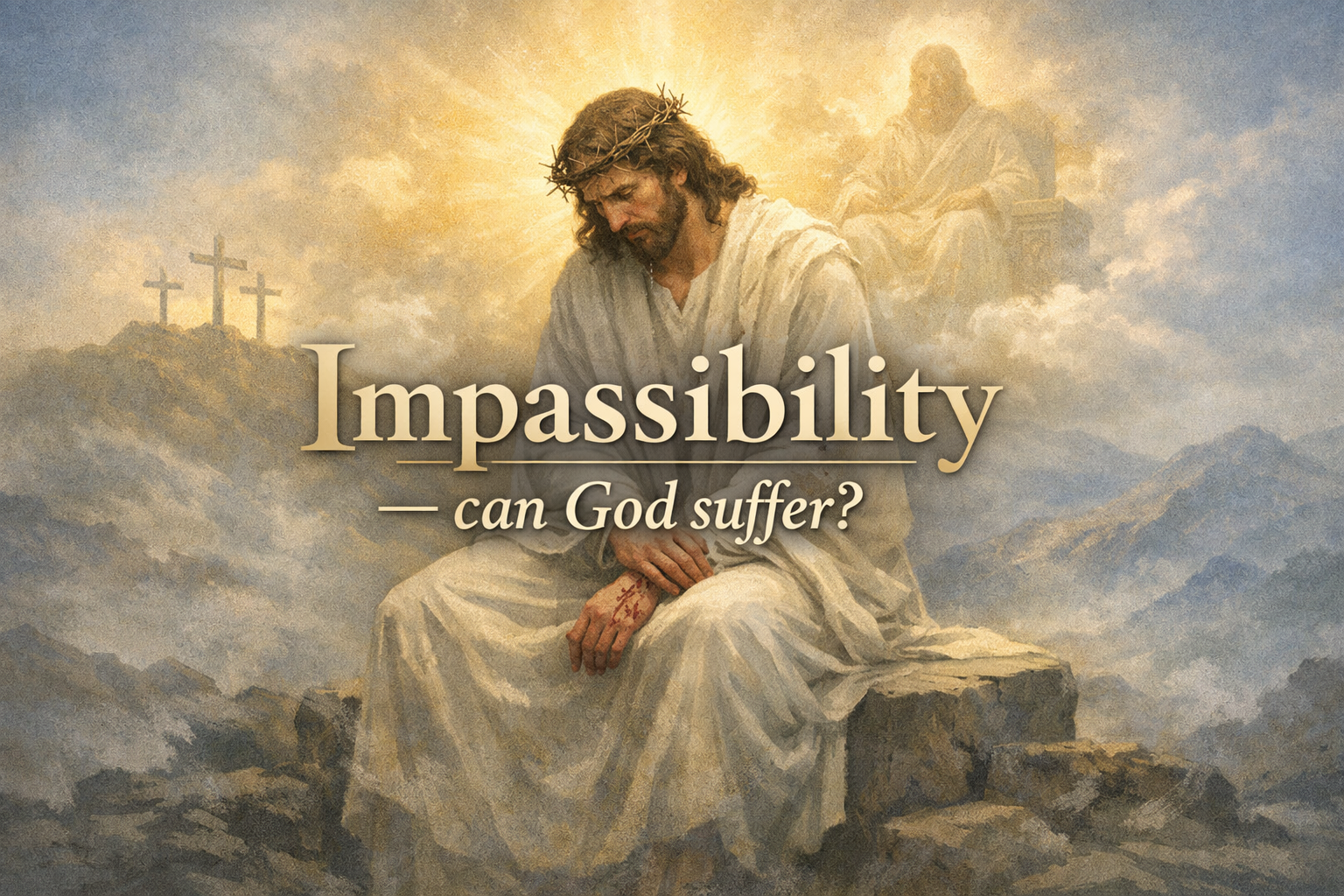
Impassibility — can God suffer?
Can God suffer? The question sounds simple. The answer is one of the most contested in all of Christian theology — and how you answer it shapes everything from how you read the Psalms to how you understand the cross. The classical tradition said God cannot suffer — He is impassible, beyond the reach of pain. Modern theology has pushed back hard, insisting a God who cannot suffer is a God who cannot love. Both sides have something right. And the place where they meet is a hill outside Jerusalem on a Friday afternoon.
The word “impassibility” doesn’t show up in your Bible. But the reality it’s trying to describe does, and so does the pushback against it. To say God is impassible is to say He cannot be acted upon from outside — that He cannot be moved by forces external to Himself, that He does not suffer in the way creatures suffer, that He is not subject to emotional states that rise and fall with circumstances the way ours do.
Put that way, it sounds cold. Distant. Like the God of the philosophers rather than the God of Abraham. And that’s exactly the objection modern theology has leveled against it.
But before we discard two thousand years of careful theological reflection in favor of a more relatable deity, we need to understand what impassibility was actually trying to protect — and what gets lost if we abandon it entirely.
What the Classical Tradition Meant
The doctrine of divine impassibility was nearly universal in Christian theology from the early fathers through the Reformation. It was included in the theological heritage of Ignatius of Antioch, Justin Martyr, Origen, Augustine, Aquinas, and the Reformed confessions. The Westminster Confession of Faith describes God as “without body, parts, or passions” — that word “passions” being the older English term for the kind of reactive emotional suffering the doctrine denies to God.
But here’s what’s critical to understand: the classical theologians were not saying God is emotionally inert, blank, or indifferent. They were making a specific metaphysical claim. They were denying that God is subject to passio in the Aristotelian sense — being acted upon, being changed from outside, being moved from potency to act by external forces.
The distinction matters enormously. When a human being suffers grief, something happens to us. We are changed. We move from a state of equilibrium to a state of distress because something outside us impacted us and altered our condition. We are passive recipients of that impact. That’s what passio means: being acted upon.
The classical claim is that God cannot be in that position. Not because He doesn’t care, but because He is not a being with unactualized potential waiting to be triggered by external events. He is pure act, fully actual, entirely Himself — and nothing outside Him can diminish, wound, destabilize, or alter what He is.
“The impassibility of God does not mean that God is without feeling, but that His feeling is not subject to change from without. God is not indifferent — He is sovereignly and perfectly engaged with all things according to His own eternal nature.” — Thomas G. Weinandy, Does God Suffer?
The Biblical Data That Pushes Back
Scripture is full of language that sounds like God suffers, feels, and responds. And it’s not peripheral language — it’s central to the narrative of Scripture from beginning to end.
Genesis 6:6 — “The Lord regretted that he had made man on the earth, and it grieved him to his heart.” That’s not a minor anthropomorphism buried in an obscure text. That’s God, grieved, at the center of a pivotal moment in redemptive history.
Hosea 11:8 — God speaks in the voice of a father aching over a wayward son: “How can I give you up, O Ephraim? How can I hand you over, O Israel?… My heart recoils within me; my compassion grows warm and tender.” This is not the language of stoic indifference.
Isaiah 63:9 — “In all their affliction he was afflicted.” God’s identification with the suffering of His people is presented as real, not merely metaphorical performance.
Ephesians 4:30 — “Do not grieve the Holy Spirit of God.” Paul uses the language of grief as a real possibility — something believers can actually cause.
The modern critique of impassibility draws on exactly this kind of language and argues that the classical doctrine was importing Greek philosophical categories — particularly Aristotle’s unmoved mover — into Christian theology in a way that distorts the biblical portrait of God. J�rgen Moltmann made this argument most forcefully in The Crucified God, insisting that a God who cannot suffer cannot truly love, and that the cross demands a God who enters genuinely into suffering — not above it, not observing it, but in it.
The Patristic Paradox: Impassible and Yet Compassionate
Here’s what often gets missed in the modern critique: many of the same fathers who affirmed impassibility also spoke freely — even lavishly — about God’s love, grief, wrath, and compassion. They didn’t think these were contradictory. They held them together through a distinction that modern theology tends to flatten.
Cyril of Alexandria, a fierce defender of classical Christology, could speak of the Word “suffering impassibly” — a phrase that sounds like nonsense until you understand what he meant. The divine nature of the Son is impassible. It cannot be wounded, diminished, or destroyed. But the Son genuinely suffered in His human nature. The cross was not theater. The cry of dereliction was not performance. Something real happened to the Son of God on the cross — in His flesh, in His human experience, in the fullness of His solidarity with fallen humanity.
Origen made an even more striking move, speaking of the “passions of love” in God — not as involuntary reactions but as the free, eternal, overflowing love that God is by nature. God’s love is not something that happens to God when we appear on the scene. It is what God eternally is. And precisely because it is not reactive but eternal, it is more fully love than anything creaturely love can approximate.
“The Father himself is not impassible. If he is asked, he takes pity and feels grief; he suffers something of love.” — Origen, Homilies on Ezekiel
That’s not a rogue statement from a theological maverick. It’s one of the early church’s most brilliant minds wrestling honestly with the biblical text and refusing to let philosophical categories override it — while also refusing to let the biblical language collapse into creaturely limitation applied to God.
The Incarnation as the Decisive Turn
Any serious treatment of this question has to come to terms with the Incarnation, because the Incarnation changes the terms of the question entirely.
The Son of God took on human flesh. That is the non-negotiable center of Christian faith. And in taking on human flesh, He took on everything that goes with it — including the capacity for suffering, grief, weariness, temptation, and death. Hebrews 4:15 — “we do not have a high priest who is unable to sympathize with our weaknesses, but one who in every respect has been tempted as we are, yet without sin.” The sympathy is not simulated. It is grounded in genuine shared experience.
At Gethsemane, Jesus was “deeply grieved, even to death” (Matthew 26:38). On the cross, He cried out in desolation (Matthew 27:46). At the tomb of Lazarus, He wept (John 11:35). These are not diplomatic performances by a God who remained safely above the fray. They are the real experiences of the Son of God in human flesh.
So the question is not “Did God suffer on the cross?” The answer to that question is unambiguously yes — in the person of the Son, in His human nature, genuinely, really, devastatingly. The more precise question is: did the divine nature as such undergo suffering? And here the tradition has been careful for good reason.
If the divine nature can be wounded, diminished, or destroyed, then what happened on the cross was the destruction of God — and if God can be destroyed, He is not the God of Scripture. The power of the resurrection is precisely that death could not hold Him (Acts 2:24). The divine life is indestructible. That’s not a limitation on God’s love. It’s the guarantee that His love is more powerful than anything that can be brought against it.
The Two Natures and the Communication of Attributes
Classical Christology — worked out under enormous pressure at the councils of Nicaea, Ephesus, and Chalcedon — developed the doctrine of the two natures precisely to hold these truths together. The Son is one person in two natures: fully divine, fully human, without mixture, confusion, separation, or division (the four Chalcedonian negatives).
Within this framework, theologians developed the concept of the communicatio idiomatum — the communication of attributes. Because the divine and human natures are united in the one person of the Son, what belongs to the human nature can be attributed to the person, and what belongs to the divine nature can be attributed to the person. So we can truly say “God died on the cross” — because the one who died is the divine Son, even though His divine nature as such is not subject to death.
This is not word games. It’s the only framework that keeps the cross from collapsing in one of two directions: either toward docetism (Jesus only appeared to suffer — He was really unaffected behind the scenes) or toward a raw theopaschitism that makes the divine nature itself subject to injury and death, which undermines the very power that makes salvation possible.
Luther pushed hard on the communicatio idiomatum, insisting that the suffering of Christ is genuinely the suffering of God — not the suffering of a human appendage of an untouched divine core. And he was right to push there. The cross has no saving power if it is merely the suffering of a human nature with divine nature watching from a distance. The one who suffered is the Son of God. That’s what makes it matter.
Moltmann’s Challenge and Its Limits
J�rgen Moltmann’s The Crucified God (1972) is the most influential modern attack on divine impassibility, and it deserves a serious response. Moltmann argued that classical impassibility made God into an Aristotelian unmoved mover — distant, cold, incapable of genuine solidarity with human suffering. He insisted that the cross must mean God genuinely suffers, that the Father suffers the loss of the Son, and that a suffering God is more loving, more credible, and more pastorally powerful than an impassible one.
There’s something right in Moltmann. The pastoral instinct is correct: people in genuine suffering need a God who is genuinely with them, not a God who observes their pain from a position of serene philosophical detachment. The cross has to mean something for how God relates to human suffering. Moltmann is right to insist on that.
But the logic of his solution creates serious problems. If God genuinely suffers in the sense of being acted upon, wounded, and changed by creaturely events, then God is a being who can be diminished. A God who can be diminished by creaturely suffering is a God who needs redemption as much as we do. Moltmann’s God is ultimately a God who suffers alongside us — which is moving — but not a God who can decisively act to end suffering. For that, you need a God whose being is not subject to creaturely disruption.
“The God who cannot suffer is poorer than any human. For a God who is incapable of suffering is a being who cannot be involved… But the God who is capable of suffering is a God who loves.” — J�rgen Moltmann, The Crucified God
Moltmann’s formulation is rhetorically powerful. But notice the assumption buried in it: that suffering is a mark of love, and therefore a God who doesn’t suffer loves less. That assumption needs to be questioned. A parent who remains strong and steady precisely so that their child has something to hold onto in crisis is not loving less than a parent who collapses alongside the child. God’s impassibility, rightly understood, is not absence from suffering — it’s the invincible strength that makes real rescue possible.
Where This Lands Pastorally
Here’s what matters for real life, real grief, real suffering.
You are not praying to a God who is philosophically detached from your pain. The Son of God walked into human suffering without reservation. He took on flesh. He wept. He bled. He died. The author of Hebrews 2:17–18 is emphatic: He “had to be made like his brothers in every respect, so that he might become a merciful and faithful high priest… For because he himself has suffered when tempted, he is able to help those who are being tempted.” That is not metaphor. That is the ground of priestly intercession.
And at the same time — this is the part that actually gives hope — the God you’re praying to is not overwhelmed by your situation. He is not wringing His hands alongside you, hoping it works out. He is the God who raises the dead (Romans 4:17). He is the God whose love “bears all things, believes all things, hopes all things, endures all things” and “never fails” (1 Corinthians 13:7–8) — not because He is emotionally numb, but because He is infinitely, indestructibly, eternally alive.
The impassible God is not the cold God. He is the God whose love cannot be defeated. The God who suffers alongside you in the Son and yet remains entirely sovereign over your suffering is not a contradiction. He is the only God worth trusting in the dark.
A Word for Those Sitting with Real Suffering
If you’re in a season of genuine pain — grief, loss, illness, betrayal — this doctrine can sound abstract at the worst possible time. But here’s what it actually means for you: the God you’re crying out to knows suffering from the inside, through the Son who entered it fully. And He is not destabilized by yours. He is not wringing His hands wondering if He can handle this. He is the God who was “in Christ reconciling the world to himself” (2 Corinthians 5:19) precisely in the moment of maximum suffering — and He came out the other side holding you. That’s not cold comfort. That’s the only comfort that actually holds.
Key Takeaways
- Impassibility does not mean emotional indifference. The classical doctrine denies that God is acted upon, changed, or diminished by external forces — not that God is blank, cold, or uncaring.
- The biblical language of divine grief and compassion is real. Scripture’s use of divine emotion is not mere metaphor to be explained away; the tradition’s best thinkers held it alongside impassibility through careful distinction, not by eliminating it.
- The Incarnation changes the question. In the Son, God genuinely entered human suffering — not as theater but as full solidarity. The cry of dereliction, the tears at Lazarus’s tomb, the agony of Gethsemane are all real.
- Chalcedonian Christology provides the framework. The two-natures doctrine allows us to say the Son truly suffered without saying the divine nature as such was wounded, diminished, or destroyed — which would undermine the power of the resurrection.
- Moltmann is right pastorally but wrong metaphysically. A God who is genuinely acted upon and diminished by creaturely suffering is a God who cannot decisively rescue us from it — which defeats the pastoral purpose Moltmann intended.
- Divine impassibility is the guarantee of divine reliability. A God whose being is not subject to creaturely disruption is a God whose love, promises, and power are not subject to creaturely disruption either.
- The cross is both the problem and the answer. The Son of God suffered — really, devastatingly, finally. And the divine life proved indestructible. Both truths together are what make the cross good news.
Key Scriptures: Genesis 6:6 · Hosea 11:8 · Isaiah 63:9 · Matthew 26:38 · Matthew 27:46 · John 11:35 · Hebrews 2:17–18 · Hebrews 4:15 · Ephesians 4:30 · Romans 8:38–39 · Revelation 21:4