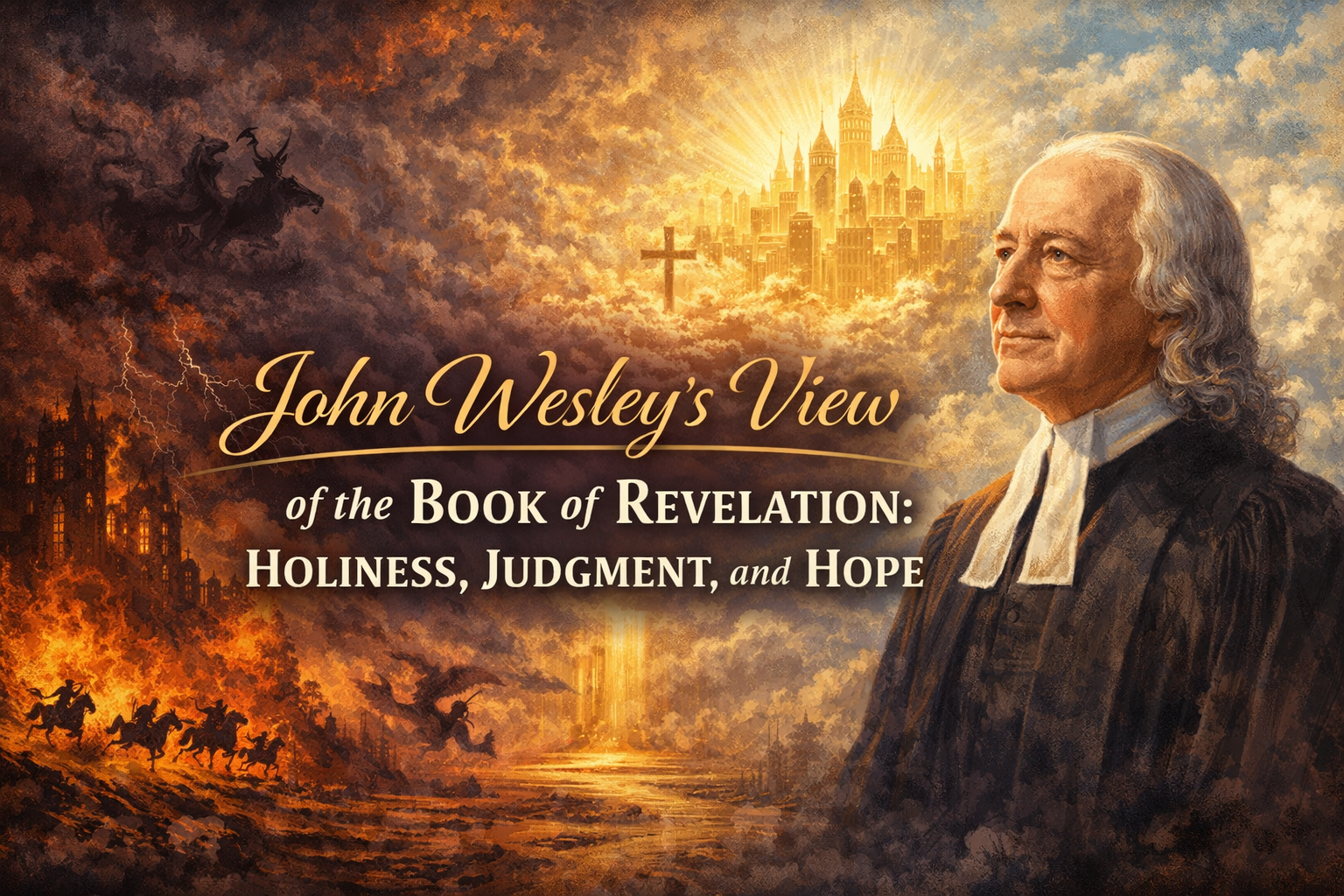
John Wesley’s View of the Book of Revelation: Holiness, Judgment, and Hope
How the Founder of Methodism Read the Apocalypse — Not as a Puzzle to Solve, But a Call to Live Holy
The Book of Revelation has stirred up debate, awe, and anxiety for centuries. But what did John Wesley — the founder of Methodism and one of the greatest revival preachers in English history — think about it? And what did he believe it means for the Christian life?
John Wesley (1703–1791)
Anglican priest, theologian, and founder of the Methodist movement. Wesley rode over 250,000 miles on horseback to preach the gospel, catalyzed one of the greatest revivals in English history, and produced an influential verse-by-verse commentary on the New Testament — the Explanatory Notes upon the New Testament — that included a careful treatment of Revelation.
“The prophecies are not given to gratify our curiosity but to excite our piety.” — John Wesley
How Wesley Interpreted Revelation
Wesley wasn’t interested in decoding every dragon, trumpet, and plague like a theological puzzle master. Instead, he approached Revelation as a spiritual and prophetic guide for believers — a call to watchfulness, repentance, and purity, not a sequence chart to be plotted against newspaper headlines.
He followed the historicist interpretation, the dominant Protestant reading of his era: the visions of Revelation were not confined to the past or the far-off future, but were being fulfilled across the entire scope of church history. Revelation was a map for the church through the ages — showing her how to stay faithful, endure persecution, resist corruption, and live in holiness while waiting for the final triumph of Christ.
Wesley’s Notes on Revelation
📜 Prophetic Guide, Not Prophetic Puzzle
That was the key for Wesley: the primary purpose of Revelation is not to satisfy theological curiosity about the sequence of end-times events. It is to shape how the Church lives right now — today, in whatever century it finds itself.
Walking Through Wesley’s Reading
Chapters 2–3
🏛️ The Seven Churches — A Mirror for Every Generation
Wesley saw the seven churches not just as historical congregations in Asia Minor, but as spiritual types — each representing different conditions the Church would face across time. He found each one personally applicable, and he didn’t spare his own movement from the comparison.
Ephesus
Busy with good works, but love has grown cold
Smyrna
Faithful and courageous amid active persecution
Pergamum
Tolerant of false teaching — compromising truth for peace
Thyatira
Corrupted by immorality under false prophetic cover
Sardis
Has the name of being alive — but spiritually dead
Philadelphia
Obedient and persevering; an open door set before it
Laodicea
Lukewarm, self-satisfied, and spiritually blind — Wesley saw this as the gravest danger for comfortable, prosperous Christianity in any age
Wesley warned that the Methodist church itself could fall into Laodicean lukewarmness. The cure was not better theology or more activity — it was a return to the fire of holiness and complete dependence on Christ.
Chapters 13 & 17
🐉 Babylon and the Beast — The Protestant Protest
Like Luther and Calvin before him, Wesley interpreted Babylon and the Beast as symbols of corrupt religious authority — particularly the Roman Catholic Church as it had developed through the Middle Ages, with its persecution of the faithful, suppression of Scripture, and sale of indulgences.
Wesley was careful to distinguish between his critique of the institution and his love for people. He preached and showed love toward Roman Catholics as individuals. But he, like the Reformers, believed Revelation’s imagery of persecution, blasphemy, and false authority was being fulfilled in the medieval church’s corruptions.
Crucially, Wesley extended the warning beyond Rome: any church — Protestant or Catholic — can fall into Babylon’s pattern if it leaves the purity of Christ’s Word. The beast was a warning for his own movement as much as anyone else’s.
Chapters 6–16
⚡ Judgment with Mercy — Seals, Trumpets, and Bowls
Wesley did not minimize the judgments of Revelation. But he interpreted them as expressions of both God’s justice and His mercy. Every plague, every trumpet, every bowl of wrath was not just punishment — it was an urgent call to repentance.
God’s mercy was still active, even amid wrath. Revelation was not only about destruction; it was about invitation. The same Jesus who opened the seals was still calling people to be saved. The judgments were God’s voice saying: “Turn to Me before it’s too late.”
Chapter 19
✝️ Christ’s Triumph — The Heartbeat of Revelation
Though much of Revelation deals with judgment, Wesley read it ultimately as a book of hope — centered on the final, certain victory of Jesus Christ. All the pain, all the war, all the deception in the world would ultimately be overcome by the Lamb who was slain (Revelation 5:6).
He rejoiced in the marriage supper of the Lamb and the glorious reunion of Christ with His faithful Church — believing this moment represented not just forensic justification, but the full sanctification and glorification of the saints. Wesley’s soteriology always ran toward complete salvation, and Revelation’s consummation was its ultimate expression.
He also affirmed a literal Second Coming of Christ and a millennial reign, though his exact millennial position was cautious and secondary. What mattered was not the timing — it was the call to be ready.
Chapters 21–22
🌅 New Heaven and New Earth — The Consummation of Holiness
Wesley was captivated by the final chapters of Revelation. The New Jerusalem was, for him, the consummation of the holiness he had preached his entire life — the place where God would dwell eternally with His people, where righteousness and joy would never end.
“He will wipe away every tear from their eyes. Death will be no more; neither will there be mourning, nor crying, nor pain anymore.” — Revelation 21:4
For Wesley, Revelation ended not in fear, but in faith, glory, and celebration. The holiness he called people to in this life was only the beginning of an eternal holiness in the life to come.
Wesley’s Theological Lens — Key Themes
🔥 Holiness
Overcoming sin is the primary purpose of prophecy — not satisfying curiosity about the future
👁️ Watchfulness
Christians must stay alert and ready for Christ’s return — not with fear, but with active, prepared faith
📜 Historical Symbolism
Revelation unfolds across church history — it speaks to every generation, not just the last one
⚠️ Anti-Corruption
False teaching and religious abuse — in any church — are warned against in Revelation’s imagery
🕊️ Hope in Christ
Christ’s victory is certain and final — Revelation ends in glory, not despair
🙏 Practical Piety
The blessing of Revelation (Rev. 1:3) comes through obedience and growth, not through correct prophetic decoding
How Wesley’s View Compares
| Viewpoint | Summary | Wesley’s Stance |
|---|---|---|
| Preterist | Revelation fulfilled primarily in the first century | ✗ Rejected |
| Futurist | Most of Revelation describes a future tribulation period | ⚠ Cautious — partial openness |
| Historicist | Prophecy unfolds progressively through church history | ✓ His primary framework |
| Idealist | Purely symbolic, expressing timeless spiritual truths | ⚠ Appreciated some value |
Four Practical Lessons from Wesley’s Revelation
Be Faithful in Persecution
Just like the church in Smyrna, Christians are called to be faithful even when suffering. Wesley consistently reminded believers that persecution does not mean God is absent — it refines faith and produces the kind of steadfastness that no comfortable season can.
Beware Spiritual Lukewarmness
Wesley considered Laodicean lukewarmness one of the gravest dangers in Christian history — more dangerous, in some ways, than outright opposition. A cold enemy is less dangerous than a warm friend who is spiritually asleep. He called his own movement back to this warning constantly.
Read and Keep Its Sayings
Revelation 1:3 promises a specific blessing to those who read it and obey it. For Wesley, that blessing came not through mastering a prophetic timeline, but through letting the book shape your character, sharpen your watchfulness, and fuel your love for Christ and neighbor.
Live Expectantly — Without Setting Dates
Wesley never fixed dates for the end of the world. But he believed Jesus could return at any moment. The practical conclusion was not speculation but sanctification: live the holy life now, because the King may arrive before the day is out.
John Wesley’s view of the Book of Revelation is a corrective for any age that turns prophecy into entertainment or speculation into substitute for holiness. He invites us to seek sanctification over sensation, to persevere through hardship, to watch with joy for Christ’s return, to resist corruption in all its forms, and to hope in the promise of a new creation.
For Wesley, Revelation wasn’t a scary book. It was a holy one. A book meant to awaken sleepy saints, warn drifting churches, and call everyone to stand firm for the Lamb who reigns.
So the next time you read Revelation, don’t just ask what does this mean? Ask: how should I live in light of this? That’s what Wesley would have done.
“Let us be watchful and stand firm; for the Lord is at hand, and He who shall come will come, and will not tarry.” — John Wesley
Key Scriptures: Revelation 1:3; 2–3; 5:6; 13:1–18; 17; 19:1–9; 21:1–4; 22:7 · 1 Thessalonians 5:2 · 2 Corinthians 7:1 · Hebrews 12:14
Want to Go Deeper?
This post is part of an ongoing eschatology series comparing how different Christian thinkers have interpreted Revelation. Read the companion posts for the full picture:
- John MacArthur on Revelation — The dispensational, literal-futurist approach: every judgment, every beast, every number treated as literal future prophecy.
- Tim Keller on Revelation — Reformed/symbolic reading: comfort for the suffering church, Christ at the center, heaven coming down.
- David Jeremiah on Revelation — Pastoral dispensationalism with strong pastoral application and connections to current world events.
- What the Early Church Fathers Believed — Irenaeus, Hippolytus, Augustine, and Chrysostom on the Second Coming and end times.
- Read Wesley directly — His Explanatory Notes upon the New Testament commentary on Revelation is the primary source; Kenneth Collins’s The Theology of John Wesley gives the best modern summary of his eschatological framework.
- Subscribe to get new posts delivered straight to your inbox — gospel-rooted, plain-spoken truth for the week ahead.
“Behold, I come quickly: blessed is he that keepeth the sayings of the prophecy of this book.” — Revelation 22:7