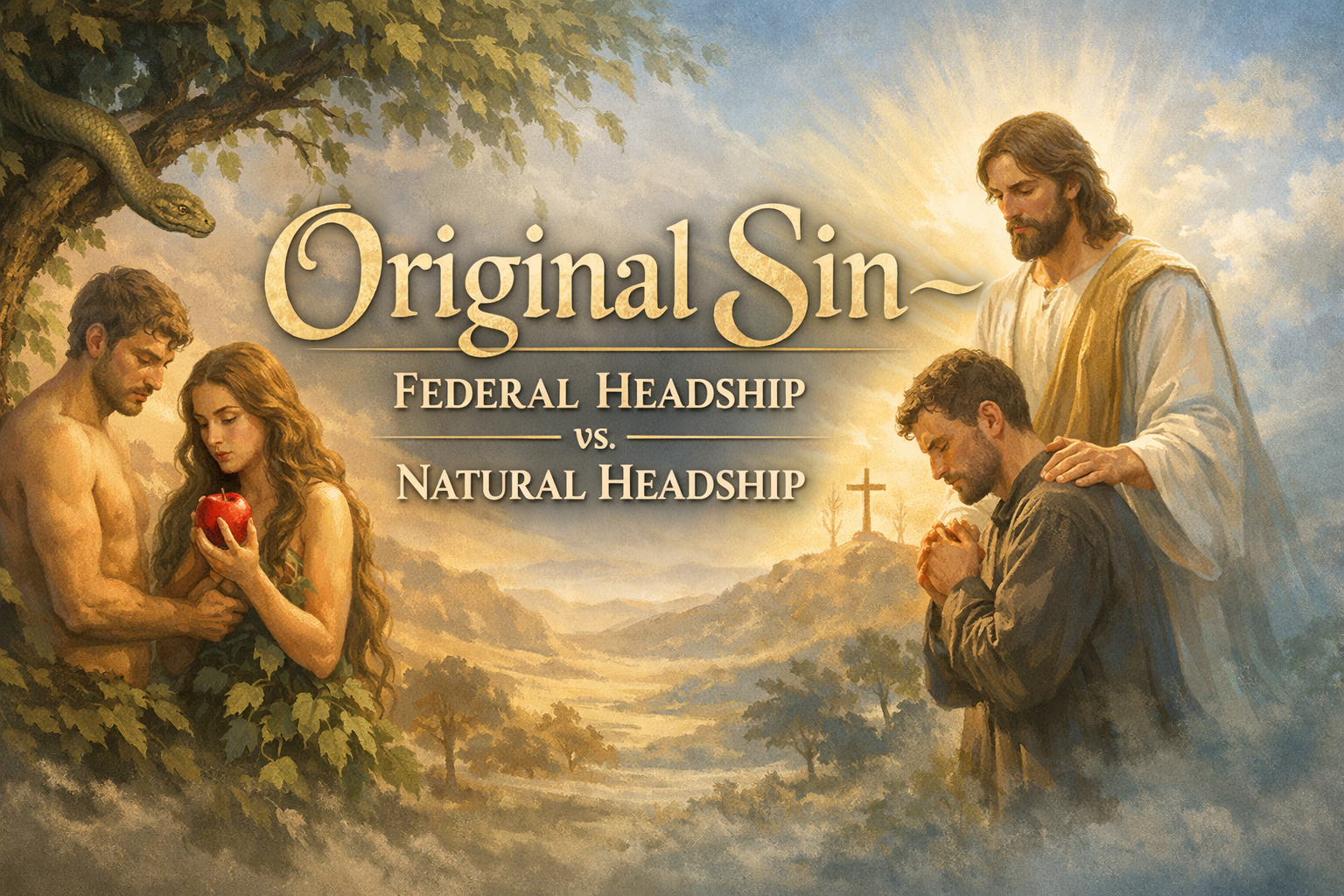
Original Sin — Federal Headship vs. Natural Headship
How can Adam’s sin have anything to do with me? That question has echoed through centuries of Christian thinking, and the answer reaches straight into how we understand sin, grace, Christ, and salvation. Federal headship explains why Adam’s guilt is counted to us. Natural headship explains why Adam’s corruption is passed to us. And both together drive us to the only hope sinners have: Jesus Christ, the last Adam, who obeyed where Adam failed and gives life where Adam brought death.
There are some doctrines that feel heavy the minute you say them out loud, and original sin is one of them. Folks hear that phrase and often land on one simple question: How can Adam’s sin have anything to do with me? Why should the failure of one man in a garden long ago have any bearing on the guilt, corruption, and misery of the whole human race now?
That question is not new. Christians have wrestled with it for centuries. And when the discussion gets down to brass tacks, two ideas usually come into view: federal headship and natural headship. Those are big terms, but the issue underneath them is plain enough. Did Adam represent us by God’s appointment as our covenant head? Or are we connected to Adam mainly because we all come from him by natural descent? Put simply: Are we in Adam legally, naturally, or both?
The best Christian answer — especially in the Augustinian and Reformed stream of theology — is that Adam was both our federal head and our natural head. Federal headship best explains the imputation of guilt, while natural headship helps explain the transmission of corruption. Adam stood for us covenantally, and because we descend from him naturally, we also share in the fallen condition that flows from him.
That may sound like a mouthful, but it matters a great deal. This is not just a dusty theological debate. It reaches straight into how we understand sin, grace, Christ, salvation, and the fairness of God.
Why This Doctrine Matters
Some people hear the doctrine of original sin and recoil. It sounds unfair to modern ears. We are used to thinking of ourselves as isolated individuals. “I should answer for my choices,” we say, “but not for somebody else’s.” That sounds sensible on the surface.
But the Bible does not speak of humanity as a pile of disconnected individuals. Scripture treats mankind as a race, a family, a people bound up together in a representative order established by God. And here is why that matters beyond the doctrine itself: the same framework that explains how Adam’s sin affects us also explains how Christ’s righteousness can be counted to believers.
If you tear down the idea of representation in Adam, you start sawing off the limb you are sitting on when it comes to salvation in Christ.
Paul makes the connection plain:
“For as in Adam all die, even so in Christ shall all be made alive.” — 1 Corinthians 15:22 (KJV)
“Therefore as by the offence of one judgment came upon all men to condemnation; even so by the righteousness of one the free gift came upon all men unto justification of life.” — Romans 5:18 (KJV)
The whole gospel comparison rests on this pattern: one man acting for many. Deny it in Adam, and you have weakened it in Christ.
What Is Original Sin?
Before we get into headship, we ought to define the doctrine itself. Original sin does not mean that the first sin ever committed was ours personally. It means that the sin of Adam, the first man, has consequences for the whole human race. Traditionally, Christians have said original sin includes two things:
First, original guilt. Adam’s first sin is counted to those he represented.
Second, original corruption. The human nature we inherit is fallen, bent, disordered, and inclined toward sin.
So original sin is not just bad examples handed down through history. It is not merely that people copy Adam’s mistake. It is that the race fell in Adam and now comes into the world under sin. David says:
“Behold, I was shapen in iniquity; and in sin did my mother conceive me.” — Psalm 51:5 (KJV)
He is not blaming his mother for sinning in conception. He is confessing that from the very beginning of his existence, he belongs to a fallen race. Sin is not just something he started doing later; it is a condition into which he was born.
What Is Federal Headship?
The word federal comes from a word related to covenant. Federal headship means Adam stood as the representative head of humanity in the covenant of works. God appointed him to act not merely as a private man, but as the public representative of the race. When Adam obeyed or disobeyed, he did not act for himself alone. He acted for all who were in him as their covenant head.
You can think of it like a leader signing on behalf of his people. A president declares war, and the nation is at war. A father makes a decision that affects the whole household. A company head signs an agreement, and the whole firm is bound by it. Representation is not foreign to ordinary life — it is woven right into how God has ordered the world.
The strongest biblical support for this is Romans 5:
“By one man sin entered into the world, and death by sin; and so death passed upon all men, for that all have sinned.” — Romans 5:12 (KJV)
Then Paul keeps repeating the same drumbeat: by one man’s disobedience many were made sinners; by one offence judgment came; by one trespass came condemnation; through one man death reigned. That is not Adam setting a bad example. That is Adam acting in a way that has judicial consequences for all connected to him.
What Is Natural Headship?
Natural headship means Adam is the natural root of the human race. We all descend from him. He is our father according to human nature. Because humanity comes from him, what happened to his nature affects ours. When Adam fell, human nature itself became corrupted. Since we all come from him by ordinary generation, we inherit that fallen nature.
That fits ordinary experience pretty well. Nobody has to teach a child to be selfish. Nobody has to run a seminar on pride, envy, lying, or stubbornness. Sin comes naturally because our nature is fallen. Paul says in Ephesians:
“And were by nature the children of wrath, even as others.” — Ephesians 2:3 (KJV)
That phrase by nature matters. It points to something more than chosen habits. It points to what we are in Adam apart from grace.
The Plain Distinction
Here is the difference in a sentence:
Federal headship deals with representation and imputation — why we are counted guilty in Adam.
Natural headship deals with descent and inherited corruption — why we are born corrupt from Adam.
Those two questions overlap, but they are not identical. A lot of confusion in this doctrine comes from folks trying to make one category do all the work. The truth is, the Bible gives us reason to keep both in view.
Why Federal Headship Matters So Much
If you read Romans 5 carefully, Paul leans hard on the representative principle — five times in five verses he hammers the same point: by one man’s act, condemnation and death came to many. He is not mainly describing biology. He is describing judicial solidarity under a representative head.
And here is why that matters beyond the doctrine of the fall: Paul is building a parallel with Christ. Just as Adam’s one disobedience is counted to those he represents, Christ’s obedience is counted to those united to Him by faith. If you deny the representative principle in Adam, you weaken the representative principle in Christ.
The gospel is gloriously federal. Jesus does not save us merely by moral influence or good example. He saves us as our representative head. He obeys for His people. He dies for His people. He rises for His people. His righteousness is imputed to His people. So federal headship may feel strange at first, but it is not bad news alone — it is the very structure that makes justification such good news.
Why Natural Headship Still Matters
If we stress federal headship alone, some folks begin to wonder whether original sin becomes too abstract — almost like a legal fiction. “Are we only counted guilty,” they ask, “or are we actually fallen?”
That is where natural headship helps. The problem with humanity is not merely that we have guilt on the books. We are inwardly ruined. We do not come into the world as clean hearts who just happen to have Adam’s legal record attached to us. We come corrupted. Twisted. Spiritually dead. Inclined away from God. Sin is not merely external to us — it lives in us. We inherit from Adam not just a bad standing, but a bad nature.
That is why salvation must include more than pardon. We need new birth. We need regeneration. We need a new heart. A man with only guilt needs forgiveness. A man with guilt and corruption needs forgiveness and transformation. Scripture says we need both.
What About Fairness?
This is where folks usually stop you and say, “That still does not seem fair.” And that is an honest question.
Part of the answer is that we tend to overestimate our independence. The Bible’s world is fuller and more connected than the modern individualistic mind likes. In Scripture, families, tribes, nations, and covenants matter. Heads represent bodies. Kings affect kingdoms. Priests act for people. Above all, Adam and Christ stand as the two great heads of humanity.
Another part of the answer is this: no one finally perishes because he was morally pure except for Adam’s guilt stuck unfairly onto him. Every one of us gladly confirms Adam’s rebellion with our own actual sins. Original sin is not the only sin we have. It is the poisoned spring from which our own sins flow.
And still deeper: if we reject Adam’s representation as unfair, what will we do with Christ’s representation? Nobody says, “It is unfair that Christ obeyed and suffered for me and that I receive righteousness by union with Him.” That is our only hope. The very principle that troubles us in Adam is the principle that saves us in Christ.
Adam and Christ: The Two Heads
Paul’s whole framework in Romans 5 and 1 Corinthians 15 is this: there are two humanities and two heads. One humanity is in Adam. The other is in Christ. In Adam there is guilt, corruption, condemnation, and death. In Christ there is righteousness, renewal, justification, and life.
“The first man Adam was made a living soul; the last Adam was made a quickening spirit.” — 1 Corinthians 15:45 (KJV)
Jesus is called the last Adam because He comes as the head of a new humanity. He does not merely help the old Adamic race limp along. He establishes a new people by His obedience, death, and resurrection. So whenever we talk about Adam’s headship, we ought to keep our eyes on Christ’s headship. Otherwise, we have only half the story.
A Word for Veterans
The military runs on representation. You know this from experience. When a commanding officer makes a call, the unit lives with the consequences — good or bad. When a nation sends its military to war, every service member carries that decision in the flesh. Representation is not an abstract idea in uniform. It is the air you breathe on deployment.
Federal headship works the same way, just at the level of the whole human race. Adam was your CO before you ever drew breath, and he made the worst possible call. His failure became yours — not because you were standing there to vote on it, but because that is how God ordered human solidarity. One head, one people, one consequence.
But here is the thing about military representation — it cuts both ways. The right leader changes everything. A new commander with a new mission and a different outcome covers his people with his victory, not his failure. That is exactly what the last Adam, Jesus Christ, has done. He took the field where Adam folded. He obeyed where Adam rebelled. He absorbed the judgment Adam’s failure deserved. And everyone under His command — everyone united to Him by faith — gets covered by His record, not Adam’s.
You may have served under leaders who let you down and leaders who didn’t. Jesus Christ is the kind of commanding officer who has never once failed His people, and He never will. In Him, the record is clean, and the mission is won.
A Rural Illustration
Think of an old irrigation ditch running from a mountain stream down through an orchard. If the source gets poisoned upstream, the whole line carries poisoned water. Every tree fed by that ditch is affected. That gets at natural headship — what flows from the root shapes everything downstream.
Now think of the owner of the whole property signing a binding agreement on behalf of the land. His signature affects every acre under his care. That gets closer to federal headship — one man acts in a representative role, and the consequences reach the whole estate.
Put those together and you have something close to Adam. He is both the root from which the race flows and the representative appointed to stand for the race. That is why both corruption and guilt come into the picture — and why you need both categories to tell the whole story.
Common Errors to Avoid
Reducing Adam to a bad example. Some folks treat Adam like the first man who simply showed us how to sin. That is far too weak. Romans 5 says more than that. Adam’s act brought condemnation and death to many. He was not just the first sinner in a long line of imitators.
Treating guilt as if corruption were unimportant. Others so emphasize imputation that they almost speak as if human beings are not truly ruined inwardly. But Scripture is clear — our problem is not only legal. It is moral and spiritual. We are dead in trespasses and sins.
Treating corruption as if representation were unnecessary. Others try to explain everything by natural descent alone. But that tends to blur Paul’s legal categories in Romans 5. The text keeps pressing the one-man, one-trespass, condemnation pattern. That is federal language.
Forgetting Christ while discussing Adam. This is probably the biggest mistake of all. The doctrine of original sin is never meant to leave the believer hopeless. It is meant to make the grace of Christ shine brighter. The darker the ruin in Adam, the sweeter the rescue in Christ.
What This Means for Christian Life
We should be humble. Original sin knocks the props out from under human pride. It tells us we are not basically good people who need a little polishing. We are fallen in Adam and sinners by nature and by choice.
We should take sin seriously. Sin is not superficial. It is not a few wrong habits pasted onto an otherwise healthy soul. It runs deep. That means we should not toy with it, excuse it, or rename it.
We should marvel at grace. If our ruin in Adam is this deep, then salvation in Christ is more glorious than we often realize. God is not merely coaching improved behavior. He is rescuing the condemned, raising the dead, and creating a new humanity in His Son.
We should cling to Christ alone. You cannot reason your way out of Adam. You cannot self-improve your way out of Adam. You cannot turn over enough new leaves to escape Adam. The only way out is union with the second Adam, Jesus Christ.
Key Takeaways
- Original sin includes both original guilt and original corruption. We are not merely legally charged because of Adam — we are genuinely and inwardly fallen. Both dimensions are real and both require an answer.
- Federal headship explains why Adam’s guilt is imputed to us. God appointed Adam as the covenant representative of the race, so his one act of disobedience had judicial consequences for all he represented.
- Natural headship explains why we inherit a fallen nature. Because we descend from Adam by ordinary generation, we come into the world already corrupted — bent away from God before we ever choose anything.
- The same representative principle that connects us to Adam’s fall connects us to Christ’s righteousness. Deny federal headship in Adam, and you have weakened the very ground on which justification in Christ stands.
- The doctrine of original sin is meant to drive us to Christ, not leave us in despair. The darker the ruin in Adam, the sweeter the rescue in the last Adam — who obeyed where Adam failed and gives life where Adam brought death.
Final Encouragement
This doctrine may feel like hard ground at first. It tells us things about ourselves we do not naturally like to hear. It tells us we are not morally neutral. It tells us we are not born clean and only later corrupted by society. It tells us that humanity’s problem goes all the way back to Adam and all the way down into our nature.
But that hard doctrine prepares the soil for a glorious gospel.
If Adam were only a private sinner, then Christ might only be a private Savior. But because Adam was the head of a fallen race, Christ comes as the head of a redeemed race. Because condemnation came through one man, justification comes through one Man. Because death came through one representative, life comes through another.
You were not only born from Adam. By grace, you may be born again in Christ. You were not only represented in the garden. By faith, you may be represented at the cross. You were not only ruined by the first man. You may be rescued forever by the last Adam.
So yes, original sin is a sobering doctrine. But it is not the end of the story.
The end of the story is Jesus.
Key Scriptures:
Genesis 2:15–17 | Genesis 3:1–19 | Psalm 51:5 | Romans 5:12–21
1 Corinthians 15:21–22, 45–49 | Ephesians 2:1–3 | Job 14:4