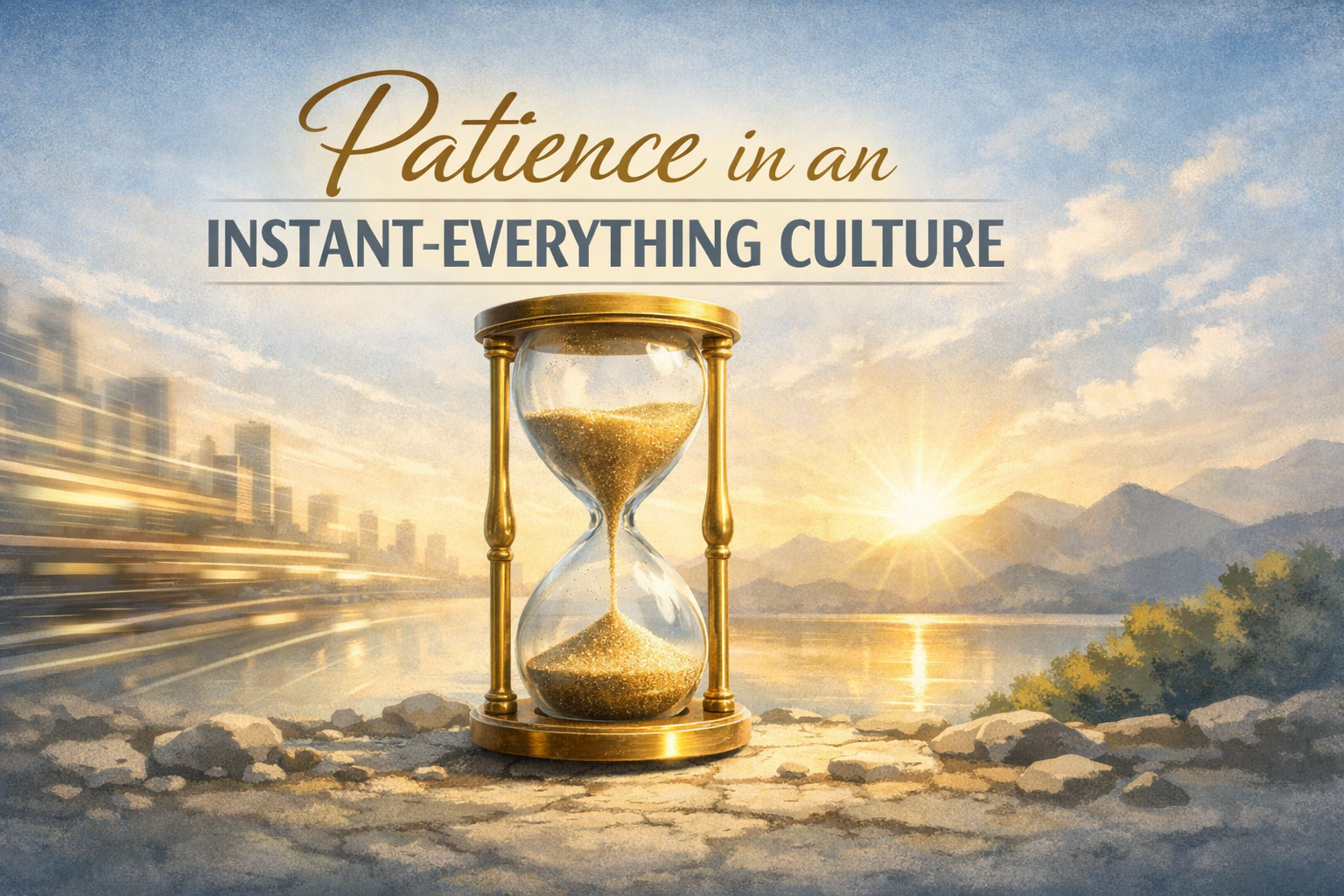
Patience in an Instant-Everything Culture
We live in a world engineered to eliminate waiting. Scripture calls us to a life built around it. That tension isn’t going away — and how you navigate it shapes more of your character than almost anything else.
Two-day shipping feels slow now. We get annoyed when a page takes three seconds to load. We have access to virtually all human knowledge in our pockets and we still feel like things aren’t moving fast enough. And into all of that, God says: wait.
Think about what we’ve built. You can order almost anything and have it at your door by tomorrow. You can watch any movie ever made, right now, without leaving your chair. You can get a medical second opinion, translate a document into forty languages, and find out the weather in Nairobi all within sixty seconds on a device that fits in your shirt pocket. The friction that used to exist between wanting something and having it has been engineered nearly out of existence.
That’s a genuinely remarkable thing. And it is doing something to us.
Not just to our attention spans — though that’s real. Not just to our tolerance for inconvenience — though that’s real too. It’s doing something to our capacity for patience as a spiritual discipline. Because patience isn’t just a personality trait or a social nicety. In Scripture, patience is a virtue with deep theological roots, a fruit of the Spirit, and one of the primary ways God shapes a man’s character over time. And the world we live in is systematically training us away from it.
This isn’t a post complaining about technology. It’s a post about what’s at stake when waiting becomes unbearable — and what Scripture offers in its place.
What We Mean When We Say Patience
The New Testament actually uses two different Greek words that both get translated “patience” in English, and keeping them distinct matters.
The first is hupomone — usually translated “patient endurance” or “steadfastness.” It carries the sense of remaining under a heavy load without buckling. Not passive resignation, but active, engaged perseverance in the face of hard circumstances. This is the patience of the long race, the hard season, the situation that isn’t changing as fast as you need it to. It’s the patience of Job, sitting in the ash heap and refusing to curse God. It’s the patience of the farmer waiting for rain.
The second is makrothumia — “longsuffering” or “patience with people.” This one is specifically relational: it’s the slow fuse, the extended grace, the willingness to bear with someone who is difficult without blowing up or giving up. It’s the patience that keeps a marriage going through a hard season, that stays present with a struggling kid, that doesn’t write off the brother who keeps falling into the same sin.
Both matter. Both are under assault from the same cultural force: the engineering of instant gratification has trained us to expect fast resolution from circumstances and from people alike. When circumstances don’t resolve quickly, we make impulsive decisions to force the issue. When people don’t change quickly, we lose patience with them and move on. Either way, we never develop the deep roots that only grow in the soil of waiting.
The Speed of God
If there is one thing that jumps off the pages of Scripture about the way God works, it’s that He is almost never in a hurry.
Abraham waits twenty-five years from the promise of a son to the birth of Isaac. Joseph spends thirteen years as a slave and a prisoner before the dream God gave him as a teenager comes to fruition. Moses is eighty years old — eighty — when God finally sends him to Pharaoh. David is anointed king as a teenager and doesn’t sit on the throne until he’s thirty, after years of running for his life. The exiles wait seventy years in Babylon. The people of God wait four hundred years between the last prophet and the birth of Christ.
These are not scheduling errors. They are not the result of God being distracted or indifferent. They are the deliberate pace of a God who is doing something in the waiting that cannot be done any other way.
Peter addresses this directly when the early church is starting to wonder why Jesus hasn’t returned yet:
“The Lord is not slow to fulfill his promise as some count slowness, but is patient toward you, not wishing that any should perish, but that all should reach repentance.” — 2 Peter 3:9
What looks like delay is actually patience — God’s own patience, extended in mercy. The slowness is purposeful. The waiting is not wasted time between events. It is the event. Something is happening in the gap that could not happen if the gap were closed.
The man who is only looking for the outcome is missing the point. God is after formation, not just fulfillment. The twenty-five years made Abraham into a man who could receive the promise and not be destroyed by it. The dungeon made Joseph into a man who could sit on a throne without forgetting where he came from. The wilderness made Moses into a man gentle enough to lead a million complainers through the desert. The waiting was the work.
What Impatience Actually Costs
It’s worth sitting with the biblical record of what happens when people decide they’ve waited long enough and take matters into their own hands. It is not a short list, and it is not a pretty one.
Abraham and Sarah, after years of waiting for the promised son, decide to help God out. Sarah gives her servant Hagar to Abraham, Ishmael is born, and the resulting family fracture reverberates for thousands of years — including in the Middle East today. The impatience that produced Ishmael didn’t cancel the promise of Isaac. But it produced consequences that outlasted everyone involved by millennia.
Saul, the first king of Israel, is waiting for Samuel to arrive before battle. Samuel is late. The army is getting nervous and starting to scatter. So Saul offers the sacrifice himself — a role reserved for the priest — rather than wait one more hour. Samuel arrives immediately after. And the verdict is devastating:
“You have done foolishly. You have not kept the command of the Lord your God, with which he commanded you. For then the Lord would have established your kingdom over Israel forever. But now your kingdom shall not continue.” — 1 Samuel 13:13–14
One decision. One hour of impatience. And it cost Saul a dynasty.
This is the pattern. Impatience almost always reaches for what God has already promised to provide — but grabs it in the wrong way, at the wrong time, through the wrong means. And the consequences of that grab tend to be disproportionate to how reasonable the decision seemed in the moment. It felt like common sense. It felt like leadership. It felt like the situation required someone to act. And it was the hinge on which an entire kingdom turned the wrong direction.
That should sober us. Because most of us, if we’re honest, can name the Saul moments in our own histories — the decision we made when God seemed to be moving too slowly, when the situation felt urgent, when we convinced ourselves that waiting any longer was irresponsible. And we know what those decisions produced.
Patience as a Fruit, Not a Feat
Here’s the thing about patience as a virtue: it cannot be manufactured by effort alone. You cannot grit your teeth into longsuffering. You cannot willpower your way to hupomone. The man who is trying to be patient through sheer discipline is running on reserves that will eventually run out, and when they do, what’s underneath comes up fast.
Paul lists patience — in both of its forms — as fruit of the Spirit (Galatians 5:22). Not a discipline of the Spirit. Not a technique the Spirit teaches. Fruit. Something that grows from the inside out when the Spirit has room to work. You don’t produce fruit by trying harder. You produce fruit by staying connected to the vine.
That reframes the whole conversation. The question isn’t “how do I become more patient?” as though patience were a skill to be learned. The question is “what is hindering the Spirit’s work in me?” — because where the Spirit has freedom, patience grows. Where the Spirit is grieved or quenched, impatience fills the vacuum.
What grieves the Spirit? Unconfessed sin, bitterness, a prayerless life, an unrenewed mind. What quenches the Spirit? Ignoring His promptings, running ahead of God, filling every quiet moment with noise so the still small voice never gets a word in. The impatient man is often the prayerless man, the man who has stopped genuinely waiting on God and started running his own program with God’s name on it.
The path back to patience, then, runs through repentance and reconnection — not technique. Prayer. Scripture. Honest confession. The practices that put us back in the place where the Spirit can do His work and the fruit can grow.
The Farmer and the Fighter
James gives us one of the most earthy and practical pictures of patient waiting in the New Testament:
“Be patient, therefore, brothers, until the coming of the Lord. See how the farmer waits for the precious fruit of the earth, being patient about it, until it receives the early and the late rains. You also, be patient. Establish your hearts, for the coming of the Lord is at hand.” — James 5:7–8
The farmer doesn’t stare at the ground willing seeds to sprout faster. He doesn’t dig them up to check on them. He doesn’t switch crops midseason because this one is taking too long. He does his work — prepares the soil, plants, tends, protects — and then he waits for rain that is not his to summon. He trusts the process because he understands that the process is not under his control, and fighting that reality only exhausts him without changing it.
That is a picture of mature patience. Not passive. The farmer is busy. But his busyness is calibrated to the actual timeline, not to his anxiety about it. He has made peace with the fact that certain things take the time they take, and no amount of urgency on his part will change that.
James frames this in light of the Lord’s coming — the ultimate “slow” promise, the one the church has been waiting two thousand years for. And his instruction is: establish your hearts. Don’t let your hearts become unsettled, anxious, double-minded. Root yourself in what is certain while you wait for what is coming.
That’s the inner work of patience. It’s not about slowing down outwardly. It’s about stabilizing inwardly — building a heart that isn’t rattled by delay because it’s anchored to something delay cannot threaten.
Patience with People Is the Harder Test
Most men will tell you they’re working on it when it comes to circumstances. Waiting on a job, a relationship, a health outcome, a prayer answer — that’s hard, but there’s something almost noble-sounding about it. We can frame it as trust, as perseverance, as the long game.
Patience with people is less flattering. It exposes things we’d rather keep covered.
Makrothumia — longsuffering — is specifically the grace to keep extending patience to the person who keeps requiring it. The colleague who never quite gets it together. The friend who is still wrestling with the same sin he was wrestling with three years ago. The family member who says the wrong thing every single time. The brother in the church who is difficult in ways that are entirely predictable and never seem to change.
Paul’s standard here is uncomfortably high:
“Walk in a manner worthy of the calling to which you have been called, with all humility and gentleness, with patience, bearing with one another in love.” — Ephesians 4:1–2
“Bearing with one another” is active language. It means there is a weight involved and you are choosing to carry it rather than set it down. It doesn’t mean pretending the difficulty isn’t real. It means staying present to people anyway, because that is what love does, and because the God who is patient with you is asking you to extend the same to others.
The theological anchor for patience with people is always God’s patience with us. Paul makes this explicit in Romans 15:7: “Welcome one another as Christ has welcomed you.” The measure of our patience with others is Christ’s patience with us — which is, frankly, staggering to contemplate if you do it honestly. The impatient man has usually lost track of how much patience he himself has required.
What Waiting Produces That Nothing Else Can
Paul’s great passage on suffering and hope in Romans 5:3–5 traces a chain that is worth sitting with carefully:
“We rejoice in our sufferings, knowing that suffering produces endurance, and endurance produces character, and character produces hope, and hope does not put us to shame, because God’s love has been poured into our hearts through the Holy Spirit who has been given to us.” — Romans 5:3–5
Endurance — hupomone, patient endurance under pressure — produces character. Not knowledge. Not skill. Not achievement. Character. The stable, settled, trustworthy quality of a man who has been through something and come out the other side without abandoning what he believed.
That kind of character cannot be downloaded. It cannot be manufactured in a weekend intensive. It cannot be acquired through a book, though books can point toward it. It grows only one way: through the sustained practice of trusting God when the outcome is uncertain and the timeline is not yours to control.
The instant-everything culture is efficient at producing many things. Character is not among them. Character is grown in the long wait, the hard season, the relationship that requires more than you thought you had to give. It is grown in the space between the promise and the fulfillment — which is exactly the space our culture has declared intolerable and has spent enormous energy trying to close.
But the man who has had that space closed for him — who has never been made to wait for anything significant — is a man who has been robbed of something he cannot recover except by going back through the waiting. And the longer he avoids it, the shallower he becomes.
Practical Resistance: Recovering the Capacity to Wait
The cultural pull toward impatience is strong and it doesn’t announce itself as virtue-destruction. It looks like convenience, efficiency, productivity. Which means recovering patience requires something slightly countercultural — not dramatic, but deliberate.
It starts with the discipline of waiting on God in prayer. Not the thirty-second check-in, but extended, unhurried time in God’s presence — time that feels inefficient by our culture’s standards and is among the most formative things a man can do. The Psalms are full of men who went into prayer frantic and came out settled, not because the circumstances changed, but because they waited long enough to remember who God is.
Psalm 27:14 says it plainly: “Wait for the Lord; be strong, and let your heart take courage; wait for the Lord!” The waiting is not the prelude to the strength. The waiting is where the strength comes from.
It continues with resisting the reflex to fix or force. Most of us have a very short window between discomfort and action — we feel the tension of an unresolved situation and we immediately move to resolve it. Sometimes that’s wisdom. But often it’s impatience wearing the costume of leadership. Learning to sit with unresolved tension, to bring it to God rather than force it to a conclusion, is a countercultural spiritual practice that most men have to deliberately and repeatedly choose.
And it is sustained in community — by brothers who have learned to wait well, who can speak into your impatience from their own hard-won experience, and who can remind you of what God has done in the long seasons when the reminder is exactly what you need.
What Are You Waiting For?
Most men reading this are in the middle of something that isn’t resolving on their preferred timeline. A relationship that isn’t healing as fast as they hoped. A prayer that seems to be hitting the ceiling. A season that was supposed to be temporary and has lasted far longer than that. A promise from God that feels like it’s been on hold.
The farmer doesn’t dig up the seeds. The waiting is not evidence that nothing is happening — it may be evidence that the most important thing is happening underground, where you can’t see it yet.
“But they who wait for the Lord shall renew their strength; they shall mount up with wings like eagles; they shall run and not be weary; they shall walk and not faint.” — Isaiah 40:31
God is not slow. He is patient. And in His patience, He is doing something in you that the shortcut would have skipped entirely.
Key Takeaways
- Scripture uses two distinct words for patience, and both are under attack. Hupomone is steadfast endurance under hard circumstances; makrothumia is longsuffering with difficult people. Our instant-everything culture is systematically eroding both by training us to expect fast resolution from everything and everyone.
- God is almost never in a hurry, and His pace is deliberate. The waiting periods of Abraham, Joseph, Moses, and David were not scheduling errors — they were the formation process. What looks like divine delay is often divine patience doing its deepest work in the person who is waiting.
- Impatience has a track record, and it isn’t good. From Ishmael to Saul’s sacrifice, the biblical record shows that grabbing what God promised through the wrong means at the wrong time produces consequences disproportionate to how reasonable the decision seemed. Impatience is almost always more costly than it looks in the moment.
- Patience is a fruit of the Spirit, not a feat of willpower. It cannot be manufactured by discipline alone. It grows from connection to God through prayer, Scripture, and honest surrender. The question is not “how do I try harder to be patient?” but “what is hindering the Spirit’s work in me?”
- Waiting produces something that nothing else can. Paul’s chain in Romans 5 is exact: suffering produces endurance, endurance produces character, and character produces hope. Character cannot be downloaded or rushed. It is grown specifically in the space between promise and fulfillment — the space our culture calls intolerable.
- The theological anchor for patience with people is God’s patience with us. The measure of our longsuffering toward others is Christ’s longsuffering toward us. The man who has lost patience with others has usually lost perspective on how much patience he himself has required and continues to require.
Key Scriptures: 2 Peter 3:9 · 1 Samuel 13:13–14 · Galatians 5:22 · James 5:7–8 · Ephesians 4:1–2 · Romans 5:3–5 · Romans 15:7 · Psalm 27:14 · Isaiah 40:31