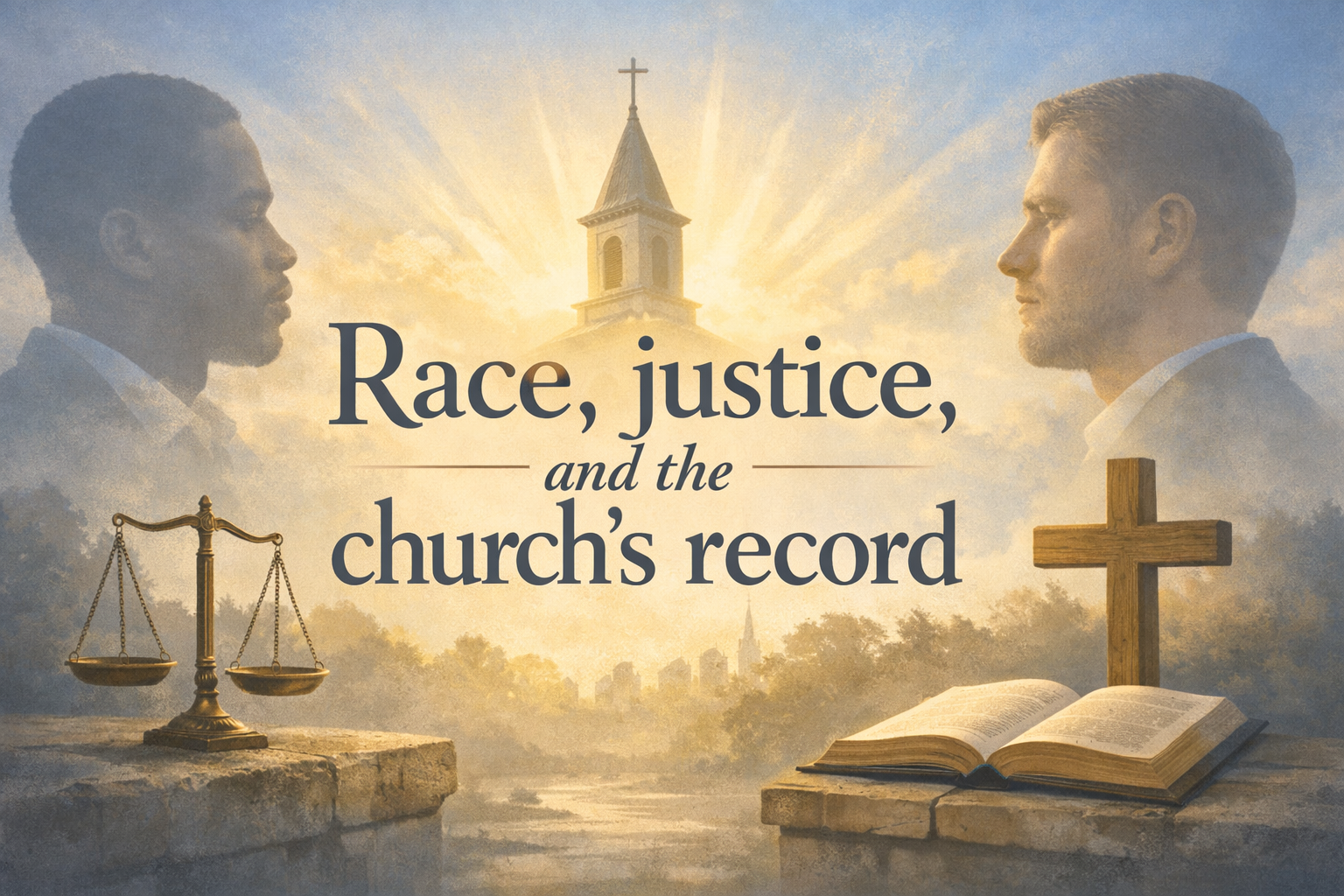
Race, justice, and the church’s record
The church has the most compelling answer in the world to the question of race — every human being made in the image of God, every tribe and tongue gathered before the throne, the dividing wall of hostility torn down by the cross. It has also spent significant portions of its history doing the opposite of that answer. Reckoning honestly with both is not a political act. It is a theological obligation.
Honest History, Biblical Foundations, and the Long Work Ahead
Race is one of those topics where the church tends to split into two unsatisfying camps. One camp treats any engagement with race and justice as a capitulation to secular progressive ideology — critical race theory by another name, a distraction from the real gospel. The other camp treats the church’s racial history as so damning that the only credible response is wholesale adoption of whatever the surrounding culture’s current framework prescribes.
Both camps are wrong. And both camps are avoiding the harder, more honest work that the Scripture and the actual history demand.
The biblical teaching on the image of God, the unity of humanity in Adam, and the multi-ethnic vision of the new creation is not a product of progressive politics. It predates progressive politics by several thousand years. The church’s record of racial sin — slavery, segregation, the weaponizing of Scripture to defend both — is not a talking point borrowed from secular critics. It is documented history that the church itself must own. Engaging both honestly is not political. It is theological faithfulness.
What the Bible Establishes About Race
One Blood, One Origin
The foundational biblical claim about race is that there is, in the deepest sense, only one — the human race. Acts 17:26: “And he made from one man every nation of mankind to live on all the face of the earth.” Every human being on the planet shares a single origin. The biological reality that geneticists have confirmed — that the genetic variation between so-called racial groups is smaller than the variation within them — is the scientific echo of a theological truth Scripture stated first.
Genesis 1:26–27 grounds human dignity in the image of God — not in ethnicity, tribe, language, or social position. Every human being, regardless of origin, bears that image. It is not earned, not graduated, not distributed unequally. It is the given foundation of every human person’s worth. A theology that takes the image of God seriously cannot simultaneously assign lesser dignity to people on the basis of race. The contradiction is not subtle.
The story of Scripture moves deliberately toward ethnic diversity, not away from it. The promise to Abraham was never just for his biological descendants — it was that through him all the families of the earth would be blessed (Genesis 12:3). The law of Moses included provisions for the stranger and the foreigner (Leviticus 19:33–34). The prophets repeatedly pictured the nations streaming to Zion. Ruth the Moabite, Rahab the Canaanite, the Ethiopian eunuch of Acts 8 — the biblical narrative keeps expanding the circle as a theological statement about who the God of Israel actually is.
The Cross Tears Down the Wall
Ephesians 2:11–22 is the New Testament’s most direct statement on ethnic division and what the gospel does to it. Paul describes Jew and Gentile — the fundamental ethnic divide of the ancient world — as having been made one in Christ. The “dividing wall of hostility” has been abolished. Both groups have access to the Father through one Spirit. The new humanity Christ creates is not color-blind in the sense of pretending difference does not exist — it is reconciled across difference, which is a far more profound and costly thing.
Galatians 3:28: “There is neither Jew nor Greek, there is neither slave nor free, there is no male and female, for you are all one in Christ Jesus.” Paul is not erasing ethnicity, class, or gender. He is declaring that none of these categories determines a person’s standing before God or their place within the body of Christ. The unity is real, and it has visible, social, embodied implications. It is not merely a spiritual truth that leaves the social order untouched.
The vision of Revelation 7:9 — the great multitude from every nation, tribe, people, and language, standing before the throne — is not a picture of homogeneity. The ethnic and cultural particularity of every group is present. It is a picture of diversity gathered in unified worship of the Lamb. That is where history is going. The church is supposed to be a foretaste of it now.
The Church’s Actual Record
This is where the post has to be direct, specific, and unflinching — because vague acknowledgment of “past mistakes” is its own form of evasion. The church’s record on race in the American context specifically is not a matter of minor failures at the margins. It is a major, sustained, theologically rationalized betrayal of its own most fundamental convictions.
Slavery and the Weaponizing of Scripture
American chattel slavery was not merely tolerated by large portions of the Christian church. It was actively defended from Scripture — by prominent theologians, in denominational statements, from pulpits across the South. The “curse of Ham” (a profound misreading of Genesis 9:20–27, which says nothing about race and curses Canaan, not Ham’s other descendants) was invoked for centuries to justify African enslavement. Ephesians 6:5 and Colossians 3:22 — instructions to slaves in the context of a first-century household code — were extracted from their context and used as divine sanction for an institution of a brutality and scale those texts never addressed.
The Southern Baptist Convention — the largest Protestant denomination in American history — was founded in 1845 specifically in defense of slaveholding missionaries. That is not an accusation borrowed from critics. It is in their own founding documents. The SBC formally apologized for this in 1995, one hundred and fifty years later.
Wilberforce and the evangelical abolitionists in Britain, the Black church tradition in America, and figures like Frederick Douglass — himself a deeply biblical thinker — all argued that the pro-slavery reading of Scripture was not just morally wrong but exegetically indefensible. They were right. The pro-slavery theologians who claimed biblical warrant for the institution were engaged in motivated reasoning of the worst kind — using the tools of biblical interpretation to defend what economic interest and cultural assumption had already decided.
Segregation and the White Church’s Silence
After Emancipation, the American church did not move toward the unity of Ephesians 2. It moved toward Jim Crow. The white church — with notable and costly exceptions — largely accommodated, rationalized, or actively defended the segregated social order. Churches that would not have tolerated open adultery in their pews tolerated the humiliation of Black members of the body of Christ with barely a murmur.
Martin Luther King Jr.’s Letter from Birmingham Jail, written in April 1963, was addressed not to secular civil rights opponents but to white Christian clergy — moderate pastors who had urged patience, order, and gradualism while Black Americans were being beaten, bombed, and lynched. King’s indictment of the white church’s silence is one of the most devastating documents in American religious history, and it was written from a cell by a man who knew his Bible better than most of his critics.
The Azusa Street Revival — birthplace of modern Pentecostalism, discussed in the church history post — was remarkable partly because it was multiracial in an era of rigid segregation, led by a Black preacher, William Seymour. Within a decade, white Pentecostal leaders had segregated the movement. The same Spirit that fell on all flesh apparently was to be channeled through separate institutions.
This post focuses primarily on the American context because that history is most directly relevant to the MVM audience and because it is the most extensively documented example of the church’s racial failure in the Protestant tradition. The global church’s record — including the role of European Christianity in colonial-era missions — involves its own complexities that deserve separate treatment.
The Ongoing Reality
Sunday morning at 11 o’clock remains, as King observed, one of the most segregated hours in American life. This is not primarily a product of deliberate exclusion anymore — though that still exists in some places. It is the accumulated product of residential segregation, denominational history, worship style differences, and the social networks through which most people find churches. The result is functionally the same: the body of Christ in America largely worships along racial lines, and that segregation is treated as normal.
This matters theologically, not just sociologically. A church that preaches Ephesians 2 on Sunday while being functionally racially homogeneous in a diverse community is proclaiming a unity it is not embodying. That gap between proclamation and practice is not just a missed opportunity. It is a testimony problem.
How to Think About This Without Losing the Gospel
The church’s racial failures are real, serious, and theologically indicting. They also do not require Christians to adopt every framework the surrounding culture offers for analyzing and addressing them. Those frameworks — critical race theory being the most prominent current example — contain genuine insights alongside elements that are in tension with, or outright contrary to, a Christian anthropology. Acknowledging the real history does not require signing on to a particular secular analytical program.
The Christian framework for thinking about race and justice is not borrowed from sociology. It is grounded in Scripture — in the image of God, in the fall that distorts every human institution including the church, in the reconciling work of the cross, in the eschatological vision of every tribe and tongue before the throne. That framework has enough internal resources to produce a serious, sustained engagement with racial injustice without importing a competing worldview to do the work.
The fall accounts for why racial sin is so persistent and so resistant to easy correction. Human beings are not merely individually sinful — sinful patterns become embedded in institutions, laws, social structures, and cultural assumptions that outlast the individuals who built them. The slave codes are gone. The effects of the slave codes — in wealth gaps, in educational opportunity, in neighborhood composition — persist and compound across generations. Acknowledging that compounding is not the same as accepting any particular policy prescription for addressing it. It is simply reading history accurately.
“The gospel does not flatten history. It takes the full weight of what human beings have done to one another seriously — serious enough to require a death to address it. A church that takes the cross seriously cannot take racial sin lightly, because the cross was the price of it along with everything else.”
What Faithfulness Looks Like
Repentance is specific, not generic. Vague acknowledgment that the church has “not always lived up to its ideals” is the ecclesial equivalent of a non-apology apology. Faithfulness on this topic requires specificity — naming what was done, by whom, to whom, and why it was wrong on the church’s own stated terms.
It also requires looking at the present rather than only at the past. The question is not merely whether your church would have opposed slavery in 1850 — a question conveniently impossible to answer. The question is whether your church is actually embodying the unity of Ephesians 2 now. Whether the people in your pews reflect something of the diversity of your community. Whether Black and brown brothers and sisters in your congregation have genuine voice, genuine leadership, and genuine belonging — not just a seat at a table whose shape they had no part in designing.
The church that wants to speak credibly about racial reconciliation has to be willing to do the slow, unglamorous, costly work of actually being reconciled — across genuine difference, at genuine cost, without expecting the people who have been harmed to do all the reaching. That work is harder than a statement, harder than a sermon series, harder than a heritage month acknowledgment. It requires the kind of persistent, ordinary faithfulness that does not generate headlines but does, over time, produce communities that look something like the vision of Revelation 7.
The Black church tradition in America has preserved the gospel through conditions designed to destroy it — through slavery, through Jim Crow, through ongoing indignity — and has produced some of the most vital theological voices in Christian history. The white church has much to receive from that tradition, and little ground on which to condescend to it. Genuine reconciliation in the body of Christ requires that kind of humility — the willingness to learn from, be corrected by, and be genuinely changed by the brothers and sisters the church has historically failed.
None of this is peripheral to the gospel. The unity of the body of Christ across ethnic difference is, according to Paul, a testimony to the principalities and powers that the wisdom of God in the gospel is real (Ephesians 3:10). When the church is racially divided along the same lines as the surrounding culture, it has nothing distinctive to say to that culture about the power of the gospel to reconcile. When it is genuinely, visibly, and costily unified across difference — that is a witness the world cannot easily explain away.
Key Takeaways
- The biblical case against racism is not borrowed from progressive politics — it is older and deeper. The image of God in every human being, the single origin of all humanity, the cross tearing down the dividing wall, and the multi-ethnic vision of the new creation are Scripture’s own framework. Christians do not need a secular analytical lens to condemn racism. Their own theology does it.
- The church’s racial record in America is a major, sustained, theologically rationalized failure — not a minor lapse. Pro-slavery exegesis, the founding of denominations in defense of slaveholding, the white church’s silence during Jim Crow, and the resegregation of the Pentecostal movement are documented history that the church must own specifically, not generically.
- Acknowledging the history does not require adopting a secular analytical framework wholesale. The Christian account of the fall — which embeds sinful patterns in institutions that outlast individuals — is sufficient to take seriously the compounding effects of historic racial sin. Biblical faithfulness on race does not depend on importing competing worldviews.
- The ongoing segregation of Sunday morning is a testimony problem. A church that preaches Ephesians 2 while being functionally racially homogeneous in a diverse community is proclaiming a unity it is not embodying. That gap is not merely sociological. It undermines the church’s witness to the reconciling power of the gospel.
- Repentance must be specific and present-tense, not generic and past-tense. The question is not whether your church would have opposed slavery in 1850. The question is whether it is embodying the unity of Ephesians 2 now — in its composition, its leadership, its genuine belonging, and its willingness to learn from traditions it has historically failed.
- Racial reconciliation in the church is not peripheral to the gospel — it is a testimony to its power. Paul says the unity of Jew and Gentile in one body is a witness to the principalities and powers that the wisdom of God is real. When the church is genuinely unified across difference, it has something to say that the world cannot explain on its own terms.
Key Scriptures: Genesis 1:27 · Acts 17:26 · Ephesians 2:14–16 · Galatians 3:28 · Revelation 7:9 · Leviticus 19:33–34 · Galatians 2:11–14 · Ephesians 3:10