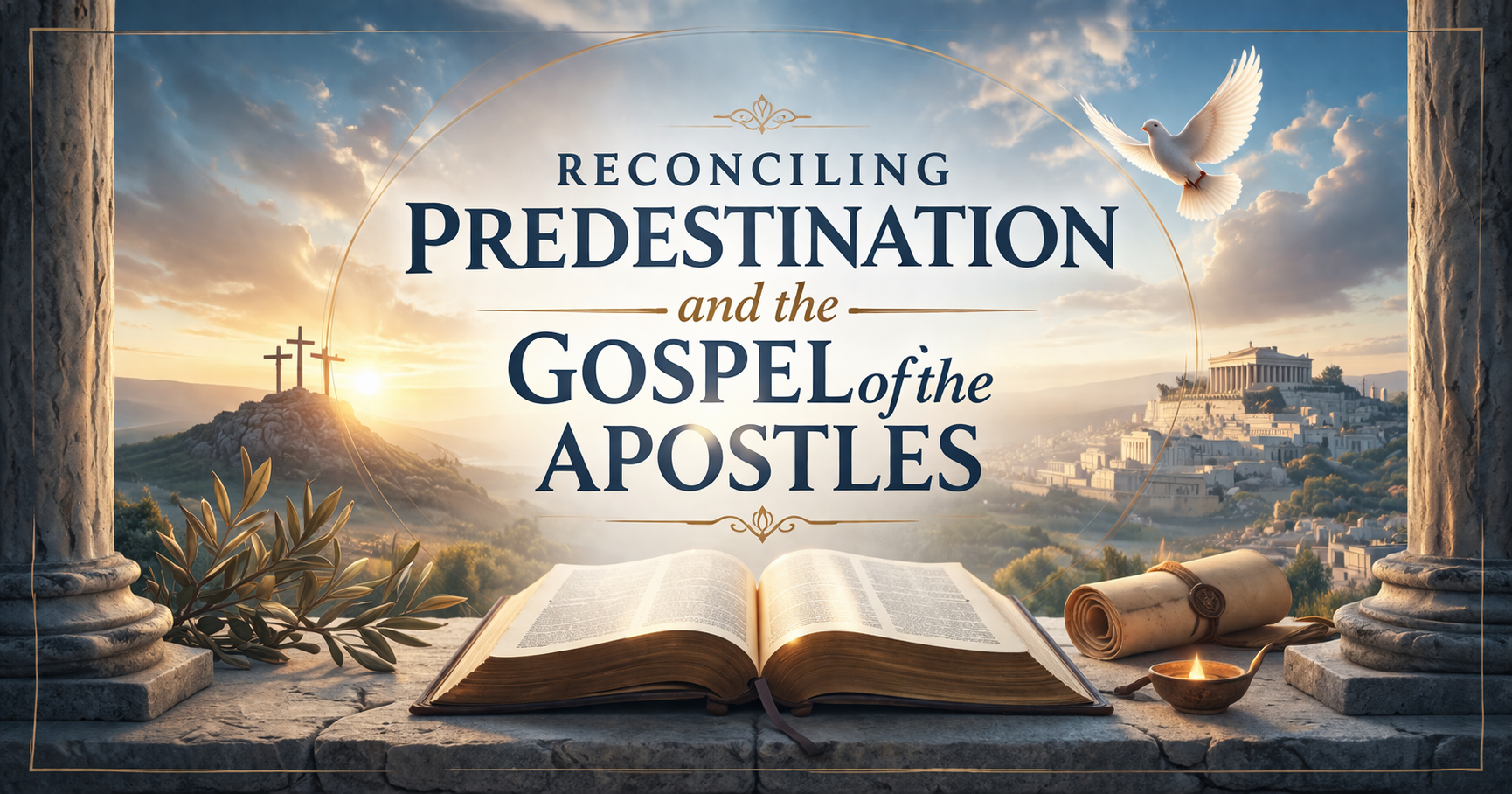
Reconciling Predestination and the Gospel of the Apostles
A Deep Biblical Look at Two Doctrines That Don’t Compete — They Complete Each Other
When Christians dig into the Bible, two powerful themes emerge that seem — at first glance — to be pulling in opposite directions. On one hand, God chose His people for salvation before the foundation of the world (Ephesians 1:4–5). On the other, the apostles preached to crowds, urging everyone to repent and believe (Acts 2:38–39; Romans 10:13).
The question comes naturally: How can salvation be both predestined by God and offered freely to all?
This post walks through Scripture, the voices of church history, and practical application to show that these two doctrines are not enemies — they are close companions in the message the apostles preached.
“So then it depends not on human will or exertion, but on God, who has mercy.” — Romans 9:16
Two Tracks Running Through Scripture
Both doctrines appear side by side throughout the New Testament. The apostles didn’t seem troubled by the tension — they proclaimed both without apology.
🎯 God Sovereignly Elects
Salvation is initiated by God, not man. He chose His people before creation, according to His own purpose and grace — not based on foreseen faith or works.
Romans 8:29–30 · Ephesians 1:4–5 · 2 Timothy 1:9 · Acts 13:48
📣 Humans Are Responsible to Respond
The gospel call goes out to all people everywhere. God commands repentance. The invitation is sincere and universal. Everyone who calls on His name will be saved.
Acts 17:30 · Romans 10:13 · 1 Timothy 2:4 · 2 Corinthians 5:20
The gospel call is universal; the saving response is sovereignly enabled. As John 6:44 makes clear: “No one can come to me unless the Father who sent me draws him.” The preaching is for everyone. The drawing is God’s work.
What Predestination Actually Teaches
Romans 8:29–30
“For those God foreknew he also predestined to be conformed to the image of his Son… those he predestined, he also called; those he called, he also justified; those he justified, he also glorified.”
Ephesians 1:4–5
“He chose us in him before the foundation of the world, to be holy and blameless… he predestined us for adoption to himself as sons through Jesus Christ.”
2 Timothy 1:9
“He saved us and called us to a holy calling… because of his own purpose and grace, which he gave us in Christ Jesus before the ages began.”
In these passages, salvation is initiated entirely by God. It isn’t that people choose God first and He then chooses them in response. His choice comes before — and enables — ours.
What the Apostles Actually Preached
If the apostles believed in sovereign election, did they preach as though it mattered whether anyone responded? Absolutely — and their lives showed it.
- Acts 5:41–42 — They left the Sanhedrin rejoicing in suffering, and every day in the temple and house to house they “did not cease teaching and preaching that the Christ is Jesus.”
- Acts 3:19 — Peter pleads: “Repent therefore, and turn back, that your sins may be blotted out.”
- 2 Corinthians 5:20 — Paul says, “We implore you on behalf of Christ, be reconciled to God.”
- Romans 10:14 — Paul asks urgently: “How are they to believe in him of whom they have never heard? And how are they to hear without someone preaching?”
These were not men passively waiting for the elect to show up. They preached hard, traveled far, suffered much — because they understood that God ordains both the end (salvation) and the means (preaching).
Four Voices from Church History
Augustine (354–430)
“God does not choose us because we believe, but so that we may believe.”
Predestination protects the truth that salvation is entirely of God — our faith itself is a gift, not a contribution.
John Calvin (1509–1564)
“Since we do not know who belongs to the number of the elect… it is fitting for us to wish that all be saved.”
Calvin taught that the Spirit draws the elect through gospel preaching — which is precisely why we must preach.
Charles Spurgeon (1834–1892)
“Since He didn’t paint a yellow stripe up the backs of the elect, I must preach ‘whosoever will’ — and when ‘whosoever’ believes, I know he is one of the elect.”
Spurgeon held election firmly while preaching to multitudes with urgent, open invitation.
J.I. Packer (1926–2020)
“God’s sovereignty and man’s responsibility are taught side by side in Scripture… we must believe both.”
In Evangelism and the Sovereignty of God, Packer called this a biblical “antinomy” — both truths necessary, neither canceling the other.
The Railroad Track Illustration
Two Tracks, One Destination
Predestination and the free offer of the gospel are like two railroad tracks. They run parallel through all of Scripture — never meeting on this side of eternity, never merging into a single philosophical explanation. Both are real. Both are load-bearing.
Trying to collapse one track into the other produces a derailment. The biblical response is to keep both tracks laid and trust the One who built the railroad.
🪓 The Logging Crew
A seasoned logging crew heads into the forest. The foreman already knows which trees will be cut and hauled — but he still sends his workers in with clear instructions: “Go cut every tree that responds to your pull.”
They work hard, not knowing which trees are marked. Some fall easily; others resist. But every tree that comes down is one the foreman had already tagged. The loggers rejoice in the harvest — not because of their own strength, but because they were part of a plan bigger than themselves.
God ordains both the end and the means. The means is the preaching of the gospel.
Four Reasons This Matters for Daily Life
Evangelize Boldly
Knowing God has chosen people gives us confidence to preach without paralysis. We aren’t responsible for results — just for faithfulness of witness.
“I endure everything for the sake of the elect, that they also may obtain the salvation that is in Christ Jesus.” — 2 Timothy 2:10
Pray Expectantly
Since God alone changes hearts, prayer is not supplemental — it’s essential. This doctrine fuels desperate, hopeful intercession for the lost.
“No one can come to me unless the Father who sent me draws him.” — John 6:44
Worship Gratefully
If you’re saved, it wasn’t because you were smarter, more spiritually open, or more deserving. It was God’s mercy. That humbles the proud and gives all glory to God.
“By grace you have been saved through faith… not of yourselves; it is the gift of God.” — Ephesians 2:8
Avoid Pride and Despair
Predestination is not a cause for smug certainty (“I must be special”) or crippling anxiety (“Maybe I’m not chosen”). The gospel call is sincere: if you come to Christ, you are welcome. If you believe in Jesus, you’re among the elect.
“Whoever comes to me I will never cast out.” — John 6:37
Common Objections
❓ “Doesn’t predestination make God unfair?”
Paul addresses this directly in Romans 9 — and his answer is decisive: God is not unjust to show mercy as He chooses. Mercy, by definition, is undeserved. The remarkable thing is not that He passes over some, but that He saves any.
❓ “Doesn’t this kill the motivation to evangelize?”
History says no. The Reformation, the Puritans, the Great Awakening, and the modern missionary movement were all fueled by deep belief in God’s sovereignty in salvation. William Carey went to India holding firmly to election — and labored there for decades, knowing God had people in that nation to be gathered.
❓ “What if I’m not chosen?”
If you desire Christ — if something in you is drawn toward Him — that is itself evidence that the Father is drawing you. No one comes to Jesus without that pull. Come. He will not turn you away.
The reconciliation between predestination and the gospel of the apostles is not about solving a philosophical puzzle. It’s about trusting a Person — our sovereign and loving God who both chooses and calls.
God chooses, and we proclaim. God saves, and we share. God draws, and we declare.
Like Lydia in Acts 16:14 — “The Lord opened her heart to pay attention to what was said by Paul.” God opened. Paul spoke. Both mattered. Keep preaching. Keep praying. Keep praising. The sovereign God who chooses His people uses your voice to call them home.
“How are they to believe in him of whom they have never heard? And how are they to hear without someone preaching?” — Romans 10:14
Key Scriptures: Romans 8:29–30; 9:16; 10:13–14 · Ephesians 1:4–5; 2:8–9 · 2 Timothy 1:9; 2:10 · Acts 2:38; 13:48; 17:30; 18:10 · John 6:37, 44 · 1 Timothy 2:4 · 2 Corinthians 5:20 · Acts 16:14
Want to Go Deeper?
This post is part of an ongoing series on predestination, sovereignty, and the gospel. Read the companion posts to get the full picture:
- Tim Keller on Predestination — How one of the most influential Reformed pastors of our era taught this doctrine with pastoral care.
- Double Predestination: The Reformed View — A careful treatment of election and reprobation from the Calvinist tradition.
- Why Arminians Reject Double Predestination — The alternative perspective on grace, freedom, and who can be saved.
- Subscribe to get new posts delivered straight to your inbox — gospel-rooted, plain-spoken truth for the week ahead.
“Whoever comes to me I will never cast out.” — John 6:37