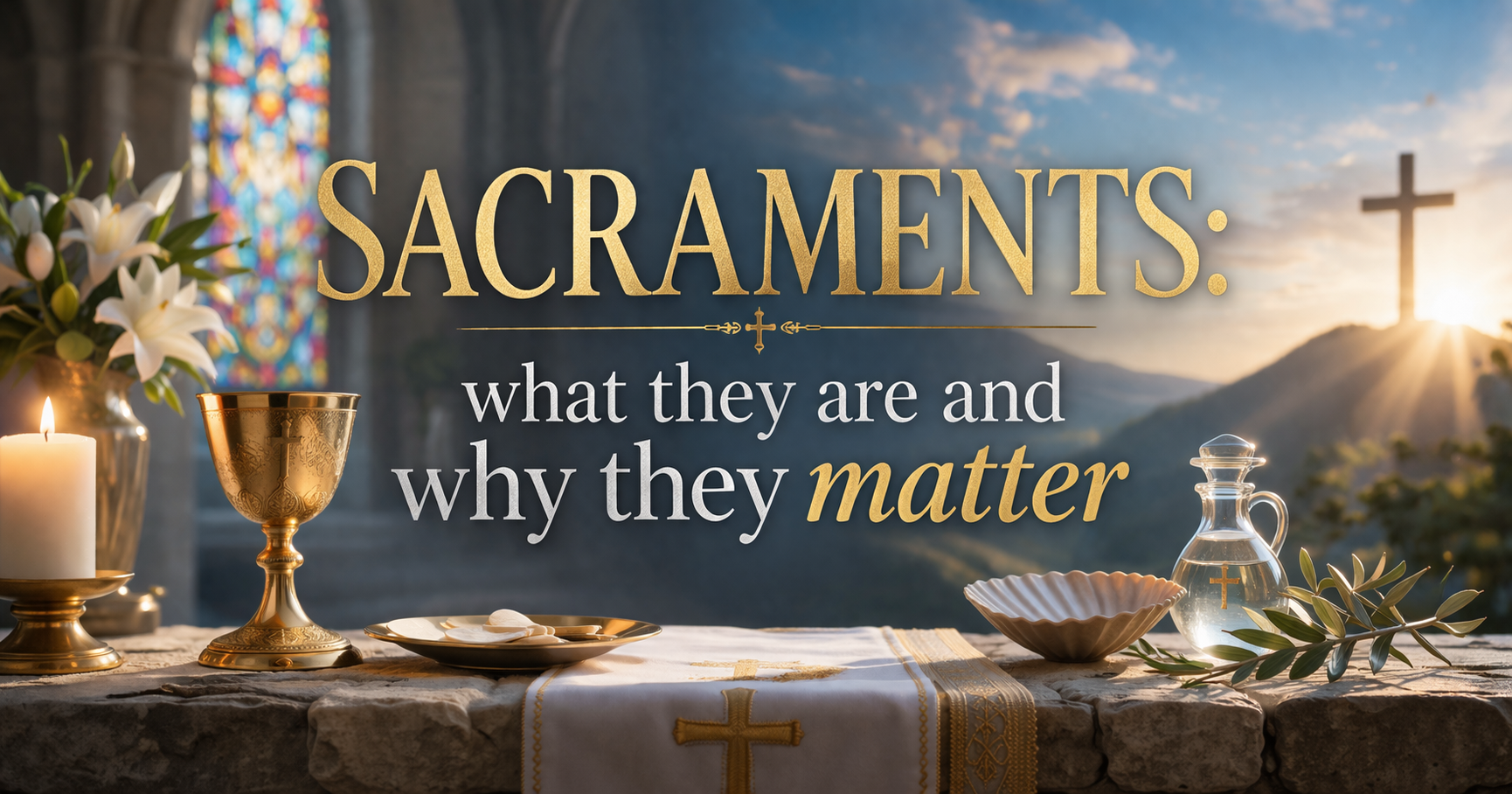
Sacraments: what they are and why they matter
Christianity is not a purely spiritual religion. It uses water, bread, and wine — physical stuff — as means of grace. That is not an accident or a holdover from primitive religion. It is a deliberate choice by a God who took on flesh, and it tells you something essential about how he works. Understanding the sacraments is not a detour from the gospel. It is a way deeper into it.
Water, Bread, Wine — and the God Who Works Through Physical Things
There is a persistent temptation in Christian spirituality to treat the physical world as an obstacle to God rather than a vehicle for him. Real faith, this thinking goes, is internal, invisible, purely spiritual — the external stuff is just ceremony, ritual, the training wheels you eventually leave behind. Get past the forms and find the pure inner experience.
The sacraments push back hard against that instinct. Not because ceremony is what matters, but because God has repeatedly chosen to work through the physical — burning bushes, pillars of fire, a bronze serpent on a pole, a river called the Jordan, and ultimately a body of flesh and blood that bled and died and rose again. The Incarnation is the definitive statement that God is not embarrassed by matter. He made it. He entered it. He uses it.
The sacraments are the places where that pattern continues in the life of the church. Understanding what they are, what they do, and where Christians disagree about them is worth the time — because you cannot understand Christian worship, Christian unity, or Christian history without them.
What Is a Sacrament?
The word sacrament comes from the Latin sacramentum — a term the early church borrowed partly from the Roman military oath of allegiance. Tertullian was among the first to apply it to Christian rites. The Greek word used in the New Testament is mysterion — mystery — which points toward something visible that carries an invisible reality within it.
The classic Protestant definition, drawn from Augustine and refined by the Reformers, is: a sacrament is an outward and visible sign of an inward and invisible grace, instituted by Christ. That three-part definition contains the key criteria. First, it must be outward and visible — a physical action with physical elements. Second, it must signify and seal an inward spiritual reality — it is not mere ceremony, but a sign that points to and participates in something real. Third, it must be instituted by Christ — commanded by Jesus himself, not invented by the church.
That third criterion is where Catholic and Protestant traditions diverge most sharply. The Catholic Church recognizes seven sacraments: Baptism, Confirmation, Eucharist, Penance, Anointing of the Sick, Holy Orders, and Matrimony. Most Protestant traditions recognize two — Baptism and the Lord’s Supper — arguing that only these two were explicitly commanded by Jesus with a specific physical element and a promise attached. The other five have biblical roots but lack the direct dominical institution (explicit command from Christ) that makes a sacrament a sacrament in the stricter sense.
This post focuses on the two sacraments recognized across all major Protestant traditions, with attention to where the broader Christian family agrees and where it does not.
Baptism
What the Bible Says
Baptism is commanded by Jesus in the Great Commission: “Go therefore and make disciples of all nations, baptizing them in the name of the Father and of the Son and of the Holy Spirit” (Matthew 28:19). It is the rite of entry into the Christian community — the New Covenant counterpart to circumcision in the Old, the sign and seal of belonging to the people of God.
The New Testament connects baptism to several realities simultaneously. Peter at Pentecost links it to repentance and the forgiveness of sins (Acts 2:38). Paul describes it as union with Christ in his death and resurrection — being buried with him and raised to walk in newness of life (Romans 6:3–5). He calls it a washing and renewal by the Holy Spirit (Titus 3:5). He connects it to the New Covenant sign of circumcision, the cutting away of the flesh (Colossians 2:11–12). Peter connects it to Noah’s ark — the water through which God brought his people to safety (1 Peter 3:20–21).
That is a lot of freight for one sign to carry. The Reformed tradition has always insisted that the sign and the thing signified must be distinguished — baptism points to and seals the spiritual realities; it does not automatically produce them. A person can be baptized without being regenerated. But the sign is not therefore empty. It is a real pledge of what God offers in the gospel, and it is the means by which the church publicly marks a person as belonging to Christ.
The Disagreement That Has Not Gone Away
The most persistent debate in Protestant theology around baptism is not what it means but who should receive it. Should infants of believing parents be baptized, or should baptism be reserved for those who can personally profess faith?
The case for infant baptism (paedobaptism) runs like this: in the Old Covenant, the sign of belonging to the covenant community was given to infants — male children were circumcised on the eighth day, before they could believe or understand anything. If baptism is the New Covenant counterpart to circumcision (as Colossians 2:11–12 suggests), then it belongs to covenant households, not just professing individuals. The household baptisms in Acts — Cornelius’s household, Lydia’s household, the Philippian jailer’s household (Acts 16:15, 33) — likely included children. Jesus’ welcome of children and his declaration that the kingdom belongs to such as these (Mark 10:13–16) strengthens the case.
The case for believer’s baptism (credobaptism) runs like this: the New Covenant is explicitly a covenant of regenerate members — Jeremiah 31:34 says all shall know the Lord, from the least to the greatest. Every clear baptism account in the New Testament follows a pattern of hearing the gospel, believing, and then being baptized. Baptism is the public declaration of personal faith, and administering it to those incapable of faith confuses the sign with the thing signified. The household baptisms are not proof that infants were included — they prove only that households were baptized.
Both sides have serious biblical exegetes. Both positions have been held by faithful, gospel-committed Christians for centuries. This is a genuine second-tier disagreement — significant enough to distinguish denominations, not significant enough to unchurch individuals.
“The debate over baptism is not a debate about whether grace is real. Both sides believe grace is real. It is a debate about how God has structured his covenant community and who the sign belongs to. That is worth arguing about carefully — and it is worth keeping in its proper place.”
The Mode Question
A separate but related debate concerns the mode of baptism — immersion, pouring (affusion), or sprinkling (aspersion). Baptists and most evangelical churches insist on immersion, arguing that the Greek word baptizō means to immerse, that the symbolism of death and resurrection (Romans 6:3–5) requires it, and that the river settings of New Testament baptisms support it. Reformed and Presbyterian churches generally hold that the mode is not specified and that sprinkling or pouring is sufficient, pointing to Old Testament patterns of sprinkling as cleansing and the practical realities of early church practice.
This is a genuine disagreement. It is also, in the range of things Christians argue about, closer to the third tier than the second. The death and resurrection of Christ that baptism signifies is what matters. The water is real. What the water does to you physically is secondary to what it says about what Christ has done for you spiritually.
The Lord’s Supper
What the Bible Says
On the night he was betrayed, Jesus took bread, gave thanks, broke it, and gave it to his disciples saying: “This is my body, which is given for you. Do this in remembrance of me.” In the same way he took the cup after supper, saying: “This cup that is poured out for you is the new covenant in my blood” (Luke 22:19–20). Paul’s account in 1 Corinthians 11:23–26 is the earliest written version — earlier than the Gospels — and adds: “For as often as you eat this bread and drink the cup, you proclaim the Lord’s death until he comes.”
The Lord’s Supper is a meal of proclamation, remembrance, participation, and anticipation. It proclaims the Lord’s death. It remembers what he did. It anticipates his return. And Paul’s language in 1 Corinthians 10:16 goes further: “The cup of blessing that we bless, is it not a participation in the blood of Christ? The bread that we break, is it not a participation in the body of Christ?” The word translated “participation” is koinōnia — fellowship, communion, sharing in. The Supper is not merely a mental exercise in remembering a past event. It is a real sharing in the benefits of Christ’s death.
Four Positions on the Table
No question in Protestant theology has generated more heat than the nature of Christ’s presence in the Lord’s Supper. The Reformation produced at least four distinct positions, all of which persist in different streams today.
The bread and wine become, in their substance, the actual body and blood of Christ — while the outward appearances (accidents) of bread and wine remain. This is not metaphor. At the words of consecration by the priest, a real ontological change occurs. The Mass is also understood as a re-presentation of the sacrifice of Calvary, not merely a commemoration of it. Catholic theology regards the Eucharist as the source and summit of Christian life.
Christ’s body and blood are truly and physically present in, with, and under the bread and wine — but the bread and wine are not transformed into something else. Luther refused to abandon the plain language of “This is my body” and insisted that Christ’s glorified body, which is not bound by spatial limitations, is genuinely present wherever the Supper is celebrated. He called this sacramental union. The Supper is a real means of grace — Christ himself is received, not just remembered.
Christ is truly and really present in the Lord’s Supper — but spiritually, not physically. His glorified body is at the right hand of the Father; it is not locally present in bread and wine on a thousand tables simultaneously. But by the Holy Spirit, the believer genuinely receives Christ in the Supper — feeds on him by faith, is nourished by his body and blood spiritually. Calvin insisted this was a real presence and a real feeding, not mere symbolism. The Supper is a genuine means of grace for those who receive it in faith.
The Lord’s Supper is primarily a commemoration — a vivid, enacted remembrance of Christ’s death. The bread and wine signify his body and blood; they do not convey his presence in any special sense. The spiritual benefit comes from the faith exercised by the believer, not from any grace attached to the elements themselves. This is the dominant view in Baptist and much of broader evangelical practice, though it is often held without awareness of its Zwinglian origins.
These are not small differences. Luther and Zwingli met at Marburg in 1529 specifically to resolve the dispute and failed — famously, Luther wrote “This is my body” on the table in chalk and refused to move from it. Calvin spent years trying to find a middle position between Luther and Zwingli and produced the spiritual presence view as a genuine third way, not a compromise.
Where this post stands: the Reformed position — genuine spiritual presence, real feeding on Christ by faith, the Supper as a true means of grace — is the most exegetically defensible reading of the relevant texts. It takes Paul’s koinōnia language seriously without requiring a physical presence that strains both philosophy and the biblical account of Christ’s glorified body. It avoids both the overreach of transubstantiation and the underreach of bare memorialism.
That said, Christians who hold the memorial view are not outside the faith. They are celebrating the same Supper, in obedience to the same command, in memory of the same Lord. The disagreement is real and worth engaging. It is not a gospel-dividing issue.
What the Sacraments Do Together
Taken together, Baptism and the Lord’s Supper form the bookends of Christian life in community. Baptism marks the entry — once, unrepeated, the seal of belonging to Christ. The Lord’s Supper marks the ongoing journey — repeated, regular, the nourishment that sustains the community on the road.
Both are word-made-visible. Augustine called the sacraments “visible words” — the gospel enacted in physical form. Baptism enacts the gospel of dying and rising with Christ, of washing and renewal, of being marked as belonging to God. The Supper enacts the gospel of the body broken and blood poured out, of covenant sealed in death, of the community gathered at the Lord’s table in anticipation of the marriage supper of the Lamb (Revelation 19:9).
Both are community acts. Baptism is administered by the church, not self-administered — you cannot baptize yourself, because the point is being received into the body. The Supper is eaten together — Paul’s rebuke in 1 Corinthians 11:17–22 is precisely that the Corinthians have turned the communal meal into a private act, each eating their own food, leaving the poor humiliated. The sacraments are inherently ecclesial — they belong to the gathered community, not to isolated individuals.
Both also require honest self-examination. 1 Corinthians 11:27–29 is solemn: eating the bread and drinking the cup “in an unworthy manner” brings judgment, not blessing. This is not a call to perfectionism before approaching the Table — it is a call to self-examination, to coming in faith and repentance rather than casual indifference. The Supper is for sinners who know they are sinners and are trusting Christ. It is not for those who are treating it as an empty ritual or — Paul’s specific concern — eating it while despising their brothers and sisters in the body.
“The sacraments are not magic, and they are not mere symbols. They are the gospel made visible and touchable — enacted promises from a God who knows that human beings are not disembodied spirits but creatures of flesh and blood who need to see, taste, and touch the grace they are receiving.”
Why They Matter for Ordinary Christian Life
The sacraments can feel like theological territory — interesting for pastors and seminarians, optional for everyone else. That impression is wrong, and it has practical consequences.
If you have been baptized, you carry a mark. Not a physical one — a covenantal one. Your baptism is God’s claim on you, sealed in water, in the name of the Father, Son, and Holy Spirit. When doubt attacks and you wonder whether you belong to God, the Reformers’ counsel was: remember your baptism. Not as a substitute for faith, but as its anchor. God made a promise over you. That promise does not fluctuate with your feelings.
If you come to the Lord’s Table regularly, you are being formed. The repeated act of coming with empty hands, receiving bread and cup, proclaiming the Lord’s death — this shapes you over time in ways you may not fully perceive in the moment. The Table preaches the gospel to you in a register that bypasses the purely intellectual. You taste it. You hold it. You swallow it. The gospel enters you physically, which is exactly the kind of embodied creature you are.
And if your church treats the Table as an afterthought — a quarterly addition to the main event of worship — there is something worth reconsidering there. The early church gathered every week around the Table. The ancient liturgies built everything else around the Supper. The frequency and centrality with which a congregation celebrates the Lord’s Supper says something about what it believes the Supper actually is. If it is merely a memorial, once a quarter may be enough. If it is a genuine means of grace — a real feeding on Christ — then every week makes sense. Starve yourself and see what happens.
Key Takeaways
- A sacrament is an outward sign of an inward grace, instituted by Christ. It must be physical, it must signify a spiritual reality, and it must be commanded by Jesus himself. Those three criteria distinguish sacraments from other meaningful practices in the church’s life.
- Most Protestant traditions recognize two sacraments — Baptism and the Lord’s Supper. Both were explicitly commanded by Christ with a physical element and a promise. The other five Catholic sacraments have biblical roots but lack the direct dominical institution that defines a sacrament in the stricter Protestant sense.
- The baptism debate is real and second-tier. Paedobaptists and credobaptists both have serious exegetical cases, both believe in the same gospel, and both have faithful Christians across centuries. The disagreement is about covenant structure, not about whether grace is real or whether Christ saves.
- Christ’s presence in the Supper is the deepest and most consequential sacramental debate. Transubstantiation, Lutheran real presence, Reformed spiritual presence, and Zwinglian memorialism are four genuinely different answers. The Reformed spiritual presence view — real feeding on Christ by faith through the Spirit — takes the biblical language seriously without requiring what the other views require.
- The sacraments are community acts, not private ones. Baptism receives you into the body; the Supper feeds you as part of the body. Both are administered in the gathered church, and both lose something essential when they are privatized or treated as individual spiritual experiences detached from community.
- Baptism is a covenantal anchor and the Supper is ongoing nourishment. In seasons of doubt, remember your baptism — God made a public promise. In seasons of spiritual drought, come to the Table — the gospel is there for you to taste and touch, not just to think about. The sacraments are for embodied creatures who need embodied grace.
Key Scriptures: Matthew 28:19 · Romans 6:3–4 · Colossians 2:11–12 · Luke 22:19–20 · 1 Corinthians 10:16 · 1 Corinthians 11:23–26 · 1 Corinthians 11:28–29 · Revelation 19:9