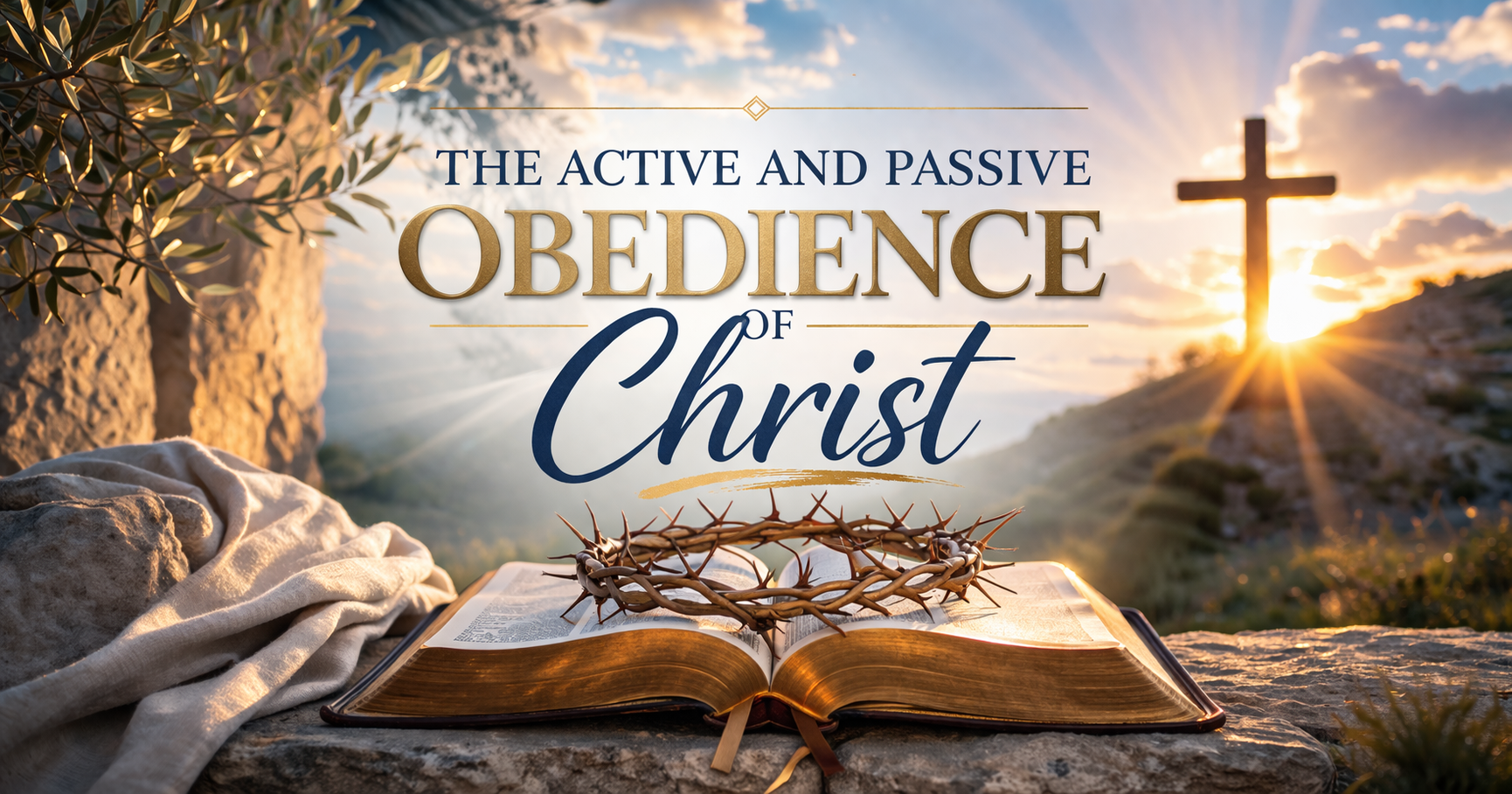
The active and passive obedience of Christ
Most Christians understand that Jesus died for their sins. Fewer have grasped that Jesus also lived for their righteousness. The cross deals with the penalty of what we have done. But there is a second problem the cross alone does not address: the absence of what we should have done. God does not merely require that sin be punished. He requires perfect obedience. And if justification means being declared righteous — not merely pardoned — then the righteousness that covers the believer has to come from somewhere. It comes from the life Jesus lived, not just the death he died. That is what the doctrine of Christ’s active obedience is about. And until you understand it, you only have half the gospel.
Ask most Christians what Jesus accomplished for them and they will say something like: “He died for my sins.” That answer is true. It is also incomplete. Because the question the cross answers — how does the penalty of sin get dealt with? — is not the only question a holy God is asking. The other question is this: where is the righteousness?
God is not only a Judge who must punish wrongdoing. He is also the one who created human beings for a purpose — to bear his image, to love him with their whole heart, to obey him perfectly in everything. That positive obligation did not disappear when humanity fell. It remained. And a salvation that only deals with the negative — wiping out the debt of sin — without addressing the positive — providing the righteousness the law requires — leaves the sinner pardoned but not righteous. Acquitted but not approved. Free from condemnation but not clothed in the standing God’s law demands.
The distinction between Christ’s active and passive obedience is the church’s way of saying that Jesus addressed both problems. His passive obedience — his suffering and death — dealt with the penalty. His active obedience — his life of perfect conformity to God’s law — provided the righteousness. Both are credited to the believer through union with Christ. Both are necessary for a complete gospel.
Defining the Terms
The terms “active” and “passive” can be slightly misleading, so a brief clarification is worth the effort before going further.
Passive obedience does not mean Jesus was passive in his death — he was not merely a victim. It refers to his passion — the Latin passio, meaning suffering. Passive obedience is the obedience Jesus rendered in his suffering and death: bearing the curse, enduring the wrath, absorbing the penalty that human sin deserved. It is “passive” in the sense that he received what was done to him — the punishment — as the representative substitute for sinners.
Active obedience refers to the positive, active fulfillment of the law throughout his entire earthly life. Every commandment kept. Every demand of God’s law met. Every temptation resisted. Every moment of love toward God and neighbor lived out perfectly. This was not passive reception — it was active doing, over thirty-three years of genuine human life lived under the full weight of God’s moral demands.
The distinction is not absolute — the two overlap and interpenetrate throughout Jesus’s life and death. His dying was itself an act of obedience (Philippians 2:8: “he humbled himself by becoming obedient to the point of death, even death on a cross”). His active obedience was itself a form of suffering. But the distinction is real and theologically crucial: the passive obedience removes the negative (penalty); the active obedience provides the positive (righteousness).
The Problem That Requires Both
To understand why both are necessary, you have to understand the full scope of what a holy God requires from human beings.
God’s law, given in the covenant with Adam and renewed through Moses, has two dimensions. First, it prohibits wrongdoing — transgression brings death and condemnation. Second, it requires righteous doing — the positive obligation to love God and neighbor perfectly. These are not the same requirement. Avoiding murder is not the same as loving your neighbor. Not stealing is not the same as generous giving. Refraining from adultery is not the same as covenant faithfulness. The law requires both the cessation of evil and the practice of righteousness.
Human beings, in the fall, failed on both counts. They transgressed what God prohibited. And they failed to render the positive obedience God required. Both failures need addressing in salvation.
Passive obedience addresses the first: the penalty for transgression is borne by Christ, and the believer is freed from condemnation. But the second problem — the deficit of positive righteousness — remains. A pardoned prisoner walks out of the courthouse as a free person, but they do not walk out clothed in the judge’s commendation. They are free from penalty, but they have no positive standing. That positive standing — the righteous record that God’s law requires — must come from somewhere. In the gospel, it comes from the active obedience of Christ, credited to the believer through faith.
This is the point of the great exchange articulated in 2 Corinthians 5:21: “For our sake he made him to be sin who knew no sin, so that in him we might become the righteousness of God.” The exchange has two sides. Our sin goes to Christ’s account — passive obedience handles that. The righteousness of God — the positive, active, perfect righteousness that Christ accumulated in his life of perfect law-keeping — comes to our account. Both sides of the ledger are addressed. Both sides of the exchange are necessary.
The Biblical Foundation
Several passages provide the exegetical ground for this distinction.
Romans 5:12–19 — the Second Adam. Paul’s Adam-Christ parallel is the most important text for the active obedience. Just as Adam’s one act of disobedience brought condemnation on all who are in him, Christ’s one act of righteousness brought justification to all who are in him. But Paul does not limit Christ’s contribution to a single act — he develops the parallel in terms of the “obedience of the one man” through whom “the many will be made righteous” (Romans 5:19). The obedience is comprehensive. It corresponds to Adam’s disobedience — which was not merely the single act of eating, but the entire disposition of turning from God. Christ’s obedience reverses that at every point.
Philippians 3:9 — an alien righteousness. Paul says his aim is to be found in Christ, “not having a righteousness of my own that comes from the law, but that which comes through faith in Christ, the righteousness from God that depends on faith.” The righteousness Paul is describing is explicitly not his own — it is an alien righteousness, from outside himself, received through faith. It is the righteousness that God credits to the one who believes. For that righteousness to be real and credited, it must have been produced somewhere. It was produced in the life of Christ — actively, obediently, perfectly.
Galatians 4:4–5 — born under the law to redeem those under the law. Paul says God sent his Son “born of woman, born under the law, to redeem those who were under the law.” Why was the Son born under the law? Not merely to die under it. He was born under it to fulfill it — to render, from within the human condition, the perfect obedience that the law required and that human beings had failed to provide. His being born under the law is not an incidental detail. It is the mechanism by which his active obedience becomes relevant to human beings who are also under the law.
Matthew 3:15 — fulfilling all righteousness. When Jesus is baptized and John objects, Jesus replies: “Let it be so now, for thus it is fitting for us to fulfill all righteousness.” Jesus did not need baptism for repentance — he had no sin. He underwent it because it was fitting to fulfill all righteousness. From the beginning of his public ministry, Jesus frames his earthly life as the project of fulfilling — completing, rendering in full — every righteousness that God’s law requires.
Hebrews 10:5–10 — doing the will of God. The writer of Hebrews quotes Psalm 40 as spoken by Christ: “In burnt offerings and sin offerings you have taken no pleasure. Then I said, ‘Behold, I have come to do your will, O God.'” The contrast is between the sacrificial system — which could not ultimately take away sins — and the will of God, which Christ came to do. The doing of God’s will is set alongside the offering of his body. Both are aspects of his obedience. Both contribute to the sanctification of those who are sanctified by that will.
The Second Adam Framework
The most illuminating framework for understanding active and passive obedience is the Adam-Christ typology that Paul develops in Romans 5 and 1 Corinthians 15.
Adam was placed in the garden as the covenant head of humanity, under obligation to obey God. His obedience would have secured life — for himself and for those who were in him. His disobedience brought death and condemnation — for himself and for those who were in him. He did not merely transgress a single rule. He failed the entire test of covenant faithfulness.
Christ came as the second Adam — the new covenant head of a new humanity — to do what the first Adam failed to do and to undo what the first Adam did. He undid what Adam did through his passive obedience: bearing the condemnation that Adam’s failure had earned. He did what Adam failed to do through his active obedience: rendering the perfect covenant faithfulness that Adam owed and forfeited.
This is why the temptation narratives in the Gospels are not incidental. Jesus is tested in the wilderness — as Adam was tested in the garden — and where Adam failed, Jesus held. He was “tempted in every respect as we are, yet without sin” (Hebrews 4:15). Every temptation resisted was an instance of active obedience. Every commandment kept, every act of love, every moment of submission to the Father in the face of pressure to do otherwise — all of it was the positive accumulation of the righteousness that the second Adam was rendering on behalf of those who are in him.
The result is what Paul describes: through the obedience of the one man, the many will be made righteous (Romans 5:19). Not declared “not guilty” only — declared righteous. That is more than acquittal. It is the positive crediting of an alien righteousness that was actually earned, by actually keeping the law, in an actual human life.
A Disputed Point — and Why It Matters
Not all Reformed theologians have affirmed the active obedience in the same terms, and a minority within the broader Reformed tradition has questioned whether the imputation of Christ’s active obedience is explicitly taught in Scripture or is a theological inference from it. The debate is real. It is also, in the judgment of the mainstream Reformed tradition, settled: the active obedience is required by the logic of imputation, by the Second Adam framework of Romans 5, and by the alien righteousness of Philippians 3:9.
The practical stakes of denying it are significant. If only the passive obedience is imputed — if Christ’s death removes the penalty but his life does not provide the righteousness — then the believer is left pardoned but not positively righteous before God. The standard has been cleared, but it has not been met. That leaves a gap in the account of justification that is difficult to close without either (a) returning to some form of works-contribution by the believer, or (b) leaving the question of positive righteousness unanswered. Neither is satisfactory. The imputation of the active obedience fills the gap that the passive obedience alone cannot fill.
What This Means for Assurance
The doctrine of active obedience is one of the most powerful grounds of Christian assurance — and one of the most neglected.
Consider what it means. The righteousness with which you stand before God is not your best day. It is not your accumulated moral effort. It is not even your genuine sanctification, as real and important as that is. It is the righteousness of the Son of God — thirty-three years of perfect love, perfect obedience, perfect conformity to every demand of God’s law, under real temptation, in real human flesh, rendered without a single failure. That is what is credited to your account the moment you are united to Christ by faith.
When the accuser comes — and Revelation 12:10 tells us he does — he has nothing to work with on the justification question. Not because you have been good enough, but because the one whose righteousness stands for you has been infinitely good enough, in your place, on your behalf. The record is not blank — it is full. Full of the righteousness of Christ, active and passive, doing and dying, lived and credited.
“For as by the one man’s disobedience the many were made sinners, so by the one man’s obedience the many will be made righteous.” — Romans 5:19
Made righteous — not merely pardoned. The active obedience of Christ is the difference between those two phrases. And that difference is the difference between a gospel that removes condemnation and a gospel that bestows a standing you could never have earned and can never lose.
The Pastoral Word
If you are a Christian who lives under the weight of your own failures — who measures your standing before God by your recent moral performance, who goes to prayer with more anxiety than confidence, who is not sure how to face God on a bad day — the doctrine of active obedience is addressed to you.
Your standing before God is not determined by yesterday. It is determined by what Christ did in thirty-three years of perfect faithfulness that he did not need for himself and rendered entirely for you. On the day you sinned most badly, the righteousness credited to your account did not diminish. On the day you felt most distant from God, the alien righteousness covering you was as complete as it was on the day you first believed. It does not fluctuate. It does not erode. It cannot be improved by your best days or damaged by your worst.
That is not license for careless living — the person who hears that and reaches for the throttle has not understood grace. The person who hears it and is moved to gratitude and worship is responding rightly. The right response to learning that Jesus lived perfectly for you is not to stop trying to live well. It is to try well for different reasons — from security rather than anxiety, from love rather than fear, from the overflow of received grace rather than the exhausted effort to produce your own righteousness.
“Therefore, as one trespass led to condemnation for all men, so one act of righteousness leads to justification and life for all men.” — Romans 5:18
One act of righteousness. Paul is speaking there of the cross — but the act of righteousness that culminated there was the whole life that preceded it. The cross was the final act of a life that was, from Bethlehem to Golgotha, the active obedience of the Son of God rendered for you. Every moment of that life is credited to your account. Every commandment he kept on your behalf stands for you before the Father. That is the gospel — not half of it, but all of it.
Key Takeaways
- Passive obedience addresses the penalty of sin; active obedience provides the righteousness God requires. The cross deals with the negative — the debt of transgression. Christ’s life of perfect law-keeping deals with the positive — the righteous record that justification credits to the believer. Both are necessary for a complete gospel.
- The Second Adam framework is the key biblical structure for understanding active obedience. As Adam’s disobedience brought condemnation on those in him, Christ’s obedience brings righteousness to those in him. Romans 5:19 — “by the one man’s obedience the many will be made righteous” — is the central text.
- The righteousness imputed to the believer is an alien righteousness — not their own. Philippians 3:9 describes it explicitly: not a righteousness from the law, but one that comes through faith in Christ, from God. It was produced outside the believer, in Christ’s earthly life, and credited to them through union with him.
- Denying the active obedience leaves justification incomplete. Without it, the believer is pardoned but not positively righteous — acquitted but not approved. The gap between “not guilty” and “righteous” is filled only by the imputed active obedience of Christ.
- Active obedience is one of the strongest grounds of Christian assurance. The righteousness that covers the believer is not their moral performance — it is the perfect, complete, thirty-three-year obedience of the Son of God. It does not fluctuate with the believer’s best or worst days. It is as complete today as it was the moment they first believed.
Key Scriptures: Romans 5:18–19 · 2 Corinthians 5:21 · Philippians 3:9 · Galatians 4:4–5 · Matthew 3:15 · Hebrews 4:15 · Hebrews 10:7–10 · Romans 8:1–4
he