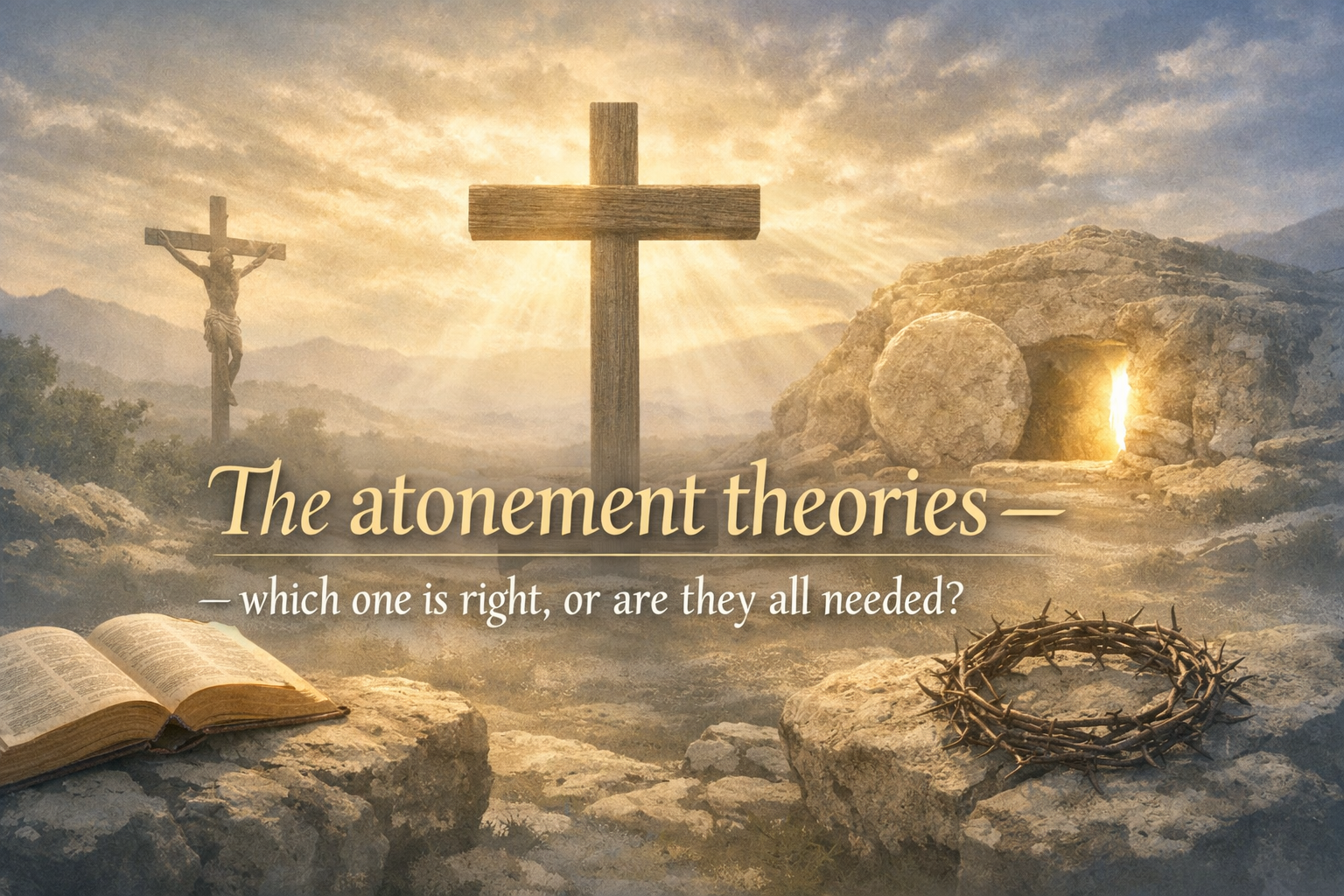
The atonement theories — which one is right, or are they all needed?
Christians agree that Jesus died for sins. They have argued for two thousand years about exactly how that death accomplishes what it accomplishes. Is it a payment to satisfy divine justice? A ransom to liberate captives? A moral example that draws the sinner upward? A victory over death and demonic powers? A demonstration of God’s love designed to melt a hard heart? Every one of these answers has serious theologians behind it and real biblical texts supporting it. The question is whether they are competitors — only one can be right — or whether the cross is large enough to require all of them to say what it actually did.
The atonement is the center of the Christian faith. Everything else — creation, fall, covenant, incarnation, resurrection, new creation — either leads to it or flows from it. The question of how the death of Jesus reconciles sinners to God is not a secondary question that can be safely left to specialists. It is the question. And the church has answered it, across its history, in more than one way.
That plurality can be unsettling. If Christianity is true, and the cross is central, shouldn’t there be a single definitive answer about what it did? The short reply is: there is a single definitive event, and that event is large enough that every angle from which the church has examined it has found something real. The theories are not all equal, and they are not all correct in every detail. But the cross accomplished more than any single theory has captured — and the responsible move is to understand what each theory sees, where each one reaches its limits, and how they fit together into a picture larger than any one frame.
Why There Are Multiple Theories
The New Testament itself uses more than one framework to describe what the cross accomplished. Paul writes of redemption, propitiation, reconciliation, justification, and victory — all in reference to the same event. John writes of the Lamb of God who takes away the sin of the world. Hebrews develops an elaborate priestly and sacrificial framework. The Gospels present Jesus as the servant who gives his life as a ransom for many. Revelation portrays Christ as the conquering Lamb whose blood purchases people from every tribe and tongue.
No single framework in the New Testament is presented as the exclusive account of what the cross achieved. The writers reach for multiple images — legal, sacrificial, relational, military, commercial — because the event they are describing does not fit neatly inside any one of them. The cross simultaneously satisfies divine justice, defeats the powers of sin and death, reconciles estranged parties, demonstrates divine love, liberates the enslaved, and transforms the one who contemplates it. Reducing it to a single mechanism impoverishes it. The church’s multiple atonement theories are, in large part, the history of different generations reaching for the biblical image that their context made most vivid.
Penal Substitution
Penal substitution is the theory that Jesus bore the punishment that human sin deserved — that God’s just wrath against sin was poured out on Christ in the place of sinners, so that those who trust in him are freed from condemnation. It is the dominant theory in Reformed and evangelical Protestantism, and it has the densest concentration of explicit biblical support of any atonement theory.
The key texts are abundant. Isaiah 53:4–6: “Surely he has borne our griefs and carried our sorrows… he was pierced for our transgressions; he was crushed for our iniquities; upon him was the chastisement that brought us peace, and with his wounds we are healed… and the Lord has laid on him the iniquity of us all.” The language of bearing, being crushed, and receiving chastisement is explicitly substitutionary and explicitly penal. Romans 3:25–26 describes Christ as a “propitiation” — a word that carries the specific meaning of satisfying divine wrath — “to show God’s righteousness, because in his divine forbearance he had passed over former sins.” 2 Corinthians 5:21: “For our sake he made him to be sin who knew no sin.” Galatians 3:13: “Christ redeemed us from the curse of the law by becoming a curse for us.”
The logic of penal substitution is anchored in God’s character as holy and just. Sin is not a violation of arbitrary rules. It is an offense against the infinite holiness of God. An infinitely holy God cannot simply overlook it — that would mean his justice is negotiable and his holiness is performative. The penalty must be paid. Penal substitution says it was — by the one who had no sin of his own to answer for, who stood in the place of those who did.
The objection most commonly raised is that it makes God the one being appeased — that it implies the Father is angry and the Son steps in to calm him down. This misreads the doctrine. Penal substitution, properly understood, is not a transaction within a divided Trinity. It is the triune God — Father, Son, and Spirit together — providing what his own justice required. Romans 3:25 says God put Christ forward as the propitiation. God is both the one who demands satisfaction and the one who provides it. The love of the Father and the justice of the Father are not in tension. The cross is where they meet.
Christus Victor
The Christus Victor theory — developed most fully by the Swedish theologian Gustaf Aulén in the twentieth century but rooted in the thinking of the early church fathers — frames the atonement as a cosmic battle. Jesus enters enemy-occupied territory, meets the powers of sin, death, and the devil on their own ground, and defeats them. The cross is not primarily a courtroom transaction but a battlefield victory.
The biblical support is genuine and substantial. Colossians 2:15: “He disarmed the rulers and authorities and put them to open shame, by triumphing over them in him.” Hebrews 2:14–15: “Since therefore the children share in flesh and blood, he himself likewise partook of the same things, that through death he might destroy the one who has the power of death, that is, the devil, and deliver all those who through fear of death were subject to lifelong slavery.” 1 John 3:8: “The reason the Son of God appeared was to destroy the works of the devil.” Revelation 12:10–11 celebrates the defeat of the accuser by the blood of the Lamb.
Christus Victor captures something penal substitution can underemphasize: that sin is not only a legal problem between the individual sinner and God, but also a domain problem. The creation has been taken captive. The powers of darkness have established a regime. The cross does not merely address individual guilt — it liberates the creation from an occupying force. This is why the resurrection is not an afterthought to the atonement in Christus Victor thinking — it is the victory’s announcement. Death, the last enemy, has been defeated (1 Corinthians 15:26).
The limitation of Christus Victor, standing alone, is that it can leave the justice question unanswered. How exactly does the death of Jesus defeat the powers? On what basis does God have the right to free sinners who genuinely deserve condemnation? Christus Victor describes the outcome but can underspecify the mechanism. It needs penal substitution — or something like it — to explain why the Victor’s death accomplishes the liberation rather than merely demonstrating God’s power.
Satisfaction Theory
Anselm of Canterbury developed the satisfaction theory in the eleventh century in his work Cur Deus Homo (Why the God-Man). Anselm’s framework drew on the feudal honor culture of his day: sin is an offense against God’s honor that creates an infinite debt the creature cannot pay. God’s honor demands satisfaction. A human being owes the debt but cannot pay it. God can pay it but does not owe it. Therefore only a God-man — one who both owes the debt as human and can pay it infinitely as divine — can provide the satisfaction. This is why the God-man was necessary.
Anselm’s contribution was enormous: he grounded the necessity of the incarnation in the logic of atonement, and he articulated clearly why the cross could not be a divine shrug — why God’s character required that the offense of sin be dealt with, not merely overlooked. His framework is not identical to penal substitution — Anselm emphasized the satisfaction of divine honor rather than the bearing of divine punishment — but it is closely related and fed directly into the Reformation’s development of penal substitution.
The limitation of satisfaction theory, as formulated by Anselm, is that it tends to frame the atonement primarily as a resolution to a problem internal to the divine honor, which can leave the relational and cosmic dimensions underemphasized. It also tends to underplay the resurrection, since the death accomplishes the satisfaction and the resurrection appears as something of an addition.
Moral Influence Theory
Peter Abelard, Anselm’s near-contemporary, proposed a very different account: Jesus died to demonstrate the love of God in a way so powerful that it moves the hardened human heart to repentance and love in return. The cross is not a transaction that satisfies justice or defeats powers — it is a revelation of divine love that transforms the one who receives it. The atonement works by moral influence, by drawing out the response of love and repentance from the person who contemplates it.
John 3:16, read in isolation, gestures toward this: “For God so loved the world, that he gave his only Son.” Romans 5:8: “God shows his love for us in that while we were still sinners, Christ died for us.” 1 John 4:10: “In this is love, not that we have loved God but that he loved us and sent his Son to be the propitiation for our sins.” The cross is indeed a demonstration of love. The moral influence theory is correct that beholding it should move us.
The problem is that moral influence, standing alone, cannot bear the weight the New Testament places on the cross. It makes the atonement a powerful gesture rather than an objective accomplishment. The cross on this account does not actually deal with sin — it does not pay for it, defeat it, or absorb its penalty. It merely displays love with enough intensity to motivate human response. But a powerful display of love leaves the sinner’s guilt unaddressed. The problem of justice is not solved by a demonstration of sentiment, however genuine. Moral influence also imports a troubling assumption: that the human problem is primarily motivational rather than judicial. If the problem is not a debt that needs paying but only a heart that needs warming, then the cross is therapy rather than atonement.
Ransom Theory
The ransom theory is among the oldest — prominent in the early church fathers — and draws on the New Testament’s own language: Jesus gave his life “as a ransom for many” (Mark 10:45). The image is of slaves being purchased and set free. Some early fathers — Origen and Gregory of Nyssa most notably — pushed the metaphor in a direction that created more problems than it solved, suggesting the ransom was paid to the devil, who had legal claim over sinners. This version was rightly criticized: the devil has no legitimate claim that God is obligated to honor, and treating him as a party to a transaction with God is theologically incoherent.
But the ransoming image itself is genuinely biblical. Galatians 4:4–5: God sent his Son “to redeem those who were under the law.” Titus 2:14: Jesus “gave himself for us to redeem us from all lawlessness.” Revelation 5:9: “You were slain, and by your blood you ransomed people for God from every tribe and language and people and nation.” The language of purchase and liberation is real. People were in bondage — to sin, to the law’s condemnation, to the fear of death — and the cross is the price of their liberation.
The ransom image is best understood not as a competing theory with its own standalone mechanism, but as one of the New Testament’s vivid pictures of the result the cross achieves — liberation — without specifying a precise transactional structure. It works alongside penal substitution and Christus Victor rather than in opposition to them.
Governmental Theory
Hugo Grotius proposed in the seventeenth century that God, as the moral Governor of the universe, could accept Christ’s suffering as a demonstration that the moral law is serious — a public display of the cost of sin — while not requiring that the precise penalty for each individual’s sin be paid by Christ. God, as Governor, can remit the penalty once justice has been publicly honored. This theory was influential in Arminian traditions and in much American revivalism.
The governmental theory rightly recognizes that the atonement has a public, cosmic dimension — that it is not merely a private transaction between God and individual sinners but a display before the watching universe of the seriousness of sin and the character of God. But it tends to weaken the substitutionary connection between Christ’s death and the believer’s forgiveness, making the cross more of a public demonstration than an actual bearing of specific penalty. The believer’s forgiveness becomes more conditional on their response and less grounded in the objective accomplishment of the cross.
Which One Is Right?
The honest answer is that the theories are not equally adequate, but none is entirely without biblical basis, and the richest account of the atonement requires more than one of them.
Penal substitution stands at the center. It has the densest biblical support, it addresses the deepest problem — the just condemnation of sinners before a holy God — and it provides the mechanism that the other theories need in order to explain how the cross accomplishes what they claim it accomplishes. Christus Victor is compelling as an account of what the cross achieved at the cosmic level, but it needs the mechanism of penal substitution to explain why the death of the Son defeats the powers rather than simply demonstrating God’s willingness to die. Moral influence rightly identifies the cross as a revelation of love, but that love is demonstrated by something — a real bearing of penalty, a real sacrifice — and without that something, the display is gesture rather than gift.
Penal substitution without Christus Victor can become too narrow — a courtroom transaction that says nothing about the enslavement of creation and the defeat of death. Christus Victor without penal substitution can become too vague — a cosmic battle narrative without a clear account of how the debt of sin is handled. Moral influence without penal substitution is insufficient — a motivational account that leaves guilt unaddressed. But moral influence, understood as a consequence of the genuine bearing of penalty and the genuine demonstration of love it involves, is entirely correct: beholding the cross should and does transform the one who genuinely sees it.
The New Testament holds these together without apology. Romans 5:8–10 moves from love demonstrated (moral influence) to reconciliation accomplished (penal substitution) to salvation from wrath secured — all in three verses. The cross is a single event with multiple dimensions, and the responsible Christian account of it refuses to flatten any of them.
The Pastoral Payoff
Understanding the atonement theories is not just theological furniture. Different dimensions of the atonement speak to different dimensions of human need — and a pastor, a counselor, or a friend who knows the full picture is equipped for more situations.
The person crushed by guilt — the one who lies awake at three in the morning cataloguing their failures — needs penal substitution. They need to know that the penalty has been paid, the debt has been discharged, the verdict has been rendered and it is “not guilty” on account of what Christ bore. That is not a feeling. It is a fact. And it is penal substitution that makes it a fact rather than merely a wish.
The person who feels enslaved — to addiction, to patterns of sin they cannot break, to the fear of death that shapes everything — needs Christus Victor. They need to know that the powers that hold them are defeated powers. That they are living under a regime that has already been overthrown. That the liberation the cross accomplished is real and available to them now, through the Spirit who applies the victory of the Son.
The person who cannot believe God loves them — who sees the cross as a legal mechanism rather than a personal act of love — needs the moral influence dimension. They need to see that the cross is not merely God doing paperwork. It is God himself entering human suffering and death, absorbing it, enduring it, so that no one who comes to him will ever be alone in it. That is love demonstrating itself in the most costly form imaginable.
“In this is love, not that we have loved God but that he loved us and sent his Son to be the propitiation for our sins.” — 1 John 4:10
Propitiation and love in the same sentence. The legal and the relational not in tension but woven together. That is the atonement — not a theory, but an act. Not a mechanism, but a person. The cross is what it looks like when the holy, just, loving God does everything necessary to bring his enemies home.
Key Takeaways
- The New Testament uses multiple frameworks to describe the atonement because the cross accomplished multiple things simultaneously. Legal, sacrificial, relational, military, and commercial images all appear in Scripture — not as competing accounts but as different angles on a single, dimensionally rich event.
- Penal substitution stands at the center and has the densest biblical support. Christ bore the penalty that human sin deserved, satisfying divine justice, so that those who trust in him are freed from condemnation. Isaiah 53, Romans 3:25, 2 Corinthians 5:21, and Galatians 3:13 all speak directly to this mechanism.
- Christus Victor captures the cosmic dimension penal substitution can underemphasize. Sin is not only an individual legal problem — it is a domain problem. The cross liberates the creation from the powers of sin and death, and the resurrection is the victory’s announcement. Both dimensions are needed for the full picture.
- Moral influence rightly identifies the cross as a revelation of love, but cannot stand alone. A demonstration of love that leaves guilt objectively unaddressed is gesture rather than gift. The moral influence of the cross is real and significant — but it is the consequence of something the cross actually did, not the mechanism of the atonement itself.
- The atonement theories speak to different dimensions of human need. Penal substitution addresses crushing guilt. Christus Victor addresses enslaving bondage. Moral influence addresses the inability to believe in God’s personal love. A pastor who understands all three is equipped for more pastoral situations than one who knows only one.
Key Scriptures: Isaiah 53:4–6 · Romans 3:25–26 · 2 Corinthians 5:21 · Colossians 2:15 · Hebrews 2:14–15 · Mark 10:45 · Galatians 3:13 · 1 John 4:10