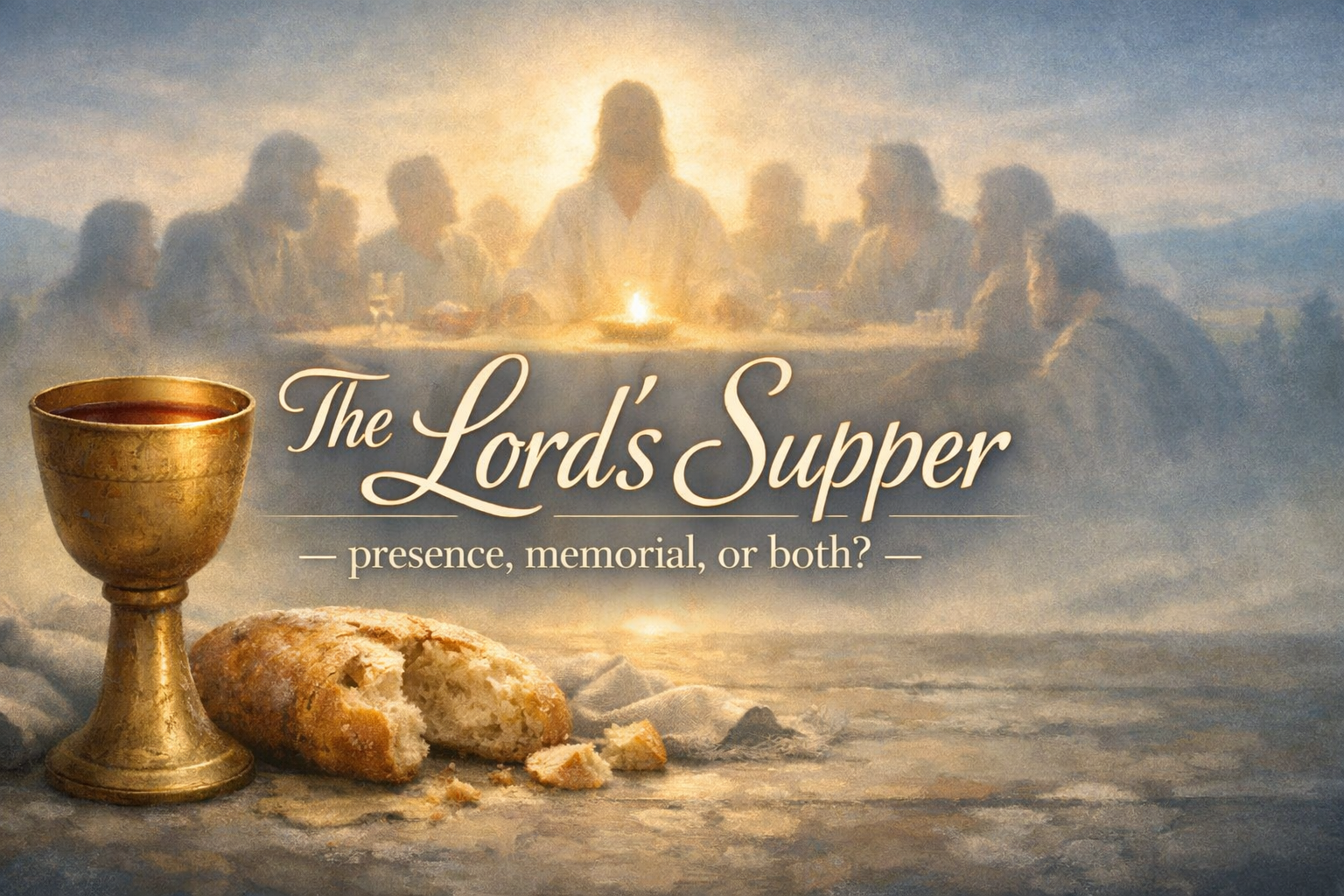
The Lord’s Supper — presence, memorial, or both?
Nearly every branch of Christianity honors the Lord’s Supper in some form — but Christians have long disagreed over a central question: What is actually happening at the Table? Is Christ present in a special way? Is the Supper mainly a memorial of His death? Or is it somehow both? That question touches worship, sacrament, faith, and how we understand Christ’s promise to meet His people. And the answer matters more than most people realize.
This is not a debate over fine print. It touches worship, sacrament, faith, and the very nature of how Christ gives Himself to His people. Whether a Christian comes from a tradition that stresses the real presence of Christ in the elements, or one that understands the Supper primarily as a memorial act, the way that tradition answers this question shapes everything about how the Table is approached, practiced, and treasured.
The goal here is not to adjudicate every denominational dispute, but to lay out what the Bible says, walk through the main Christian positions fairly, and land on something that honors the full biblical witness — including the parts that do not fit neatly into any one tradition’s tidy category.
What the Bible Says
Three Truths the Text Will Not Let Us Lose
Any sound theology of the Lord’s Supper has to begin with Scripture, and Scripture gives us at least three distinct truths that all have to be honored.
When Jesus instituted the Supper, He said, “This is my body… this is my blood… this do in remembrance of me” (Luke 22:19–20; cf. Matthew 26:26–28; Mark 14:22–24). The word “remembrance” is right there in the text, and any theology of the Supper that minimizes it has already gone wrong.
But then Paul writes in 1 Corinthians 10:16:
“The cup of blessing which we bless, is it not the communion of the blood of Christ? The bread which we break, is it not the communion of the body of Christ?”
That word communion — in Greek, koinōnia — means participation, sharing, genuine fellowship. Not mental recollection alone, but actual participation in something. Then in 1 Corinthians 11:27–29, Paul warns that eating and drinking unworthily makes a person “guilty of the body and blood of the Lord” — language that carries real moral and spiritual weight, far heavier than one might expect from a bare memorial act.
So the biblical data gives us three things together: the Supper is a remembrance, it proclaims Christ’s death, and it is a genuine participation or communion. That is why the question cannot be settled by picking one word and dropping the others. All three are in the text.
Four Views on the Lord’s Supper
Where the Traditions Divide — and Why
Christian traditions have answered the “what is happening here?” question in four main ways. Understanding each view — and what each is trying to protect — is more useful than simply declaring a winner.
The Supper is primarily an act of remembering Christ’s sacrifice, publicly proclaiming His death, and stirring faith and gratitude. The bread and cup do not become Christ’s body and blood, nor is Christ specially present in the elements. The sign points to Christ; it does not contain Him.
The bread and wine become the body and blood of Christ in substance, while their outward appearances remain. Christ is truly and fully present in the elements — body, blood, soul, and divinity. The Mass has a sacrificial dimension, though understood as representing the one sacrifice of Calvary.
Christ’s body and blood are truly present “in, with, and under” the bread and wine. The elements remain bread and wine, but Christ is genuinely, bodily present in the sacrament — not by a change of substance, but by a real sacramental union. Luther insisted this was not symbolism but objective fact.
Christ is truly present in the Supper, but spiritually — not physically or locally enclosed in the elements. By the Holy Spirit, believers are genuinely nourished by Christ through faith as they partake. The bread and wine remain bread and wine, but through them Christ truly communicates Himself to His people.
It is worth noticing what each view is trying to protect. The memorial view protects the once-for-all sufficiency of the cross and guards against superstition. Transubstantiation protects the full seriousness and sacredness of the Table and refuses bare symbolism. The Lutheran view protects the objectivity of Christ’s gift — He truly gives Himself, not merely tells us to think about Him. The Reformed view tries to hold all of that together while preserving Christ’s bodily ascension and the role of faith in genuine reception.
Almost every serious tradition agrees on one thing: the Supper is not just snack time with a religious thought attached.
The Memorial View — Strengths and Limits
The memorial view takes seriously what Jesus plainly said: “Do this in remembrance of me.” That language is right there and must not be minimized. The view also rightly protects the once-for-all sufficiency of Christ’s sacrifice — the cross is not repeated in the Supper, and the saving power is in Christ, not in elements or rites. It also guards against the danger of treating physical participation as though it conveys grace automatically, apart from faith.
But the danger comes when “memorial” collapses into nothing more than mental recollection — thinking about Jesus while eating symbolic bread. When that happens, the weight of Paul’s language in 1 Corinthians 10–11 becomes very hard to explain. Why would Paul speak of communion with Christ’s body and blood, and warn of being guilty concerning the body and blood of the Lord, if the Supper were purely a subjective act of remembering? The language is too strong for that reading to carry it comfortably.
So remembrance is surely part of the meaning — Jesus said so — but “memorial only” can flatten the Supper into a visual sermon when the New Testament seems to speak of something weightier.
Real Presence Views — Strengths and Limits
Transubstantiation takes seriously Christ’s words, “This is my body,” refuses to reduce the Table to bare symbolism, and insists that the Supper is a holy mystery in which Christ truly gives Himself to His church. Its strength is the seriousness with which it treats the ordinance. The Protestant concerns center on whether it blurs the sign and the thing signified, whether it implies a repeated offering of Christ, and whether it fits with His bodily ascension and once-for-all sacrifice at Calvary.
The Lutheran view rejects transubstantiation but equally rejects bare memorialism. Luther’s insistence that Christ is truly present “in, with, and under” the elements has a great strength: it preserves the objectivity of the Supper. Christ truly meets His people there; the Supper is not merely a human act of recalling, but a divine act of giving. Critics ask whether pressing bodily presence language this far sits comfortably with the ascension, and whether the mode of presence can be defined clearly enough to be meaningful.
The Reformed view — associated with Calvin and the Westminster Standards — may be the most balanced of the real presence positions. It says Christ is truly present, but the locus of that presence is not the physical elements. Rather, by the Spirit, faith is lifted into genuine communion with the risen Christ. The Supper is a means of grace through which Christ actually nourishes His people — not mere memory, not physical enclosure, but real spiritual participation by the Spirit through faith. The weakness people sometimes raise is that “spiritual presence” can sound vague if poorly explained, but in its historic form it is a robust affirmation: the Supper is a genuine means by which Christ gives Himself to believing souls.
“Memorial or Presence?” Is Probably the Wrong Question
The title question is useful for framing the debate, but it can mislead if it makes us think we must choose one and drop the other. Biblically, the Lord’s Supper is certainly a memorial — Jesus said so. But it also appears to be more than bare memory — Paul’s language of communion, participation, and solemn accountability points to something of greater weight.
The better question is: What kind of presence accompanies this memorial? That is where the traditions divide. A thin memorialism says mostly remembrance. Catholicism says substantial presence. Lutheranism says true bodily presence sacramentally joined to the elements. Reformed theology says true spiritual presence through faith by the Holy Spirit. But they are not arguing about whether the Supper matters — they are arguing about the nature of why and how it matters.
What the Supper Clearly Does — Whatever Your Tradition
Even where Christians disagree sharply on presence and mode, several things about the Lord’s Supper are clear across the breadth of the New Testament witness.
It remembers Christ’s death. The Supper points the church back to the cross, again and again, saying that salvation rests on Christ crucified.
It proclaims the gospel. Paul says the church “shew[s] the Lord’s death till he come” (1 Corinthians 11:26). The Table visibly preaches what the pulpit declares in words.
It nourishes faith. Even traditions that stress memorial strongly admit the Supper strengthens believers by directing them afresh to Christ and His finished work.
It expresses communion — vertical and horizontal. Believers come not as isolated individuals, but as one body. The Supper has communion with Christ and fellowship with His people woven together.
It calls for self-examination. Paul’s warnings in 1 Corinthians 11:27–32 show that the Table is holy and must not be approached casually or carelessly.
It points forward. The Supper is not only backward-looking. It anticipates the return of Christ and the marriage supper of the Lamb. The church eats this meal while waiting for another.
The Table looks backward, upward, inward, outward, and forward — all at once. That is a rich ordinance, however one’s tradition names the mode of Christ’s presence in it.
The Deeper Theological Question
Underneath the whole debate lies a larger question: How does Christ give Himself to His church now? Does He do so mainly through memory and obedience to His command? Does He do so sacramentally in or through the elements? Does He do so spiritually through faith and the Spirit?
That is why the debate about the Supper is really part of a bigger theology of grace, worship, and the means by which Christ feeds His people. Those who favor a stronger presence view want to protect the reality that Christ does not merely tell us to think about Him — He meets His people. Those who favor a stronger memorial emphasis want to protect the sufficiency of the cross and keep the church from any hint of superstition or mechanical grace. Both concerns are legitimate. Both are anchored in genuine biblical instincts.
The Lord’s Table is not just a photograph of Christ pinned to the wall for us to look at. It is a God-given meal where His people remember Him, receive from Him, and are strengthened in Him — and they wait there for the day when they will feast with Him face to face.
Common Mistakes to Avoid
Reducing the Supper to bare symbolism drains it of its biblical seriousness and makes Paul’s solemn warnings hard to explain. Treating the elements superstitiously — as though the bread itself carries power apart from Christ and faith — inverts the relationship between sign and Savior. Forgetting self-examination turns a holy ordinance into a casual routine; the warnings of 1 Corinthians 11 are there for a reason. Neglecting the communal dimension reduces the Supper to a private spiritual transaction between me and Jesus, when it is an ordinance of the gathered body. And turning mystery into speculation — pretending to explain more than God has revealed — produces more heat than light. The church should speak where Scripture speaks and hold the rest with reverence.
Key Takeaways
- The Bible gives us three things together: remembrance, proclamation, and real participation. All three are in the text, and any sound theology of the Supper has to honor all of them without sacrificing one to tidy up the system.
- Four main traditions answer the question of Christ’s presence differently. The memorial view (Zwinglian), transubstantiation (Catholic), sacramental union (Lutheran), and spiritual presence (Reformed) each try to protect something genuinely biblical — and each has corresponding weaknesses to reckon with.
- “Memorial or presence?” is probably the wrong question. The better question is: what kind of presence accompanies this memorial? Almost all serious traditions agree the Supper is more than snack time with a religious thought attached.
- The Supper looks backward, upward, inward, outward, and forward all at once. It remembers the cross, communes with the risen Christ, calls for self-examination, expresses unity with the body, and anticipates the marriage supper of the Lamb.
- The deepest question is how Christ gives Himself to His church now. The debate about the Supper is part of a larger theology of grace and the means by which Christ feeds His people — not a minor housekeeping dispute about ceremony.
Key Scriptures: Matthew 26:26–28 · Luke 22:14–20 · John 6:32–58 · 1 Corinthians 10:14–22 · 1 Corinthians 11:17–34 · Exodus 12:1–14 · 1 Corinthians 5:7 · Revelation 19:6–9