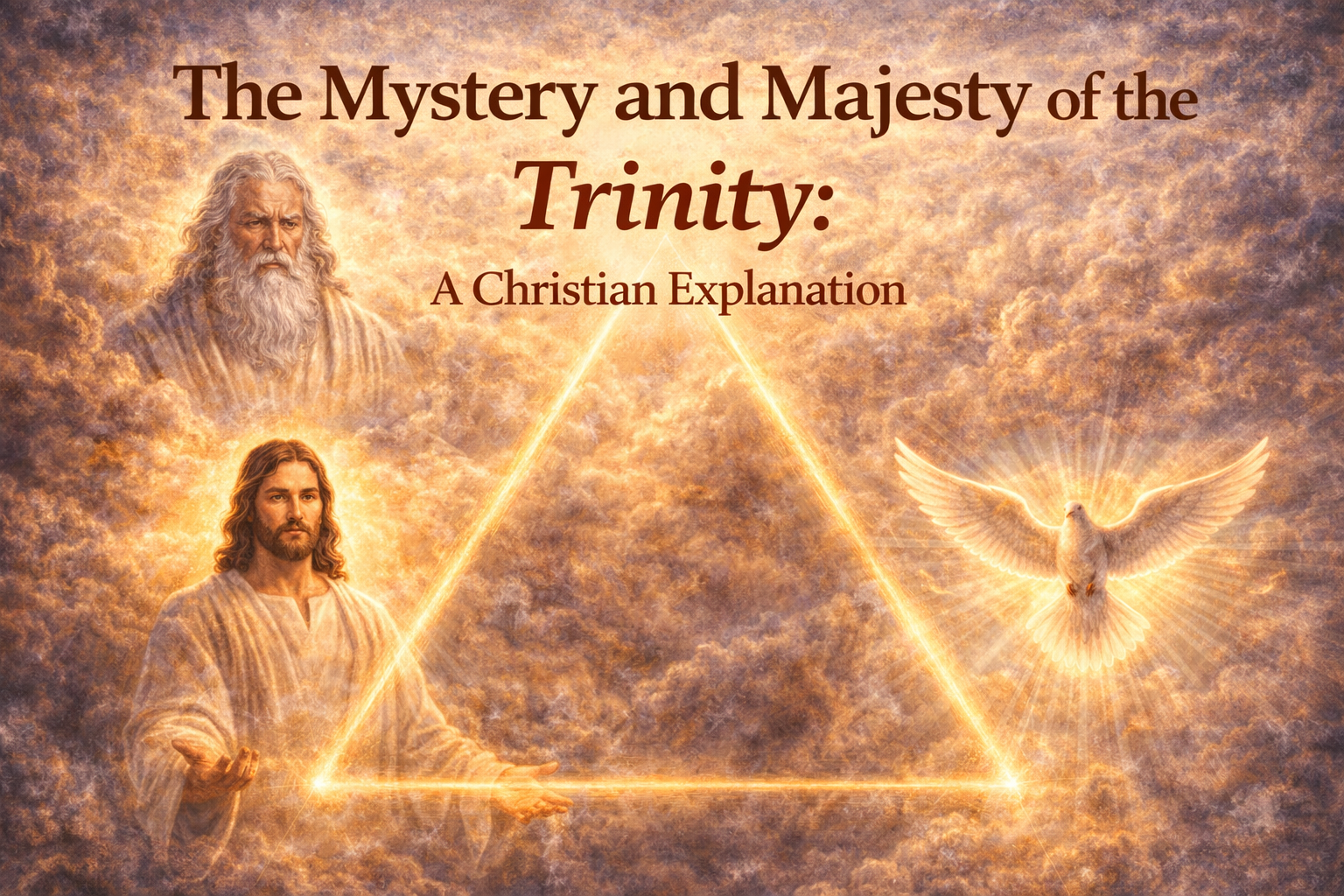
The Mystery and Majesty of the Trinity: A Christian Explanation
The Most Beautiful Mystery in Christian Theology — Its Biblical Basis, Historical Defense, and Practical Meaning for the Believer
The Trinity is one of the most profound — and most misunderstood — truths in all of Christian theology. In short: there is one God who exists eternally in three persons — the Father, the Son, and the Holy Spirit.
This does not mean Christians believe in three gods. Christianity is firmly monotheistic. But unlike other monotheistic religions, Christianity proclaims that the one God is tri-personal — three distinct persons sharing one divine essence, in eternal loving relationship with one another.
It is not a contradiction. It is a mystery — something that transcends human categories rather than violating them. And it has massive implications for how we understand salvation, prayer, community, and the very nature of love.
“We worship one God in Trinity, and Trinity in Unity; neither confounding the persons nor dividing the substance.” — The Athanasian Creed
The Trinity in the Bible
The word Trinity does not appear in Scripture, but the concept is woven throughout the biblical narrative — planted as seeds in the Old Testament and brought to full bloom in the New.
Old Testament Hints
Plurality Within God Before the Incarnation
Several Old Testament passages hint at plurality within the one God. Genesis 1:26 uses the striking plural “let us make man in our image” — language that is at minimum unusual for strict monotheism. Isaiah 48:16 identifies three distinct agents: “The Lord God has sent Me, and His Spirit” — the Lord, the Messiah-figure speaking, and the Spirit each appearing in a single sentence.
These are not full Trinitarian disclosures. They are seeds planted in the narrative, awaiting the fuller revelation that comes with Christ.
New Testament Clarity
Three Persons Appearing Together
The New Testament makes the distinctions explicit. At Jesus’ baptism (Matthew 3:16–17), all three persons of the Trinity appear simultaneously: the Son in the water, the Spirit descending as a dove, the Father’s voice from heaven. They are present together, distinct from one another, yet unified in the event. No modalist explanation — in which God merely shifts between modes — can account for this scene.
In John 14:16–17, Jesus speaks of sending “another Helper” — the Spirit — in language that clearly distinguishes the three. The Great Commission in Matthew 28:19 commands baptism “in the name of the Father, and of the Son, and of the Holy Spirit” — one name, three persons.
One Essence, Three Persons — The Core Distinction
The key theological distinction is between essence and person. Essence refers to what God is — His divine being, His nature. Person refers to the individual distinctions — Father, Son, and Spirit — who are not interchangeable roles but genuinely distinct persons, each of whom is fully and completely God.
| Attribute | Father | Son (Jesus) | Holy Spirit |
|---|---|---|---|
| Fully God | Yes | Yes | Yes |
| Distinct Person | Yes | Yes | Yes |
| Eternal | Yes | Yes | Yes |
| Relational Role | Origin, Source | Redeemer, Word | Comforter, Guide |
The simplest formulation: God is one what and three whos. Each person is fully God — not a third of God, not a manifestation of God — but the complete divine nature, personally distinguished from the other two.
The Historical Defense of the Trinity
The Church did not invent the Trinity — it clarified and defended what Scripture taught as heresies arose that distorted both the unity and the personal distinctions within God.
Analogies — and Why Every One Falls Short
The Trinity transcends human categories, which is why every analogy breaks down somewhere. That is not a failure of the doctrine — it is exactly what you would expect of an infinite God whose inner being cannot be exhausted by finite illustrations.
Common Analogies and Their Limits
Why No Illustration Is Adequate — and What Each Can Still Offer
Water (solid, liquid, vapor): Illustrates one substance in different states, but suggests God shifts between modes — which is the heresy of modalism. The three persons of the Trinity exist simultaneously, not sequentially.
The sun (star, light, heat): Helpful for showing distinct but inseparable aspects, but fails to express genuine personhood. The three persons of the Trinity are not impersonal properties — they speak, love, and act.
A man as father, son, and husband: Captures one individual in multiple relations, but again collapses into modalism — one person wearing different hats, not three genuinely distinct persons co-existing eternally.
C.S. Lewis observed: “If Christianity were something we were making up, of course we could make it easier. But it is not.” The difficulty of the doctrine is itself a form of evidence that it was not invented for convenience.
Common Misunderstandings — Heresies Worth Knowing
The early Church’s precision on these points was not theological pedantry. Each heresy, if left uncorrected, dismantles the gospel itself. A merely human Jesus cannot bear the infinite weight of the world’s sin. A God who is merely one person cannot be love-in-himself from eternity.
Why the Trinity Matters — Three Practical Implications
Salvation Is Trinitarian — All Three Persons Working Together
The redemption of a human soul is not the work of one person of the Godhead in isolation. In Ephesians 1:3–14, Paul traces the full arc: the Father planned salvation and chose us in Christ before the foundation of the world; the Son accomplished it through His death and resurrection; the Spirit applies it — sealing believers, guaranteeing the inheritance. Your redemption is the work of all three persons, in complete harmony, each contributing what only that person contributes.
Prayer Reflects the Trinity — We Pray to the Father, Through the Son, by the Spirit
Christian prayer is Trinitarian in structure, whether or not we are conscious of it. Romans 8:26 describes the Spirit interceding for us when we don’t know how to pray. Hebrews 4:16 invites us to approach the throne through Jesus. We pray to the Father, in the name of the Son, through the power of the Spirit. The doctrine shapes the act.
Romans 8:26 · Hebrews 4:16 · Matthew 6:9 · John 14:13Community Reflects the Trinity — Unity in Diversity Is the Divine Pattern
Just as the three persons of the Trinity exist in eternal love and unity without being identical to one another, the Church is called to the same pattern: genuine unity that does not erase genuine difference. Jesus prayed in John 17:21–23 that believers would be one “just as we are one.” The Trinity is not only a fact about God — it is the model for human community.
Tim Keller observed: “If God is unipersonal, then love is something that God must learn or create. But if God is tri-personal, then love is at the core of His being from all eternity.” God did not create us because He was lonely. He created us to invite us into a joy that was already fully present within Himself.
The Trinity is not merely a doctrine to be memorized and defended. It is a truth about who God actually is — and therefore a truth that should shape how we pray, how we relate to one another, and how we understand the salvation we have received.
The Father loves you. The Son died for you. The Spirit lives in you. When you say “in the name of the Father, and of the Son, and of the Holy Spirit,” you are not reciting a formula — you are entering into the mystery of divine fellowship, participating in a community of love that has existed from before the world began.
That is very good news. And it is news that no other religion, and no other account of God, can offer.
“May the grace of the Lord Jesus Christ, and the love of God, and the fellowship of the Holy Spirit be with you all.” — 2 Corinthians 13:14
Key Scriptures: Matthew 28:19; 3:16–17 · John 14:16–17; 17:21–23; 1:1–14 · Ephesians 1:3–14 · Romans 8:26–27 · 2 Corinthians 13:14 · Hebrews 4:16 · Genesis 1:26 · Isaiah 48:16 · 1 John 4:8
Want to Go Deeper?
The Trinity is the doctrinal foundation on which everything else in MVM’s theology series rests. These companion posts and resources connect directly:
- The Nicene Creed — the full MVM post on the creed that emerged from the Council of Nicaea, line by line, with the Arian controversy as its essential backdrop
- The Holy Spirit — the full treatment of the third person of the Trinity: His eight roles in the believer’s life, His work in regeneration, indwelling, and empowerment
- Ten Christian Leaders on the Doctrine of Jesus — the full deity of Christ — the doctrine Nicaea defended and without which the Trinity collapses
- Delighting in the Trinity — Michael Reeves; the most joyful and accessible introduction to the doctrine, written to make the reader love the Trinity rather than merely understand it
- Systematic Theology — Wayne Grudem; the standard evangelical reference for careful, thorough treatment of the Trinity and every related doctrine
- Subscribe to get new posts delivered straight to your inbox — gospel-rooted, plain-spoken truth for the week ahead.
“Go therefore and make disciples of all nations, baptizing them in the name of the Father and of the Son and of the Holy Spirit.” — Matthew 28:19