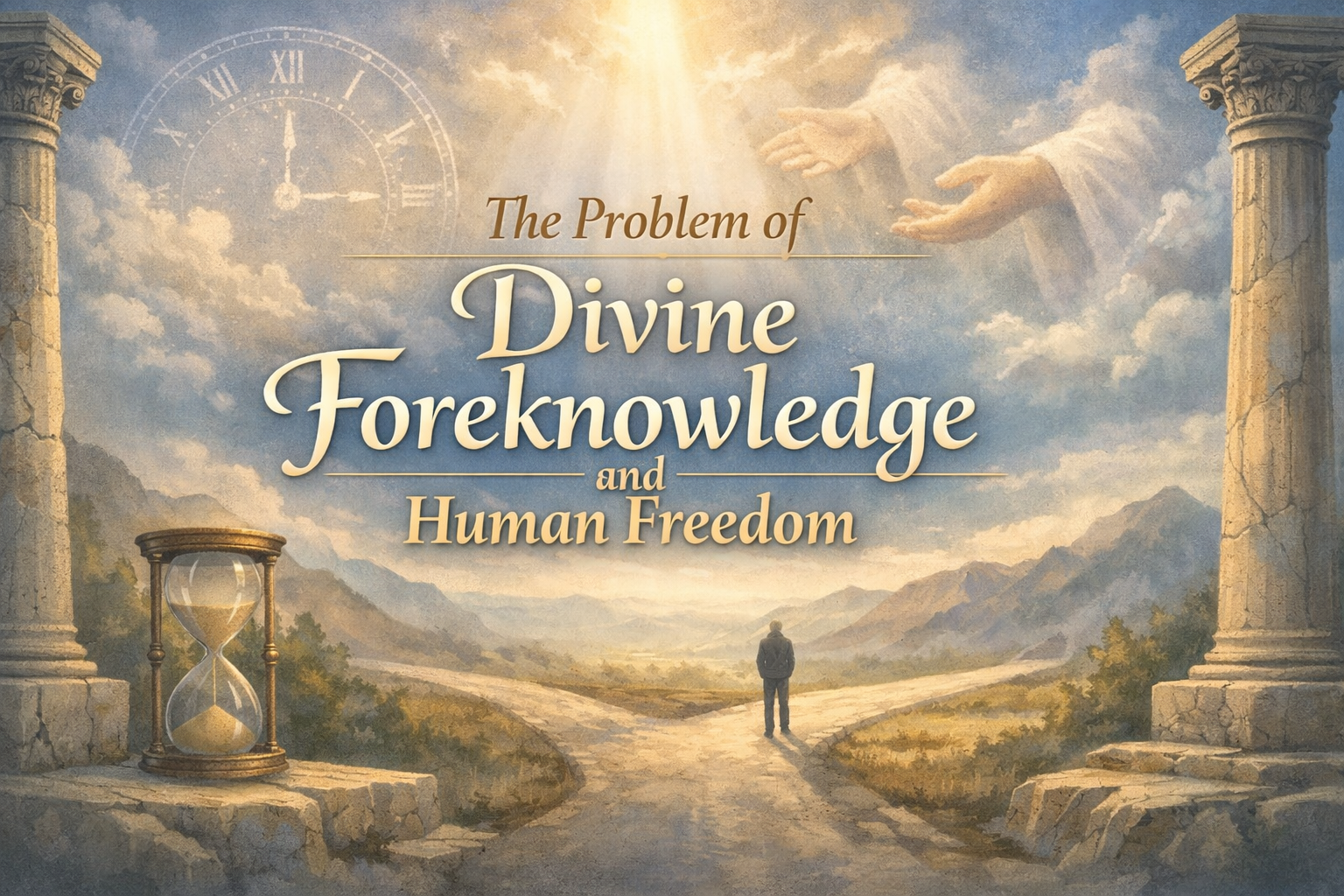
The problem of divine foreknowledge and human freedom
If God knew before you were born exactly what you would choose today, did you ever really have a choice? This question has unsettled philosophers and theologians for centuries — and it deserves an honest answer, not a pat dismissal. The problem of divine foreknowledge and human freedom cuts to the heart of how we understand God, how we understand ourselves, and what it actually means to be responsible for anything at all. The good news is that the problem, properly understood, points us toward a richer view of God — not a smaller one.
Here’s the problem in plain English. God is omniscient. He knows all things — past, present, and future. That means before you were born, God already knew every decision you would ever make. Every word you would speak. Every sin you would commit. Every moment you would trust Him or walk away.
Now here’s the rub: if God knew all that in advance, how could you have done anything differently? If your choices were foreknown, weren’t they in some sense fixed? And if they were fixed, in what sense did you actually choose freely? And if you didn’t choose freely, how are you morally responsible for anything?
This isn’t a gotcha question from an internet skeptic. Augustine wrestled with it. Boethius wrote one of the most elegant solutions in the history of philosophy from a prison cell while awaiting execution. Aquinas addressed it. Calvin addressed it. Jonathan Edwards wrote an entire book about it. The problem is real, the stakes are high, and it deserves a serious answer.
Setting Up the Problem Precisely
Before we can solve a problem, we need to state it accurately. The argument usually runs something like this:
If God infallibly foreknew yesterday that you would choose X tomorrow, then it is now necessary that you choose X. If it is necessary that you choose X, you cannot choose otherwise. If you cannot choose otherwise, you do not choose freely. If you do not choose freely, you are not morally responsible.
That’s a tight logical chain. But notice where the real weight rests: on the word “necessary.” The question is whether foreknowledge generates necessity — whether God knowing what you will do locks you into doing it.
Here’s an analogy that helps. Suppose you watch a recording of a football game after the final score is posted. You know exactly what will happen on every play. Does your knowledge of what’s coming cause those plays to happen? Of course not. The game was played freely by real players making real decisions. Your after-the-fact knowledge doesn’t reach backward in time and force the outcomes. It just tracks them.
The objection to this analogy is obvious: you knew the game after it happened. God knows it before. And that asymmetry seems to change everything. Or does it?
Boethius and the Eternal Present
Writing in the early sixth century, awaiting his execution on false charges, Boethius produced in The Consolation of Philosophy what remains one of the most powerful responses to this problem. His move was deceptively simple: God doesn’t foreknow. God knows.
The prefix matters. “Fore” implies time — knowing ahead of time. But Boethius argued that God is not in time at all. God doesn’t experience a past that is over or a future that hasn’t arrived. God exists in what Boethius called an eternal present — a single, complete, simultaneous apprehension of all that is, was, or will be.
“God’s knowledge surveys all things in His eternal present, as we might watch events unfolding below us from a high place — seeing them all at once, not causing them by seeing them.” — Boethius, The Consolation of Philosophy, Book V
Think of it this way. Imagine you’re in a helicopter hovering over a long mountain road. From your vantage point, you can see a car at the beginning of the road, another car at the midpoint, and a third car at the end — all at the same time. The drivers don’t see each other. They experience their positions sequentially. You see them simultaneously. Your seeing them doesn’t cause their positions. It simply registers all their positions at once.
God’s relationship to time is something like that — infinitely elevated beyond that analogy, but pointing in the right direction. God doesn’t look ahead to see what you’ll choose. He sees all of your choices, including the ones you haven’t made yet from your perspective, in a single, eternal act of knowledge. His knowing doesn’t precede your choosing and thereby constrain it. He knows your free choices as free choices.
This is why Scripture uses language like Psalm 139:16 — “in your book were written, every one of them, the days that were formed for me, when as yet there was none of them” — without implying that those days are robotically scripted. They are known. Known completely, eternally, infallibly. But known as what they are: days lived by a real person making real choices.
The Compatibilist Answer: Freedom Redefined
Another major answer to this problem comes from the compatibilist tradition, which includes most of the classical Reformed theologians — Calvin, Edwards, Turretin, and in the modern era, figures like R.C. Sproul.
Compatibilism argues that the kind of freedom required for moral responsibility is not the ability to do otherwise in some absolute metaphysical sense, but the ability to act according to your own desires and reasoning without external compulsion. You are free when you do what you want to do, for reasons that are genuinely yours, without anyone holding a gun to your head. Foreknowledge is compatible with that kind of freedom.
Jonathan Edwards made this case at length in Freedom of the Will (1754), arguing that the common notion of “libertarian free will” — the ability to choose equally between alternatives in a causally undetermined way — is actually incoherent. A truly random choice, uncaused by anything in you, is not a free choice. It’s just noise. Real freedom is the ability to act from your own nature, desires, and character without coercion.
“The will always follows the strongest inclination of the mind. This is not bondage — it is simply what it means to be a self who has a nature.” — Jonathan Edwards, Freedom of the Will
On this view, God foreknowing (or timelessly knowing) what you will choose is not a threat to your freedom because your choice flows from your own desires and character — which is exactly what genuine freedom requires. God knows what you will freely choose because He knows you — your nature, your loves, your history, your character — completely.
The Libertarian Objection: Is Compatibilism Really Freedom?
Compatibilism has critics, and they have a real point worth hearing. The libertarian free will position — held by most Arminian theologians and many Catholic thinkers — objects that compatibilist “freedom” is not really freedom at all. If your choices inevitably follow from your nature and desires, and your nature and desires are ultimately shaped by factors outside your control (upbringing, biology, God’s sovereign design), then in what meaningful sense did you author your choice?
This is a serious philosophical objection. It leads libertarians to insist that genuine freedom requires what philosophers call “alternative possibilities” — the genuine ability, in the exact same circumstances, to have chosen differently. And if God infallibly foreknows which alternative you’ll choose, it seems like the other alternatives were never really live options.
The libertarian theological response to the foreknowledge problem usually takes one of two routes. The first is Molinism — the view associated with the 16th-century Jesuit Luis de Molina — which holds that God has “middle knowledge”: He knows not only what will happen but what any free creature would freely choose in any possible set of circumstances. God then actualizes the world in which those free choices produce the outcomes He intends, without directly determining those choices. God works with libertarian freedom, not around it.
The second route — taken by open theists — bites the bullet and limits God’s foreknowledge. If libertarian freedom is real and foreknowledge eliminates it, then God simply doesn’t know future free choices with certainty. He makes His best predictions, adjusts in real time, and sovereignly guides history despite not controlling it completely. This preserves libertarian freedom but at the cost of the classical doctrine of omniscience — and most would argue, at the cost of the God of Scripture.
What Scripture Actually Emphasizes
The philosophical debate is real and worth engaging. But we should notice what Scripture itself emphasizes — because the biblical writers don’t seem to feel the tension as acutely as modern philosophers do.
Scripture is simultaneously and unapologetically insistent on both divine sovereignty and human responsibility. Acts 2:23 is the single sharpest example: “this Jesus, delivered up according to the definite plan and foreknowledge of God, you crucified and killed by the hands of lawless men.” In one sentence: God’s definite plan, God’s foreknowledge, and human culpability for murder. No qualification. No hedge. Both are simply true.
Genesis 50:20 — Joseph to his brothers: “You intended to harm me, but God intended it for good.” The same event has two real intentions behind it. The brothers’ evil intention is genuinely theirs. God’s sovereign intention is genuinely His. Both are true. The text doesn’t resolve the tension; it presents it as simple fact.
Romans 9 — “Jacob I loved, but Esau I hated” — grounds God’s electing choice entirely in His own sovereign will, not in any foreseen merit or choice. Yet Paul immediately anticipates the objection: “Is there injustice on God’s part?” (Romans 9:14). The objection only makes sense if real human choices and real human responsibility are still in view. Paul’s answer is not to collapse sovereignty into a determinism that eliminates responsibility — it’s to insist that both truths belong together and that our creaturely perspective isn’t the right measure for God’s ways.
Holding the Tension Well
Here’s where intellectual honesty requires something uncomfortable: the problem of divine foreknowledge and human freedom is not fully solved by any of the options on the table. Boethius’s eternal present is the most elegant philosophical response, but it raises its own questions about how a timeless God relates to temporal creatures. Compatibilism gives a coherent account of freedom, but libertarians aren’t wrong that it redefines the term. Molinism is ingenious but requires a kind of counterfactual knowledge that many find philosophically problematic. Open theism solves the problem by cutting away what makes God God.
What we can say with confidence — what Scripture warrants us to affirm — is this:
God’s foreknowledge is real and complete. Not a single event, not a single choice, escapes His eternal knowledge. “Great is our Lord, and abundant in power; his understanding is beyond measure” (Psalm 147:5). Human choices are real and genuinely ours. We are not puppets. Our deliberations are real deliberations, our loves are real loves, our sins are genuinely our sins. Moral responsibility is real. Scripture holds both without apology.
“The secret things belong to the Lord our God, but the things that are revealed belong to us and to our children forever.” — Deuteronomy 29:29
The “secret things” here include precisely the mechanics of how God’s sovereign foreknowledge and human freedom ultimately cohere at the metaphysical level. God hasn’t told us everything. What He has told us is enough to live by, to trust Him, and to hold ourselves responsible before Him.
Why This Matters for the Life of Faith
This isn’t an abstract puzzle. The foreknowledge problem touches real life in at least three ways.
It bears on prayer. If God already knows what will happen, why pray? Because prayer is part of what God has ordained, not a mechanism for changing a plan He hasn’t made yet. Your prayers are not news to God. They are part of the fabric of how His will unfolds in the world. He ordains ends and means together — which means your praying is as much a part of His purpose as the outcome you’re praying toward.
It bears on repentance and responsibility. The foreknowledge problem could be used as an excuse — “God knew I’d do this, so it was inevitable.” Scripture won’t allow that move. You chose. You are accountable. That God knew you would choose doesn’t transfer the choice to Him or strip it from you. The conviction of sin is not wrong because God foreknew it. It’s right because you did it.
It bears on assurance. Here’s where foreknowledge becomes pastoral gold. If God’s knowledge of you is complete — if He knew every failure, every doubt, every dark moment before He called you — then His call was not uninformed. He didn’t elect you thinking you’d turn out better than you did. He knew. And He called you anyway. That’s not a God who might be surprised into regret. That’s the God of Romans 8:29–30 — “those whom he foreknew he also predestined… those whom he predestined he also called… those whom he called he also justified… those whom he justified he also glorified.” Past tense. Done. Settled. Before you ever showed up.
For the Person Who Finds This Unsettling
If you’re wrestling with this problem and it’s shaking your sense of responsibility or your sense of freedom, that’s actually a sign you’re taking both God and yourself seriously — which is exactly right. The goal isn’t to flatten one truth to protect the other. Live inside the tension. Trust the God who holds both without contradiction, even when you can’t fully see how. The mystery here is not a defect in the faith — it’s a signpost pointing to a God whose ways are genuinely higher than ours (Isaiah 55:8–9). That’s not a cop-out. It’s theology at its most honest.
Key Takeaways
- The problem is real and has ancient roots. The tension between divine foreknowledge and human freedom is not a modern skeptic’s trick — Augustine, Boethius, Aquinas, Calvin, and Edwards all wrestled with it seriously, and so should we.
- Boethius’s eternal present reframes the problem. God doesn’t “fore”-know — He timelessly knows all things in an eternal present, seeing our free choices as free choices without reaching back through time to cause them.
- Compatibilism offers a coherent account of freedom. Real freedom is acting according to your own desires and nature without coercion — and that kind of freedom is fully compatible with God’s foreknowledge.
- Molinism and open theism represent other live options. Molinism preserves libertarian freedom through middle knowledge; open theism preserves it by limiting divine foreknowledge — though most orthodox theologians find the latter theologically unacceptable.
- Scripture holds both truths without apology. Acts 2:23 and Genesis 50:20 present divine sovereignty and human responsibility as simultaneously, unambiguously true — without explaining the mechanics.
- The tension bears on prayer, repentance, and assurance. God’s foreknowledge doesn’t eliminate the reality or the necessity of prayer, nor does it relieve human moral responsibility — but it does make the security of the believer absolute.
- Some mystery is appropriate and honest. Deuteronomy 29:29 reminds us that the secret things belong to God. Holding the biblical tension without forcing a resolution that Scripture doesn’t provide is not intellectual weakness — it’s theological faithfulness.
Key Scriptures: Genesis 50:20 · Deuteronomy 29:29 · Psalm 139:16 · Psalm 147:5 · Isaiah 55:8–9 · Acts 2:23 · Romans 8:29–30 · Romans 9:14 · Ephesians 1:4 · Revelation 13:8