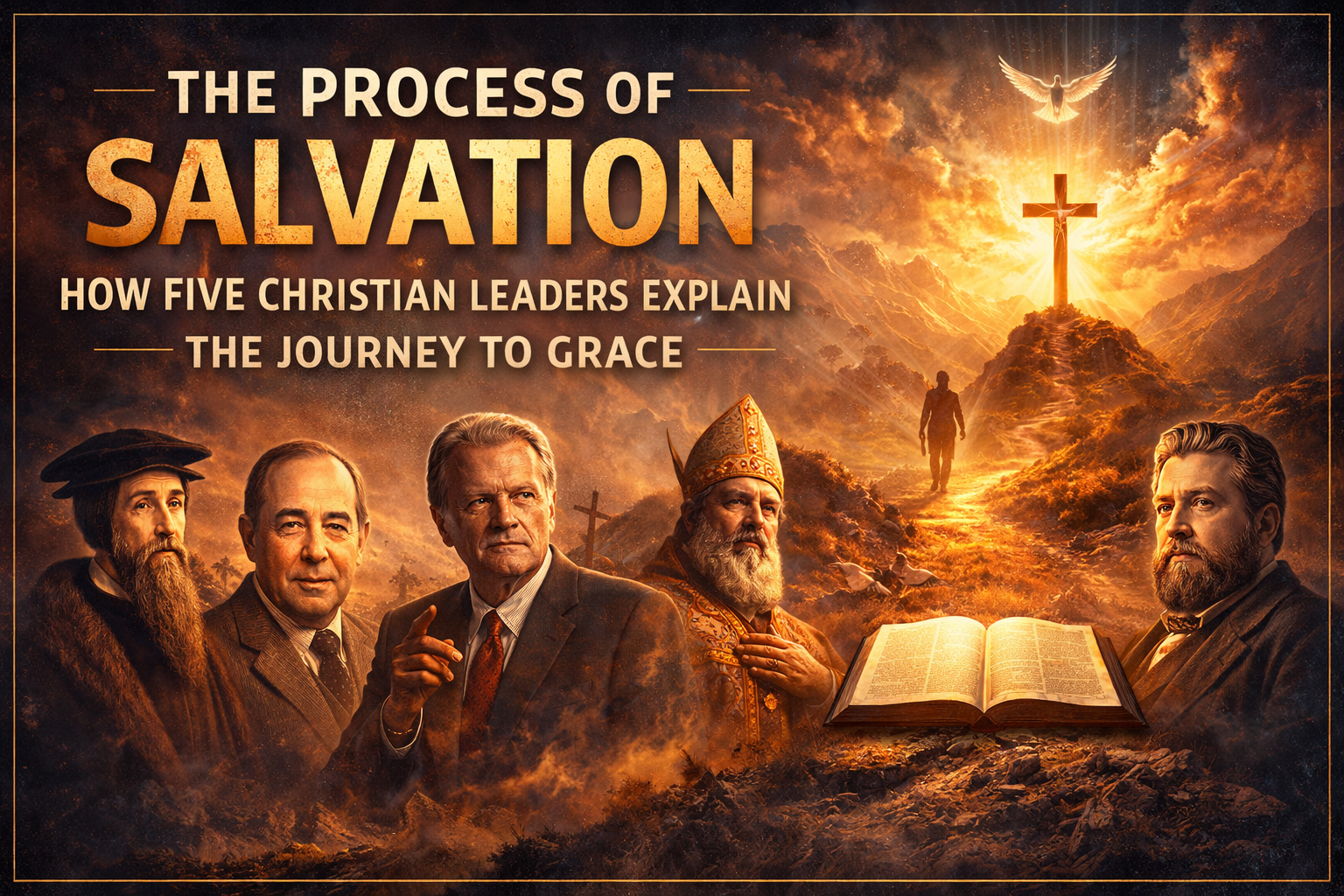
🛤️ The Process of Salvation: How Five Christian Leaders Explain the Journey to Grace
Calvin, Wesley, Graham, MacArthur, and Keller on the Journey from Death to Glory
Ask ten people what “salvation” means and you’ll likely get ten different answers. For some it’s about avoiding hell. For others it’s finding peace with God. But the Bible paints a far richer picture — salvation is a process, a divine journey that starts with God’s call and ends in eternal glory.
Five of the most influential Christian voices of the last five centuries each bring a distinct angle to this journey. They agree on the essentials. They emphasize different facets. Together, they give us a fuller picture than any one of them alone.
“It is by grace you have been saved, through faith — and this is not from yourselves, it is the gift of God.” — Ephesians 2:8
Five Voices, One Gospel
Voice One
🏔️ John Calvin — The Sovereign Hand of God
French Reformer · 1509–1564 · Institutes of the Christian Religion
“The salvation of the elect is the work of God’s sovereign will.” — John Calvin
Calvin believed salvation begins before we were even born. God, in His infinite wisdom, chose the elect before the foundation of the world (Ephesians 1:4–5). Salvation isn’t a response to something good God saw in us — it’s the outworking of His prior, sovereign love. The chain of salvation holds because God holds it.
- ElectionGod chooses some for salvation before creation
- Effectual CallingThe Spirit awakens the heart
- JustificationGod declares the sinner righteous
- SanctificationGod conforms the believer to Christ
- PerseveranceThe elect will not ultimately fall away
📖 Romans 8:29–30 — “Those he predestined, he also called; those he called, he also justified; those he justified, he also glorified.”
Voice Two
🌱 John Wesley — Grace That Goes Before
Methodist Founder · 1703–1791 · Sermons on Several Occasions
“All the steps of salvation are steps of grace.” — John Wesley
Wesley agreed that we are helpless in our sin — but he emphasized prevenient grace: the grace that goes before, restoring enough freedom to every person to respond to God’s call. Salvation is entirely God’s work, but it is offered genuinely to all, and genuine response is required.
- Prevenient GraceGod awakens the soul before we seek Him
- Repentance & FaithThe person freely responds
- JustificationForgiveness and peace with God
- SanctificationGrowth in holiness
- Christian PerfectionFullness of love — the ongoing goal
📖 Titus 2:11 — “For the grace of God has appeared that offers salvation to all people.”
Voice Three
🎤 Billy Graham — The Call to Decision
Evangelist · 1918–2018 · Peace with God
“You must make a decision. Neutrality is a decision against Christ.” — Billy Graham
Graham spoke to more people about salvation than perhaps anyone in history. His message was clear, simple, and urgent: turn from sin and trust Christ. He didn’t waste time with theological abstractions — he brought people to the moment of choice and called them to step forward.
- ConvictionThe Holy Spirit convicts of sin
- RepentanceA turning of heart and mind
- Faith in ChristTrusting in His finished work
- New BirthA changed life begins
- AssuranceConfidence in God’s promises
📖 John 3:16 — “That whoever believes in him shall not perish but have eternal life.”
Voice Four
🪨 John MacArthur — No Cheap Grace
Reformed Pastor · 1939–present · The Gospel According to Jesus
“You are saved by grace through faith — but that faith will produce obedience.” — John MacArthur
MacArthur agrees with Calvin on God’s sovereignty but adds a strong pastoral warning: salvation must produce fruit. He insists on “Lordship salvation” — you cannot have Jesus as Savior and reject Him as Lord. Grace is not a transaction that leaves you unchanged. If it doesn’t change you, examine whether it was real.
- RegenerationThe Spirit gives new birth
- Faith & RepentanceA turning to Christ with surrender
- JustificationLegal acquittal by God
- SanctificationA lifelong obedience
- PerseveranceTrue believers endure to the end
📖 Luke 6:46 — “Why do you call me ‘Lord, Lord,’ and not do what I say?”
Voice Five
🕊️ Tim Keller — The Gospel for Heart and Culture
Presbyterian Pastor · 1950–2023 · The Reason for God
“You are more sinful than you ever dared believe, yet more loved than you ever dared hope.” — Tim Keller
Keller blended Reformed theology with cultural insight, seeing salvation as a story of identity, not just transaction. It’s not enough to be forgiven — we are united to Christ, brought into His family, and sent into the world with a mission. The gospel reshapes not just our standing before God but who we understand ourselves to be.
- Justification by GraceDeclared righteous in Christ
- Union with ChristIdentity is fully reshaped
- SanctificationSpirit-led transformation
- MissionLiving the gospel in the world
📖 Galatians 2:20 — “I no longer live, but Christ lives in me.”
Common Ground Across Five Traditions
These five voices stress different facets — Calvin and MacArthur emphasize God’s initiative; Wesley and Graham emphasize human response; Keller emphasizes identity and mission. But all five stand on the same foundation:
Salvation begins with God’s grace — no one earns it, no one deserves it
Jesus Christ is the only way — His cross is the only ground of forgiveness
Faith involves trust and transformation — it is never merely intellectual
Salvation is ongoing — not just a moment, but a journey to glory
All five point to the same cross, where salvation was purchased once for all (Hebrews 10:10). The angles differ; the anchor is the same.
Five Illustrations for Preaching and Teaching
- Rescue Mission (Calvin) — God planned the delivery before you were even lost on the trail. He initiates the whole mission.
- Porch Light Invitation (Wesley) — Grace draws every soul home. The light is on. The door is open.
- Grab the Rope (Graham) — The lifeguard has thrown it. The decision is yours. Take hold.
- Boot Camp Commitment (MacArthur) — Real enlistment shows up for basic training. Real salvation changes the way you live.
- Adoption Papers Signed (Keller) — You’re not just forgiven — you’re in the family. That changes everything about who you are.
Salvation is not a formula — it’s a relationship. Whether God grabbed hold of you at rock bottom, or you slowly walked toward Him through conviction and grace, it was His hand at work the whole time.
Whether you find yourself drawn more to Calvin’s sovereignty, Wesley’s open invitation, Graham’s urgency, MacArthur’s discipleship, or Keller’s identity transformation — they all lead to the same place: the cross, and the empty tomb, and the God who keeps what He has claimed.
In the end, it’s not our grip on Him that saves us. It’s His grip on us.
“It is by grace you have been saved, through faith — and this is not from yourselves, it is the gift of God — not by works, so that no one can boast.” — Ephesians 2:8–9
Key Scriptures: Ephesians 1:4–5; 2:8–9 · Romans 8:29–30 · Titus 2:11 · John 3:16 · Luke 6:46 · Galatians 2:20 · Hebrews 10:10 · Romans 10:9–10
Want to Go Deeper?
This post is part of an ongoing series on the theologians and pastors who have shaped how Christians understand grace, salvation, and discipleship. Read the companion posts:
- Tim Keller on Predestination — A deeper look at how Keller taught God’s sovereign love.
- What Is Calvinism? TULIP Explained — The full five-point Reformed framework Calvin built.
- What Is Arminianism? — The theological tradition that shaped Wesley and Graham’s evangelism.
- Subscribe to get new posts delivered straight to your inbox — gospel-rooted, plain-spoken truth for the week ahead.
“For it is God who works in you, both to will and to work for his good pleasure.” — Philippians 2:13