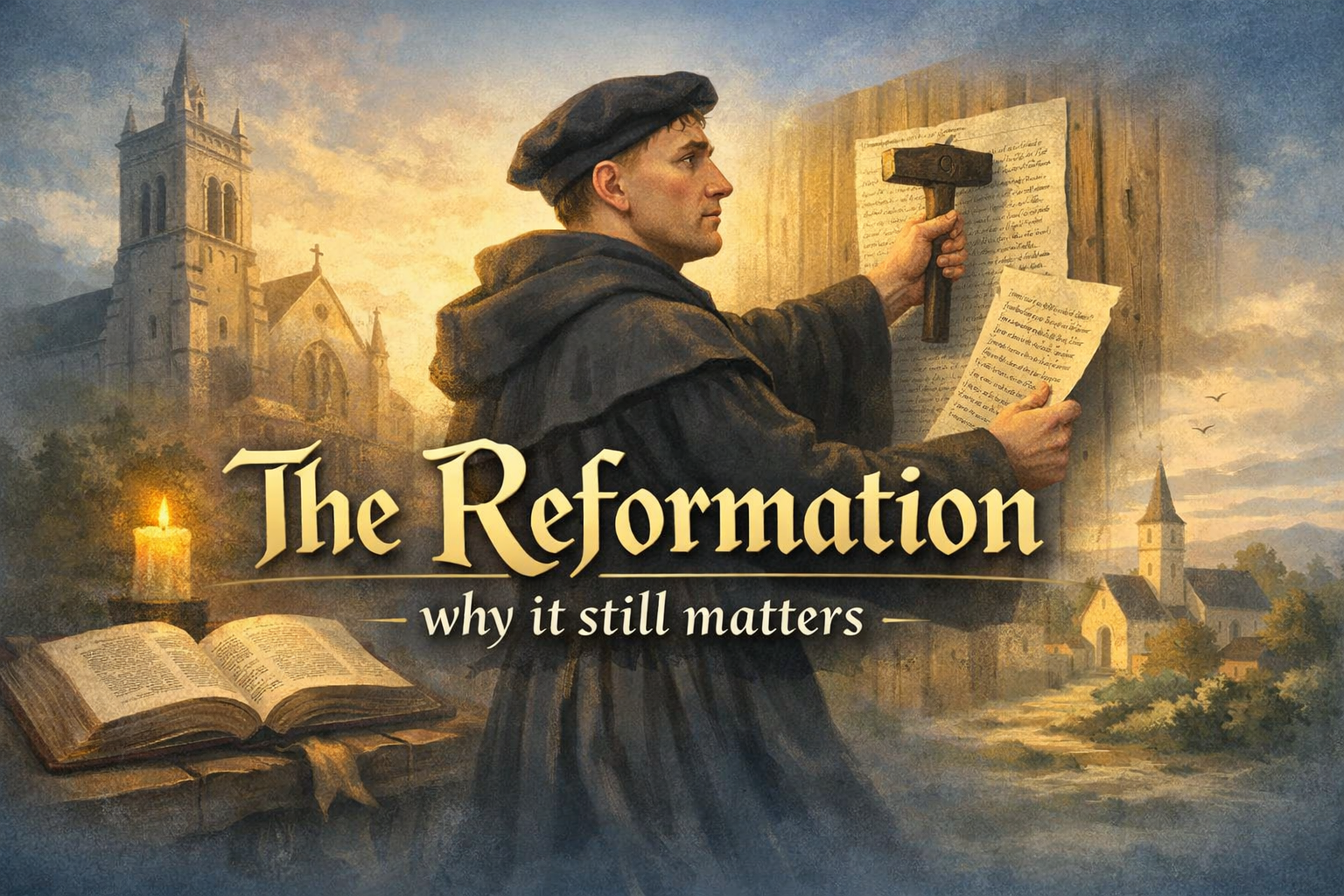
The Reformation: why it still matters
The Reformation was not a rebellion. It was a retrieval. Five hundred years later, the questions Luther forced onto the table — What saves a person? Who speaks for God? What is the church? — are not historical curiosities. They are the questions every serious Christian still has to answer. And the answers still matter more than most people realize.
October 31, 1517 Changed Everything — and We’re Still Living in It
Most people know the basic story. Martin Luther, an Augustinian monk and professor of theology in Wittenberg, Germany, nailed a list of ninety-five theses to the door of the Castle Church on October 31, 1517. He wanted a debate about indulgences — the church’s practice of selling certificates that reduced time in purgatory for the buyer or their deceased relatives. He got a revolution.
Within weeks, copies of his theses had spread across Germany. Within years, the unified institutional church of Western Europe had fractured permanently. Within a generation, new churches had formed in Germany, Switzerland, France, England, Scotland, and the Netherlands — each working out its own answer to the questions Luther had forced into the open.
Five hundred years later, the Reformation can feel like a chapter in a history textbook — interesting if you’re into that sort of thing, but not obviously relevant to how you read your Bible, worship on Sunday, or understand your standing before God. That impression is wrong. The Reformation is not background noise. It is the water most Western Christians are swimming in, whether they know it or not.
What the Reformation Was Actually About
The popular version of the Reformation reduces it to Luther’s outrage over indulgences — a corrupt church selling get-out-of-purgatory certificates, and one brave German standing up to say that was wrong. That’s true as far as it goes, but it misses the depth of what was actually at stake.
The indulgences were the match. The powder keg was the question underneath them: On what basis does a sinful human being stand before a holy God?
Luther had spent years tormented by that question. He was not a casual Christian looking for an excuse to rebel. He was a man driven nearly to despair by his inability to achieve the righteousness God required. He fasted, confessed, flagellated himself — and found no peace. The medieval system told him his standing before God depended on his cooperation with grace, his reception of the sacraments, his penance, his moral progress. He looked at his soul honestly and concluded he was never going to make it.
Then he read Romans. Specifically, he sat with Romans 1:17 — “the righteousness of God is revealed from faith for faith, as it is written, ‘The righteous shall live by faith.'” He had understood “the righteousness of God” as the righteousness by which God judges and punishes sinners. He came to understand it as the righteousness God gives to sinners — freely, as a gift, received through faith alone. He later called this realization his “tower experience.” He said it felt like the gates of paradise had swung open.
That insight — justification by grace alone through faith alone in Christ alone — is what the Reformation was about at its heart. Everything else flowed from it.
The Five Solas: The Reformation in Five Phrases
The Reformers eventually crystallized their recovery of the gospel into five Latin phrases — the Five Solas. They are not a creed, but they function as a diagnostic: if you understand these five phrases and what they rule out, you understand what the Reformation recovered and why it mattered.
Sola Scriptura — Scripture Alone
Scripture alone is the supreme authority for Christian faith and practice. Not Scripture plus tradition. Not Scripture as interpreted by the Pope. Not Scripture filtered through an infallible magisterium. Scripture — the written Word of God — stands over every human authority and corrects every human institution, including the church.
This was the authority claim that made everything else possible. When Luther stood before the Diet of Worms in 1521 and was commanded to recant, he didn’t appeal to tradition or church councils. He said his conscience was captive to the Word of God, and unless he was convinced by Scripture or clear reason, he could not and would not recant. That stand was only possible because he believed Scripture held authority over councils — not the other way around.
Sola Scriptura does not mean every believer reads the Bible in isolation, ignoring two thousand years of Christian interpretation. It means that tradition, while valuable, is always subject to correction by Scripture. Creeds and confessions carry real weight — but always derivative, always reformable if they’re shown to be wrong. The touchstone is always the text.
Sola Gratia — Grace Alone
Salvation is by grace alone — not by human merit, moral achievement, or cooperation with grace. From first to last, salvation originates in the will and action of God, not in the will or action of the sinner. Ephesians 2:8–9 was the Reformation proof text: “For by grace you have been saved through faith. And this is not your own doing; it is the gift of God, not a result of works, so that no one may boast.”
This ruled out the medieval system in which the sacraments functioned as mechanisms for merit-accumulation, and in which a person’s ultimate standing before God depended partly on what they did with the grace they were given. The Reformers insisted that grace is not a substance God infuses into you so you can then cooperate your way to righteousness. Grace is God acting sovereignly and entirely on behalf of helpless sinners.
Sola Fide — Faith Alone
Luther called justification by faith alone “the article by which the church stands or falls.” It is the hinge on which everything turns. Sinners are declared righteous before God — justified — not by what they do, but by faith in what Christ has done. The righteousness by which the believer stands before God is not their own. It is Christ’s righteousness, credited to their account.
The theological term is imputation: Christ’s perfect obedience and atoning death are imputed — counted, credited — to the believer through faith. The sinner’s guilt was imputed to Christ on the cross. Christ’s righteousness is imputed to the sinner through faith. This double exchange is the beating heart of the Reformation gospel.
Paul’s argument in Romans 4 is the anchor: Abraham was justified before he was circumcised, before the law existed, by faith — and the same pattern applies to all who share Abraham’s faith. Justification is a legal declaration, not a process of moral improvement. It is complete at the moment of genuine faith. The Christian’s standing before God does not fluctuate with their moral performance.
Solus Christus — Christ Alone
Christ alone is the mediator between God and humanity. Not Christ plus Mary. Not Christ plus the saints. Not Christ plus the Pope. Not Christ plus the sacramental system. 1 Timothy 2:5: “For there is one God, and there is one mediator between God and men, the man Christ Jesus.” John 14:6: “I am the way, and the truth, and the life. No one comes to the Father except through me.”
The Reformation cleared away the accumulated mediatorial apparatus of medieval Catholicism — the treasury of merit, prayers to saints as intercessors, the priest as necessary mediator of grace — and insisted that the sinner has direct access to God through Christ and Christ alone. This was not anti-clericalism. It was a recovery of the New Testament doctrine of the priesthood of all believers (1 Peter 2:9) — that every Christian has direct access to God through the one high priest who has passed through the heavens (Hebrews 4:14–16).
Soli Deo Gloria — To God Alone Be the Glory
If salvation is by grace alone, through faith alone, in Christ alone, then the glory belongs to God alone — not partially to God and partially to human effort, merit, or cooperation. The Reformers saw the medieval system as ultimately robbing God of glory by making the sinner a co-contributor to their own salvation. If you contributed something to your justification — even the smallest act of cooperation — then some portion of the credit belongs to you.
The Reformation answer: the sinner contributes nothing to their justification except the sin that made it necessary. Everything else — the atonement, the imputed righteousness, the faith itself — is gift. The appropriate response is not pride in spiritual achievement but wonder at sovereign grace. 1 Corinthians 1:29–31: “so that no human being might boast in the presence of God… ‘Let the one who boasts, boast in the Lord.'”
The Reformers Were Not Starting Something New
One of the most persistent misunderstandings of the Reformation is that the Reformers invented a new religion. They didn’t claim to. They claimed to be recovering what had always been there — buried under centuries of tradition, institutional corruption, and theological drift, but still present in the text of Scripture and visible in the early church fathers.
Luther found his doctrine of justification in Augustine. Calvin’s theology is saturated with Chrysostom and Ambrose. The Reformers read the fathers voraciously — not to find support for novelty, but to demonstrate continuity. Their argument was not “we have discovered something new” but “we have uncovered something old that the institutional church has obscured.”
That argument is historically defensible. Historians of medieval theology have traced the development of indulgences, purgatory, and the treasury of merit as innovations with specific dates of origin — not ancient apostolic teaching but later accretions. The Reformation was not the introduction of a foreign body into Christianity. It was surgery to remove one.
“The Reformers didn’t want to start a new church. They wanted to give the church back its gospel. That distinction matters — because a church that has lost its gospel is not being divisive when it says so. It is being faithful.”
What the Reformation Got Wrong
Intellectual honesty requires saying this. The Reformation was a recovery of the gospel — and it was also a movement led by fallen men working in a fallen world, and it produced some things that are hard to defend.
Luther’s later writings about the Jewish people are a stain on his legacy and were used by anti-Semites for centuries after his death. The Reformers’ relationship with civil authority led in some cases to coercion of conscience — Calvin’s Geneva executed Michael Servetus for heresy, and the Reformed tradition in general was slow to develop robust doctrines of religious liberty. The splintering of Protestantism into competing factions created some of the denominational chaos explored in the previous post in this series.
The Reformation also broke some things that didn’t need breaking. The loss of liturgical depth in many Protestant traditions, the erosion of a theology of beauty in worship, the severing of the church from fifteen centuries of accumulated spiritual wisdom — these are real losses, and honest Protestants acknowledge them.
None of this invalidates the recovery of the gospel. But it is a reminder that God works through imperfect instruments, that no movement is immune to the corruption it sets out to oppose, and that the church is always in need of reform — semper reformanda, always reforming. That phrase, often attributed to the Reformed tradition, is not a license for endless doctrinal revision. It is a posture of perpetual accountability to Scripture.
Why It Still Matters Today
The Reformation is not a settled historical question. The issues it raised are live ones — not just between Protestants and Catholics, but within Protestantism itself.
The doctrine of justification by faith alone is under pressure from multiple directions. From the New Perspective on Paul — a school of scholarship that reframes Paul’s argument about justification in ways that some argue blur the Reformation distinctions. From the Federal Vision controversy within Reformed circles, which raised questions about the nature of the covenant and the role of works in final justification. From the practical drift of evangelical preaching toward moralism — telling people to try harder, be better, do more — which is functionally the medieval system with contemporary language.
When a preacher — in any tradition — implies that your standing before God fluctuates with your performance, he has abandoned justification by faith alone, whether he knows it or not. When a church teaches that your access to God depends on your conformity to its institutional requirements rather than your union with Christ by faith, it has rebuilt what the Reformers tore down.
The question Luther asked in his tower is the question every person in every pew still needs answered: How does a sinful human being stand before a holy God? The Reformation answer — by grace alone, through faith alone, in Christ alone, to God’s glory alone, revealed in Scripture alone — is not a 16th-century answer to a 16th-century problem. It is the New Testament answer to the oldest problem in the human story.
That’s why it still matters. Not because history is interesting — though it is. But because the gospel it recovered is the only answer that actually holds under the weight of honest self-examination. Look at your soul the way Luther did and ask whether your moral performance is good enough to stand before a holy God. If the answer is honest, the Reformation starts to look less like a chapter in a textbook and more like a lifeline.
Key Takeaways
- The Reformation was about the gospel, not just church corruption. Luther’s break with Rome was not fundamentally about institutional abuses — it was about the question underneath them: how does a sinful person stand before a holy God? The indulgences were the match; justification was the powder keg.
- The Five Solas are the Reformation in compressed form. Scripture alone, grace alone, faith alone, Christ alone, glory to God alone — each one defines something essential and rules something out. Understanding them is understanding what was recovered and why it mattered.
- Justification by faith alone is the article that makes or breaks everything. Luther called it the article by which the church stands or falls. If your standing before God depends on your performance — even partially — the gospel has been lost, whatever label is on the building.
- The Reformers were recovering something old, not inventing something new. They traced their doctrine through Augustine and the early fathers to Paul and the apostles. The Reformation was retrieval, not revolution — surgery, not construction.
- The Reformation had real failures alongside its real achievements. Luther’s anti-Semitism, the coercion in Reformed Geneva, and the loss of liturgical depth are genuine problems. Acknowledging them is not a concession that the gospel recovery was wrong — it is the posture of semper reformanda applied honestly.
- The Reformation questions are live today, not settled. Justification by faith alone is under pressure from scholarship, from within evangelical Protestantism itself, and from the practical moralism of much contemporary preaching. The recovery is always in danger of being lost again.
Key Scriptures: Romans 1:17 · Romans 3:21–24 · Romans 4:4–5 · Galatians 2:16 · Ephesians 2:8–9 · 1 Timothy 2:5 · 2 Timothy 3:16–17 · 1 Corinthians 1:30–31