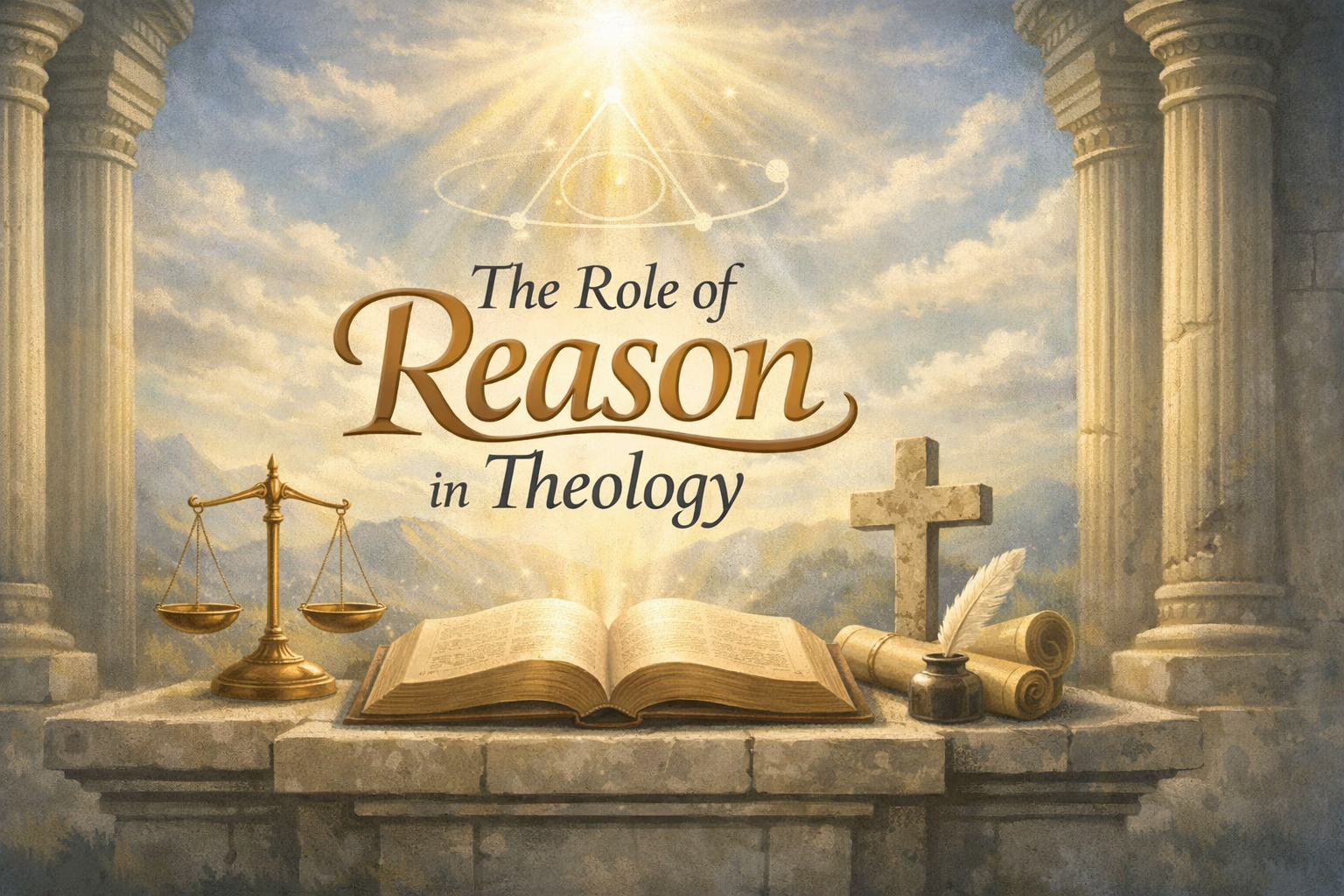
The Role of Reason in Theology
There has always been a tug-of-war in Christian thinking when it comes to reason. Some act as though reason is theology’s great savior — if a thing cannot be neatly measured or explained, they begin to doubt it. Others get so nervous about reason that they speak as if thinking carefully is a threat to faith, as though shutting the mind down is a sign of spiritual seriousness. Both roads go crooked. The right Christian answer is steadier than either extreme.
The Christian faith has never taught that reason is our lord. But neither has it taught that reason is our enemy. Reason has a real role in theology. We use it when we read the Bible, compare passages, draw conclusions, answer objections, guard doctrine, expose error, and explain the faith to others. But reason is not the source of divine truth — God’s revelation is. Reason helps us receive, understand, and apply what God has made known. It does not sit in judgment above Him.
Two Ditches, One Narrow Road
If we get this wrong in either direction, the church suffers.
When reason gets too much authority, we start trimming Christian doctrine to fit what seems manageable. Mysteries like the Trinity, the incarnation, providence, election, and miracles start looking suspicious. Men begin saying “I cannot accept that” — when what they really mean is “I will not accept anything higher than my own mental reach.”
If we throw reason away, we become careless — unable to read carefully, think clearly, defend truth, or expose false teaching. We become easy prey for confusion, emotional manipulation, and shallow religion. Theology without reason becomes mush. A refusal to think is not holiness. Carelessness with doctrine is not humility.
The Christian way is better than both. Theology without reason becomes mush. Reason without revelation becomes pride. The church needs warm hearts and clear heads together.
God Made Us Rational Creatures
Reason is part of God’s good creation. God made man in His image — and while that does not mean we think like God in a divine way, it does mean human beings were created with minds capable of thought, language, judgment, understanding, memory, and reflection. We are not animals driven by instinct alone. We are rational, moral, speaking creatures made to know God, receive His word, and live under His truth.
That means reason itself is not the problem. The problem is fallen reason. Before the fall, Adam’s mind was upright. After the fall, the human mind was not destroyed, but it was darkened by sin. So we still reason — but we do not reason rightly apart from God’s grace and truth.
Ephesians 4:18 — “Having the understanding darkened, being alienated from the life of God through the ignorance that is in them, because of the blindness of their heart.”
The Christian view is not that reason is evil by nature. It is that reason is good by creation, damaged by sin, and therefore in need of correction by revelation. Reason rightly ordered — under Scripture, humble before God — is a genuine blessing. Reason enthroned as the final judge of revelation is a genuine danger.
Theology Already Uses Reason — Always Has
Whether a man realizes it or not, the moment he starts doing theology, he is using reason. When you read one verse and compare it with another, you are reasoning. When you conclude that Jesus is truly God and truly man from Scripture’s witness, you are reasoning. When you say, “This teaching cannot be right because it contradicts that passage,” you are reasoning.
Even the person who says “I do not need reason, I just believe the Bible” is still using reason to read words, understand grammar, connect thoughts, and draw meaning from the text. He may not call it reason, but he is using it all the same. The real issue is not whether reason is used, but how it is used and under what authority.
What Reason Does in Theology
In theology, reason serves revelation. God speaks first. Man listens. Then reason goes to work under God’s word. There is a world of difference between using reason to understand revelation and using reason to judge revelation. The first is faithful theology. The second is rebellion dressed up in respectable language.
- Understanding the meaning of the biblical text — grammar, context, word sense
- Comparing Scripture with Scripture to arrive at the full teaching
- Drawing good and necessary conclusions from what God has revealed
- Organizing doctrine into a coherent, consistent whole
- Answering objections to the faith and exposing contradictions in false teaching
- Guarding against heresy by asking whether a claim fits the whole witness of Scripture
- Applying truth carefully to different situations and questions
- Defending the faith before those outside it
A farmhand can be very useful on the ranch. But if he starts acting like he owns the place, trouble is coming. So it is with reason.
Scripture Shows Reason at Work
The Bible does not call us to mindless faith. It calls us to thoughtful faith.
Matthew 22:37 — “Thou shalt love the Lord thy God with all thy heart, and with all thy soul, and with all thy mind.”
The mind is not left at the church door. Loving God includes thinking rightly about Him. Paul modeled this everywhere he went: “As his manner was, he went in unto them, and three sabbath days reasoned with them out of the scriptures” (Acts 17:2). Not reason apart from Scripture. Not emotion without Scripture. Not mere assertion. He reasoned from what God had revealed.
Even God’s invitation through Isaiah — “Come now, and let us reason together” (Isaiah 1:18) — addresses His people as moral and rational creatures, calling them to reckon honestly with His truth. Theology is not less than rational. It is more than rational, but never less.
Good and Necessary Conclusions
One of the most important roles of reason in theology is helping us draw out what Scripture teaches, even where a doctrine is not stated in one tidy sentence.
Take the doctrine of the Trinity. The word Trinity does not appear in Scripture, but the doctrine is plainly rooted there. How do we arrive at it? By reasoning from the biblical data: there is one God; the Father is God; the Son is God; the Holy Spirit is God; and yet the three are personally distinct. That is reason doing its proper work — not inventing doctrine, but gathering and arranging what God has said.
The same process drives doctrines like the two natures of Christ, justification by imputed righteousness, and the full implications of resurrection hope. Theology depends on what older Christians called “good and necessary consequence” — if Scripture teaches A and Scripture teaches B, and the conclusion naturally follows, that conclusion carries biblical authority. That is not philosophy replacing the Bible. That is reason serving the Bible.
Reason and the Limits of Reason
Reason is useful, but it is not infinite. It does not have access to God’s mind except where God has chosen to reveal Himself. And because man is fallen, reason is not only limited by creatureliness — it is also bent by sin.
Reason can say true things about the Trinity — guard against false statements, explain what the church means and does not mean, protect the doctrine. But no man can exhaust the mystery of the triune God.
Reason can confess and defend the incarnation — one person in two natures, fully God and fully man. But no man can reduce that mystery to something small enough to fit in his pocket.
Reason can help us hold together God’s sovereignty and man’s accountability without collapsing either. But it cannot flatten the mystery away or turn it into a system with no remainder.
The role of reason is not to erase mystery, but to help us think faithfully up to the edge of it — without stepping into contradiction or unbelief. There is a real difference between a mystery and a nonsense. Christianity contains mysteries, not absurdities. Reason helps us see that difference.
The best theology is never cocky. Right theology should produce both clarity and reverence. A good theologian knows how to say both: “This is clearly what Scripture teaches” — and — “This part remains beyond my full understanding.” That is not weakness. That is wisdom.
Reason Must Bow Before Revelation
This may be the most important sentence in the whole discussion: where God has spoken clearly, reason must submit humbly, even when the truth stretches beyond our full understanding.
A child may not understand how electricity works, but he trusts the instruction not to grab a live wire. The issue is not whether he comprehends all the mechanics — it is whether he trusts the one who knows. So too in theology. There are doctrines that humble the mind because they come from above. The right use of reason does not mean we only accept what feels easy or tidy. It means we think carefully — and then bow where Scripture speaks.
Reason says, “I will follow the text.” Pride says, “The text must follow me.” That is the dividing line. And a great deal of theological drift in every age can be traced back to which side of that line a man is standing on.
What Rationalism Actually Does
When reason stops being a servant and starts trying to be king, theology drifts into rationalism — the habit of making human reason the final judge of what may be believed. If a doctrine does not fit the preferences of the modern mind, it gets cut down, redefined, or rejected.
That road has led many to deny miracles, the virgin birth, substitutionary atonement, bodily resurrection, eternal judgment, divine election, and the supernatural character of Christianity itself. Rationalism sounds sophisticated, but it usually amounts to this: “I will accept only the parts of revelation that do not offend my sensibilities.” That is not maturity. That is unbelief with a polished accent. The Christian faith has always insisted that revelation comes first — the mind is not thrown away, but it is not enthroned.
Reason in Apologetics and Systematic Theology
Reason also has a real role in defending the faith before the world. Christians are called to give an answer for the hope within them (1 Peter 3:15). We explain, persuade, clarify, and answer objections. Reason helps us show that the Christian worldview makes sense of morality, that the resurrection rests on serious historical claims, that unbelieving systems often collapse under their own contradictions, and that Christianity offers a coherent account of God, man, sin, and redemption. None of that means reason can convert a soul by itself — only the Holy Spirit can open blind eyes. But reason is a useful instrument in clearing brush and putting truth plainly before men. Paul reasoned. Apollos reasoned. The church should too.
In systematic theology, reason helps us organize the Bible’s teaching on God, Christ, salvation, the church, and the last things into a coherent whole — asking how one doctrine relates to another, protecting against cherry-picking verses, and ensuring that one truth is not preached in a way that crushes another. Without careful thinking, theology gets lopsided fast.
What This Means for Everyday Christians
This is not just for scholars. It has everyday value for every believer who reads the Bible, sits under preaching, or tries to explain their faith to a neighbor.
It means reading the Bible carefully rather than casually. Thinking patiently through hard passages rather than skipping past them. Asking honest questions rather than suppressing them. Avoiding shallow slogans and demanding something more from theological teaching than emotional effect. When you hear a preacher, teacher, podcast, or book, do not only ask “Did that move me?” — ask “Is that true? Does it fit Scripture? Does it hold together?”
It means loving God with your mind is part of faithful discipleship — not a threat to it. And when you come to a hard doctrine, the right response is neither panic nor posturing. Think carefully. Pray humbly. Compare Scripture with Scripture. Be willing to let God be bigger than your comfort zone.
Reason is a servant. Scripture is the rule. God is the Lord. The faithful Christian path is neither blind irrationalism nor arrogant rationalism — it is humble, disciplined, Scripture-shaped thought in the service of knowing and worshiping God. We do not need less thought in theology. We need better thought: humble thought, biblical thought, reverent thought. Minds awake to truth and hearts bowed before God.
Key Takeaways
- Reason is a God-given gift — good by creation, damaged by sin, and necessary in theology. The Christian faith has never called for mindless faith. Loving God with “all your mind” (Matthew 22:37) is part of the command. The question is not whether to use reason, but how and under what authority.
- Reason must be a servant of Scripture, not a master over it. There is a world of difference between using reason to understand revelation and using reason to judge revelation. The first is faithful theology. The second is rebellion dressed up in respectable language.
- Two errors must be avoided: rationalism and anti-intellectualism. Rationalism makes human reason the final judge and ends by denying the supernatural. Anti-intellectualism produces shallow faith, easy prey for false teaching, and an inability to handle the Word carefully.
- Reason draws good and necessary conclusions from Scripture. Doctrines like the Trinity and the two natures of Christ are not found in any one verse but are gathered from the whole biblical witness by disciplined reasoning. That is not philosophy replacing the Bible — it is reason serving it.
- Reason must bow where Scripture speaks, even when mystery remains. There is a difference between a mystery and a nonsense. Christianity contains mysteries — truths that exceed full comprehension but do not contradict reason. The right response is humble confidence, not proud dismissal or anxious retreat.
- Reason serves the church in reading, guarding, defending, and organizing truth. The church needs men who can think clearly, define terms carefully, spot bad arguments, and expose contradiction. Reason is one of God’s instruments for protecting what He has revealed.
Key Scriptures: Isaiah 1:18 · Matthew 22:37 · Acts 17:2 · Romans 12:1–2 · 1 Corinthians 1:18–25 · 2 Corinthians 10:5 · Ephesians 4:17–24 · Colossians 2:2–8 · 1 Peter 3:15