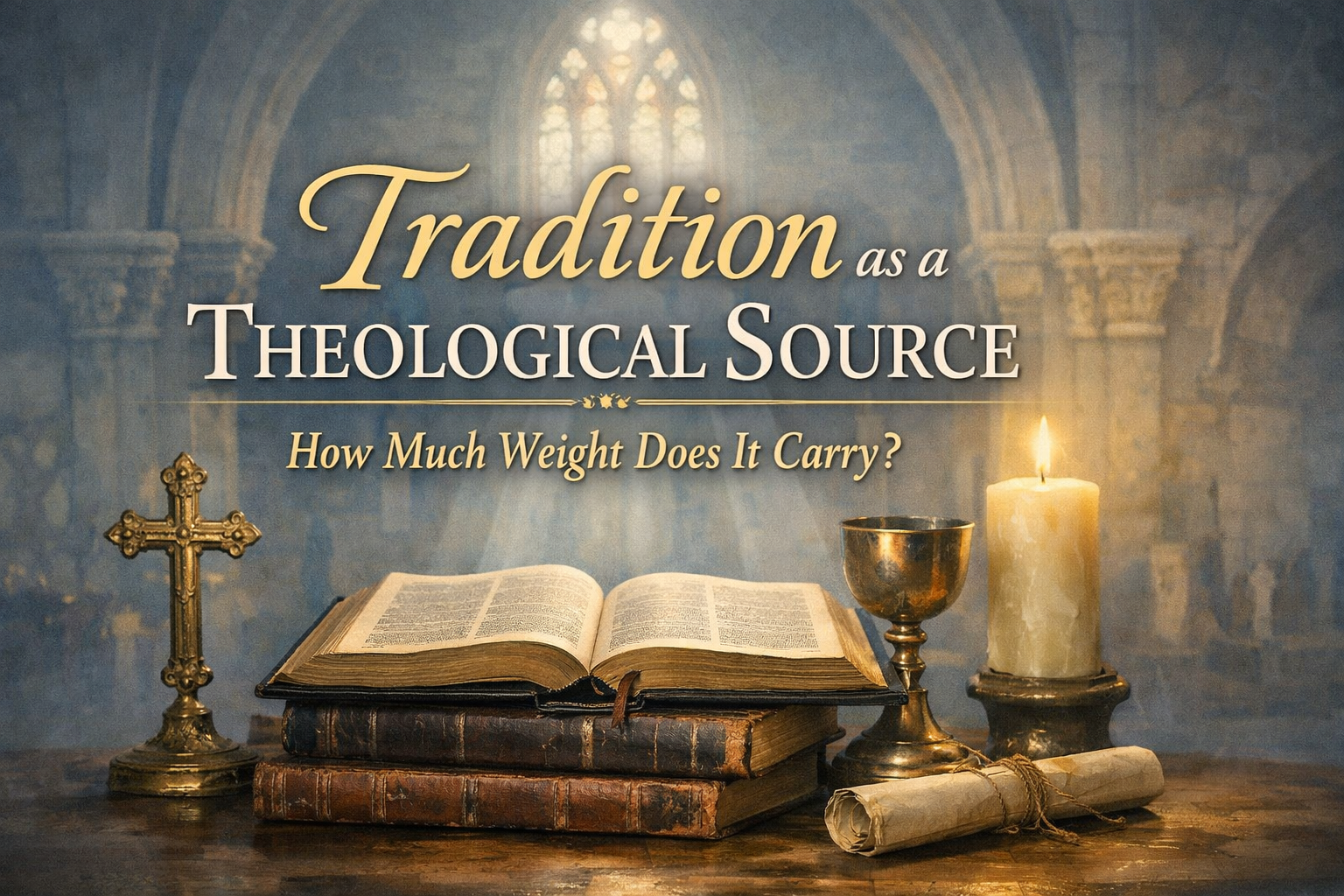
Tradition as a Theological Source — How Much Weight Does It Carry?
Few words in church life stir up as much confusion as the word tradition. For some it is almost a dirty word — dead formalism, man-made rules, dusty habits. For others it carries great weight — the collected wisdom of the saints, the creeds, confessions, and faithful teaching handed down across the centuries. Both instincts have some truth in them. The real question is not whether tradition matters. It plainly does. The real question is how much weight it should carry as a theological source.
A church can go wrong in two opposite directions on this question. One error is treating tradition as nearly untouchable, as though age alone proves truth — a road that leads to man-made rules and unbiblical doctrines. The other is despising all tradition, acting as though the Holy Spirit skipped the first two thousand years of church history and finally started speaking when we opened our Bible last Tuesday — a road that leads to arrogance, novelty, and old heresies wearing fresh boots. The biblical path is steadier than both.
Two Errors, One Balanced Path
Treating tradition as nearly untouchable — as though age alone proves truth — leads to man-made rules elevated to divine law, unbiblical doctrines defended by inertia, and a church that mistakes habit for holiness. Human beings have a talent for turning their preferences into sacred law.
Acting as if history began when you got saved leaves the church arrogant, unstable, and exposed to old errors in new clothes. A man with one Bible and an internet connection can become very puffed up acting as though he has discovered what the entire historic church somehow missed. Usually that is not courage. Usually it is pride.
What “Tradition” Actually Means
Part of the trouble is that the word covers very different things, and not all traditions belong in the same basket.
Sometimes tradition means the passing down of teaching from one generation to the next — what every faithful church is doing when it holds biblical truth over time. Sometimes it means customs and practices like liturgy, hymns, worship styles, or church calendars. Sometimes it means formal doctrinal inheritance — creeds, confessions, council decisions, and the historic consensus of the church on central teachings. And sometimes it refers to human additions that crowd out or contradict Scripture — the most dangerous kind.
Before arguing about tradition, the first question is: which kind are we talking about? Some traditions are wise. Some are helpful. Some are harmless. Some are dangerous. Not all carry the same weight.
What Jesus and Paul Both Say
Scripture gives us both a sharp warning and a real commendation — and we need both.
Jesus’s warning cuts deep:
Mark 7:13 — “Making the word of God of none effect through your tradition, which ye have delivered.”
The Pharisees had built layers of human teaching and practice that in many cases overruled the true intent of Scripture. That is always the danger — a church can start with something practical or even beautiful and over time begin treating it like divine command. Jesus does not condemn age-old faithfulness. He condemns human tradition that cancels divine revelation. That is the line to keep in view.
But Paul gives a real commendation too:
2 Thessalonians 2:15 — “Therefore, brethren, stand fast, and hold the traditions which ye have been taught, whether by word, or our epistle.”
Not all tradition is bad. There was apostolic teaching handed down to the churches, and they were told to hold it fast. That said, the apostolic traditions Paul refers to were tied directly to the authority of the apostles as Christ’s authorized messengers — not merely to later church custom or merely human inheritance. The church today has access to apostolic teaching in its settled, abiding form through Holy Scripture. Later tradition may reflect apostolic truth, but it does not stand alongside Scripture as a second infallible fountain.
Scripture Alone as the Final Authority
This is where the Reformation principle of sola Scriptura matters so much. Sola Scriptura does not mean the Bible is the only thing Christians ever read, or that church history means nothing, or that pastors should ignore the creeds. It means something simpler and stronger: only Scripture is God-breathed and therefore the only infallible rule for faith and practice.
2 Timothy 3:16–17 — “All scripture is given by inspiration of God, and is profitable for doctrine, for reproof, for correction, for instruction in righteousness: that the man of God may be perfect, thoroughly furnished unto all good works.”
The church is under the Word, not over it. Tradition may help us understand, summarize, and apply Scripture — but it cannot rival Scripture in authority. It has ministerial authority, not magisterial authority. It serves, but it does not rule. It instructs, but it does not bind the conscience apart from Scripture.
Four Levels of Theological Weight
Not all tradition carries the same authority. Thinking in layers helps keep the matter clear.
God-breathed, final, and supreme. The only source that carries inherent divine authority. Everything else is tested against it.
The church’s settled, tested confession on core matters like the Trinity, the full deity and humanity of Christ, and the bodily resurrection. This carries very serious weight — a man should tremble before contradicting the settled witness of the faithful church on such things. Not because the consensus is infallible in itself, but because it usually reflects the plain teaching of Scripture hammered out under careful testing.
Important and useful subordinate standards. They help churches state what they believe, preserve doctrinal order, and provide accountability. Not equal to Scripture, but often very helpful for faithful Christian community.
May be wise, foolish, beautiful, clumsy, helpful, or outdated depending on the case. Carry the least theological weight and must never be mistaken for divine law. Old paths should be examined carefully before being bulldozed — but examined they must be.
Why Tradition Still Matters
It reminds us we are not the first Christians. Men and women have walked with Christ for centuries — suffering, praying, studying, preaching, and defending the faith under pressure we can barely imagine. That should make us humble. Tradition reminds us to listen to the communion of saints across time.
It preserves doctrinal clarity. The creeds did not drop from heaven, but many arose because the church had to fight for biblical truth. The Nicene Creed guarded the full deity of Christ. Chalcedon protected the biblical teaching that He is one person in two natures. These are not replacements for Scripture — they are guardrails built by believers who had already driven near some dangerous cliffs. That kind of tradition deserves respect.
It protects against novelty. The church has seen many strange teachings come and go. Every generation produces somebody who says, “I have a new insight nobody else has seen.” Usually the church would do well to ask, “Is it really new — or is it just an old error with a new haircut?” Tradition can help expose novelties for what they are.
It provides wise patterns of worship and discipleship. Not every custom is equally important, but churches benefit from inherited wisdom in prayer, preaching, hymnody, catechesis, and pastoral care. A church that cuts itself loose from all inherited practice often ends up shallow and unstable.
When Tradition Helps — and When It Must Be Resisted
- The church is facing heresy — faithful believers have already answered many old errors
- Interpreting difficult passages — the broad historic reading provides useful footing
- Modern culture pressures the church — tradition is a ballast against passing trends
- Believers are tempted to spiritual individualism — tradition reminds us Christianity is a shared, handed-down faith
- It contradicts the plain teaching of Scripture — the clearest case; it must go
- It binds the conscience where Scripture gives freedom — dangerous ground
- It obscures the gospel or crowds Christ to the edge
- It is defended only because “we have always done it this way” — usually a sign it is being carried by inertia, not conviction
Something can be old and wrong. Something can be old and right. Its age alone does not decide the matter.
The Weight of the Historic Church
Even though Scripture alone is final, the historic church’s broad consensus on central doctrine carries tremendous moral weight. A Christian should not casually dismiss what faithful believers across centuries, languages, and lands have confessed together.
If a man says, “Everybody before me got the Trinity wrong,” or “The church misunderstood Christ for 1,800 years,” he is not showing boldness — he is showing that he has stepped into dangerous country. Councils can err. Confessions can err. Individual fathers can err. Protestants have rightly insisted on that. But it remains a serious thing to stand against the settled witness of the faithful church on foundational matters.
A wise Christian says, “Scripture is my final authority — but I do not trust myself more than the whole historic church without very good reason.” That is a healthy posture.
The Crucial Distinction
Scripture is inspired. The church’s reading of Scripture is not inspired in the same way. Scripture is infallible. Tradition is not infallible in itself. Scripture creates and reforms the church. Tradition should be continually reformed by Scripture. Yet the church’s reading of Scripture still matters — we read the Bible as members of Christ’s body, with help from pastors, teachers, confessions, and the saints who have gone before us. Neither flatten the difference nor sever the relationship.
Think of tradition like an old cast-iron skillet passed down through the generations. It has proven useful. It carries the marks of many hands before yours. You ought not throw it out lightly. But the skillet is not the stove fire — it does not create the heat, only carries it. So it is with tradition: it can carry the warmth of truth handed down, but it does not generate divine authority on its own. The fire comes from God’s Word. And if the skillet cracks and starts poisoning the meal, sentiment alone is not enough to save it.
Key Takeaways
- Tradition carries significant but subordinate weight. It carries enough to deserve respect, careful attention, and real gratitude. It does not carry final, infallible, or Scripture-rivaling authority. The plain answer: tradition is a respected witness, not the supreme judge.
- Scripture alone is God-breathed and therefore the only infallible rule for faith and practice. Sola Scriptura does not mean ignoring history. It means recognizing that only Scripture holds inherent divine authority — everything else, including tradition, must be tested by it.
- Not all tradition belongs in the same basket. Historic creeds and broad doctrinal consensus carry more weight than local customs. Apostolic tradition inscripturated in the New Testament carries infinitely more weight than later church practice. Thinking in levels protects against both over-weighting and under-weighting.
- Tradition serves the church best when it reflects biblical truth — and must be resisted when it contradicts Scripture, binds where Scripture gives freedom, or obscures the gospel. Age alone does not prove rightness. Neither does novelty prove error. Scripture is the test.
- The broad historic consensus of the church on central doctrines carries serious moral weight. A wise Christian does not casually depart from what faithful believers across centuries have confessed together — not because the consensus is infallible, but because such consensus usually reflects the plain teaching of Scripture carefully tested under pressure.
- A healthy church receives tradition gratefully, tests it constantly by Scripture, and hands down what is good without pretending it equals God’s Word. That kind of church has roots without being chained to dead weight, reverence without superstition, and continuity without idolatry.
Key Scriptures: Mark 7:1–13 · 2 Thessalonians 2:15 · Acts 17:11 · 1 Corinthians 4:6 · 2 Timothy 3:16–17 · Jude 3 · Hebrews 11–12