
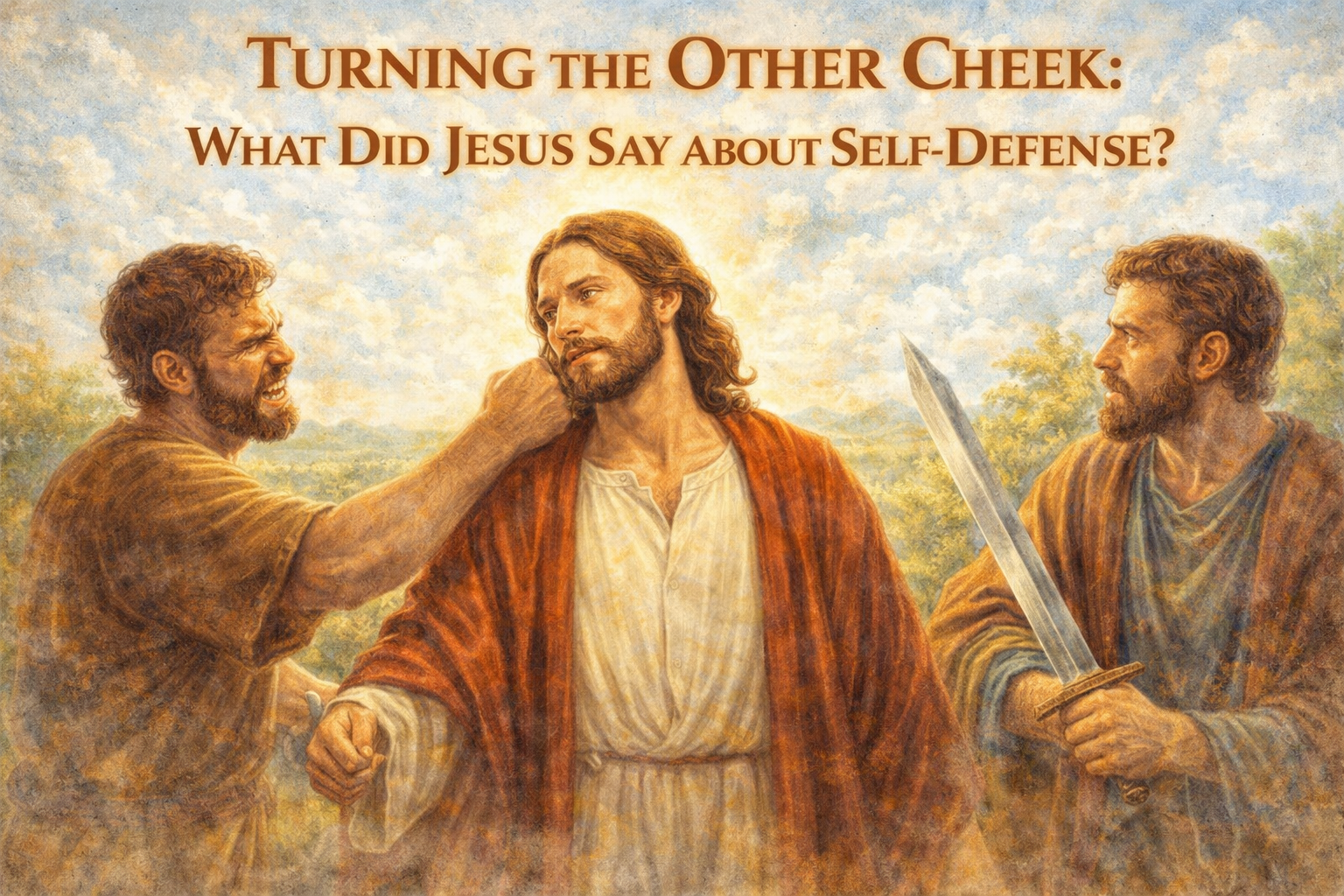
Turning the Other Cheek: What Did Jesus Say About Self-Defense?
Should Christians Be Passive in the Face of Evil? A Careful Look at Matthew 5:39
In a world where violence and injustice seem to be everywhere, Jesus’ words about “turning the other cheek” leave many believers with real questions: Should Christians be passive in the face of evil? Does Jesus expect us to be doormats? Is it sinful to protect ourselves or others?
These aren’t trivial questions — especially for veterans, rural families, and anyone who has faced genuine danger. Let’s look carefully at what Jesus actually meant, and how His teaching applies to everyday life.
“But I tell you, do not resist an evil person. If anyone slaps you on the right cheek, turn to them the other cheek also.” — Matthew 5:39 (NIV)
What Did Jesus Mean by “Turn the Other Cheek”?
Context is everything here. In first-century Jewish culture, a slap on the right cheek — from a right-handed person — would almost certainly be a backhanded slap. That was a gesture of deliberate insult and humiliation, not a physical assault designed to cause bodily harm. It was the kind of thing you did to shame someone you considered inferior.
Jesus isn’t addressing every possible scenario of violence. He’s addressing the specific human reflex to strike back when personally insulted or shamed — and calling His followers to something harder and better than retaliation.
❌ What Jesus Is NOT Saying
- Let someone break your jaw or cause you physical harm
- Allow yourself to be mugged without response
- Refuse to defend your family
- Abolish law enforcement or all use of force
- Practice total pacifism in every situation
✅ What Jesus IS Saying
- Don’t repay personal insult with retaliation
- Refuse the reflex to escalate when shamed
- Break the cycle of vengeance with grace
- Trust God’s justice rather than seeking your own
- Lead with mercy, not wounded pride
This teaching is about rejecting revenge — not abandoning protection. There’s a crucial difference between those two things, and Jesus draws it clearly.
What Does the Rest of Scripture Say About Defense?
Luke 22:36 — “Buy a Sword”
Jesus Anticipated His Followers Would Need to Protect Themselves
“If you don’t have a sword, sell your cloak and buy one.” While this has been interpreted in multiple ways, it at minimum shows that Jesus didn’t forbid His followers from possessing means of defense. He later tells Peter to put the sword away — not because owning it was wrong, but because violence wasn’t the answer in that specific moment.
Romans 13:4 — The Role of Government
Civil Authority Has a Legitimate Role in Using Force
“The one in authority is God’s servant for your good… They do not bear the sword for no reason.” Paul explicitly affirms that governments and law enforcement can rightly use force to maintain order and protect the innocent. Justice and protection are not contrary to God’s design.
Proverbs 24:11 — Rescue the Vulnerable
We Have a Moral Responsibility to Protect the Helpless
“Rescue those being led away to death; hold back those staggering toward slaughter.” This verse makes clear that failing to act in defense of the vulnerable can be just as morally wrong as retaliating in anger. Protecting the innocent is not a violation of Jesus’s teaching — it is an expression of the love Jesus commanded.
The Heart of the Teaching: Let Go of Personal Retaliation
The center of Jesus’s command is this: don’t respond to evil with more evil. The world says hit back harder. Jesus says show mercy and break the cycle. He’s not preaching weakness — He’s preaching restraint, grace, and trust in God’s justice.
The Farmer and the Slander
A farmer is slandered by a neighbor — lies spread through the community about his character. He’s furious. He has every right to fight back publicly, to make the neighbor pay for what he said.
Instead, he shows up at the neighbor’s door with a basket of potatoes and blesses his family.
That’s not weakness. That’s grace under pressure. That’s “turning the other cheek” — refusing to let the neighbor’s wrong become his own.
And before we say that’s impossible — Jesus modeled it Himself. When falsely accused, beaten, and mocked, He didn’t strike back. He fulfilled Isaiah 53:7 — “He was oppressed and afflicted, yet He did not open His mouth.” On the cross, He prayed for the men driving the nails: “Father, forgive them, for they do not know what they are doing” (Luke 23:34). He wasn’t weak. He was victorious through sacrificial love.
Protecting Others Is Different from Personal Revenge
It’s important to distinguish between two things that are often confused: personal retaliation when we’re insulted, and protective action on behalf of others who cannot defend themselves. The Bible treats these differently.
- Psalm 82:4 — “Rescue the weak and needy; deliver them from the hand of the wicked.”
- James 1:27 — “Pure religion… look after orphans and widows in their distress.”
- Micah 6:8 — “Do justice, love mercy, walk humbly with your God.”
It is not unloving to defend your family. In many circumstances, it is the most loving thing you can do. The command to turn the other cheek is personal and relational — it addresses the heart that wants revenge. It does not suspend our responsibility to protect those in our care.
Applying It Today
Online Attacks
When insulted on social media, respond with grace — or not at all. Let your character speak louder than your keyboard. The platform rewards escalation; Jesus rewards restraint.
Public Conflict
In a parking lot, on the road, or at the gas station — choose peace over escalation. A moment of wounded pride can turn into a lifetime of regret. Walk away. It’s a strength move, not a weak one.
Church and Community Drama
When rumors spread, resist the urge to strike back with more words. Pray. Forgive. Bless. Let the truth come out on its own. That’s the Jesus way — and it tends to work better than the alternative.
Two True Stories That Put This to the Test
🕊️ True Story One
Corrie ten Boom — Forgiving a Nazi Guard
Corrie ten Boom survived a Nazi concentration camp, where her sister died. Years later, she came face-to-face with one of her former captors — now a Christian — who extended his hand and asked for her forgiveness.
Her heart said no. Every part of her resisted. But in an act of obedience to Christ, she extended her hand. She later wrote that she felt a warmth flood through her — a love for that man she could never have produced herself.
That moment changed both of them. That’s the power of turning the other cheek — not as a passive gesture, but as a costly, deliberate act of grace.
🕯️ True Story Two
The Amish of Nickel Mines, Pennsylvania — 2006
After a gunman killed five Amish girls at a schoolhouse in 2006, the Amish community did something the world struggled to comprehend. They forgave him publicly — and not just with words. They attended his funeral. They established a charitable fund for his widow and children.
The world watched, bewildered. But that community was simply doing what Jesus said. Their response was not weakness — it was a supernatural testimony that drew national attention and changed conversations about faith, grief, and grace.
Turning the other cheek doesn’t mean you let yourself or others be destroyed. It means you refuse to let evil rule your heart. Jesus is calling you to a radical lifestyle — one that forgives instead of retaliating, loves instead of hating, and trusts God’s justice instead of seizing your own.
That’s not weakness. That’s the strength of a transformed heart. And in a world that has never stopped shouting for revenge, it is one of the most distinctive things a Christian can do.
“Do not repay anyone evil for evil… Do not be overcome by evil, but overcome evil with good.” — Romans 12:17, 21 (ESV)
🙏 Closing Prayer
Lord Jesus, help me turn the other cheek when I am insulted. Give me wisdom to know when to defend and when to be silent. Teach me to trust You with justice. Let Your love rule my heart, not anger. Make me a peacemaker in this broken world. In Your strong name, Amen.
Key Scriptures: Matthew 5:39, 44 · Romans 12:17–21 · Luke 22:36 · Luke 23:34 · Romans 13:4 · Proverbs 24:11 · Psalm 82:4 · James 1:27 · Micah 6:8 · Isaiah 53:7 · Matthew 5:9 · Luke 6:36
Want to Go Deeper?
This post is part of an ongoing series on what the Bible actually teaches — in context and without the common misreadings. If it helped clarify a passage you’ve wrestled with, here are a few next steps:
- Share it with someone struggling with forgiveness, or a veteran wrestling with how Christian faith relates to force and protection — this post speaks to both.
- Read Matthew 5:38–48 in full — the larger context of “turn the other cheek,” which includes loving enemies and praying for persecutors. It’s one of the most demanding and beautiful passages in all of Scripture.
- Subscribe to get new posts delivered straight to your inbox — gospel-rooted, plain-spoken truth for the week ahead.
“Blessed are the peacemakers, for they shall be called sons of God.” — Matthew 5:9




Thank you for sending this Don. It makes everything so much clearer.