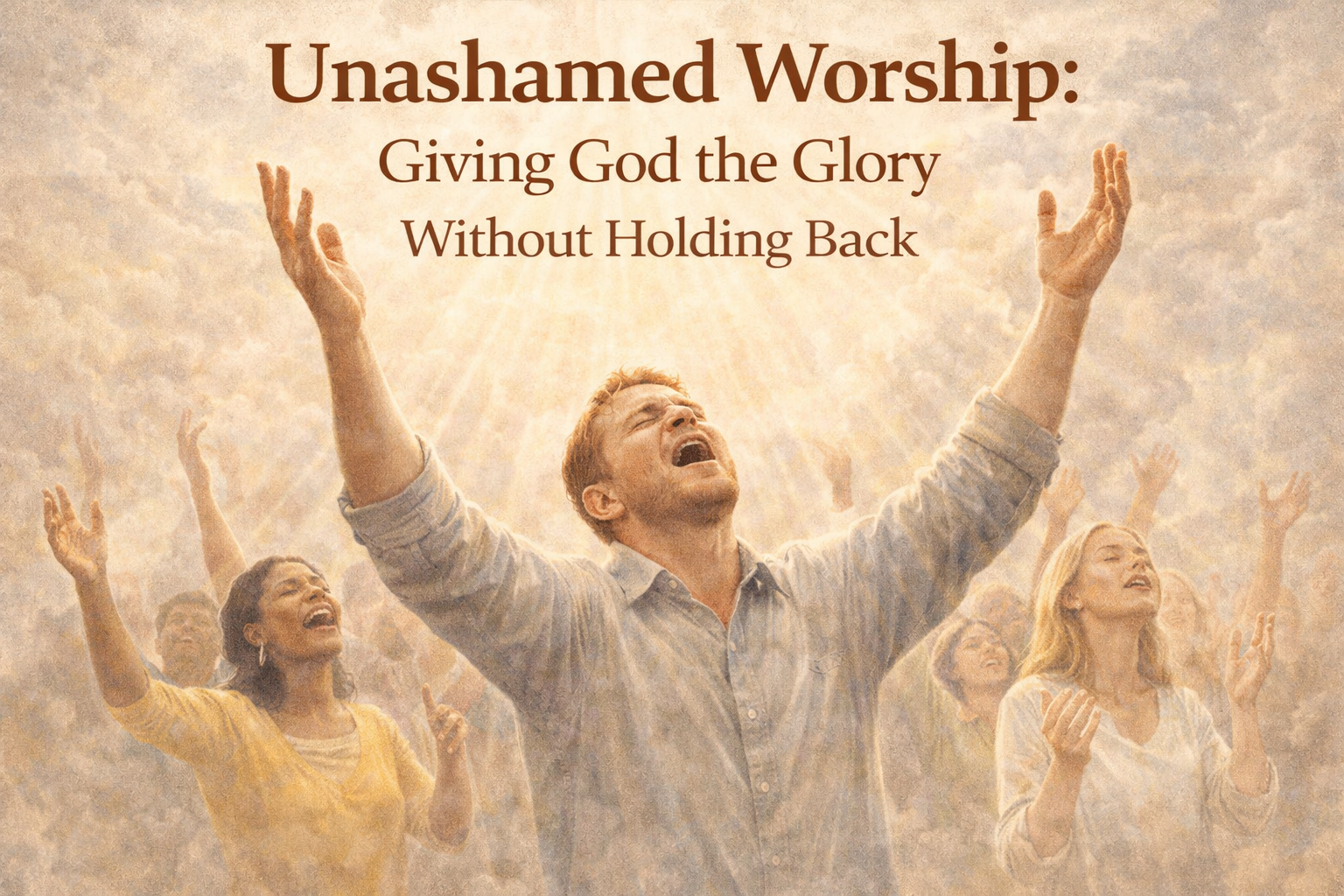
Unashamed Worship: Giving God the Glory Without Holding Back
Biblical Roots, Theological Voices, and a Few Boots-on-the-Ground Stories About What It Looks Like to Praise God Without Apology
In a world that often scoffs at faith and sidesteps reverence, unashamed worship is more than a spiritual discipline — it’s a declaration. It says: God is worthy, regardless of what anyone around me thinks. But what does unashamed worship actually look like? Is it about raising your hands in a Sunday service? Is it shouting praise on the job site? Or is it something deeper and more durable than any single expression?
This post explores the biblical foundations, theological voices, and practical shape of unashamed worship — the kind that doesn’t stay inside the church walls.
“I am not ashamed of the gospel, for it is the power of God that brings salvation to everyone who believes.” — Romans 1:16
What Is Unashamed Worship?
Unashamed worship is the open, fearless, and sincere honoring of God in every part of life. It is the kind of worship that is more concerned with God’s glory than with public opinion — not about putting on a show, but about refusing to conceal the fire that God has lit in your soul.
Psalm 34:1 captures it plainly: “I will bless the Lord at all times; His praise shall continually be in my mouth.” That word continually is the key. This is not worship confined to a service or a season — it is worship as a way of existing. And Luke 9:26 makes the stakes clear: “Whoever is ashamed of me and my words, of him the Son of Man will be ashamed.”
Worship isn’t just singing in a pew. It’s living in a way that unapologetically declares God’s worth — with your heart, your hands, your voice, and your life.
The Coal Miner Who Sang
In a small Appalachian town, a coal miner came out of a twelve-hour shift, covered in black dust, and sat on the bench outside the mine entrance. People said he’d start humming “How Great Thou Art,” and by the second verse he was singing full-throated, with tears cutting through the grime on his face.
Some called him strange. Others joined in.
He never preached a sermon. But his unashamed worship moved more souls than many preachers ever did. That is the quiet power of giving God praise when nobody’s watching — or when everybody is.
Three Biblical Portraits of Bold Worship
Portrait One — 2 Samuel 6:14–22
King David’s Dance
When the Ark of the Covenant was brought back to Jerusalem, David worshiped with uninhibited joy — dancing in the streets before all the people. His wife Michal watched from a window and despised him for it, mocking him for making a spectacle of himself. David’s response was among the most memorable in Scripture: “I will become even more undignified than this” (v. 22).
The lesson is unmistakable: David cared more about pleasing God than impressing people. True worship may look foolish to those watching from a distance, but it is precious to the One it’s directed toward.
Portrait Two — Luke 7:36–50
The Woman with the Alabaster Jar
A woman known throughout the town for her sinful past enters a Pharisee’s dinner party uninvited. She breaks open a costly jar of perfume at Jesus’ feet, weeping, wiping them with her hair. The religious elite were scandalized. Jesus praised her extravagantly: “Her many sins have been forgiven — as her great love has shown.”
Real worship is costly. It is rooted in gratitude and love, not in reputation management. This woman had nothing left to lose in terms of social standing — and everything to give to the One who had forgiven her.
Portrait Three — Acts 16:25
Paul and Silas in the Prison Cell
They were in chains, in a Roman prison, after a public beating. And they sang. Not quietly, apparently — the other prisoners were listening. The result was a jailer and his entire household coming to faith before morning.
Worship is not dependent on circumstances, comfort, or freedom. It is an act of faith — a declaration that God is worth praising regardless of what surrounds you at the moment.
Four Theological Voices on Unashamed Worship
John Piper — Desiring God
Piper argues that genuine worship springs from joy in God. When God becomes our treasure — the thing we most want — we naturally express it with boldness. Timid worship often reflects a heart that hasn’t fully grasped what it has received.
A.W. Tozer — Whatever Happened to Worship?
Tozer saw worship as far more than a Sunday routine. It is the believer’s lifelong calling — the purpose for which we were made. Worship that is dry, mechanical, or fear-driven dishonors the Spirit who gives life, and reveals a soul that has lost sight of who God actually is.
Darlene Zschech — Extravagant Worship
The songwriter behind “Shout to the Lord” presses the point that bold worship happens not just in a sanctuary, but in everyday obedience, ordinary work, and daily love for people. What happens on Sunday is meant to spill into Monday.
Matt Redman — The Heart of Worship
Redman’s famous song was written after his church stripped away all their music and production to ask a harder question: are we worshiping God, or are we worshiping our worship experience? Performance and showmanship can rob worship of its power. Honest, humble praise — without polish — is what God is after.
Why We Sometimes Hold Back
Many believers hold back in worship, even when they know they shouldn’t. Three reasons come up most often — and each has a biblical response.
Fear of Looking Foolish
We are afraid of what people will think. In our reputation-obsessed culture, vulnerability feels genuinely costly. But Paul wrote: “If I am out of my mind, it is for God” (2 Corinthians 5:13). The apostle who wrote that was not embarrassed by it. The fear of looking foolish in worship is really just pride dressed in more acceptable clothes.
Cultural and Denominational Norms
Some traditions rightly emphasize quiet, solemn, reverent worship — and there is real beauty in that. But sometimes those norms stifle expressions that Scripture actually encourages: shouting, dancing, clapping, kneeling, weeping. The Psalms model all of these. The question worth asking is whether the restraint comes from reverence or from self-consciousness.
Spiritual Apathy — Love That Has Cooled
When our love for God cools, worship becomes ritual instead of real. The form continues but the fire is gone. Jesus addressed exactly this in His letter to the Ephesian church: “You have forsaken the love you had at first” (Revelation 2:4). Apathetic worship is usually a symptom of a love that needs rekindling, not a posture that needs adjusting.
The cure for apathy is not more effort. It is more encounter — returning to the gospel, to prayer, to the Word, until the first love revives.How to Cultivate Unashamed Worship
Remember What God Has Done
Gratitude is the fuel of worship. Meditate on His faithfulness, His mercy, His patience, and the specific moments in your own life where He showed up. A heart that remembers tends to praise.
“Forget not all His benefits.” — Psalm 103:2Practice Worship in Private First
Sing in your car. Pray aloud at home. Lift your hands when no one is watching. What you do in private shapes who you are in public. The habit of unashamed worship has to be built somewhere before it can show up naturally in the presence of others.
Join a Community That Worships Without Fear
Worship is genuinely contagious. Being around believers who are unafraid to express their love for God gives courage to those who are still learning. Don’t underestimate what the right community does to the health of your own worship life.
Let the Psalms Shape You
The Psalms model worship in every form — lament, joy, repentance, celebration, shouting, silence, confession, and praise. They give language to the full range of human experience before God. Read them slowly. Pray them back. Let them teach your soul the vocabulary of honest worship.
Psalm 150 — “Praise Him with trumpet, lyre, harp, dancing, strings, pipe, and clashing cymbals. Let everything that has breath praise the Lord.”The Rancher and the Doxology
A rancher from Wyoming shared this story with a pastor friend. He was out on the north range, and the sun was breaking over the ridge. It hit him that he hadn’t thanked the Lord in days. So he tipped his hat, stood by his horse, and sang the Doxology like he was standing in a cathedral.
Worship doesn’t need stained glass. It needs sincerity. That was church for him that day.
Worship as Witness
When we worship openly and joyfully, it affects the people around us in ways we rarely anticipate. Paul and Silas sang in a Roman prison and a jailer’s family came to faith. The coal miner sang at the end of his shift and people joined in. Worship that is unashamed is also, quietly, evangelism.
“You are a chosen people… that you may declare the praises of him who called you out of darkness into his wonderful light.” — 1 Peter 2:9
Nonbelievers see authenticity when they cannot see anything else. Children learn how to value God by watching whether the adults around them do. Fellow believers are strengthened when someone else is willing to go first. Unashamed worship is not about drawing attention to ourselves. It is about drawing attention to God — and the world needs more of that, not less.
We live in a time when many people are loud about their opinions and quiet about their faith. The church must be the opposite: bold in worship, humble in heart.
Whether you’re a farmer, a teacher, a veteran, or a young parent — don’t hold back your praise. Raise your voice in whatever way is genuine for you. Bow your heart. Let your life say, in the ordinary moments of every ordinary day, that God is worthy.
Because He is. And the world around you is watching, whether it admits to looking or not.
“I will bless the Lord at all times; His praise shall continually be in my mouth.” — Psalm 34:1
Key Scriptures: Romans 1:16 · Psalm 34:1; 103:2; 150 · Luke 7:36–50; 9:26 · 2 Samuel 6:14–22 · Acts 16:25 · Revelation 2:4 · 2 Corinthians 5:13 · 1 Peter 2:9 · John 4:23–24 · Philippians 4:4
Want to Go Deeper?
This post connects to several others in MVM’s series on Christian life and discipleship:
- The Holy Spirit — the One who enables the kind of worship described here, producing in us what we cannot produce in ourselves
- What Jesus Expects from His Church — worship in Spirit and truth is one of the eight things Jesus specifically expects from the body He is building
- Sanctification — how the ongoing work of the Spirit shapes the character that makes unashamed worship feel natural rather than forced
- The Pursuit of God — A.W. Tozer; perhaps the finest short treatment of what genuine worship costs and what it produces in the one who pursues it
- Desiring God — John Piper; the full theological case for why satisfaction in God is the root of all authentic praise
- Subscribe to get new posts delivered straight to your inbox — gospel-rooted, plain-spoken truth for the week ahead.
“God is spirit, and his worshipers must worship in the Spirit and in truth.” — John 4:24