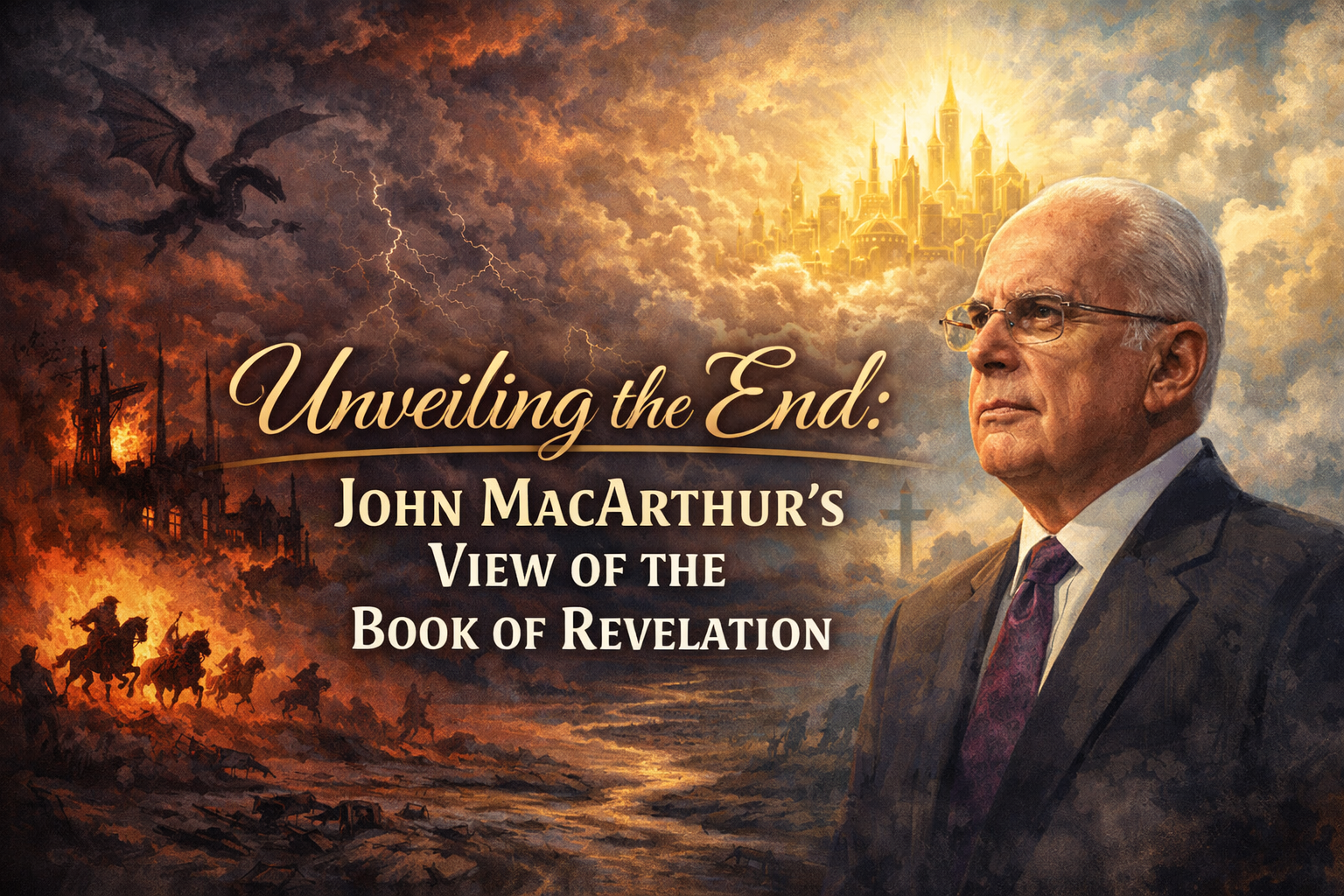
Unveiling the End: John MacArthur’s View of the Book of Revelation
How Pastor-Teacher John MacArthur’s Expository Method Unlocks the Majesty, Judgment, and Hope of Revelation
The Book of Revelation has stirred hearts and stirred debate ever since the Apostle John penned it on the island of Patmos. Mysterious imagery, prophetic declarations, and dramatic visions have fascinated — and puzzled — believers for centuries. But for Dr. John MacArthur, Revelation is not meant to confuse. It’s meant to reveal.
John MacArthur
Pastor-Teacher of Grace Community Church in Sun Valley, California; founder of Grace to You radio ministry; author of the MacArthur New Testament Commentary series. MacArthur has preached verse-by-verse through the entire New Testament over more than fifty years of pastoral ministry, including multiple series through Revelation.
“When the plain sense makes good sense, seek no other sense.” — John MacArthur
MacArthur’s Interpretive Method
MacArthur interprets Revelation literally, unless the text itself clearly signals a symbol. He applies a consistent literal-grammatical-historical hermeneutic — the same method he uses throughout Scripture — treating Revelation as divine prophecy written in advance, not allegory, not church history in disguise, and not a symbolic poem about first-century Rome.
He structures the entire book using the outline provided within Revelation itself:
Chapter 1
“What you have seen”
John’s vision of the glorified Christ in His full majesty and authority
Chapters 2–3
“What is”
The seven letters to real churches — the church age, from Pentecost to the rapture
Chapters 4–22
“What will take place after this”
Future events — from the tribulation through the eternal state
Walking Through the Book
Chapter 1
👑 The Supremacy of Christ Unveiled
At the heart of Revelation is not primarily a prophetic sequence — it is a Person. MacArthur emphasizes that the book opens with Jesus in His glorified, sovereign role as Judge and King. John’s vision of the exalted Christ (Rev. 1:12–20) — with hair white as wool, eyes like blazing fire, feet like bronze, a voice like rushing waters, and a sharp sword from His mouth — is meant to overwhelm and reorient us before any tribulation vision begins.
He is the Alpha and Omega (Rev. 1:8), the Lamb who was slain (Rev. 5:6), and the Rider on the White Horse (Rev. 19:11–16). Every subsequent vision in the book is anchored in His identity.
Chapters 2–3
📌 Letters to Seven Real Churches
MacArthur treats these letters as written to actual first-century congregations — with genuine commendations and genuine warnings. But he also reads them as carrying a representative message for churches in every age. Ephesus has left its first love. Smyrna will face persecution. Laodicea is neither hot nor cold and will be spat out. These letters function as a mirror for every congregation that reads them.
Chapters 4–5
🏛️ The Throne Room — Where History Is Governed
John is called up into heaven and sees the throne of God, surrounded by four living creatures and twenty-four elders in ceaseless worship. The sealed scroll represents God’s plan for history — and no one is found worthy to open it until the Lamb appears. This scene establishes the theological premise for everything that follows: history is not out of control. It is in the hands of the slain and risen Lamb.
Chapters 6–18
⚡ The Seven-Year Tribulation
MacArthur teaches a literal seven-year Tribulation period, aligned with Daniel’s 70th week (Daniel 9:24–27). God’s wrath is poured out in three escalating series of judgments:
🔒 Seals (Ch. 6)
War, famine, death, martyrdom — the opening of history’s final chapter
🎺 Trumpets (Ch. 8–9)
Natural disasters, cosmic upheaval, demonic forces unleashed
🥣 Bowls (Ch. 16)
Final, unrestrained judgments — the full measure of divine wrath
Each series builds on the last, intensifying toward a final confrontation between Christ and the kingdoms of the world. Also during this period: the Antichrist rises, the 144,000 literal Jewish evangelists preach the gospel worldwide (Rev. 7, 14), and the Two Witnesses stand boldly in Jerusalem.
Chapter 13
🐉 The Antichrist and the False Prophet
MacArthur interprets Revelation 13 as describing two literal future individuals — not systems or symbols. The Beast from the Sea is the Antichrist: a world leader empowered by Satan, who emerges as a diplomat and peacemaker before revealing himself as a global tyrant. The Beast from the Earth is the False Prophet: a religious leader who directs worship toward the Antichrist and enforces the Mark of the Beast.
The Mark (Rev. 13:16–18) is a literal economic control system — required for buying and selling, signifying allegiance to the Antichrist. Those who refuse it will be marginalized and many will be martyred.
Chapter 19
⚔️ The Second Coming — Not in Humility, But in Glory
The white horse symbolizes conquest and victory. The eyes of fire represent judgment. The sword from His mouth executes His enemies. This is not symbolic language for something spiritual. It is the literal, physical, visible return of Jesus Christ in glory — ending the Tribulation, defeating the Antichrist and False Prophet, and beginning His reign.
Chapter 20
🌿 The Millennial Kingdom — 1,000 Literal Years
MacArthur teaches a literal, 1,000-year earthly reign of Christ from Jerusalem. Satan is bound. The curse is progressively lifted. Believers reign with Christ. This is not a metaphor for the Church age — it is the direct fulfillment of God’s covenant promises to Israel, the restoration that the Old Testament prophets anticipated (Isaiah 2:2–4; Zechariah 14).
Chapters 20–22
🌅 Judgment, and the New Heaven and New Earth
After the Millennium, unbelievers face the Great White Throne Judgment — judged according to their deeds, their names absent from the Book of Life, and cast into the Lake of Fire. MacArthur affirms the eternal conscious punishment of hell without qualification, countering modern attempts to soften or spiritualize it.
Then the final chapters reveal God’s ultimate plan: a new creation, a New Jerusalem descending to earth, God dwelling permanently with His people. No more death, pain, or tears. Streets of gold, gates of pearl, the river of life, the tree of life. MacArthur takes all of this literally — not as metaphor for spiritual states, but as the actual eternal home of the redeemed.
MacArthur’s Revelation Roadmap
- 1Church AgeChapters 2–3: letters to the churches; the current era of gospel proclamation
- 2Rapture (implied)Church removed before the tribulation; basis in 1 Thess. 4:16–17 and Rev. 3:10
- 3Seven-Year TribulationSeals, trumpets, bowls; the Antichrist’s rise; 144,000 Jewish evangelists
- 4Second Coming of ChristChapter 19: visible, physical, glorious return in power and judgment
- 5Millennial Kingdom1,000-year reign; Satan bound; fulfillment of covenant promises to Israel
- 6Great White Throne JudgmentFinal judgment of all unbelievers; the Lake of Fire
- 7New Heaven and New EarthEternal state; God dwelling with His people; all things made new forever
Strengths and Honest Critiques
✅ Strengths
- Biblical fidelity — verse-by-verse exposition that takes the text seriously on its own terms
- Christ-centered — Jesus remains the gravitational center from chapter 1 to 22, not just a figure in the prophetic sequence
- Clarity for believers — his accessible writing and preaching translates complex prophecy without dumbing it down
- Evangelistic urgency — the reality of judgment fuels a genuine passion for the gospel
⚠️ Common Critiques
- Over-literalism — some argue his readings constrain genuinely symbolic passages into rigid literalism, especially in apocalyptic genre
- Israel/Church division — his dispensational separation is disputed by covenant theologians and historic premillennialists
- Limited engagement with other views — amillennial and postmillennial frameworks get little serious hearing
- Pre-tribulation rapture — a contested doctrine even within evangelical circles, not taught by the early Church
Five Practical Lessons
Be Watchful
Revelation opens with a specific promise: “Blessed is the one who reads aloud the words of this prophecy, and blessed are those who hear” (Rev. 1:3). MacArthur emphasizes spiritual alertness and readiness as the first fruit of a right reading of Revelation.
Live Holy
The letters to the churches in chapters 2–3 are not historical curiosities. They call us to repentance, purity, and faithfulness in a darkening world. If Jesus had something against Ephesus or Laodicea, He may have something to say to your church — and to you — as well.
Share the Gospel
If judgment is real — and Revelation insists it is — then sharing Christ becomes urgent and non-negotiable. The same book that describes the wrath of God also describes the mercy He extends through the gospel before that day arrives.
Worship the Lamb
Heaven is filled with ceaseless worship — in chapters 5, 7, and 19. MacArthur regularly points to these scenes as the truest picture of what church should be: the creature worshipping the Creator, not with entertainment or performance, but with awe and gratitude.
Rest in God’s Sovereignty
Whatever the headlines say, God is not surprised. The scroll of history is in the hands of the Lamb. He is not managing a crisis — He is executing a plan. Revelation was written to remind the church of that truth, especially when the world looks most out of control.
John MacArthur’s interpretation of Revelation offers believers a clear, literal, and Christ-centered vision of where history is heading. Though not without criticism, his theology is grounded in Scripture, rich in pastoral application, and unflinching on the truths that comfortable Christianity would rather soften.
Whether you agree with every detail of his dispensational framework or not, his core message is one every tradition affirms: Jesus wins. The Lamb who was slain will return as the Lion who conquers. And that changes everything about how we live between now and then.
“We win because Christ wins. That’s the message of Revelation. And that’s the hope of every believer.” — John MacArthur
Key Scriptures: Revelation 1:1–20; 2–3; 5:6; 6–9; 13:1–18; 16; 19:11–21; 20:1–15; 21:1–5; 22:1–5 · Daniel 9:24–27 · 1 Thessalonians 4:16–17 · Isaiah 2:2–4 · Zechariah 14 · Romans 11:25–27
Want to Go Deeper?
This post is part of an ongoing eschatology series examining how different Christian thinkers interpret Revelation. Read the companion posts to compare approaches:
- David Jeremiah on Revelation — A similar dispensational premillennial approach, with stronger emphasis on current events and pastoral encouragement.
- Tim Keller on Revelation — A Reformed/symbolic reading that prioritizes the pastoral and christological heart of the book over prophetic sequence.
- What the Early Church Fathers Believed About the Rapture — How the ancient Church read these same texts before the dispensational tradition existed.
- MacArthur’s resources — Because the Time Is Near (accessible lay commentary); The MacArthur New Testament Commentary: Revelation Vol. 1 & 2 (Moody Publishers) for full scholarly exposition; and the complete Revelation sermon series at gty.org, free to access.
- Subscribe to get new posts delivered straight to your inbox — gospel-rooted, plain-spoken truth for the week ahead.
“Blessed is the one who reads aloud the words of this prophecy, and blessed are those who hear, and who keep what is written in it, for the time is near.” — Revelation 1:3