
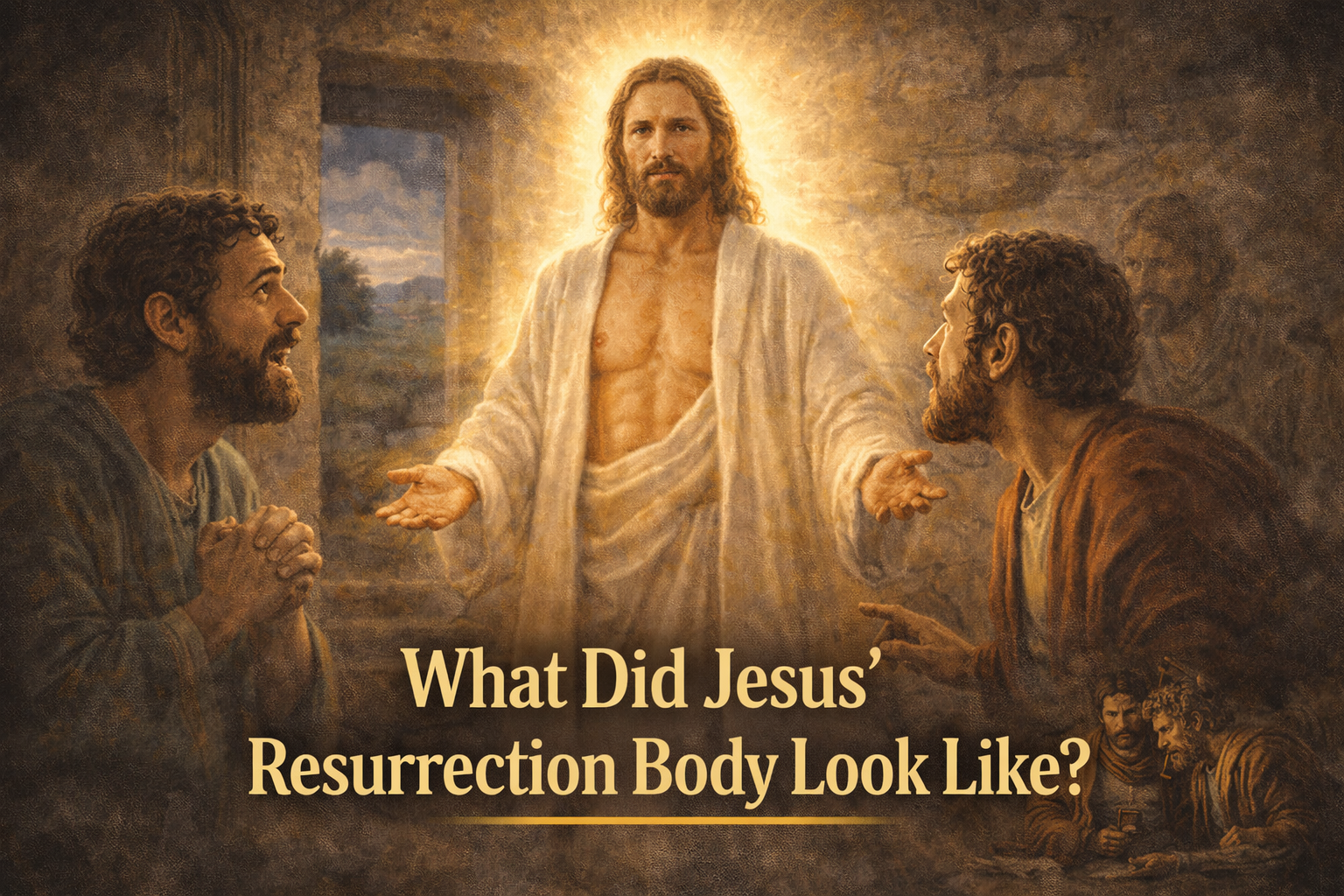
What Did Jesus’ Resurrection Body Look Like?
It’s a question that doesn’t come up much on Easter Sunday morning, but it should. When the disciples encountered Jesus after the resurrection, what exactly did they see? Was it a ghost? A spiritual vision?
The Same Body That Was Buried — and Something Far More. What Scripture Actually Says.
It’s a question that doesn’t come up much on Easter Sunday morning, but it should. When the disciples encountered Jesus after the resurrection, what exactly did they see? Was it a ghost? A spiritual vision? A resuscitated corpse that would die again? Or something else entirely — something the world had never seen before?
The answer the New Testament gives is precise, consistent, and theologically loaded. Jesus’ resurrection body was genuinely physical — He ate, He was touched, He bore the wounds of the crucifixion. But it was also transformed — He appeared in locked rooms, He was sometimes not immediately recognized, and He eventually ascended bodily into heaven. It was the same body, made gloriously different.
Understanding what Jesus rose into matters — not just as a historical curiosity but because His resurrection is described as the pattern and the promise for our own.
What the Resurrection Was Not
Before looking at what the Gospels tell us about the resurrection body, it helps to clear away two common misunderstandings.
It was not a resuscitation. Lazarus was raised from the dead (John 11), but Lazarus eventually died again. He came back to the same mortal existence he had left. That is not what happened to Jesus. Jesus was raised to a transformed, glorified, permanently deathless existence. Paul makes this explicit: “Christ, having been raised from the dead, will never die again; death no longer has dominion over him” (Romans 6:9).
It was not a ghost or purely spiritual apparition. The Greek philosophical world — the world the New Testament was written into — was very comfortable with the idea of a soul surviving death while the body stayed in the ground. The disciples could easily have described a spiritual vision of Jesus. They didn’t. They were at pains to insist on the physical, bodily nature of what they encountered. Luke records Jesus explicitly addressing this: “Touch me and see. For a spirit does not have flesh and bones as you see that I have” (Luke 24:39).
“Touch me and see. For a spirit does not have flesh and bones as you see that I have.” — Luke 24:39
The resurrection the disciples proclaimed was neither a body coming back to ordinary life nor a soul surviving without a body. It was something new — a body that had passed through death and come out the other side transformed.
What the Gospel Accounts Show Us
The four Gospels record multiple appearances of the risen Jesus over forty days. Taken together, they paint a consistent portrait of a body that is both continuous with what it was and radically changed.
John 20:14–16 · The Garden — Mary Magdalene
Mary sees Jesus outside the tomb but does not recognize Him — she mistakes Him for the gardener. He speaks her name, and she recognizes Him. The body is real enough to be present in a physical location, unrecognized until He speaks.
Luke 24:13–35 · The Road to Emmaus
Two disciples walk seven miles with Jesus and do not recognize Him. He explains the Scriptures. He sits with them, takes bread, blesses and breaks it — and at that moment their eyes are opened and they recognize Him, at which point He vanishes from their sight. Physical enough to walk, eat, and handle bread. Mobile in ways ordinary bodies are not.
Luke 24:36–43 · The Upper Room — First Appearance to the Eleven
Jesus appears suddenly among the disciples — the doors were locked (John 20:19). He shows them His hands and feet. He explicitly invites them to touch Him and see that He is not a ghost. He asks for food and eats a piece of broiled fish in front of them. Tangible flesh and bone, capable of eating, able to appear through locked doors.
John 20:24–29 · Thomas
Thomas had declared he would not believe without touching the wounds. Jesus appears, invites Thomas to place his finger in the nail marks and his hand in the side. The wounds are present and real. Thomas’s response — “My Lord and my God!” — is the highest confession of the resurrection’s meaning in the entire Gospel of John.
John 21:1–14 · The Beach — Breakfast by the Sea
Jesus appears on the shore of the Sea of Galilee. He directs a miraculous catch of fish. He has already prepared a charcoal fire with fish on it. He serves breakfast. John notes carefully: “None of the disciples dared ask him, ‘Who are you?’ They knew it was the Lord.” Physical enough to cook and serve a meal. Recognizable — but with an awe about Him that made the question unnecessary.
The Pattern: Continuity and Transformation
Reading these accounts together, a clear pattern emerges. The resurrection body was both same and different — and both of those things matter enormously.
Continuity — The Same Body
- The wounds of the crucifixion are present and touchable
- He eats real food — fish, bread
- He is in a specific place at a specific time
- He is recognized as the same Jesus who was crucified
- The tomb that held his body is empty — same body, relocated
Transformation — Something New
- He appears and disappears without using doors
- He is sometimes not immediately recognized
- He is no longer subject to death or decay
- He ascends bodily into heaven
- He is described as a “life-giving spirit” (1 Cor 15:45)
N.T. Wright, whose multi-volume study of the resurrection is the most comprehensive modern treatment, describes the resurrection body as neither purely physical in the ordinary sense nor purely spiritual in the Platonic sense — but a new kind of bodily existence that ancient categories simply couldn’t contain. The disciples weren’t reporting what they expected to see. They were reporting what they couldn’t explain any other way.
Paul’s Framework: The Seed and the Plant
1 Corinthians 15:35–44 — Paul’s Answer to “What Kind of Body?”
Someone in Corinth had asked exactly the right question: “How are the dead raised? With what kind of body do they come?” Paul doesn’t evade it. He reaches for an analogy from farming — which would have resonated immediately in a culture where everyone understood seeds and harvests.
When you plant a seed, what comes up is not the same as what went in. The acorn becomes an oak. The wheat seed becomes a stalk of grain. There is continuity — the plant has the same identity as the seed. And there is transformation — the glory of what grows is entirely different from the humble thing that was buried.
Paul applies this directly: “What is sown is perishable; what is raised is imperishable. It is sown in dishonor; it is raised in glory. It is sown in weakness; it is raised in power. It is sown a natural body; it is raised a spiritual body.” The word “spiritual” here does not mean immaterial — Paul uses it the way he uses it elsewhere, to mean a body fully animated and governed by the Holy Spirit, as opposed to a body governed by the flesh.
Paul’s framework resolves the apparent tension in the Gospel accounts. The resurrection body is the same body — there is genuine continuity, which is why the tomb was empty and why the wounds were real. But it has been transformed into something that transcends the limitations of ordinary physical existence. It is imperishable, powerful, glorious — the seed having become the full flowering plant.
Why Jesus Kept the Wounds
One detail in the resurrection accounts deserves its own attention: Jesus kept the wounds. He didn’t rise with a perfected, unblemished body that showed no trace of what had happened to Him. The nail marks in His hands and the spear wound in His side were present and touchable days after the crucifixion.
This is not an oversight in the narrative. It’s a theological statement. The wounds are the permanent marks of what happened on the cross — the price paid, the victory won. They identify the risen Jesus unmistakably as the crucified Jesus. There is no resurrection without the cross; the glorified body carries the evidence of the suffering that preceded it.
Thomas’s encounter makes this explicit. His confession — “My Lord and my God!” — comes precisely at the moment he sees and touches the wounds. The wounds are not evidence of defeat. In the resurrection they become evidence of triumph. The One who bore them is alive, and the marks He carries are the marks of love.
“Put your finger here, and see my hands; and put out your hand, and place it in my side. Do not disbelieve, but believe.” — John 20:27
What This Means for Us
Paul describes Jesus as “the firstfruits of those who have fallen asleep” (1 Corinthians 15:20). In Jewish harvest theology, the firstfruits were not a separate category — they were the first portion of the same crop that would follow. Jesus’ resurrection body is not a one-off event. It is the preview and the pattern of what awaits every believer.
- The body matters. The resurrection is not an escape from physicality into pure spirit. God redeems the body. The physical creation is not abandoned but renewed. This has enormous implications for how we treat our bodies, care for the sick, and think about physical suffering.
- Death is not the end of you. The same person who dies is the same person who rises — with full continuity of identity, memory, and relationship. You will be you, glorified. This is not the absorption of a soul into an undifferentiated divine essence. It is the resurrection of a person.
- Suffering now is not the last word. Paul writes: “For I consider that the sufferings of this present time are not worth comparing with the glory that is to be revealed to us” (Romans 8:18). The resurrection body is imperishable, powerful, glorious. Whatever the body endures in this life, the trajectory is toward a glory that makes present suffering look small.
- The wounds can be carried to glory. Jesus carried His wounds into resurrection life — not as signs of defeat but as marks of triumph. Our scars, our histories, our stories of suffering are not erased. They are taken up into something glorious.
When Mary stood outside the tomb weeping and heard her name spoken, she turned and saw someone she had every reason to think was the gardener. The resurrection body was real enough to stand in a garden at dawn and speak a woman’s name. It was transformed enough that she didn’t recognize it until He spoke.
That is the pattern of the age to come — known and new, continuous and transformed, the same and more than the same. And it is not only His pattern. It is ours.
“He who raised Christ Jesus from the dead will also give life to your mortal bodies through his Spirit who dwells in you.” — Romans 8:11
🙏 Closing Prayer
Lord Jesus, thank You that You did not rise as a ghost or a vision or a memory. You rose in a body — the same body that was broken for us, now glorious and eternal. Thank You that Your resurrection is not just a past event but a future promise. Give us eyes to see past the suffering of the present moment to the imperishable glory that awaits, and give us courage to live now as people who know that death is not the end. Amen.
Key Scriptures: Luke 24:36–43 · John 20:19–29 · John 21:1–14 · 1 Corinthians 15:35–49 · Romans 6:9 · Romans 8:11, 18 · Philippians 3:20–21
On the resurrection appearances — Matthew 28:9–10 · Luke 24:13–35 · John 20:11–18 · Acts 1:3
On the nature of the resurrection body — 1 Corinthians 15:12–58 · 2 Corinthians 5:1–5 · Philippians 3:20–21 · 1 John 3:2
On our future resurrection — Romans 8:23 · 1 Thessalonians 4:13–18 · Revelation 21:1–5 · Isaiah 26:19
Want to Go Deeper?
This post is part of our Easter apologetics and theology series. Read it alongside:
- Why the World Keeps Trying to Explain Away the Empty Tomb — the historical case for the bodily resurrection
- Didn’t the Disciples Just Make It Up? — answering the fabrication and conspiracy objections
- What the Early Enemies of Christianity Admitted About the Resurrection — hostile witness testimony
For theological depth on the resurrection body and what it means:
- The Resurrection of the Son of God — N.T. Wright. Exhaustive, rigorous, and ultimately worshipful.
- Surprised by Hope — N.T. Wright. More accessible — the theological and practical implications of bodily resurrection for life now.
- The Last Enemy — Michael Wittmer. A pastoral and theological treatment of death, resurrection, and the new creation.
“Just as we have borne the image of the man of dust, we shall also bear the image of the man of heaven.” — 1 Corinthians 15:49