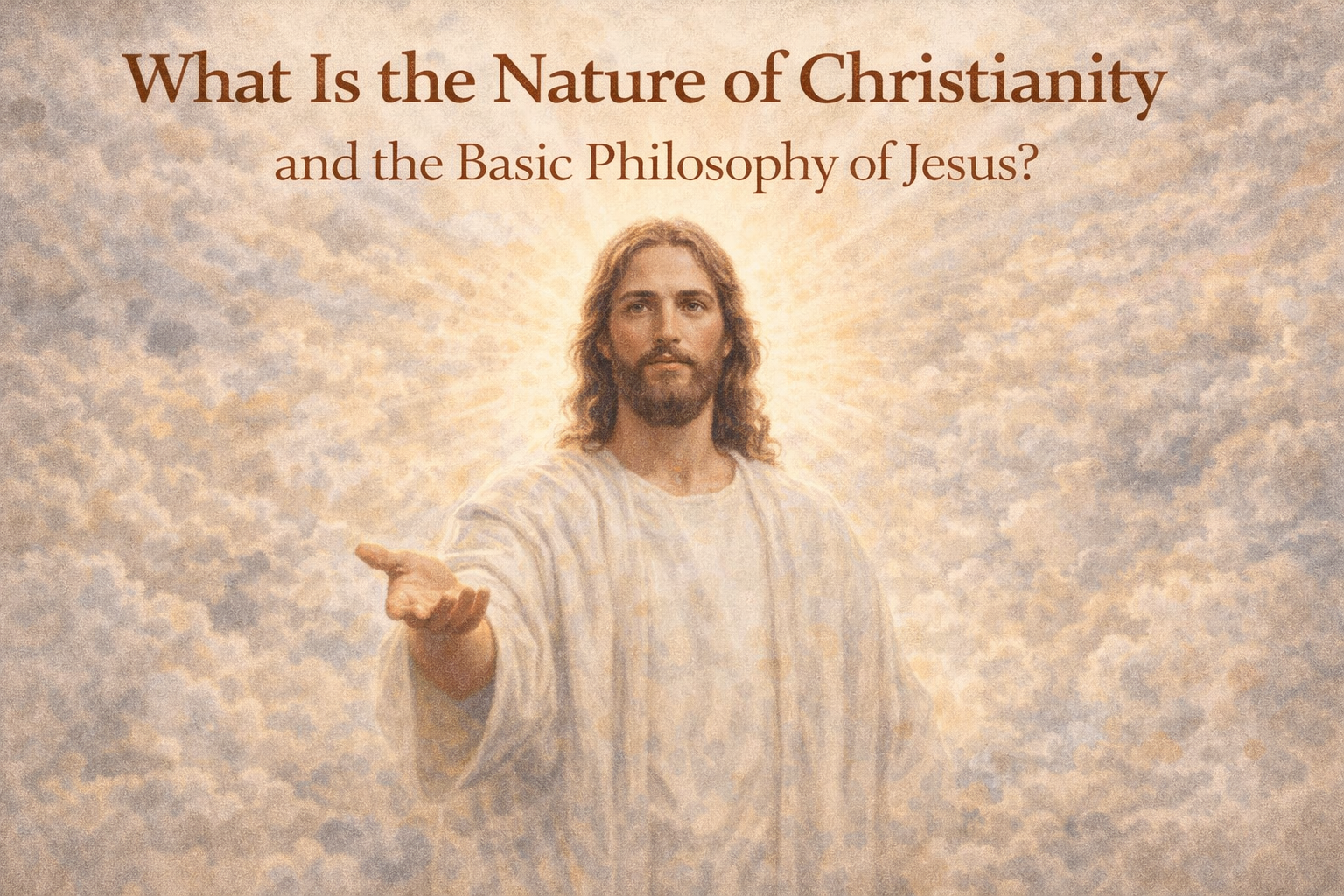
What Is the Nature of Christianity and the Basic Philosophy of Jesus?
A Clear Introduction to What Sets Christianity Apart — and the Core Teachings of Jesus That Continue to Transform Lives
In a world filled with religions, ideologies, and philosophies, the Christian faith continues to draw millions across every culture, language, and generation. But what is Christianity actually about? Is it a rulebook? A community? A belief system? And who was Jesus — not just as a historical figure, but as the heart of everything Christians claim?
The truth is, Christianity is unlike any other faith tradition. It is not primarily about what we do for God — it is about what God has done for us. At its center is Jesus Christ, whose life, death, and resurrection form the cornerstone of Christian identity. This post explores both the nature of the faith and the core teachings of the One at its center.
“I am the way and the truth and the life. No one comes to the Father except through me.” — John 14:6
The Nature of Christianity: A Living Relationship, Not Dead Religion
Authentic Christianity is not a man-made system of moral behavior that earns God’s approval. It is divine rescue — made possible through Jesus Christ — and it rests on five foundational convictions.
Foundation One
A Restored Relationship with God Through Jesus Christ
From the first pages of Scripture, humans were created in God’s image for relationship with Him (Genesis 1:26–27). Sin — our disobedience and rebellion — broke that relationship (Romans 5:12). Christianity teaches that God, in love, did not leave us in that broken state. He took the initiative.
This is not the story of people climbing up to God. It is the story of God coming down to us — in the person of Jesus, fully human and fully divine — to accomplish what we could not accomplish for ourselves.
Foundation Two
Salvation: A Gift of Grace Received by Faith
One of Christianity’s most radical teachings is that salvation cannot be earned. It is not about keeping enough rules or accumulating enough good deeds. It is about trusting in what Jesus has already accomplished through His death and resurrection.
This truth liberates people from guilt and performance-based religion. God’s love is not a reward for the righteous — it is a gift for the undeserving. That is what makes it grace rather than wages.
Foundation Three
The Authority of Scripture
Christianity stands or falls on the trustworthiness of the Bible. Christians believe Scripture is God’s inspired Word — revealing His character, His purposes, and His redemptive work through Jesus. It is not simply a collection of moral wisdom or ancient religious texts.
The Bible is a living narrative that invites the reader into God’s unfolding story — from creation and fall through redemption and restoration. It shapes how Christians understand reality, morality, suffering, death, and hope.
Foundation Four
A Transformed Life by the Power of the Holy Spirit
When someone turns to Christ, God does not simply forgive the past — He changes the future. He puts His Spirit in the believer (Romans 8:11) and begins a lifelong process of shaping character, redirecting desires, and producing what human willpower cannot generate on its own.
This is not mere self-improvement or positive thinking. It is the supernatural work of God making people more like Jesus from the inside out — slowly, persistently, over the course of an entire life.
Foundation Five
A Community of Believers — the Church
Christianity is deeply personal — but never merely private. Believers are meant to live in community with one another: encouraging, serving, and worshiping together as a spiritual family. The faith was never designed to be practiced alone.
The Church is not a building or a denomination. It is the worldwide fellowship of all who follow Christ — spanning every culture, language, century, and social category. Belonging to it is part of what salvation means, not an optional add-on.
The Core Philosophy of Jesus: A Way of Living That Changes Everything
Jesus of Nazareth was not simply a moral teacher. He claimed to be the Son of God (John 10:30) and the only path to eternal life (John 14:6). His teachings were not lofty abstractions for scholars — they were practical truths for ordinary daily life. Here are the seven central principles of His teaching.
Principle One
Love: The Greatest Command
This was not soft sentimentalism. Jesus modeled sacrificial love — for the sick, the outcast, the marginalized, and even His enemies. To Jesus, love was not a feeling but a decision, and it was the most visible evidence of genuine faith (John 13:34–35). This love crosses racial, political, and religious lines. It redefines what goodness actually looks like.
Principle Two
The Kingdom of God: God’s Rule Entering Human Life
Jesus spoke more about the Kingdom of God than any other subject. It is not only a future place but a present reign — a reality that begins wherever human beings surrender to God’s will and authority.
In Jesus’ Kingdom, the poor are rich in faith, the merciful receive mercy, the last will be first, and power is demonstrated through humility. His Kingdom consistently inverts the values of every human power structure — which is why it was threatening to every political and religious authority that encountered it.
Principle Three
Radical Forgiveness: The Condition for Freedom
Jesus called His followers to forgive without limit — “seventy times seven” (Matthew 18:22), which means without keeping count. He did not merely preach this. He embodied it: hanging on the cross, He prayed for the people who were executing Him (Luke 23:34). His philosophy: a person who cannot forgive remains imprisoned by what was done to them. Forgiveness is the door to genuine freedom — for the one who extends it as much as the one who receives it.
Principle Four
Faith Over Fear: Daily Dependence on the Father
Jesus repeatedly addressed the anxious, worried human heart — not with rebuke but with invitation.
Faith, to Jesus, was not primarily a theological position. It was a daily posture — trusting God’s provision, protection, and plan even when circumstances gave no visible reason to. He consistently connected trust in God with release from fear, and fear with a failure to trust.
Principle Five
Service Over Status: The Way Up Is Down
In a world obsessed with power and position — then as now — Jesus taught that true greatness is found in humility and service. He who was King washed His disciples’ feet (John 13), befriended people that respectable society avoided, and touched those the religious system had declared untouchable. In His framework, every person matters — and serving others is not below the dignity of a leader. It is the definition of leadership.
Principle Six
Truth with Grace: Conviction Without Condemnation
Jesus never watered down truth — but He never wielded it as a weapon either. He spoke with grace and genuine compassion, especially toward the broken, the sinful, and the lost. To the woman caught in adultery, He said:
He held people accountable to God’s standards — but always from a posture of love and hope rather than contempt. Truth without grace is harshness. Grace without truth is sentimentality. Jesus managed to hold both without sacrificing either.
Principle Seven
Eternal Life Through Him Alone
No claim Jesus made was more central — or more controversial — than this: He Himself was the only way to God. Not one good teacher among many. Not the best option on a spiritual menu. The only way.
His death was not a tragedy that interrupted His mission — it was the mission. His resurrection proved that His authority over sin and death was real. And on that basis, He offers life — genuine, eternal, abundant life — to anyone who comes to Him.
What Living This Out Looks Like
In the 21st century, these convictions translate into a particular way of existing in the world — ordinary in its setting, extraordinary in its character.
Being a Christian does not mean having all the answers. It means following the One who does — and trusting that the way He described is the way that actually works, not just spiritually but in the texture of real daily life.
The Prodigal Son — Luke 15
Jesus told the story of a rebellious son who demands his inheritance early, wastes everything, and ends up starving in a foreign field. Ashamed, he begins the long walk home — expecting, at best, to be taken on as a hired hand. What he finds instead is his father running toward him from a distance, robe lifted, arms open, shouting for a celebration before the son can finish his prepared speech.
That father is a picture of God. Christianity is God running toward the undeserving. It is grace for prodigals and a welcome home for wanderers — which is to say, for everyone.
Christianity is not about working harder or becoming good enough. It is about coming home to a Father who has been watching the road.
Jesus did not come to start a more sophisticated religion. He came to offer a genuinely better way to live — and an eternal reason to hope. The invitation has never been rescinded, and it does not expire.
“Come to me, all you who are weary and burdened, and I will give you rest.” — Matthew 11:28
Key Scriptures: John 14:6; 10:30; 13:34–35 · Romans 5:8, 12 · Ephesians 2:8–9 · 2 Timothy 3:16 · Galatians 5:22–23 · 1 Corinthians 12:27 · Matthew 22:37–39; 6:34; 11:28 · Mark 10:43 · Luke 17:21; 15:24; 23:34 · John 8:11; 16:33
Want to Go Deeper?
This introductory overview connects to every other post in MVM’s series. These are the best starting points for exploring each of the five foundations and seven principles further:
- The Call to Faith — what responding to Christ’s invitation actually looks like, and what it produces in those who answer
- Is Forgiveness Really Free? — the full theological treatment of Foundation Two: why grace is free to the sinner and costly to the Savior
- The Holy Spirit — how Foundation Four (transformation by the Spirit) actually works in the believer’s daily life
- Ten Christian Leaders on the Doctrine of Jesus — who Jesus claimed to be and why those claims cannot be safely ignored or reduced
- Basic Christianity — John Stott; still the best short introduction to Christianity in print — clear, honest, and compelling
- Subscribe to get new posts delivered straight to your inbox — gospel-rooted, plain-spoken truth for the week ahead.
“For God so loved the world that he gave his one and only Son, that whoever believes in him shall not perish but have eternal life.” — John 3:16